


Mandurah's median house price is $701,000, and properties in popular coastal suburbs can sell within 16 days. That combination makes a current, evidence-based appraisal far more useful than a broad estimate based on an old sale or a government valuation.
For homeowners, buyers and investors across Mandurah, Lakelands, Madora Bay, Meadow Springs, Halls Head, Falcon, Wannanup and Dudley Park, price is shaped by more than the number of bedrooms. A home's position, condition, permitted use, presentation, buyer demand and recent comparable sales all influence the result. The right property appraisal services bring those factors together, then translate them into a practical pricing or purchasing decision.
Table of Contents
- Why Accurate Property Appraisal Services Matter in Mandurah
- Understanding the Two Types of Property Valuations in WA
- The Three Data Pillars Behind Every Mandurah Appraisal
- When You Need a Formal Valuation Versus a Market Appraisal
- How Rapid Market Growth Affects Appraisal Accuracy
- How to Request a Free Property Appraisal from Beshay Realty
- Key Takeaways for Mandurah Property Owners
Why Accurate Property Appraisal Services Matter in Mandurah
A Mandurah owner can make an expensive mistake by treating a property value as a fixed number. In a fast-moving coastal market, the difference between pricing confidently and pricing from outdated information may affect how many buyers engage, how long a campaign runs and whether the final result reflects the home's real appeal.
The current Mandurah baseline is useful, but it isn't enough on its own. REIWA reports a median house price of $701,000 for Mandurah, while a separate local market profile records houses selling in about 16 days, based on its analysis of the previous twelve months. See the REIWA Mandurah suburb profile and the Mandurah market profile for the underlying figures.

Consider two homes with similar floor areas. One may sit in Halls Head with water access, polished outdoor entertaining and a recent renovation. Another may be in Meadow Springs, closer to family amenities and established services, but with dated interiors and less outdoor appeal. A simple price-per-square-metre comparison could miss the reasons buyers respond differently to each property.
The same principle applies in Lakelands and Madora Bay. A newer home with efficient design may attract a different buyer group from an older home requiring work. In Falcon or Wannanup, lifestyle positioning can influence demand, but only when the property's condition and site characteristics support the price.
Practical rule: An appraisal should explain not only what a home may be worth, but why buyers would pay that amount today.
Owners should ask how the comparable sales were selected, whether they're recent enough to reflect current conditions, and which features justify moving above or below the local median. The guidance on what affects property value is a useful starting point, but a property-specific assessment remains essential before setting a campaign price.
Understanding the Two Types of Property Valuations in WA
Western Australia has a formal statutory valuation system, but that system serves a different purpose from a market appraisal prepared for a seller. Confusing the two can lead to poor pricing decisions, particularly in coastal suburbs where buyer demand and development potential can shift the comparison set.
Landgate's Valuer-General conducts independent and unbiased valuations of properties across WA for rating and taxing purposes, as explained in Landgate's overview of the Valuer-General. These assessments sit within the state's statutory framework and aren't designed to tell a homeowner what price a buyer may offer during a current sales campaign.
Statutory valuation
For rating and taxing purposes, WA uses formal bases including Gross Rental Values and Unimproved Values. Landgate states that land is assessed annually using a Date of Valuation of 1 August from the previous year, with unimproved land assessments informed by retrospective vacant-land sales evidence at that date. Property-specific considerations include location, land area, lot configuration, topography, zoning and development potential. These details are set out in Landgate's valuation information guides.
That makes a statutory valuation appropriate for its legal and administrative purpose. It doesn't automatically provide a current marketing price for a renovated home in Madora Bay, a development site in Lakelands or a waterfront property in Wannanup.
Market appraisal
A market appraisal is a local agent's informed opinion of a likely selling range. It considers current buyer enquiry, competing listings, recent comparable sales, presentation and campaign positioning. It's useful when an owner is deciding whether to sell, preparing a property for market or reviewing an investment strategy.
A bank evaluation is also different again. It may be prepared for lending security and can apply a more conservative approach than a campaign strategy. The difference between bank evaluations and real estate agent appraisals matters when an owner sees different figures from different professionals.
The useful question isn't which figure is “the value”. It's which assessment matches the decision you're making.
The Three Data Pillars Behind Every Mandurah Appraisal
A sound Mandurah appraisal should be built from three forms of evidence. Comparable sales provide the foundation, current buyer behaviour shows how the market is responding, and property-specific analysis explains why one home deserves a different position from another.
Comparable sales create the first range
The best comparison isn't always the closest sale. It should reflect similar use, condition, land characteristics, accommodation and market exposure. A family home in Halls Head may need to be compared with homes offering similar lifestyle access and presentation, while a property in Falcon may attract a different buyer because of its land, beach-side character or renovation profile.
Suburb data shows why broad Mandurah averages can mislead. Reported median prices include $790,000 for Falcon houses, $920,000 for Madora Bay houses, $665,000 for Halls Head units and $590,000 for Dudley Park units. The same source reports different twelve-month growth rates across those categories, including 16% in Falcon, 21% in Madora Bay, 21% for Halls Head units and 34% for Dudley Park units. These figures appear in the coastal suburb market comparison.
Those numbers aren't a substitute for a valuation. They're a warning against applying one suburb's result to another property type.
Buyer behaviour tests the estimate
A price range must make sense beside competing homes. If similar properties are attracting strong enquiry, selling promptly and receiving serious offers, the appraisal can reflect that urgency. If listings are sitting while buyers negotiate heavily, a higher figure may create resistance even when the owner believes the home deserves it.
The property itself determines the adjustment
Renovation quality, natural light, floor-plan efficiency, outlook, parking, outdoor living and maintenance all matter. So do zoning, lot configuration and development constraints. A polished coastal home in Madora Bay may command a different response from an investment property in Dudley Park, even where the basic accommodation appears similar.
For a more detailed framework, review the guidance on accurate property appraisals. The strongest assessment combines market evidence with an honest inspection of what a buyer will experience.
When You Need a Formal Valuation Versus a Market Appraisal
The practical distinction is simple. Use a market appraisal to make a selling or marketing decision. Use a formal valuation when a legal, tax, lending or official process requires an independent report from a qualified valuer.
An agent's appraisal is usually the right first step for an owner in Halls Head, Falcon or Meadow Springs who is considering a sale. It can help establish a realistic range, identify presentation priorities and decide whether the campaign should use a fixed asking price, offers strategy or another approach. It can also help an investor review whether current rent, condition and likely sale value support the next decision.
A formal valuation is more appropriate for matters such as:
- Tax purposes: A formal report may be required when a value must be supported for a tax position or dispute.
- Probate and estate matters: Beneficiaries may need an independent assessment rather than an interested party's opinion.
- Litigation and family law: An impartial valuation can help establish evidence where parties disagree.
- SMSF and compliance matters: Certain decisions require formal documentation and an appropriately qualified valuer.
- Lending: A lender may commission or require a valuation that follows its own risk process.
Independent valuation guidance explains the difference between an agent's market opinion and a formal, evidence-based valuation, including situations involving tax, probate, litigation, SMSF, lending and family law. The valuation frequently asked questions provide useful context.
The definition of market value also matters. The Australian Property Institute and the ATO describe it as the amount a willing buyer and willing seller would agree on in an arm's-length transaction after proper marketing, assessed at the relevant inspection or valuation date and having regard to highest and best use. That means a report must consider more than an average of recent sales.
A free appraisal won't replace a formal valuation where an authority, court, lender or professional adviser requires one. Conversely, commissioning a formal valuation when you only need a campaign price may give you a technically sound figure that doesn't fully reflect the current buyer conversation. Match the service to the decision.
How Rapid Market Growth Affects Appraisal Accuracy
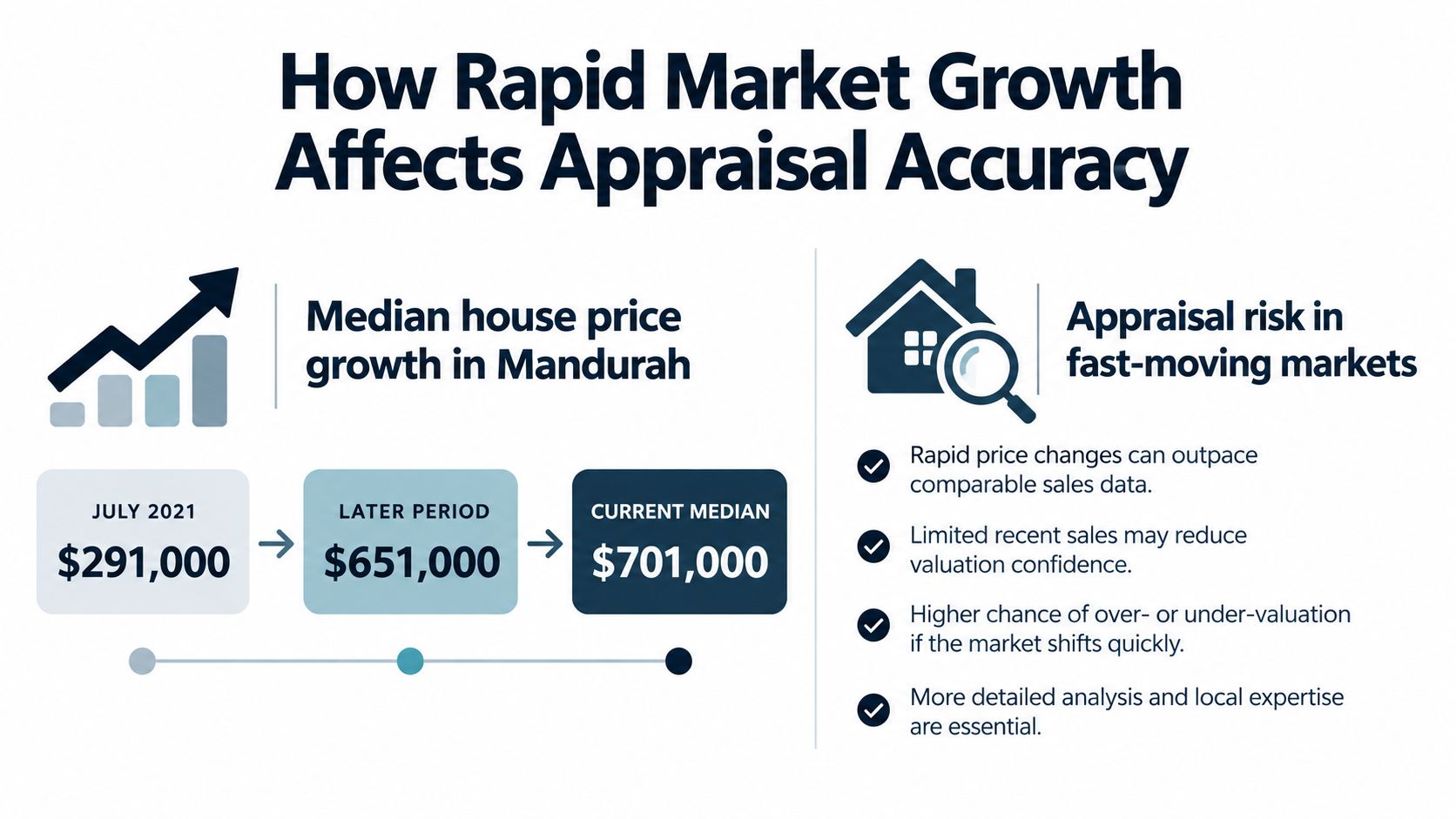
Older comparable sales can become unreliable when prices move quickly. A sale that looked relevant several months ago may understate what buyers are prepared to pay today, while a premium result may overstate the position of a home with weaker presentation or less useful land.
Recent market snapshots report Mandurah's median price moving from approximately $291,000 in July 2021 to $651,000 by June 2026, with other reported 2026 sources placing the median between $630,000 and $765,000 and annual growth between 14.5% and 16.1%. Those figures are drawn from the Mandurah property growth analysis. They describe a market where timing and source selection matter, rather than proving that every property has moved in the same way.
REIWA reports 20.9% annual growth for Mandurah and a median monthly mortgage repayment of $1,486, alongside a median age of 48 years. Those local mechanics help explain why buyer decisions can vary between established homeowners, downsizers, families and investors. They're available in REIWA's Mandurah property listings and suburb information.
What an agent should do with older sales
An experienced local agent shouldn't discard every older comparable, but should test it against current competition and buyer feedback. The key questions are:
- Has the market moved since the sale?
- Did that property have a similar renovation standard?
- Was the sale exposed to buyers for a similar period?
- Did it include features that this home lacks?
- Are current buyers responding to the same suburb attributes?
For a renovated family home near the coast, a stale sale may be particularly misleading. The same applies to an investment property where rental appeal, maintenance and tenant demand affect the buyer pool. In Lakelands, Madora Bay and Meadow Springs, new development and changing competition can also alter how buyers compare available homes.
An appraisal is current only when the evidence, the inspection and the buyer conversation are current.
This is why property appraisal services should be refreshed when circumstances change. A new renovation, a shift in competing listings or a change in campaign timing can all justify revisiting the price strategy.
How to Request a Free Property Appraisal from Beshay Realty
A useful appraisal begins before the agent arrives. The more clearly you explain the property and your circumstances, the more practical the conversation will be.

Start with the address and your reason for requesting an appraisal. You may be considering a sale in Halls Head, reviewing an investment in Dudley Park, preparing for a move from Lakelands or trying to understand how your home sits within the current Mandurah market. That context helps an agent provide advice that goes beyond a headline estimate.
Prepare a short record of improvements. Include kitchen or bathroom work, flooring, painting, landscaping, solar, air conditioning, outdoor entertaining areas and any structural changes. Be clear about what has been completed, what remains unfinished and whether approvals or documentation are available.
Make the inspection useful
Before the appointment, identify features that may not be obvious from a quick walk-through. A rear access point, storage area, water outlook, development restriction or recent maintenance can affect the comparison process. In Madora Bay and Wannanup, lifestyle features may be important, but they still need to be assessed alongside condition, utility and buyer demand.
You should also be ready to discuss timing. A seller planning an immediate campaign needs a sharper pricing and presentation conversation than an owner gathering information for later. Investors may want to focus on likely buyer demand, rental positioning and the cost of bringing the property to market.
The free market appraisal service gives homeowners a way to begin that discussion without committing to a sale. David Beshay Real Estate operates as a boutique agency across Mandurah and surrounding suburbs, with services covering residential, coastal, lifestyle and investment property.
A short video can also help owners understand what to expect from the process.
The best outcome isn't just receiving a number. It's leaving with a clear view of the likely buyer, the evidence behind the range, the work worth completing and the pricing approach that fits the property.
Key Takeaways for Mandurah Property Owners
Accurate property appraisal services are most useful when they connect current evidence with the specific property and the owner's intended decision. A statutory valuation may serve rating or taxing requirements, while a market appraisal helps guide pricing, presentation and campaign strategy. Neither should be used automatically for the other purpose.
Before requesting an appraisal, use this checklist:
- Confirm the purpose: Decide whether you need a selling opinion, lending assessment, tax evidence or another formal report.
- Gather improvements: List renovations, approvals, maintenance and features that may influence comparable sales.
- Review the suburb context: Compare the property with relevant homes in Lakelands, Madora Bay, Meadow Springs, Halls Head, Falcon, Wannanup or Dudley Park, not just the broader Mandurah median.
- Ask about timing: Find out how recent the evidence is and whether current listings support the proposed range.
- Challenge the comparison: Ask why each comparable was selected and what adjustments have been made.
- Separate value from strategy: A likely market range and the best campaign method are related, but they aren't identical.
For sellers and investors, local knowledge matters because Mandurah's coastal suburbs don't move as one uniform market. A careful appraisal gives you a defensible starting point, while a formal valuation remains the right path when legal or official requirements apply.
David Beshay Real Estate offers complimentary market appraisals for homeowners across Mandurah and nearby coastal suburbs, using local comparable sales, property condition and current buyer demand to inform the discussion. Visit David Beshay Real Estate to request an appraisal and speak with a local team about your property's next step.

