


When you’re thinking about selling your home, one of the first and biggest questions that comes to mind is, "how much is this going to cost?" In Western Australia, the standard approach is for agents to charge a commission—a percentage of the final sale price, which typically lands somewhere between 2% to 3.5%. This structure means their fee is directly linked to the result they get for you.
Your Quick Guide to Real Estate Agent Costs
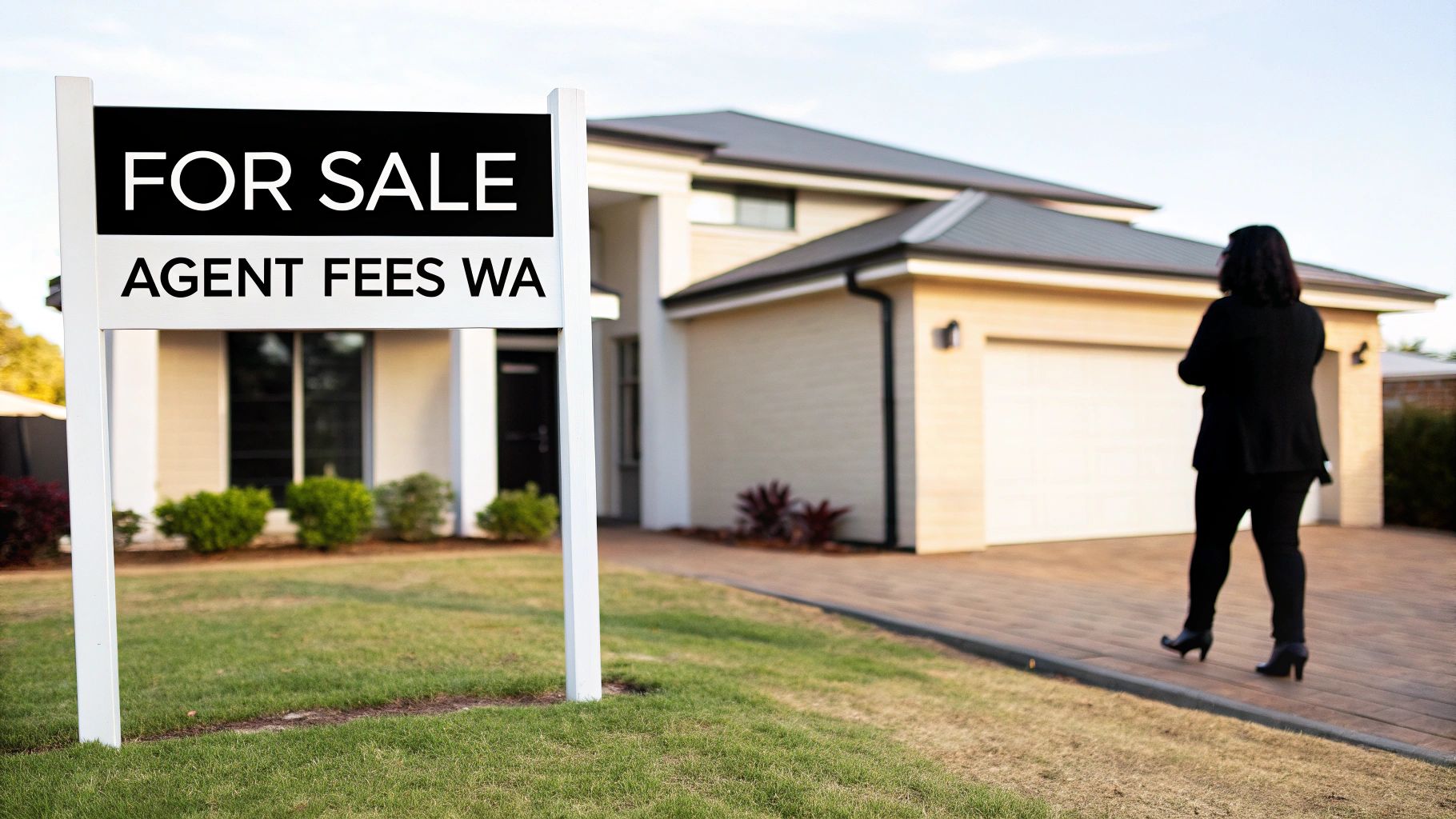
Getting your head around the costs of selling is the first real step towards a smooth, stress-free sale. Instead of a set dollar figure, the industry standard here in WA is a commission-based fee. Think of it like a success fee; your agent only gets paid when your property actually sells. This setup is great because it aligns their goals directly with yours—to get the best possible price for your home.
Now, that percentage isn't set in stone. It can shift depending on your location, the value of your property, and the agent's track record and experience. In a competitive market like Mandurah, rates are often negotiable. But be careful—the cheapest fee doesn't always translate to the best value. An experienced agent with a brilliant marketing plan might secure a much higher sale price that more than covers a small difference in their commission.
Understanding the National Context
Zooming out for a moment, the commission model is the norm right across Australia, with fees usually ranging from 1.6% to 3.5%. The exact rate changes quite a bit depending on the state, property values, and how competitive the local market is. For example, you'll often see lower rates in metro areas of New South Wales simply because there are more agents fighting for business. If you're curious, you can discover more insights about real estate fees across Australia.
Typical Seller Costs At a Glance
The agent's commission is definitely the main expense, but it's not the only one. It’s smart to budget for the entire process from start to finish. Here’s a quick table to give you a clearer picture of the typical costs you can expect when selling in Western Australia.
| Cost Component | Typical Fee Structure | Average Cost Range (WA) |
|---|---|---|
| Real Estate Agent Commission | Percentage of the final sale price | 2.0% – 3.5% |
| Marketing & Advertising | Upfront fixed-fee package | $800 – $3,000+ |
| Conveyancing/Settlement Fees | Fixed fee for legal services | $800 – $2,200 |
| Home Staging & Styling | Varies (consultation to full staging) | $500 – $6,000+ |
This little summary should help you see the financial side of things right from the get-go. With these figures in mind, we can dive deeper into what these fees actually cover and how you can get the best possible return on your investment.
What Your Agent's Commission Actually Buys You

When you see that commission figure, it's easy to wonder, "What am I really paying for?" It’s a fair question. The best way to think about it is less like a simple fee and more like an investment in a full-service project manager whose entire goal is to get you the highest possible sale price with the least amount of stress.
An agent's work starts well before the "For Sale" sign ever hits your front lawn. They're orchestrating a complex process behind the scenes, and it's all funded by that commission—which, importantly, they only get if the sale goes through successfully.
The Strategic Groundwork Before Launch
This initial phase is all about strategy. A top agent doesn’t just pluck a price out of thin air. They dive deep into a thorough property appraisal, pulling apart recent comparable sales in Mandurah, analysing current market trends, and looking at your home’s unique selling points to nail the perfect listing price.
From there, they build a tailored marketing plan. This isn't a one-size-fits-all job; it’s about identifying who your ideal buyer is and creating a campaign that speaks directly to them.
Key services before your property even goes live include:
- Professional Photography Coordination: Getting a skilled photographer in to capture your home's best angles. In today's market, amazing photos are non-negotiable for grabbing a buyer's attention.
- Compelling Copywriting: Crafting property descriptions for sites like realestate.com.au and Domain that do more than just list features—they tell a story.
- Marketing Material Production: Designing and printing high-quality brochures, floor plans, and signboards that create a strong, professional first impression.
"What a lot of people don’t understand is the complexity of the real estate transaction. There are so many different parties that have their hands in the basket…You have to juggle all of the parties involved with the transaction and make sure everyone gets what they need."
All this behind-the-scenes work is what sets the stage for a successful launch, making sure your property stands out from day one.
Managing the Sale and Driving Competition
Once your property is on the market, your agent switches gears into a hands-on sales role. This is where their people skills and market knowledge really come into play. They handle every single buyer enquiry, saving you the headache of filtering out the time-wasters from the genuinely interested parties.
They meticulously plan and run open homes and private viewings. This is more than just unlocking the door; it's about presenting the home perfectly, handling tricky questions on the spot, and building a rapport with potential buyers to see how serious they are.
During this time, your agent is your go-to person, giving you constant feedback and advice. They'll keep you in the loop on buyer interest, how the market is responding, and whether any tweaks to the strategy are needed.
The Art of Negotiation and Closing the Deal
This is where a great agent truly earns their commission. When offers start to land, their job shifts to that of a skilled negotiator. Their one and only goal? To create a competitive environment that pushes the price up and gets you the best possible terms.
They don't just look at the dollar figure; they vet each offer, assessing the buyer's financial situation and any conditions attached. This is a crucial step that protects you from deals likely to fall over, saving you a world of time and heartache. A sharp agent can often negotiate a final price that's tens of thousands of dollars higher than the first offer.
Finally, they manage the complicated admin journey from the signed contract right through to settlement. This involves:
- Preparing the Contract of Sale: Making sure every legal detail is spot on and your interests are protected.
- Liaising with Professionals: Juggling communication between conveyancers, building inspectors, and the buyer’s mortgage broker.
- Managing Deadlines: Keeping a close watch on key dates for things like finance approval and settlement to ensure everything happens smoothly and on time.
This end-to-end management is what the commission really buys you: a dedicated professional who navigates every twist and turn to get your home sold for the best price, with the least amount of friction for you.
Decoding Commission Structures and Fee Models
When you're figuring out how much it costs to sell your home, it's easy to get fixated on a single percentage. But not all fee models are created equal, and the structure you agree to can seriously impact your agent's motivation and, ultimately, your final sale price. Let's break down the common models you'll find here in the Mandurah market.
The most common approach by far is the percentage-based commission. You can think of this as a success fee. Your agent earns a pre-agreed percentage of the final price your property sells for, which means their income is directly tied to the result they get for you.
This structure is powerful because it creates a shared goal. If they negotiate a fantastic price, their commission goes up too. This alignment ensures they're driven to work hard for you, from rolling out a killer marketing campaign to skillfully negotiating with buyers.
The Standard Percentage Commission
This is the bread and butter of the real estate world. You and your agent simply agree on a percentage—say, 2.5%—before your property is listed. If your home sells for $700,000, the total commission would be $17,500. It’s clean, simple, and very easy to calculate.
The real beauty of a percentage commission is the shared risk and reward. The agent puts their time, expertise, and resources on the line without getting paid upfront. They only get compensated when your property sells, which keeps their focus squarely on getting you the best possible outcome.
This model is popular for a reason: it’s transparent and performance-driven. The trick is to make sure the agent’s service and marketing plan justify the rate you agree on. For a deeper dive into what's typically covered, you can learn more about how a real estate agent's commission works in our detailed guide.
Tiered Commissions: A Win-Win Structure
A tiered or "kicker" commission is a smarter way to really light a fire under your agent and motivate them to smash expectations. It’s a fantastic strategy for rewarding exceptional performance and is becoming a go-to for sellers who believe their property can achieve a premium price.
Here’s how it works:
- Set a Base Price: You and your agent agree on a realistic target sale price (e.g., $750,000).
- Agree on Two Tiers: You set a standard commission rate on the sale price up to that target (e.g., 2.5%).
- Incentivise the Extra Mile: For every dollar achieved above that target, you agree to a higher commission rate (e.g., 10%).
Let's say the final sale price hits $780,000. The commission gets calculated in two parts. The agent earns 2.5% on the first $750,000 ($18,750) and a juicy 10% on the extra $30,000 ($3,000). The total commission is $21,750. This structure gives your agent a powerful reason to push past the expected price, creating a true win-win.
Fixed-Fee and Online Agencies: The Alternative Path
You’ve probably also seen agents and online platforms offering a fixed-fee or flat-fee service. Instead of a percentage, you pay a set amount, no matter what the final sale price is. For instance, an agency might charge a flat $8,000 to sell your home.
On the surface, this can look incredibly appealing, especially if you have a high-value property where a percentage fee would be a significant number. The main draw is cost certainty—you know exactly what you’re paying from day one.
However, there are some major trade-offs to think about. Because the agent’s fee isn't linked to the sale price, there’s far less financial incentive for them to fight tooth and nail for that extra $10,000 or $20,000. They get paid once a contract is signed, not necessarily when the best contract is signed.
On top of that, many fixed-fee or "discount" agencies are built on a high-volume model, which can sometimes mean:
- Reduced Service Levels: Your property might not get the personalised attention it deserves.
- DIY Elements: You might find yourself handling tasks like home opens or even negotiating directly with buyers.
- Upfront Payments: Some models require you to pay some or all of the fee upfront, whether your home sells or not.
Choosing between a percentage and a fixed-fee model really comes down to what you value most. If you want a full-service experience with an agent who is financially motivated to squeeze every last dollar out of your sale, a percentage-based structure is almost always the better choice.
Calculating Real Estate Fees With WA Examples
It’s one thing to talk about commission structures in theory, but seeing how those percentages translate into actual dollars and cents is what really matters for your budget. Let's make it real and walk through some examples based on typical property values here in Mandurah and the broader Western Australian market.
Seeing the maths laid out clearly takes the mystery out of agent fees. It puts you in the driver's seat, allowing you to forecast your expenses accurately and sell your home with total financial clarity.
Standard Commission Calculations
Let's begin with the most common model you'll encounter: a straightforward percentage commission. Here in WA, that rate often sits around the 2.5% mark. The calculation itself is simple enough—you just multiply your home's final sale price by the agreed-upon commission rate.
Here’s a quick breakdown of what that looks like at a few different price points:
- For a $500,000 Sale: $500,000 x 0.025 = $12,500 in commission.
- For a $750,000 Sale: $750,000 x 0.025 = $18,750 in commission.
- For a $1,000,000 Sale: $1,000,000 x 0.025 = $25,000 in commission.
To make this even clearer, the table below shows how a 2.5% commission applies to various sale prices you might see in our local market.
Sample Real Estate Agent Commission Calculations in WA
| Final Sale Price | Commission Rate | Estimated Agent Fee |
|---|---|---|
| $400,000 | 2.5% | $10,000 |
| $550,000 | 2.5% | $13,750 |
| $700,000 | 2.5% | $17,500 |
| $850,000 | 2.5% | $21,250 |
| $1,100,000 | 2.5% | $27,500 |
As you can see, the fee scales directly with the final price your home achieves.
This chart offers a great visual comparison between a standard percentage fee and a fixed-fee model.

It really highlights how a percentage fee scales with your property’s value, which directly links the agent’s earnings to the outcome they get for you. A fixed fee, on the other hand, stays the same no matter what.
The Impact of Local Market Dynamics
It’s important to remember that commission rates aren't the same everywhere in Australia. Local market conditions and average property prices play a huge role. Perth, for example, tends to have slightly higher average commissions, typically ranging from 2.44% to 3.25%. This often reflects the property values here compared to the more expensive eastern capitals.
It shows how agents adapt their rates to the realities of the local market. If you're interested in the bigger picture, you can read the full research about real estate commissions across Australia.
A Worked Example of a Tiered Commission
Now, let's get into something a bit more interesting: a tiered commission structure. This is a brilliant model designed to really motivate an agent to smash your price expectations.
Imagine you and your agent agree on a target price of $800,000 for your Mandurah home. You settle on these terms:
- A base commission of 2.5% on the sale price up to the $800,000 mark.
- A juicy incentive bonus of 10% on any amount achieved above $800,000.
Your agent works their magic, secures a fantastic offer, and your property sells for $830,000. Here’s how the fee breaks down:
Part 1 (Base Commission):
$800,000 x 2.5% = $20,000Part 2 (Incentive Bonus):
$30,000 ($830,000 – $800,000) x 10% = $3,000Total Commission Payable:
$20,000 + $3,000 = $23,000
In this scenario, the tiered structure cost you an extra $750 compared to if you’d just paid a flat 2.5% on the final price. But think about it—that small additional investment helped put an extra $30,000 in your pocket. This is the perfect example of a "win-win" incentive, where a tiny increase in cost can lead to a much bigger return for you.
Hidden Costs to Budget for When Selling Your Home

While the agent’s commission is the single biggest line item on the bill, it’s definitely not the only cost you’ll face. Thinking the commission is the only expense is a classic oversight that can lead to some pretty unwelcome financial surprises down the track.
Getting a clear picture of all the potential expenses is the key to creating a realistic budget. This way, you’ll know exactly how much you'll walk away with after the sale is all said and done. Let’s shine a light on the other costs you need to plan for.
Marketing and Advertising Campaigns
Your agent’s commission covers their time, expertise, and negotiation skills, but the direct costs of marketing your property are almost always a separate, upfront investment from you. Think of it as your advertising budget—it’s the fuel that gets your home in front of as many qualified buyers as possible.
A standard marketing package in WA typically includes:
- Professional Photography: This is non-negotiable. High-quality images are the first thing buyers see, and a basic package will set you back $200 to $400.
- Online Portal Listings: Fees for prominent placement on major real estate websites like realestate.com.au and Domain to maximise visibility.
- Signage and Print Materials: A professional "For Sale" sign and quality brochures for open homes.
- Floor Plans: A simple but essential tool that helps buyers visualise themselves in the space.
Depending on the scale of the campaign, you should budget anywhere from $800 to over $3,000 for marketing. More extensive campaigns might include extras like drone photography or video tours, which will bump up the cost.
Professional Home Staging
First impressions are everything in real estate. Professional home staging is all about arranging furniture and decor to highlight your home's best features, making it feel more appealing and spacious to anyone who walks through the door.
While it’s not essential for every property, staging can lead to a quicker sale and a higher price. The costs can vary significantly:
- A simple consultation with a stylist might just be a few hundred dollars.
- Partial staging, using some of your own furniture, could cost $1,500 to $3,000.
- Full staging for an empty home can range from $3,000 to $6,000+, depending on the size of your property.
Conveyancing and Settlement Fees
This one’s a mandatory cost. You'll need a licensed conveyancer or settlement agent to handle all the legal paperwork required to transfer ownership of the property. They manage the contract, conduct necessary searches, and make sure the funds are transferred correctly on settlement day.
In Western Australia, you can expect to pay a fixed fee for these services, typically ranging from $800 to $2,200. It’s also worth noting that buyers have their own set of costs, including stamp duty. If you're curious about what they’ll be up for, you can get a quick estimate with our user-friendly stamp duty calculator for WA.
Budgeting Tip: Always get a written quote from your chosen settlement agent upfront. This quote should clearly outline all included services and any potential extra charges, so there are no surprises at the end.
How to Negotiate Agent Fees for the Best Value
Knowing how much real estate agents charge is one thing, but getting the best possible value for your money is the real goal. Let’s be clear: negotiation isn't about grinding an agent down to the lowest possible fee. It’s about finding that sweet spot—a fair commission that secures you exceptional service and, ultimately, a premium sale price for your home.
Many sellers feel a bit awkward bringing up fees, but you shouldn't. Commissions are almost always negotiable, and a professional agent will welcome a transparent conversation about their costs and the value they bring. Your aim is to find an expert partner who will maximise your return, not just the one with the cheapest percentage.
Your Strongest Tool is Comparison
Without a doubt, the most powerful strategy you have is to sit down and interview at least three different agents. This isn’t just about comparing commission rates side-by-side. You're assessing what each agent truly delivers for their proposed fee. For a complete game plan, our guide on how to choose a real estate agent has a detailed checklist to walk you through this.
During these meetings, ask each agent to justify their fee by showing you their:
- Track Record: Get a list of their recent, comparable sales in your suburb. How close did they get to the asking price? Did they exceed it?
- Marketing Plan: A top agent will present a detailed, bespoke marketing strategy designed specifically for your property, not a generic, one-size-fits-all template.
- Negotiation Strategy: How do they plan to handle multiple offers? What's their process for creating a competitive environment to drive the final price up?
When you compare these crucial elements, you can make a decision based on value, not just cost. An agent proposing 2.5% with a brilliant marketing plan and a proven history of smashing price expectations will often deliver far more money in your pocket than an agent who quickly drops to 2.0% but offers a cookie-cutter approach.
A low commission is no bargain if it results in a low sale price. The right agent doesn't cost you money; they make you money. Focus on the agent's strategy to generate the highest possible return on your biggest asset.
Propose a Tiered Commission for a Win-Win
If you feel your home has the potential to sell for a fantastic price, suggesting a tiered commission structure is a savvy negotiation tactic. This model gives your agent a powerful, direct incentive to push past the expected sale price. It creates a perfect win-win.
Here’s how it works: you suggest a standard commission rate up to an agreed-upon target price, with a higher "kicker" rate on any amount they achieve above that.
For example, you could agree on 2.5% for the sale price up to $750,000, and then 10% on every single dollar above it. This shows you’re serious about rewarding stellar performance and perfectly aligns their financial goals with yours.
Ultimately, smart negotiation is just a respectful, informed conversation. Go in prepared, understand exactly what you’re paying for, and always keep your focus on the total value an agent provides. An open discussion with a trusted local expert is the best way to kick things off, making sure you feel confident and clear about your selling journey right from the start.
Got Questions About Agent Costs? We've Got Answers
Let's be honest, the financial side of selling your home can feel a bit murky. When you're making one of the biggest transactions of your life, you need straight answers. We'll cut through the jargon and tackle the most common questions sellers in Western Australia ask about real estate agent costs.
The goal here is simple: no grey areas. Just clear information so you can budget properly and know exactly what to expect.
Do I Have to Pay for Marketing Upfront?
Yes, in WA, this is standard practice across the industry. The budget for advertising and marketing your property is paid by you, the seller, right at the start of the campaign. It’s important to see this as a separate investment from the agent's commission.
Think of it this way: your marketing payment is the fuel needed to launch your property into the market and get buyers excited. The commission, on the other hand, is the success fee you pay the agent after they've successfully negotiated and finalised the sale. That commission only gets paid once the sale has officially settled.
Is the Agent's Commission Negotiable in WA?
Absolutely. There are no government-set or fixed commission rates in Western Australia, which means you can always negotiate the fee. But it's really important to approach this conversation with the right mindset.
The aim isn't just to find the cheapest agent, but to secure the best value. A top-tier agent might charge a slightly higher percentage, but their skill and strategy could land you a sale price that's tens of thousands of dollars higher. That extra money in your pocket will far outweigh the small difference in their fee.
When you're comparing agents, look at their track record, their proposed strategy for your home, and the overall service they provide. Don't make the decision based on the lowest percentage alone.
What Happens If My Property Doesn't Sell?
This is a very common worry, but the answer is straightforward. If, for whatever reason, your property doesn't sell and your agreement with the agent ends, you do not owe them a cent in commission. Their success fee is completely tied to a successful sale.
You will, however, still be out of pocket for the marketing and advertising costs that have already been spent. Because these funds are paid upfront to cover real expenses like professional photos, online listings, and signage, they are non-refundable.
This structure is pretty common in real estate. Buyer’s agents, who work for the person purchasing a property, also work on a success-based model, typically charging between 1% to 3% of the purchase price. As you can learn more about agent fees throughout Australia, you'll see that fees on both sides of a deal are shaped by local market conditions.
Ready to get a clear, transparent breakdown of what it would cost to sell your Mandurah property? At David Beshay Real Estate, we provide a comprehensive, no-obligation property appraisal that outlines every potential cost. You'll have complete financial clarity from day one. https://realestate-david-beshay.com.au

