


Mandurah's 17.1% unoccupied dwelling rate, compared with 10.9% across Western Australia, means a good property investment needs a more careful strategy than just buying where advertised rent looks strong. The right property is one that can sustain tenant demand, operating costs and resale appeal when rental conditions become less favourable.
That distinction matters across Mandurah's coastal market. A listing can show an attractive gross yield while carrying higher maintenance, insurance, vacancy or finance risk. Conversely, a well-positioned home with a broader tenant audience may produce more dependable net income, even if its headline yield looks less impressive.
For buyers asking what is a good property investment in Mandurah, the answer starts with demand, supply and property fit. It then moves into the less glamorous work of checking cash flow, testing downside scenarios and understanding how Lakelands differs from Madora Bay, Halls Head, Falcon, Wannanup, Dudley Park and Meadow Springs.
Table of Contents
- Defining a Strong Investment in Mandurah
- Yield Versus Net Income, The Real Numbers
- Rental Demand and Tenant Affordability
- Stress-Testing Your Investment Scenarios
- Suburb-Level Selection, Lakelands, Madora Bay, and Beyond
- Real-World Investment Profiles for Local Buyers
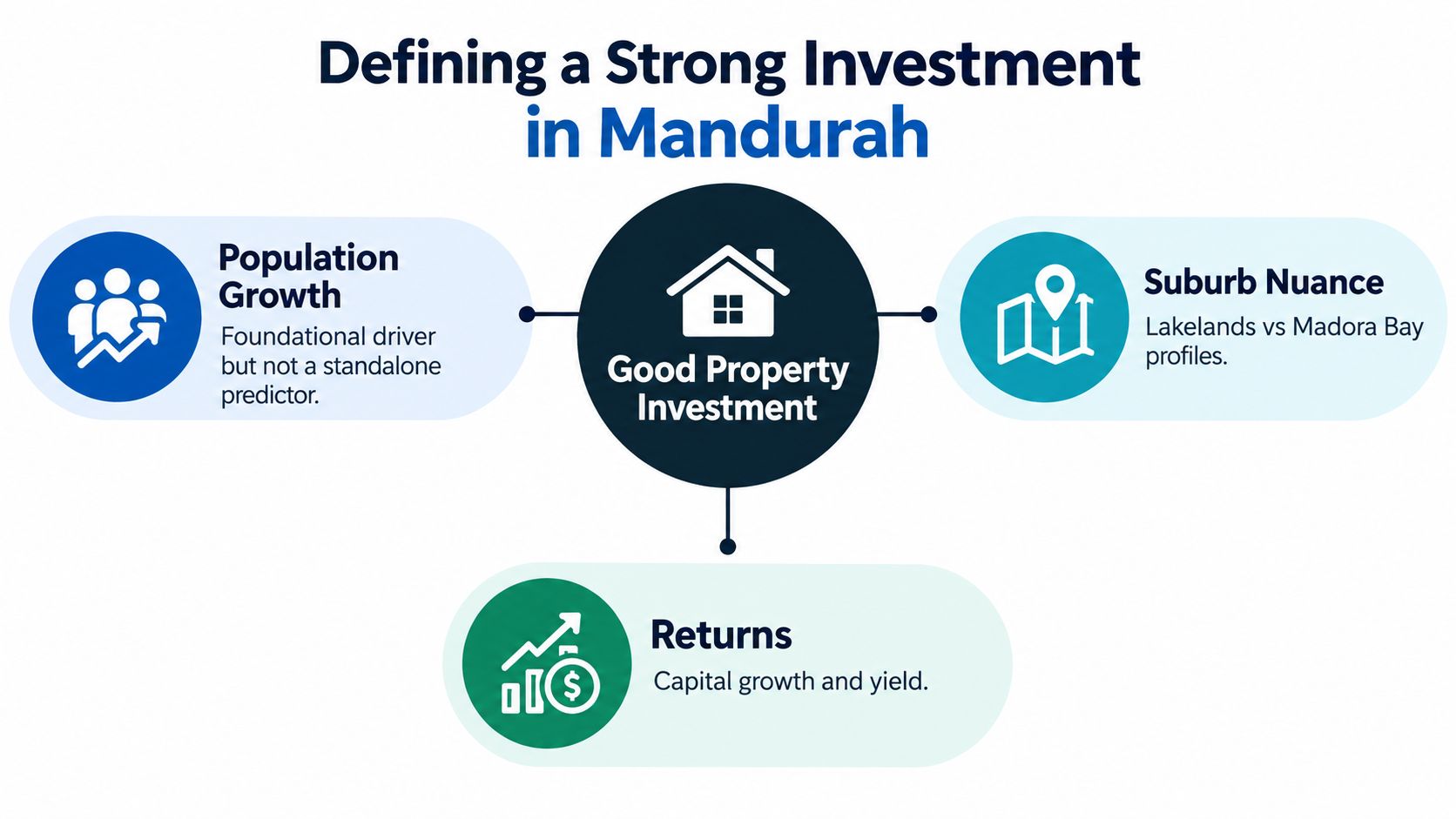
Defining a Strong Investment in Mandurah
A low purchase price isn't a strategy on its own. A strong investment combines durable local demand, appropriate housing supply, usable amenity and a property type that remains attractive to tenants and future buyers.
Mandurah's long-term demographic outlook provides a substantial foundation. City of Mandurah planning data records growth from just over 3,000 residents in 1966 to more than 85,000 in 2018, with the population forecast to approach 120,000 by 2036. The same planning strategy anticipates approximately 20,000 additional dwellings over the next two decades to accommodate nearly 50,000 new residents. These projections indicate a meaningful housing requirement, but they don't guarantee that every suburb or property will perform equally. City of Mandurah strategic planning data
Population growth needs a local test
Population growth creates a broad demand signal. It doesn't tell you whether a particular dwelling will attract tenants, whether competing stock will arrive nearby or whether buyers will want the property when you sell.
The City's planning data also identifies approximately 20,000 additional dwellings required over the coming two decades. An earlier local forecast estimated Mandurah's population at 119,877 and dwelling requirements at 58,443 by 2036, compared with 41,252 private dwellings in 2016. These figures should prompt supply analysis, not automatic optimism. An investor needs to understand where new land is being released, which projects have infrastructure support and whether the property offers something tenants can't easily find in newer competing stock.
Lakelands and Madora Bay may appeal to different household groups. Halls Head and Falcon offer established coastal amenity, while Meadow Springs and Dudley Park can appeal to tenants who value access to services, education, transport and shopping. Wannanup has a more distinct lifestyle orientation. Each location needs its own assessment of tenant depth, dwelling quality and future competition.
Practical rule: Treat population forecasts as a reason to investigate Mandurah, not as a substitute for suburb-level due diligence.
The property must work beyond the spreadsheet
A good rental property usually has practical features that support both occupancy and resale. Functional bedrooms, parking, outdoor living, manageable maintenance and access to established amenities can matter more than a superficial yield premium.
Investors can also use this guide to what makes a good rental property as a useful broader reference when assessing configuration, location and tenant appeal. For a Mandurah purchase, the final test remains local. Review comparable rents, competing listings, likely repairs and the property's position relative to schools, retail, healthcare, transport and coastal recreation.
A disciplined investor should also compare purchase price, achievable rent and ownership costs through a defined framework such as Mandurah investment property criteria. The cheapest home may have limited resale appeal. The highest-rent home may expose the owner to costly upkeep. Quality sits between those extremes, where the dwelling attracts a sufficiently broad audience and remains financially viable under conservative assumptions.
Yield Versus Net Income, The Real Numbers
Advertised yield is only the beginning of the calculation. Gross yield measures rent before costs, while net income shows what remains after the property manager, council, water, insurance, repairs, vacancy and any strata or community-title obligations have been paid.
The distinction is especially important in Mandurah, where a property may appeal to lifestyle tenants but also carry coastal exposure, gardens, pools, older construction or more substantial maintenance requirements. A larger home can command higher rent, yet its additional income may not compensate for higher insurance, repairs, land care and purchase costs.
Gross yield can conceal fragile cash flow
The basic gross-yield calculation is straightforward:
Annual rent ÷ purchase price × 100 = gross yield
That figure is useful for comparing properties at an early stage, but it shouldn't decide the purchase. A proper cash-flow review subtracts:
- Management costs, including letting and ongoing management charges.
- Council rates and water charges, checked against the actual property records.
- Insurance, including any premium affected by location, construction or coastal conditions.
- Repairs and maintenance, with realistic allowances for age, gardens, appliances and external areas.
- Strata or community-title costs, where applicable.
- Vacancy allowances, because no property is occupied continuously.
- Finance and tax considerations, assessed against the buyer's individual structure and advice.
A property with a higher gross yield can therefore produce weaker net income if it demands more maintenance or experiences a narrower tenant pool. A simpler home near established services may generate a more resilient result despite a less dramatic listing headline.
Model the ownership cost before making an offer
Investors should request evidence rather than relying on assumptions. Ask for current rent comparisons, recent leasing activity, property outgoings, strata information and a realistic condition assessment. Then compare the result with a property that may have lower rent but fewer operational demands.
Tax should be considered separately from day-to-day cash flow. The guide to managing property tax liabilities can help investors identify questions for their accountant, but tax treatment depends on personal circumstances and ownership structure. It shouldn't be used to justify a property that doesn't work before tax.
The practical calculation is simple in principle: start with achievable annual rent, subtract every recurring and probable cost, then test the remaining income against the purchase price and finance assumptions. Investors wanting a more detailed methodology can refer to how to calculate rental yield. The outcome should show both net yield and the likely cash contribution required from the owner.
Rental Demand and Tenant Affordability
Recent rental evidence places Mandurah's median weekly rent at $550, with indicative medians of $500 for two-bedroom properties, $570 for three-bedroom properties and $600 for four-bedroom properties. REIWA reported the Mandurah median had increased 3.8% over the measured period, but those figures don't mean every owner can raise rent indefinitely or that every larger home offers better risk-adjusted returns. REIWA rental listings data
The key question is whether the property matches the people likely to rent it. A four-bedroom home may suit a family seeking space, parking and outdoor living. A lower-maintenance home with accessible design and proximity to shopping, healthcare and transport may appeal to older residents or tenants who don't want the upkeep associated with a larger lifestyle property.
Higher rent isn't automatically better
A higher weekly rent can increase income, but it can also narrow affordability and increase the cost of ownership. Pools, extensive gardens, multiple bathrooms, ageing roofs, large driveways and coastal exposure can all add maintenance or insurance pressure. If the property attracts only a smaller group of tenants, the owner may face longer vacancy periods when conditions change.
Mandurah also requires careful interpretation of vacancy-related data. The 2021 Census recorded 35,358 occupied private dwellings and 7,267 unoccupied dwellings in the City of Mandurah. The unoccupied share was 17.1%, compared with 10.9% across Western Australia. This isn't a direct rental vacancy rate because it includes holiday homes, temporarily vacant properties and other non-occupied stock, but it does show why permanent rental demand must be separated from lifestyle and seasonal ownership patterns. 2021 Census profile for the City of Mandurah
Match the dwelling to the household profile
The same Census profile reports that 81.6% of existing dwellings are separate houses and 49% have four or more bedrooms. That supports a close look at family-oriented homes, but it doesn't mean every large house is a sound investment. The property still needs competitive presentation, practical parking, manageable running costs and access to amenities.
For owners assessing current opportunities, Mandurah rental properties provide a useful way to compare the type of stock competing for tenants. Look beyond the weekly asking rent. Compare condition, floor plan, outdoor space, parking, location and how easily the property could appeal to a different household if the original target tenant doesn't proceed.
Stress-Testing Your Investment Scenarios
A serious investment decision should survive more than one forecast. Use three scenarios before committing: current rent, flat rent and a temporary vacancy or repair event.
Build the model in clear stages
-
Set achievable rent. Use comparable local properties and account for differences in size, condition, parking, outdoor areas and location. Don't use the most optimistic listing as the base case.
-
Calculate recurring costs. Include management, council rates, water, insurance, repairs, maintenance, strata or community-title costs and a vacancy allowance. Separate fixed costs from expenses that may rise with the property's age or complexity.
-
Run the current-rent scenario. This shows the expected position if the property leases at the rent you can reasonably support today. It gives you a working baseline, not a promise.
-
Run a flat-rent scenario. Keep rent unchanged and test whether the property remains manageable without relying on further rental growth. This is the more useful test when the purchase price already reflects strong market sentiment.
-
Add a disruption scenario. Model temporary vacancy, a significant repair or both. The point isn't to predict the exact event. It's to see whether your available cash reserves and borrowing structure can absorb an interruption.
-
Test finance separately. Review the result if borrowing costs increase or the loan balance takes longer to reduce. A property with positive rent flow can still create pressure when debt servicing changes.
Downside discipline: If the investment only works under rising rents, minimal repairs and continuous occupancy, the purchase price is probably doing too much of the work.
A calculator can organise assumptions, but it can't validate them. The Australian property investment calculator can help structure the comparison between rent, costs, finance and vacancy. Before making an offer, check the inputs against local evidence and professional advice.
The final decision should include a clear exit question. Would a future buyer value the dwelling's location, condition and configuration, or would they see a specialised property with limited demand? Strong investments give you more than one way to succeed.
Suburb-Level Selection, Lakelands, Madora Bay, and Beyond
Mandurah isn't one uniform investment market. The suburb changes the tenant profile, competing supply, lifestyle appeal and resale audience.

Lakelands deserves a close review of new and established housing competition, school access, shopping and transport connections. Investors should check whether the dwelling has enough practical differentiation from nearby stock, particularly where multiple similar homes may compete for the same tenants.
Madora Bay can attract buyers and renters seeking a newer coastal lifestyle. That appeal needs to be weighed against the timing of land releases, future dwelling supply, infrastructure delivery and the maturity of surrounding services. A newer home isn't automatically lower risk if the tenant pool is still developing.
Meadow Springs benefits from an established suburban setting and access to services, education and employment connections. Its investment appeal often rests on convenience and functionality rather than a purely coastal proposition. A well-configured home may offer a broad audience if it remains easy to maintain.
Established coastal suburbs need property-specific judgement
Halls Head and Falcon can appeal to tenants who value coastal recreation, established amenities and lifestyle access. Yet properties within the same suburb can perform differently depending on proximity to shopping, schools, transport, the water and daily services. A beautiful coastal position may bring stronger appeal, but it may also require a closer review of insurance, weather exposure and maintenance.
Wannanup has a more specialised lifestyle profile. Investors should be comfortable with the possibility that its tenant and resale audience differs from an established family suburb. The dwelling's design, parking, outdoor areas and relationship to local amenities matter greatly.
Dudley Park can suit buyers looking for practical access to Mandurah's broader services and established urban areas. Here, the investment case should focus on tenant convenience, property condition and the ability to attract more than one household type.
The strongest location premium isn't just a view or a coastal label. It comes from the combination of healthcare, shopping, schools, transport, employment and recreation. Investors reviewing Lakelands real estate investment should apply that same discipline across every suburb. Compare the exact street and property, not just the suburb name.
Real-World Investment Profiles for Local Buyers
Three different properties can all be sensible investments, but for different reasons. The right choice depends on the investor's risk tolerance, preferred tenant audience, available cash buffer and willingness to manage property complexity.
The accessible low-maintenance home
An investor targeting Mandurah's older population may prioritise a manageable home close to healthcare, shopping and transport. Mandurah's median age is 45, compared with 38 across Western Australia, according to City planning material. That demographic difference supports consideration of single-level layouts, easier access, modest gardens, secure parking and practical bathrooms rather than automatically favouring a large lifestyle property. City of Mandurah planning and demographic material
This type of dwelling may suit parts of Meadow Springs, Dudley Park, Halls Head or other locations with established services. The trade-off is that a smaller or simpler property may produce less rent than a large family home. Its advantage can be lower upkeep, a broader practical appeal and reduced exposure to unnecessary features.
The family home near established amenity
A three- or four-bedroom home with parking, functional living areas and outdoor space can suit families seeking stability. Lakelands, Meadow Springs and parts of Halls Head may offer different versions of this profile, so the buyer should assess school access, shopping, transport, competing listings and the condition of nearby housing.
The investor shouldn't assume that more bedrooms guarantee better performance. Compare the rent uplift with the additional purchase price, insurance, garden work and repair exposure. A family home works best when the floor plan is genuinely usable and the location makes everyday life easier.
The coastal lifestyle property
A property in Falcon, Wannanup or Madora Bay may attract tenants who place a high value on coastal access, outdoor living and lifestyle convenience. That appeal can support strong enquiry, but the investment is more exposed to property-specific issues such as weather, insurance, pool maintenance, outdoor areas and a narrower audience.
The right buyer will price those risks into the decision rather than treating lifestyle appeal as a substitute for cash-flow analysis. A detailed Mandurah property investment assessment should compare the property with practical alternatives in established suburbs and test the resale audience as carefully as the initial tenant audience.
An investor who wants local guidance can use David Beshay Real Estate for property appraisals, suburb comparisons and investment-focused advice covering value, rental dynamics, property type and likely resale demand. The most useful conversation begins with the numbers and the property's limitations, not with an optimistic yield headline.
David Beshay Real Estate can help you compare Mandurah investment properties, assess likely rental performance and understand how suburb, condition and resale appeal affect value. Visit David Beshay Real Estate to arrange a local appraisal or discuss a purchase strategy built around realistic net cash flow and downside testing.

