


When you start looking into property management in Mandurah, or anywhere in Western Australia for that matter, one of the first numbers you'll see is the management fee. Typically, you can expect this to be somewhere between 7% and 10% of the weekly rent you collect.
This isn't just another cost to deduct from your returns. Think of it as the engine that keeps your investment property running smoothly, day in and day out. It's the core fee that covers all the ongoing work, from making sure the rent is paid on time to coordinating tradespeople for a leaky tap.
Understanding Your Property Management Fees
It helps to think of your property manager as the CEO of your investment. That 7% to 10% fee isn't just an expense; it's a strategic investment. You're paying for professional oversight that protects the value of your asset, keeps you on the right side of tenancy laws, and finds you great tenants who treat your property with respect.
Ultimately, it’s what transforms a potentially stressful, hands-on job into a passive income stream. But what are you actually getting for that percentage? Let's break it down.
Core Services Included in the Management Fee
This main management fee is the foundation of the service. It covers the essential, ongoing tasks that are vital for keeping your property profitable and in good shape. Without these, you’d be the one getting the late-night calls.
Here’s what’s usually bundled into that fee:
- Rent Collection and Financials: They're the ones chasing up rent if it’s late and sending you detailed monthly statements so you always know where your investment stands financially. No awkward conversations for you.
- Tenant Communication: Your manager becomes the single point of contact for your tenants. All their questions, requests, and maintenance issues go through a professional, not your personal mobile.
- Routine Inspections: They’ll carry out regular inspections (within the legal limits, of course) to make sure your property is being looked after and to spot any potential maintenance issues before they blow up into big, expensive problems.
- Maintenance Coordination: When something needs fixing, they handle it. They’ll get quotes from trusted tradespeople and make sure the work is done properly, keeping you in the loop without you having to manage the process.
This ongoing management is what truly protects your asset. Good, proactive oversight stops small issues from spiralling into costly disasters and is the secret to keeping great tenants happy and wanting to stay longer. And that’s the key to consistent rental income.
At the end of the day, this fee buys you peace of mind. It ensures every single part of your investment is handled professionally, from legal paperwork to tenant relationships. For a deeper dive into how we apply these services right here in the local market, our guide to Mandurah property management breaks it down even further.
Quick Guide to Common Property Management Fees in WA
To give you a clearer picture, here’s a quick summary of the typical fees you'll come across as a property investor in Mandurah and wider Western Australia.
| Fee Type | Typical Cost | What It Covers |
|---|---|---|
| Management Fee | 7% – 10% of weekly rent | Day-to-day management, rent collection, inspections, and tenant communication. |
| Leasing Fee | 1 – 2 weeks' rent | Finding and screening tenants, processing applications, and preparing the lease. |
| Advertising Fee | $150 – $400 (at cost) | Marketing your property on major real estate portals to attract applicants. |
| Lease Renewal Fee | 0.5 – 1 week's rent | Negotiating and preparing the documentation for a lease extension with a current tenant. |
Keep in mind these are just the standard fees. Depending on the agency and the specific services you need, you might also see charges for things like inspections, administrative tasks, or coordinating major works. It’s always best to ask for a full schedule of fees upfront.
A Complete Breakdown of Potential Management Costs
Beyond the ongoing management percentage, your monthly statement can include other specific charges. It's really important to get your head around these to accurately forecast your investment's performance and avoid any nasty surprises down the track. Think of it like a pay-as-you-go phone plan versus an all-inclusive one; some services are part of the main fee, while others are only billed when you use them.
Let's demystify the most common extra costs you might come across. These aren't hidden fees, but rather charges for distinct, significant events in your property’s life cycle. Each one serves a specific purpose, from finding new tenants to preparing legal documents.
Letting Fee and Advertising Costs
When your property becomes vacant, the top priority is finding a high-quality tenant as quickly as possible. This involves a lot more than just sticking a sign out the front, which is where the letting fee (sometimes called a leasing fee) comes in.
This one-off charge is typically equal to one to two weeks' rent. It covers all the legwork involved in securing a new tenant, including:
- Conducting countless viewings and open homes.
- Processing applications and running thorough background checks.
- Preparing and executing the legally binding lease agreement.
- Lodging the bond correctly with the relevant state authorities.
Alongside this, you'll likely see advertising costs. These are the direct expenses for marketing your property on major real estate websites. In the Mandurah area, this can range from $150 to $400, passed on at cost, to make sure your listing gets maximum exposure to the best applicants out there.
The whole point of these upfront costs is to minimise vacancy. A great agent uses these funds effectively to lock in a reliable, long-term tenant. That's far more valuable than saving a few dollars on advertising and risking a longer period with no rent coming in at all.
Once a great tenant is in place, the ongoing management fee takes over to cover the day-to-day running of the property, as this graphic shows.
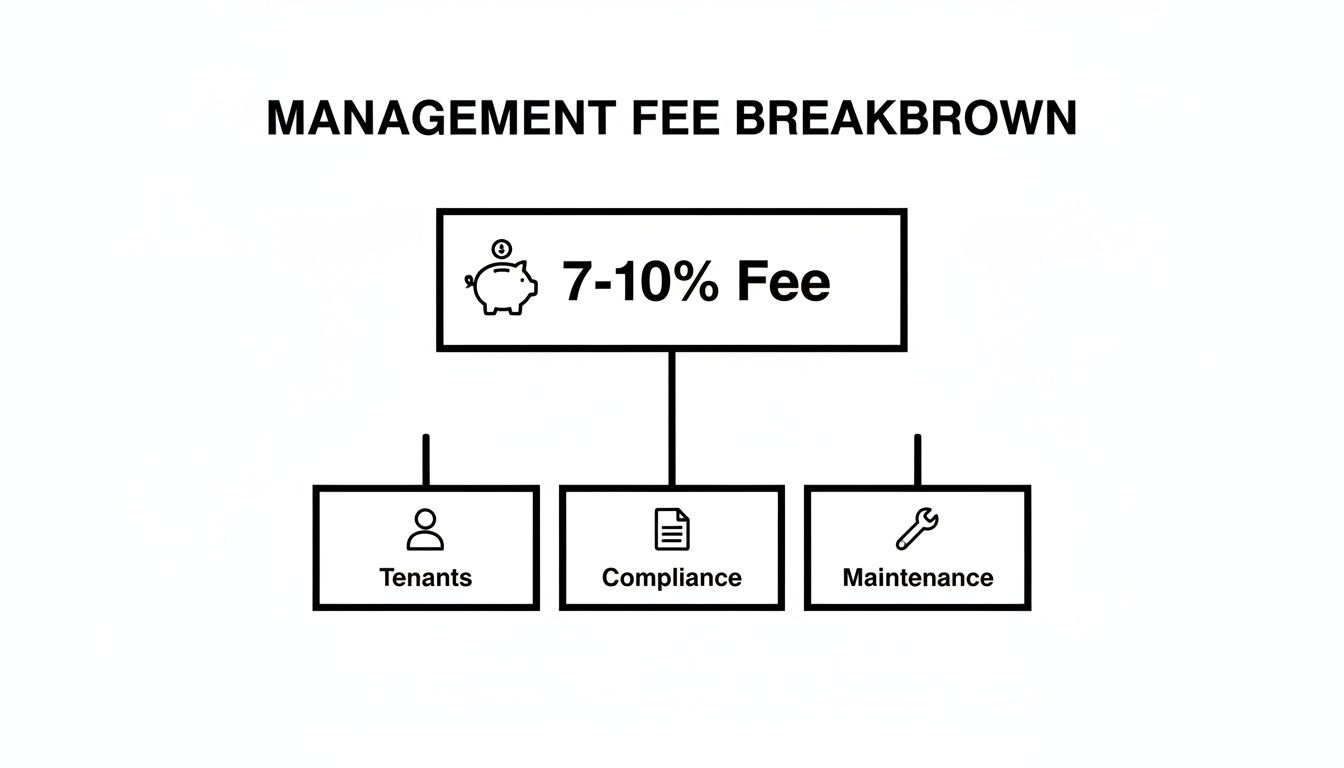
As you can see, the management fee covers the daily work of tenant relations, compliance, and maintenance coordination once your property is tenanted.
Maintenance and Renewal Fees
Another area to understand is maintenance. While the coordination of repairs is usually included in your management fee, the actual cost of the tradie’s invoice is paid by you. Be aware that some agencies add a maintenance markup (often 10-20%) to the invoice to cover their administration time. Always ask if this applies.
Finally, when a great tenant's lease is ending, the goal is to get them to stay. A lease renewal fee, often equivalent to half a week's rent, covers the admin work of negotiating new terms and preparing the updated legal paperwork. It's a small price to pay to keep a proven tenant and avoid the much larger letting and advertising fees that come with finding a new one.
For a complete overview of what to expect, explore our detailed guide on how much a property manager costs.
Choosing Your Fee Model: Percentage vs. Flat Fee
When you start looking into property management agencies, you'll quickly find that the average cost of property management is usually presented in one of two ways. Deciding between a percentage-based fee and a flat fee is one of the first choices you'll make, and it fundamentally changes how your manager gets paid. Getting your head around the pros and cons is key to making sure their service aligns with your financial goals.
The most common structure you’ll see in Mandurah, and right across Australia, is the percentage fee. This model is pretty simple: it ties your property manager's income directly to your rental income. If your rent goes up, so does their fee. If the property sits empty, they don’t get paid their management fee.
This creates a powerful, shared incentive. It means your manager is naturally motivated to negotiate the highest possible rent and get a new tenant in as quickly as possible, because their success is literally tied to yours. Think about a premium canal-front home in Halls Head where rental values can shift with the seasons; this model ensures your manager is always pushing to get you the best possible return.
The Percentage Fee Model Explained
So, how does this work in the real world? Let’s say your property is rented for $550 per week and the management fee is 8%. Your weekly cost would be $44. It's a simple calculation based on the actual rent you receive, making it easy to keep track of.
- Pros: The manager is driven to maximise your rental income and fill vacancies fast. Their paycheque only grows when yours does.
- Cons: The cost isn't fixed. If rents in the area suddenly surge, your management expenses will rise too, which can make budgeting a little less predictable.
This model is often the go-to for investors who want a genuine partner in their property's performance. That alignment of financial interests means you and your manager are on the same team, focused on the same goal: achieving the best possible rental yield.
Understanding the Flat Fee Model
On the other hand, some agencies offer a flat-fee structure. With this model, you pay a set dollar amount every month, no matter what the rent is. For instance, an agency might charge a fixed fee of $180 per month to manage your property, whether it’s rented for $450 or $600 per week.
The big appeal here is predictability. You know exactly what your management expense will be each month, which really simplifies financial planning, especially if you have a larger portfolio or are working with a tight budget.
The main drawback, however, is the potential for misaligned incentives. A flat fee doesn't financially reward a manager for securing a higher rent or for working extra hard to find a tenant quickly. Their income is the same either way, which could mean they're less motivated to push for that extra $20 a week during lease negotiations.
For a standard unit in Greenfields, a flat fee might look appealing because it's so straightforward. But over the long term, it might not deliver the best financial outcome. In the end, the choice really boils down to your investment strategy and what matters more to you—predictable costs or performance-driven service.
Key Factors That Influence Your Management Quote
Ever looked at a couple of property management quotes and wondered why one agency is quoting 7% and another is closer to 9%? It’s not just a random number they pull out of a hat. The difference comes down to the unique character of your property, because the simple truth is, not all properties demand the same amount of work.
Think about it this way: a brand-new, low-maintenance home in Lakelands is a different beast to manage than a beautiful old character home that needs a bit more TLC and regular maintenance calls. An agent will look at several key factors to build a quote that truly reflects the time and resources needed to manage your investment properly.
Property-Specific Variables
First and foremost, the physical attributes of your property play the biggest role in shaping your management quote. An agency will always consider:
- Location: Is your property in a high-demand spot with a steady stream of top-tier tenants, or is it somewhere that needs a bit more marketing muscle to get noticed? A central Mandurah address is a completely different management ballgame than a property further out.
- Property Type and Age: There’s a world of difference between managing a modern apartment and a standalone house with a sprawling garden. Older homes often need more hands-on oversight for maintenance, and that extra attention is naturally factored into the fee.
- Condition and Amenities: A well-kept property with modern perks is always easier to lease and manage. On the flip side, a place that needs a bit of work or has ongoing repair issues will demand more of a manager’s time and expertise.
A tailored quote is a good sign. It shows the agency has considered your property's specific needs rather than just offering a generic, one-size-fits-all rate. This bespoke approach often leads to better long-term management outcomes.
Market and Service Level Considerations
Beyond the four walls of your property, the wider market and the specific services you need are also crucial. For example, a red-hot rental market in the Peel region can make leasing a breeze, which might influence costs. A slower market, however, means your agent has to work harder with marketing and screening tenants.
The level of service you choose is just as important. A basic package that only covers rent collection will naturally cost less than an all-inclusive service that handles everything from paying your council rates to providing detailed financial reports.
Understanding these moving parts helps you see why quotes can vary so much. It empowers you to pick a manager whose fees actually line up with the value they’re providing for your specific investment. The Australian property management market is a significant one, hitting USD 8.1 billion in 2024, and this growth helps keep service offerings competitive. You can get a better feel for the bigger picture by reading up on Australian property management market trends.
How to Calculate Your Annual Management Costs

Seeing the percentages and fees on paper is one thing, but how does it all actually stack up? Let's get practical and walk through two real-world examples based on common investment scenarios right here in Mandurah. This will make the average cost of property management tangible and help you see exactly how these costs add up over a year.
We'll factor in the ongoing management fee, a one-off letting fee (assuming we find one new tenant a year), and a sensible budget for maintenance. Putting real numbers behind the concepts is the best way to get a clear financial picture and forecast your own expenses with confidence.
Example 1: The First-Time Investor
Let's imagine Sarah, who's just bought a modern townhouse in Greenfields. It’s a great spot for young families and professionals, and she’s aiming for a weekly rent of $500.
- Weekly Rent: $500
- Annual Rent: $26,000 ($500 x 52 weeks)
- Management Fee: 8% of rent collected
First, we work out the annual management fee, which is $2,080 per year ($26,000 x 0.08).
Now, let's add the one-off costs. Sarah's agent charges a letting fee equal to two weeks' rent for the work involved in finding and placing a quality new tenant.
- Letting Fee: $1,000 ($500 x 2 weeks)
- Estimated Annual Maintenance: $500 (a buffer for minor repairs)
Sarah’s Total Estimated Annual Cost:
$2,080 (Management) + $1,000 (Letting) + $500 (Maintenance) = $3,580
When you break it down, that's roughly $298 per month. This gives Sarah a clear, predictable budget for her investment's running costs.
Example 2: The Experienced Investor
Next up is Mark, a seasoned investor who owns a waterfront property in Halls Head. Thanks to its prime location, it pulls in a higher rent of $850 per week.
- Weekly Rent: $850
- Annual Rent: $44,200 ($850 x 52 weeks)
- Management Fee: 7% (he negotiated a slightly lower rate for his premium property)
Mark’s annual management fee comes to $3,094 per year ($44,200 x 0.07).
His agent also has a two-week letting fee structure.
- Letting Fee: $1,700 ($850 x 2 weeks)
- Estimated Annual Maintenance: $1,000 (a larger budget for an older, bigger home)
Mark’s Total Estimated Annual Cost:
$3,094 (Management) + $1,700 (Letting) + $1,000 (Maintenance) = $5,794
Historically, property management costs in Australia tend to sit somewhere between 8-12% of the total rental income. The value a skilled manager brings is crucial; research shows that without an expert negotiator, the rent you actually achieve can be much lower than what's advertised. This is a massive factor, especially with the recent financial pressures on renters.
As these examples show, variables like rent, property type, and even negotiation can really change the final numbers. Want to run the calculations for your own property? Give our free property investment calculator for Australia a try to get a detailed forecast.
Finding the Right Manager Without Overpaying

It’s one of the most common traps investors fall into: picking a property manager based purely on the lowest fee. But let me be frank—the cheapest agent is almost never the best. A rock-bottom percentage often signals that corners are being cut somewhere, leading to poor communication, longer vacancies, and, ironically, lower returns for you.
The goal isn't just to find a low price; it's to find outstanding value.
Think of your property manager as a strategic partner for your investment. Their job is to protect your asset and get the most out of it in Mandurah's fast-moving market. When you focus only on the management fee, you miss the bigger picture of what a great manager actually delivers: minimal vacancies, high-quality tenants, and proactive maintenance that prevents small issues from becoming expensive disasters.
Your Essential Interview Checklist
When you're interviewing potential managers, it's time to steer the conversation away from just the numbers. You need to dig deeper with questions that uncover their real value and how they actually operate. A quality manager will have clear, confident answers ready to go.
Here are the critical questions you should be asking:
- Tenant Screening: "Can you walk me through your tenant screening process from start to finish? What specific background and rental history checks do you run?"
- Communication: "What’s your policy for keeping owners in the loop? How often will I hear from you, and who will be my direct point of contact?"
- Maintenance Protocol: "How do you handle maintenance requests? Do you have your own network of trusted local tradies, and do you add a markup to their invoices?"
- Fee Inclusions: "Can you give me a clear breakdown of what is and isn't included in your management fee? Are there any other costs I should know about upfront?"
Choosing the right manager is an investment in your peace of mind and financial success. A slightly higher fee is often a small price to pay for a manager who fills your property faster with a better tenant, ultimately earning you more income.
By asking these targeted questions, you shift the focus from cost to value. You’ll be able to quickly spot hidden fees, get a feel for their processes, and find a genuine partner committed to protecting and growing your Mandurah property investment.
Got Questions? We've Got Answers
Diving into the world of property management often brings up a few common questions. It’s completely normal, and getting clear answers is the first step towards a great relationship with your property manager. Here are some of the queries we hear most often from landlords just like you.
Are Property Management Fees Tax Deductible in Australia?
Yes, they absolutely are. Think of your property management fees as a direct cost of doing business – the business of earning rental income. Because of this, the Australian Tax Office allows you to claim these expenses as a tax deduction.
This covers the whole spectrum of costs: your ongoing management percentage, letting fees for new tenants, advertising, and other service charges. It’s a huge plus that helps soften the overall cost. Just be sure to keep all your statements handy and have a chat with your accountant to make sure you're claiming everything you’re entitled to.
Is a Letting Fee Charged Every Year?
Thankfully, no. The letting fee, sometimes called a tenant-find fee, is a one-off charge that only applies when your property manager has to find a brand new tenant for your property. It’s a significant job that covers everything from marketing and hosting viewings to meticulously screening applicants and drawing up the lease.
If you’re lucky enough to have a great tenant who decides to stay on and renew their lease, you’ll typically face a much smaller lease renewal fee. Why the difference? Because keeping a happy, reliable tenant in place is far less work than starting the search from scratch.
The real takeaway here is that letting fees are directly tied to tenant turnover. The best way to sidestep this cost is to focus on keeping good tenants for the long haul.
What Services Aren't Included in the Standard Fee?
Your day-to-day management fee covers the ongoing supervision and administration of your property, but some things naturally fall outside of that scope. These are usually billed separately as they occur.
Common exclusions you can expect are:
- Major Maintenance & Repairs: The actual invoice from the plumber, electrician, or handyman.
- Advertising Costs: The direct spend on getting your vacant property listed on major real estate portals.
- Legal Fees: Should you ever need representation for a tribunal hearing or eviction process.
- Specialist Reports: Costs for third-party services like depreciation schedules or professional valuations.
Ready to see how a professional, transparent approach to management can unlock your Mandurah investment's potential? At David Beshay Real Estate, we skip the jargon and focus on delivering real value. Get your free, no-obligation property appraisal today and let's have a proper chat.

