


When you ask, "how much does a property manager cost," the answer almost always starts with a percentage. In Western Australia, that figure typically falls somewhere between 7% and 10% of the monthly rent.
But that number is just the starting point. Some managers use a flat-fee model, and there are other costs for specific services, like finding you a brand-new tenant. It's not as complex as it seems once you break it down.
An Investor's Quick Guide to Property Management Costs

Trying to understand property management fees can feel a bit like comparing holiday packages. You've got the 'all-inclusive resort' where everything is bundled into one price, and then there's the 'pay-as-you-go' option where you pay for extras as you need them.
Neither is better than the other; it just depends on your personal preference for budgeting and what services you value most. This comparison is a great way to think about the two main fee structures you'll come across when looking for a professional to manage your investment property.
The Two Main Fee Models
First up is the most common model you'll see: the percentage-based fee. This is straightforward—your property manager charges a set percentage of the rent they collect each month. For instance, if your Mandurah property brings in $500 per week and the management fee is 8%, your manager's fee is calculated from that income.
This model is popular because it directly ties the manager’s success to yours. When your rent goes up, their fee does too, which gives them a real incentive to maximise your return.
The alternative is the flat-fee structure. This is your 'all-inclusive' option. You pay a fixed dollar amount every month, no matter what the rent is. You might pay a set $150 per month, whether the weekly rent is $450 or it jumps to $550. This gives you absolute certainty in your budgeting, as the cost never changes.
The core decision for an investor is whether they prefer a fee that scales with their rental income (percentage-based) or one that offers absolute predictability (flat fee). Both are valid approaches, but one may better suit your financial strategy.
Common Fees at a Glance
So, what other costs pop up beyond the day-to-day management fee? There are a few standard charges for specific, one-off events that are crucial to know about. This helps you build a complete picture of the total cost.
Here's a quick summary of the typical fees an investor in the Mandurah and greater WA region might encounter.
Typical Property Management Fee Structure in Western Australia
| Fee Type | Common Cost Structure | Typical Range in WA |
|---|---|---|
| Management Fee | Ongoing fee for daily oversight of your property. | 7% – 10% of collected rent |
| Letting Fee | A one-off charge to find, screen, and place a new tenant. | 1 to 2 weeks' rent |
| Advertising/Marketing Fee | Pays for listing your vacant property on major real estate portals. | Varies by agency |
| Lease Renewal Fee | A small administrative fee to renew an existing tenant’s lease. | Varies, often a smaller fixed fee |
Knowing about these different components from the very beginning means no nasty surprises on your monthly statements.
Ultimately, professional management isn't just a single cost. It’s an investment in a complete service designed to protect your asset, maximise your returns, and give you priceless peace of mind.
Deconstructing the Core Management Fee and What You Get for It

When you see a property manager’s fee, it’s easy to just think of it as the cost of collecting rent. But that small percentage is actually your investment in a comprehensive oversight service. Think of your property manager less as a rent collector and more as the Chief Operating Officer (COO) of your investment property.
Their job is to handle the complex, time-consuming, and often stressful daily operations that keep your investment profitable and, just as importantly, protected. This core fee is the engine driving the day-to-day management of your asset. From fielding late-night emergency maintenance calls to navigating the intricate web of Western Australian tenancy laws, their most important work often happens behind the scenes.
The Daily Operations Your Fee Covers
So, what exactly are you paying for each month? It’s a powerful combination of administrative skill, legal know-how, and professional customer service. The management fee ensures an expert is dedicated to the health of your investment, tackling tasks that would otherwise eat up your time.
Here are just a few of the key responsibilities covered by this ongoing fee:
- Tenant Relations and Communication: This is a huge one. Your manager becomes the single point of contact for your tenants, handling all their enquiries, complaints, and requests with professional efficiency.
- Rent Collection and Financial Management: It's more than just cashing a cheque. They actively manage arrears, issue the proper notices if payments are late, and provide you with detailed monthly financial statements so you always know where you stand.
- Maintenance Coordination: When a tap starts leaking or the air con gives up, they’re on it. They coordinate with trusted, local tradespeople to get the issue resolved promptly, often at competitive rates thanks to their industry relationships.
- Routine Inspections: They conduct regular inspections to make sure your property is being looked after and to spot any potential maintenance issues before they snowball into major, expensive problems.
Legal Compliance and Risk Management
Honestly, one of the most valuable things your management fee buys you is a human shield against legal headaches. The residential tenancy laws here in Western Australia are specific and constantly being updated. A professional property manager lives and breathes these regulations.
They make sure every action—from the initial lease agreement to the unfortunate need for an eviction—is done by the book. This dramatically reduces your exposure to legal disputes and potential financial penalties.
This legal oversight is non-negotiable for serious investors. A single misstep in handling a bond or issuing a notice can lead to costly tribunal hearings, making the management fee a valuable form of risk mitigation.
In Australia, property managers typically charge between 6% and 10% of the rent as their core management fee. To put that in real terms, if your property brings in $550 per week and your manager charges a 7% fee, you’d be looking at about $1,995 a year for this full suite of services. Generally, inner-city and high-value rentals attract lower fees (5% to 7%), while properties that need a bit more hands-on attention might sit at the higher end (8% to 10%).
Why the Percentage Varies
You might be wondering why one agency quotes 7% while another one down the road says 9%. It's not arbitrary. Several factors influence how much a property manager costs, with the fee reflecting the property itself and the level of service you're getting.
A few key things that influence the management fee include:
- Property Location: A property in a high-demand spot in central Mandurah might have a different fee structure than one in a quieter, outlying suburb.
- Rental Value: Properties with higher rental incomes often allow for a lower management percentage because the dollar value of the fee is still substantial.
- Property Type and Condition: An older home that’s likely to need more frequent maintenance could warrant a higher fee than a brand-new, low-maintenance apartment.
- Level of Service: Some agencies offer a premium, all-inclusive service package, while others might have a more basic offering. The fee will reflect the depth of the services included.
At the end of the day, the core management fee isn’t just another bill. It's your payment for expertise, for your time back, and for genuine peace of mind, knowing your valuable asset is being managed effectively. If you want a deeper look into the specific duties involved, you can learn more about what a property manager does in our detailed guide.
Uncovering the Additional Fees Beyond the Management Percentage
While your ongoing management fee is the most predictable expense, it’s not the whole story. To really get a handle on how much a property manager costs, you need to look at the other line items that pop up on your statement from time to time. These aren’t hidden charges; they’re for specific, high-value services that happen at key moments in your property's lifecycle.
Think of it like an itemised bill from your mechanic. The main cost is for the labour, but you also see separate charges for new spark plugs, oil, and filters. Each one represents a distinct service or part. In the same way, a property manager’s statement breaks down the crucial jobs that fall outside of the day-to-day supervision.
Getting your head around these costs upfront means no nasty surprises and helps you budget properly for your investment's annual running costs.
The All-Important Letting Fee
The letting fee (sometimes called a leasing fee) is the biggest one-off charge you'll see. It’s typically the equivalent of one to two weeks' rent and only comes up when we need to find and place a brand new tenant in your property.
This fee covers the entire, labour-intensive process of turning an empty property back into a reliable, income-generating asset. This is far more than a simple admin task; it’s a full-blown marketing and screening operation.
The letting fee typically covers a whole lot of essential work:
- Professional Photography and Marketing: Creating a compelling online ad with top-notch photos to attract the best possible applicants.
- Advertising Costs: Paying for your property to be listed on the major real estate websites where tenants are actively looking.
- Conducting Viewings: Scheduling and hosting inspections, which often means multiple showings on evenings and weekends to suit potential tenants.
- Applicant Screening: This is the most critical step. It involves verifying employment, checking rental histories, and running tenancy database checks to find a reliable, long-term tenant.
- Lease Preparation and Signing: Drafting a rock-solid tenancy agreement that complies with Western Australian law and managing the entire signing process.
The letting fee is fundamentally an investment in securing a top-quality tenant. A thorough, professional screening process can save you thousands in the long run by avoiding costly dramas like property damage or unpaid rent.
Other Common One-Off Charges
Beyond finding a new tenant, a few other fees might appear on your statements for specific services. These are generally much smaller than the letting fee but are important to know about when you're calculating the total cost of management.
Advertising Fee
While sometimes rolled into the letting fee, some agencies charge for marketing separately. This is a direct reimbursement for the cost of listing your vacant property on platforms like realestate.com.au and Domain. The cost can vary, but it's a necessary spend to give your property maximum exposure and keep that vacancy period as short as possible.
Lease Renewal Fee
When you’ve got a fantastic tenant whose lease is about to expire and they want to stay on, a lease renewal fee may be charged. This is just a small administrative fee to cover negotiating new terms, preparing the updated legal documents, and locking in the tenancy for another fixed term. It’s a fraction of a letting fee because all the hard work of finding and vetting the tenant has already been done.
Tribunal Fees
In the rare and unfortunate event a dispute with a tenant has to be settled at the Magistrate's Court of WA, a fee may be charged for the property manager to prepare the case and represent you. This is a highly specialised service that requires a deep understanding of tenancy law. It's a fee you hope you never have to pay, but having that expert in your corner if you need them is invaluable. For investors in strata properties, it's also helpful to understand how these costs differ from body corporate obligations. You can check out our guide that explains in detail what body corporate fees are for a clearer picture.
Calculating Real-World Costs for a Mandurah Property
Theory is great, but let's talk about what these fees actually look like in your bank account. To really get a handle on how much a property manager costs, it helps to put pen to paper and work through some real-world examples for typical investment properties here in Mandurah.
Breaking down the annual costs line by line shows you how all the different charges—from that ongoing management percentage to the one-off fees—stack up over a year. It's the best way to see the full picture and budget properly for your own investment.
Scenario 1: The Family Home in Lakelands
Let's say you own a lovely four-bedroom family home in Lakelands. It's a popular spot, so it's pulling in a solid $600 per week in rent (that's about $2,600 a month). You've found a great property manager who charges a competitive 8% management fee.
Here’s how the numbers could break down over 12 months, assuming you needed to find one new tenant during that time:
- Annual Management Fee: This is your main, recurring cost for the day-to-day running of the property.
- $600 (weekly rent) x 52 weeks = $31,200 (annual rent)
- $31,200 x 8% = $2,496
- Letting Fee (One New Tenant): This covers the work of finding, vetting, and signing up that new family.
- 2 weeks' rent = 2 x $600 = $1,200
- Advertising Fee: This is the cost to market the property and get it seen by quality applicants.
- A typical flat fee for this is around $200
- Annual Total: Add it all up for your yearly cost.
- $2,496 + $1,200 + $200 = $3,896
So, for this Lakelands home, your total professional management costs for the year would land just under $4,000. That figure covers everything from collecting the rent and handling inspections to all the heavy lifting involved in securing a fantastic new tenant.
When you see a clear, itemised breakdown like this, you can look past the simple 8% figure and understand the full financial picture. It lets you forecast more accurately and get a much better feel for your investment's true cash flow.
The chart below gives a good visual of how those one-off costs—like letting fees, advertising, and lease renewals—can add up.
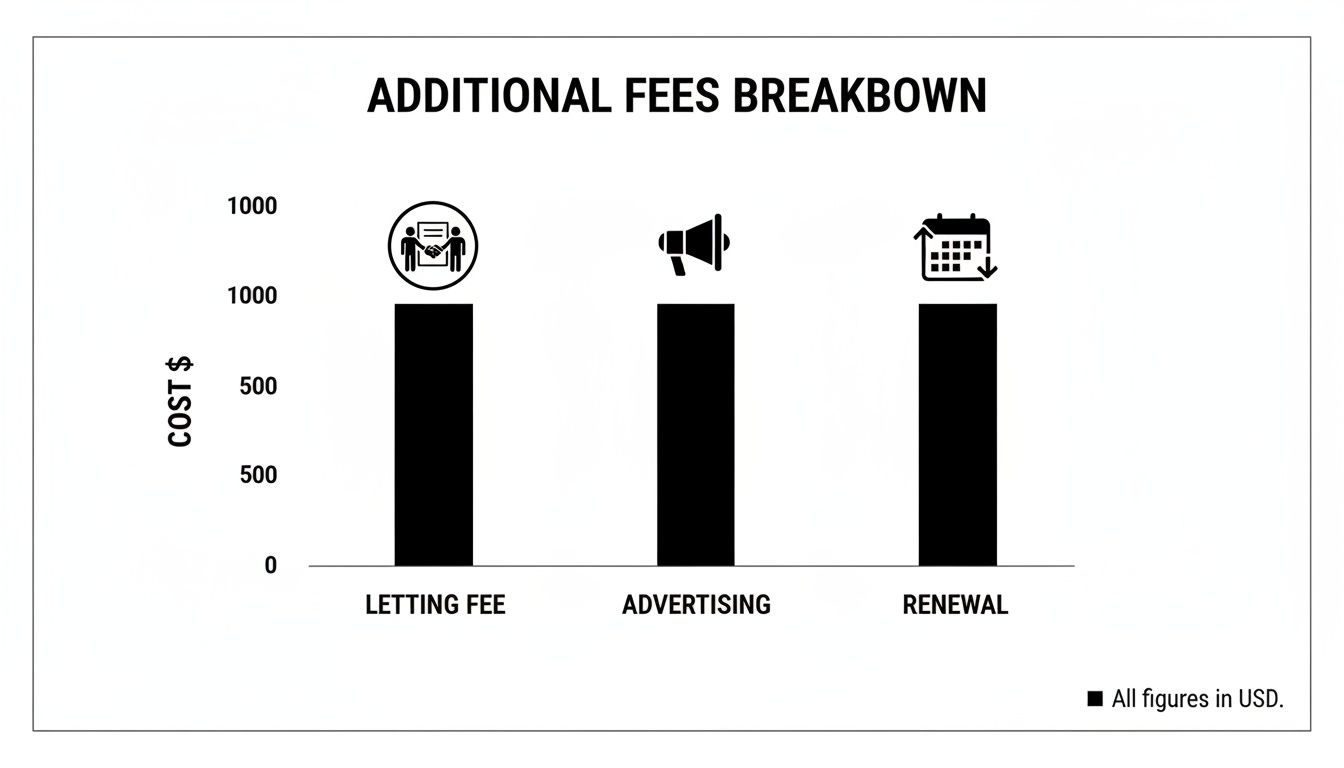
It really highlights that while the ongoing management fee is the core expense, the costs tied to finding or renewing a tenancy are also a significant part of your annual budget.
Scenario 2: The Modern Apartment Near the Foreshore
Now for something a little different. Imagine you own a modern two-bedroom apartment near the Mandurah foreshore. It's a bit smaller but always in high demand, renting for $480 per week (around $2,080 per month). We'll stick with the same 8% management fee.
Let’s assume this apartment also needed one new tenant during the year. Here's how the calculation changes:
- Calculate Annual Rent: $480 x 52 weeks = $24,960
- Calculate Management Fee: $24,960 x 8% = $1,996.80
- Calculate Letting Fee: 2 weeks' rent = 2 x $480 = $960
- Add Advertising Fee: A flat fee of $200
- Calculate Annual Total: $1,996.80 + $960 + $200 = $3,156.80
As you can see, the overall cost is lower because it’s directly tied to the property's rental income. Running the numbers on your specific property is the only way to get a true sense of the cost.
If you'd like to dive deeper into your own investment's potential returns and expenses, our property investment calculator for Australia is a brilliant tool to help you crunch the numbers.
Is Self-Management Cheaper Than Professional Management?
On the surface, managing your own investment property seems like a no-brainer for saving cash. Cut out the property manager's fee, and you're instantly putting more money in your pocket, right? It's one of the biggest questions investors wrestle with when they start comparing the numbers.
But the real answer isn't that simple. Think of it like doing your own business accounting instead of hiring a professional. Sure, you save on the accountant's fees, but you might miss out on expert strategies, legal know-how, and efficiencies that would have saved you far more in the long run.
Professional property management isn't just an expense; it’s a strategic move to protect your asset and squeeze every last drop of return from it. The real comparison isn’t just about the management fee, but about the total financial outcome at the end of the year.
The Hidden Costs of Going It Alone
When you decide to manage a property yourself, the biggest "hidden" cost is your own time. Every hour you spend advertising the property, showing it to potential tenants, chasing late rent, or calling a plumber for a burst pipe at 10 PM is an hour you can't get back. It's time stolen from your career, your family, or your hunt for the next investment.
Beyond the value of your time, there are direct costs that quickly add up. DIY landlords have to pay for their own advertising, which can easily run from $100 to $500+ per listing, not to mention the cost of running proper, comprehensive background checks on applicants. For a deeper dive, check out this great article on the true costs of self-management on yourinvestmentpropertymag.com.au.
Maximising Income and Minimising Vacancy
Here’s where a great property manager really shines: getting you the best possible rent. An experienced local manager has their finger on the pulse of the Mandurah market. They know exactly what your property is worth right now and how to price it to attract top-tier tenants without leaving money on the table.
This local expertise directly boosts your two biggest profit drivers: rental rate and occupancy.
- Higher Rental Rates: A professional makes sure your property isn't underpriced—a classic mistake private landlords make.
- Shorter Vacancy Periods: They have a database of pre-vetted tenants and a proven marketing plan to fill your property fast, slashing the income you lose between leases.
Think about this: if a property manager cuts your vacancy from three months down to just one, they've often paid for their entire annual fee with that extra income alone. Suddenly, their fee isn't a cost; it's a high-return investment.
A Direct Comparison of Your Options
To make a truly informed choice, you have to look past the monthly fee and weigh up the full picture—the responsibilities, the risks, and the potential returns. What works for one investor might be a nightmare for another.
Let's break down the key factors in a head-to-head comparison to help you see the financial and non-financial trade-offs more clearly.
Cost and Benefit Analysis of Management Approaches
| Factor | Self-Management | Professional Management |
|---|---|---|
| Upfront Costs | Lower initial cash outlay (no letting fees). | Higher initial costs (letting and advertising fees). |
| Ongoing Fees | No monthly management fee. | 7-10% of monthly rent. |
| Time Investment | Very high; requires constant availability. | Very low; manager handles all daily tasks. |
| Vacancy Risk | Higher due to limited marketing reach and time. | Lower due to professional marketing and tenant databases. |
| Legal Risk | High; personal liability for compliance errors. | Low; manager is an expert in WA tenancy law. |
| Rental Pricing | Risk of underpricing due to lack of market data. | Optimised for maximum return based on local data. |
At the end of the day, while going it alone gets rid of a direct fee, it opens the door to significant indirect costs and risks. For most busy investors, a brilliant property manager doesn't just save you time and stress—they often generate enough extra income and prevent enough costly mistakes to more than cover their own fees.
How to Choose a Mandurah Property Manager and Get the Best Value
Understanding the costs is the first step, but finding the right partner to protect your asset is where the real value lies. Choosing a property manager in Mandurah isn't just about finding the cheapest rate; it's about selecting a professional who will maximise your income, minimise your stress, and safeguard your investment.
Think of it like hiring a pilot. You wouldn't pick the one with the lowest fee, would you? You’d choose the one with the most experience, the best track record, and a deep understanding of the local airspace. Your property is a significant asset, and it deserves that same level of professional care.
Key Questions to Ask Potential Managers
Before you sign any agreement, it's absolutely vital to sit down and interview potential managers to make sure their approach lines up with your goals. A good manager will welcome your questions and give you transparent, confident answers. This is how you look past the fee structure to the actual service you’ll be getting.
Here’s a practical checklist to guide your conversations:
- Local Expertise: How long have you been managing properties specifically in Mandurah and the surrounding suburbs?
- Communication: What's your policy for communicating with owners? How often will I get updates, and who is my direct point of contact?
- Technology: What software do you use for owner portals, financial reporting, and maintenance requests?
- Tenant Screening: Can you walk me through your tenant screening process from start to finish?
- Fee Transparency: Can you provide a complete schedule of all your fees? Are there any charges not listed on your standard agreement?
Your goal is to find a manager who provides true value, not just a low price. A proactive manager who secures excellent tenants and keeps your property in top condition can easily save you more than their fee costs.
Evaluating Fee Structures and Finding Value
While the management percentage is important, don't let it be your only focus. You want a fee structure that is clear, fair, and completely transparent. A slightly higher fee from an agency with a stellar reputation for low vacancy rates and proactive maintenance is often a much better investment in the long run.
Remember, some fees might be negotiable, especially if you have multiple properties. It’s worth noting that the residential property leasing and management industry in Australia is a massive part of the real estate sector. The market size is projected to be $8.5 billion by 2026, which really highlights how much homeowners rely on these professional services. This context helps show that fees are an investment in genuine expertise within a huge, professional industry. You can read more about these Australian real estate market insights on ibisworld.com.
Ultimately, a great property manager pays for themselves through optimised rent, minimal vacancy, and the prevention of costly issues. By asking the right questions and focusing on overall value, you can confidently choose a professional who will help your Mandurah investment thrive.
A Few Final Questions About Property Management Costs
When you're weighing up the cost of professional property management, a few last-minute questions often come to mind. Getting clear, honest answers is the final piece of the puzzle, helping you feel completely confident in your decision.
Think of it as the final check-in before a flight. We've covered the main itinerary, and now we're just confirming those small but crucial details so you can sit back and relax, knowing everything is taken care of.
Is It Cheaper to Pay a Flat Fee or a Percentage?
There’s no single right answer here—it really boils down to your property and what helps you sleep at night. A percentage-based fee often makes more sense for properties with lower weekly rent, as the dollar amount will naturally be smaller. It also gives your manager a direct incentive to secure rent increases, because as your income grows, so does theirs.
On the other hand, a flat fee gives you absolute certainty for your budget. You know exactly what you'll be paying every month, which can be more cost-effective for high-rent properties where a percentage might start to feel quite substantial. It really depends on your financial strategy and what gives you more peace of mind.
Are Property Management Fees Tax Deductible?
Absolutely. In Australia, any fee you pay to a property manager to look after your rental is generally tax-deductible. This isn't just the ongoing management fee; it includes letting fees, advertising costs, and any other charges directly related to managing your investment.
This is a game-changer that many investors don't fully appreciate. Being able to claim these expenses significantly brings down the net cost of hiring a professional, making it a far more affordable way to protect your asset’s performance. Of course, you should always run this by your accountant to see how it applies to your specific situation.
Can I Negotiate Property Management Fees?
Sometimes, yes. While most agencies have a standard fee structure, there can be room to move, especially if you're bringing a portfolio of multiple properties to them. Some managers might also be flexible on one-off charges like lease renewal fees if you ask.
But a word of caution: the lowest price rarely equals the best value. An experienced, top-tier manager charging a standard rate could save you thousands in the long run by preventing a single costly vacancy or mishandled legal issue. Your focus should be on the overall value and service you’re getting, not just the headline number.
Ultimately, understanding how much a property manager costs is about looking at the whole picture—from the management fee right through to the tax benefits.
Ready to get a clear, no-obligation breakdown of the costs and potential returns for your Mandurah property? The team at David Beshay Real Estate provides a free, expert property appraisal to give you the clarity you need.

