


If you've ever looked at buying an apartment, townhouse, or unit in Mandurah, you've probably come across the term "body corporate fees." What exactly are they? Think of them as a shared wallet for the entire building or complex.
These are regular payments made by every property owner in a strata scheme, and they go towards covering the upkeep of all the shared spaces and common property. It's the collective budget that keeps everything from the swimming pool and gardens to the building insurance and hallway lighting in top shape, ensuring the whole property stays safe, clean, and valuable for everyone involved.
Demystifying Body Corporate Fees in Australia

When you buy a property in a shared complex, you’re not just purchasing the space inside your four walls—you’re also buying a slice of all the common property. This includes everything outside your front door that all the residents use, like lifts, lobbies, car parks, and gardens.
To keep these shared areas looking good and functioning properly, you need a system to manage and pay for all the ongoing costs. That's where the body corporate (also known as an owners corporation or strata company) comes in. The funding for this system comes directly from the fees paid by every owner.
The Core Purpose of These Fees
At its heart, the goal of body corporate fees is to pool everyone's resources for the benefit of the entire community. Instead of one resident having to figure out how to fix a broken lift or another mowing the common lawn, the body corporate handles it all using the collected funds.
This organised approach means the property is managed efficiently, which helps preserve its value and appeal. It covers crucial expenses that individual owners just couldn't handle on their own, like major building insurance policies, electricity for common areas, and planning for long-term repairs.
How the System Works
In Australia, owners of strata-titled properties pay these fees to cover a whole host of shared expenses. The body corporate manager or committee sits down each year to work out a budget, and this total cost is then divided among the owners.
The whole process is transparent. The proposed budget and levies are presented to all owners for approval at the Annual General Meeting (AGM). The amount each owner chips in usually depends on the size of their property or their 'unit entitlement', which is designed to make sure the financial load is shared fairly. You can find a bit more detail on how the payments are structured on propertyupdate.com.au.
Key Takeaway: Body corporate fees aren't just an extra cost; they're a critical investment in your property's future. They protect the physical and financial health of the entire building, making sure it remains a desirable place to live for years to come.
Breaking Down What Your Fees Actually Cover
Ever looked at a body corporate invoice and wondered where your money actually goes? It's a fair question, and a really important one for any Mandurah homeowner. Understanding your fees is the key to seeing them not as just another bill, but as a vital investment in maintaining and even boosting your property's value.
Your contributions aren't just thrown into one big pot. Think of it like your own household budget—you have an account for daily expenses and a separate savings account for big-ticket items. Your body corporate does the same, channelling funds into two distinct accounts to keep the community's finances healthy and transparent.
The Administrative Fund: Your Daily Operations Budget
The Administrative Fund is the workhorse of your strata scheme. It’s essentially the building’s day-to-day chequing account, designed to cover all the predictable, recurring expenses that keep the property running smoothly and looking its best week after week.
This fund pays for all the regular services you probably take for granted but would definitely miss if they disappeared. Its purpose is purely operational—to manage the here and now.
So, what does it cover?
- Routine Maintenance: Think lawn mowing, gardening, and keeping the pool sparkling clean.
- Common Area Utilities: This pays the bills for electricity in the hallways, power for the lifts, and water for the shared gardens.
- Cleaning Services: Regular cleaning of lobbies, corridors, and other shared spaces to ensure a pleasant living environment for everyone.
- Insurance Premiums: A big one. This covers essential building insurance, public liability, and other required policies.
- Management Fees: The cost of hiring a professional strata manager to handle the admin, finances, and legal compliance.
Basically, the Administrative Fund keeps the lights on, the gardens green, and the property safe for all residents.
This image shows how those key expenses branch out from your total fees.
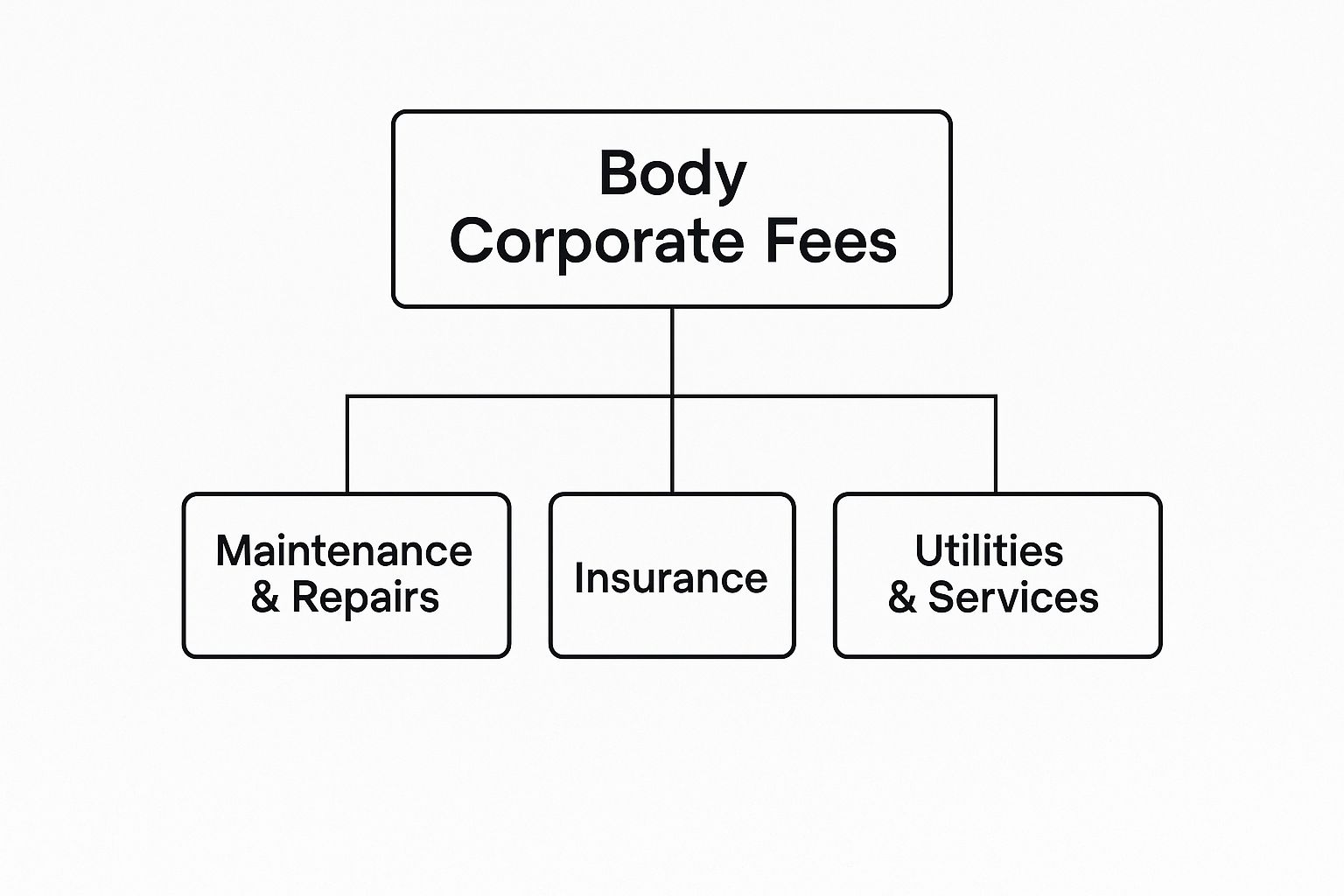
As you can see, your fees are directly tied to tangible services and protections that benefit the entire community.
The Sinking Fund: Your Long-Term Savings Plan
While the admin fund handles today, the Sinking Fund is all about planning for tomorrow. In WA legislation, you'll often see this referred to as a Capital Works Fund. This is your body corporate’s long-term savings account, and it’s arguably one of the most critical factors in protecting your investment.
Its whole purpose is to build up money over time for major capital works. Without a healthy Sinking Fund, owners would get slapped with huge, unexpected bills whenever a major part of the building needs replacing.
This forward-planning approach means money is ready and waiting for large-scale projects, preventing the financial shock of a sudden, massive expense. It’s the difference between proactive financial management and reactive crisis control.
Common projects paid for by the Sinking Fund include:
- Repainting the entire building exterior.
- Replacing the roof.
- Upgrading lifts and elevators.
- Major structural repairs to balconies or foundations.
- Resurfacing the driveway or car park.
A well-managed Sinking Fund is a clear sign of a financially healthy body corporate. It gives buyers confidence and is absolutely essential for maintaining property values over the long haul.
To make the distinction clearer, here’s a quick comparison of what each fund typically handles.
Administrative Fund vs Sinking Fund: What Your Fees Cover
This table breaks down the typical expenses covered by the two main funds, helping you see exactly where your contributions are allocated.
| Expense Category | Administrative Fund (Day-to-Day) | Sinking Fund (Long-Term Capital Works) |
|---|---|---|
| Maintenance | Minor repairs, gardening, pool cleaning | Major structural repairs, roof replacement |
| Utilities | Electricity and water for common areas | Not applicable |
| Services | Cleaning, waste removal, security patrols | Not applicable |
| Insurance | Annual building & public liability premiums | Not applicable |
| Management | Strata manager fees, bank fees, postage | Not applicable |
| Capital Projects | Not applicable | Exterior painting, lift upgrades, driveway resurfacing |
This separation ensures that day-to-day running costs don't eat into the savings earmarked for crucial future upgrades.
Special Levies: The Emergency Fund
So, what happens when an urgent, expensive repair pops up that wasn't in the budget? That’s where a Special Levy comes in. It’s a one-off, extra payment that all owners must contribute to cover unforeseen costs that neither the Administrative nor Sinking Fund can handle.
For example, a special levy might be needed for urgent repairs after a severe storm or to cover the cost of unexpected legal action. While they’re sometimes unavoidable, a history of frequent special levies can be a red flag. It might suggest poor long-term financial planning, so it’s always something to look out for.
How Body Corporate Fees Are Calculated

That figure you see on your levy notice isn't just plucked out of thin air. It’s the end result of a careful, transparent budgeting process designed to keep your property running smoothly. Getting your head around how this number comes to life helps you see exactly where your money is going and gives you the power to get involved in your building's financial decisions.
Think of it as a collaborative effort. The process involves forecasting the total annual costs for everything—from the gardener who comes weekly to the roof that might need replacing in ten years—and then splitting that cost fairly among all the owners.
The Annual Budgeting Process
It all starts with the body corporate committee, who often team up with a professional strata manager to map out the year's finances. They sit down and meticulously draft a budget, looking at all the expected expenses for both the day-to-day Administrative Fund and the long-term Sinking Fund.
This is far from guesswork. The process is pretty thorough:
- Looking Back: They start by reviewing what was spent last year to get a solid baseline for all the regular, predictable costs.
- Getting Quotes: They'll then go out and get fresh quotes from all the suppliers and contractors—think cleaners, gardeners, and insurance brokers—to make sure the numbers are current.
- Allowing for Inflation: Costs go up, so they’ll factor in an expected increase for services and materials.
- Checking the Long-Term Plan: They consult the sinking fund plan to make sure enough cash is being put away for those big-ticket items down the track.
What you end up with is a detailed financial roadmap for the property, outlining every single anticipated cost for the next 12 months.
Understanding Unit Entitlement
So, once the total budget is locked in, how is your personal share worked out? This is where a crucial concept called unit entitlement comes into play.
Imagine the entire strata property is one big pie. Your unit entitlement is simply the size of your slice.
This value is set for each apartment or townhouse right when the strata plan is first registered. It's designed to reflect the relative value of your lot compared to others in the building.
A few things typically influence your unit entitlement:
- Property Size: Bigger apartments generally have a higher unit entitlement.
- Original Market Value: A penthouse with sweeping ocean views will naturally have a higher entitlement than a ground-floor studio.
- Exclusive Use Areas: If you have access to things like a private courtyard or an extra car bay, that can also bump up the figure.
Your body corporate fees are calculated by taking the total budget and multiplying it by your unit entitlement. This ensures the costs are shared proportionally. It makes sense, right? The owner of a three-bedroom apartment will pay more towards the shared upkeep than someone in a one-bedroom unit in the same building.
The Bottom Line: Unit entitlement is the key that ensures everyone pays their fair share. It directly links the size and value of your investment to what you contribute to the collective pot.
The Role of the Annual General Meeting
The final, and arguably most important, step is the Annual General Meeting (AGM). This is where the democratic side of strata living really comes to life. The committee presents the proposed budget and the levies to all the owners for approval.
At the AGM, you have the right to:
- Review the Budget: Go through the proposed income and expenses for the year with a fine-tooth comb.
- Ask Questions: This is your chance to get clarity on anything, from the insurance premium to the cost of pool maintenance.
- Vote on Approval: The budget and the levies aren't official until they're approved by a majority vote of the owners.
This meeting is your opportunity to have a real say in how your property is managed financially. By showing up and getting involved, you ensure the whole process is transparent and that your money is being handled responsibly. Once the budget gets the green light at the AGM, the levies for the year are set, and the invoices are sent out.
Key Factors That Influence Your Fee Amount
Ever looked at two apartment buildings in Mandurah, maybe one brand new and the other a bit older, and wondered why their body corporate fees are worlds apart? It’s not just a random number plucked from the air. A handful of key factors directly shape how much you’ll pay.
Getting your head around these variables is crucial. It helps you figure out if a property's fees are fair value for the lifestyle and maintenance you're getting in return.
Think of it like owning a car. A high-performance sports car packed with the latest tech will always cost more to run than a simple, reliable hatchback. It’s the exact same principle with a strata property—its features, age, and overall condition are the biggest drivers of ongoing costs.
Building Age and Condition
One of the most significant factors is simply how old the building is. An older property, much like a classic car, often needs more love and attention to keep it running smoothly. Things just naturally wear out over time.
This means the budget for an older building will likely have more money set aside for fixing things like plumbing, roofing, and electrical systems. As a result, the sinking fund for a 30-year-old complex needs to be much healthier than for a new build, because big-ticket items like replacing a lift or all the windows could be just around the corner. This proactive saving for future works directly bumps up the regular fees owners pay today.
Amenities and Shared Facilities
This is often the big one. The more bells and whistles a property has, the higher the running costs. A simple, six-unit walk-up with a shared garden has a very straightforward expense sheet.
Now, picture a modern Mandurah complex with a full suite of resort-style amenities. The costs start to stack up pretty quickly:
- Swimming Pools and Spas: They need constant chemical balancing, cleaning, heating, and pump maintenance.
- Gymnasiums: Equipment needs to be serviced and eventually replaced, not to mention the electricity and cleaning costs.
- Lifts and Elevators: These are expensive to run, insure, and maintain, with mandatory annual safety checks and huge replacement costs down the line.
- Elaborate Gardens: Professionally manicured landscapes require gardeners, complex irrigation systems, and constant upkeep.
Every single one of these features adds another line item to the budget, which pushes up the total cost that gets divided among the owners.
Key Insight: When you're buying into a property with extensive amenities, you're not just buying the lifestyle; you're also buying into the ongoing cost of maintaining that lifestyle. It's essential to ensure the fees align with the facilities you will actually use.
Quality of Management and Financial Planning
The effectiveness of the body corporate committee and the strata manager they hire also makes a massive difference. A proactive, well-organised management team can save owners a fortune through smart financial planning. They’ll chase competitive quotes for services, schedule regular preventative maintenance to avoid expensive emergency repairs, and maintain a solid sinking fund forecast.
On the flip side, a poorly managed scheme can lead to neglected maintenance, budget blowouts, and a much higher chance of being hit with a painful special levy when something big breaks.
Across Australia, body corporate fees vary so widely because of these exact factors—the complexity of the building, the facilities on offer, and how well the committee runs the show. A savvy strata committee will often allocate more to the sinking fund each year to prepare for long-term repairs. While this means higher levies now, it's a smart financial move that helps everyone avoid the shock of a massive special levy in the future. For investors, it's also worth remembering these fees can often be claimed as a tax deduction, though it's always best to get professional advice. You can find more insights on this from RateCity.com.au.
Finally, don't forget that other expenses, like property taxes, will also affect your total holding costs. To get a clear picture of what you might need to pay when buying a property, have a look at our handy stamp duty calculator.
Your Rights and Responsibilities as an Owner

Owning a property in a Mandurah strata scheme is a unique experience. Think of it like being part of an exclusive club—you get access to fantastic shared amenities and a beautifully maintained property, but that membership comes with a clear set of rules and expectations. This is especially true when it comes to body corporate fees, which involve a crucial balance of duties on your part and entitlements you can expect.
Getting your head around this two-way street is the key to a harmonious living situation and protecting your investment. You have a legal obligation to pay your share, but you also have every right to know exactly how your money is being put to work for the community.
Your Core Responsibility: Paying Fees on Time
Your number one responsibility as a lot owner is simple: you must pay your body corporate fees on time. This isn't just a friendly suggestion; it's a legal requirement. These payments are the financial lifeblood of your entire building, covering everything from the annual insurance policy down to the weekly gardening service.
When even a single owner falls behind, it puts a strain on the community’s budget. Necessary maintenance might get delayed, or the body corporate could be forced to dip into the sinking fund that was earmarked for future projects.
The consequences for not paying are serious and are there to ensure fairness for all the owners who do meet their obligations. They typically include:
- Interest Charges: Most strata schemes will charge penalty interest on overdue levies, and this can add up surprisingly fast.
- Loss of Voting Rights: If your fees aren't paid up, you may lose your right to vote at general meetings. This means you have no say in major decisions, including the approval of the next annual budget.
- Debt Recovery Costs: The body corporate can and will take legal action to recover the debt, and you'll almost certainly be liable for all the legal costs involved.
Your Rights as a Financial Contributor
While you have a duty to pay, you also hold powerful rights that ensure complete transparency and accountability. As a financial stakeholder, you are entitled to see precisely where your money is going and have a direct say in how it’s all managed. It’s a bit like having shareholder rights in the company that is your property.
These rights empower you to be an active, informed member of your community, not just someone who passively pays the bills.
By exercising your rights, you play a vital role in ensuring the body corporate is managed responsibly, efficiently, and in the best interests of all owners. A well-informed community is a well-run community.
Your key entitlements include:
- Access to Records: You have the legal right to inspect the body corporate's records. This covers financial statements, budgets, minutes from past meetings, and insurance policies. This transparency is your best tool for understanding the scheme's financial health.
- Participation in Meetings: You have the right to attend all general meetings, especially the crucial Annual General Meeting (AGM). This is your forum to ask questions, raise concerns, and contribute to discussions about the property's future.
- Voting on Motions: Your most direct influence comes from your right to vote. You get to have your say on approving the annual budget, electing the committee members, and authorising any major projects.
Understanding these fundamentals is a huge step, particularly if you’re new to the property market. For those just starting out, our comprehensive first home buyer guide offers more essential tips for navigating the buying process here in Western Australia. Being an engaged owner helps create a thriving, financially stable community for everyone involved.
How to Analyze Body Corporate Fees Before You Buy
When you're looking at properties in Mandurah, digging into the body corporate fees is a non-negotiable part of your due diligence. It's easy to get caught up in the look and feel of a place, but these fees are the financial heartbeat of the building. High fees can put a serious strain on your budget, while suspiciously low fees could be a red flag for a poorly managed building on the brink of financial trouble.
Think of it as a financial background check on the property itself. A thorough review of the numbers gives you a clear window into the community's health and harmony, helping you sidestep a property loaded with hidden costs or simmering disputes. Getting this right ensures your new investment is a sound one from day one.
Your Essential Document Checklist
Before you let yourself get too attached to a property, it's time to play detective. The first step is to request and carefully scrutinise the key body corporate documents. These papers tell the real story of how the building is run, warts and all.
Here’s what you absolutely need to get your hands on:
- The Disclosure Statement: This is your cheat sheet. It gives you a quick overview of the strata scheme’s current financial standing and tells you what the current levy amounts are.
- Recent AGM Minutes: Reading the minutes from the last few Annual General Meetings is like being a fly on the wall. You’ll find out what issues are being debated, see any big spending decisions, and get a feel for how engaged (or disengaged) the other owners are.
- The Sinking Fund Forecast: This is the building’s long-term financial roadmap, often mapping out 10 years or more. It details all the planned major capital works—like roof replacements or lift upgrades—and how the body corporate plans to pay for them.
These documents are your best tools for uncovering the truth behind the glossy sales brochure.
A healthy set of records is a fantastic sign. It shows proactive financial planning and an engaged community that cares about its investment. On the flip side, missing documents, sloppy minutes, or a non-existent sinking fund plan are all major warning signs.
Spotting the Financial Red Flags
Once you have the documents in hand, you need to know what you’re looking for. Certain patterns can point to underlying issues that could end up costing you a fortune down the track.
Keep a sharp eye out for these common red flags:
- A Chronically Underfunded Sinking Fund: If the balance is low and doesn't match up with what the forecast says it should be, it's a huge sign they aren't saving enough for essential future repairs.
- A History of Frequent Special Levies: While a special levy might be unavoidable now and then, seeing them pop up regularly suggests poor budgeting. It’s a sign of reactive, panic-driven management rather than proactive planning.
- Records of Ongoing Disputes: The AGM minutes are gold for spotting unresolved fights between owners or conflicts with the management. A hostile environment can make for a very stressful place to live.
It's also a smart move to benchmark the fees. The strata landscape is always changing, and in some major Australian cities, average annual levies for apartments now sit anywhere from $6,000 to $12,000. Compare the fees for the property you’re eyeing with similar ones in Mandurah. This will help you gauge if they’re reasonable for the amenities you're getting. You can find more insights on these trends over at cockatoo.com.au.
This whole process is a crucial part of your pre-purchase checks, just as important as the physical inspection before settlement. To get more tips on that, check out our guide to a smooth final property inspection. Taking this proactive approach now will help you choose a well-run building that protects your investment for years to come.
Common Questions About Body Corporate Fees
Diving into strata living, especially for the first time in a place like Mandurah, naturally brings up a few questions. Getting straight answers is the key to feeling confident about your purchase, whether it's for you to live in or as an investment.
Let's tackle some of the most common questions we hear about body corporate fees.
Can I Refuse to Pay Body Corporate Fees?
The short answer? No. Paying your body corporate fees is a legal requirement for every single owner in a strata scheme. Think of it less like an optional service and more like council rates—it's essential funding that keeps everything running. These payments cover the insurance, maintenance, and general management of all the shared property.
Trying to skip these payments can lead to some serious headaches. You'll likely get hit with interest charges on the overdue amount first. If you continue to not pay, you could lose your right to vote at meetings, and eventually, the body corporate can take legal action to get the money back, leaving you with the original bill plus legal costs.
Are Body Corporate Fees Tax Deductible?
This is a big one, and the answer hinges entirely on how you use your property. For investors renting out their strata unit, the answer is generally yes. Body corporate fees are seen as a necessary expense for earning rental income, which means you can typically claim them as a tax deduction.
This applies to both your administrative and sinking fund contributions. However, if you live in the property as your main home, the fees are just considered a personal living expense and are not tax-deductible. It's always a good idea to chat with a qualified tax advisor to get advice specific to your situation.
Important Takeaway: The tax deductibility of your fees is directly tied to the property's use. What is a deductible expense for an investor is simply a personal cost for a homeowner living in their property.
How Do I Find Out the Fees Before Buying?
You should never have to guess. Before you even think about signing a contract on a strata property, the real estate agent or your settlement agent is required to give you a disclosure statement. This is a non-negotiable part of the process. This document clearly lays out the current levies for the exact property you're looking at.
But it doesn't stop there. The statement will also include other vital info, like minutes from recent AGMs and the scheme's financial reports. Going through these documents with a fine-tooth comb is a critical part of your due diligence. It gives you a clear, honest picture of the building's financial health and helps you sidestep any nasty surprises after you've already bought the place.

