


So, you’re thinking about buying your first home in Mandurah. It’s a massive step, one of the biggest you’ll ever take, but it absolutely doesn't need to be a stressful one. We've put this guide together to walk you through the entire process, specifically for the Mandurah and wider Western Australian market. Think of it as your roadmap—no jargon, just a clear, step-by-step plan.
Your Homeownership Journey in WA Starts Here
Getting the keys to your first place is more than just a single transaction; it’s a journey with a few key milestones. From getting your head around the market and your finances to dealing with the legal side of things, each stage builds on the last. When you understand the path ahead, the whole thing transforms from a daunting task into an organised and exciting adventure.
A Look at the Current WA Property Market
First things first, let's talk about the market you're stepping into. The property scene in Western Australia, especially in beautiful coastal spots like Mandurah, is buzzing with both challenges and great opportunities. It's no secret that property values have been on the move.
To give you an idea, the Perth market has seen a huge shift. Entry-level unit prices have shot up by a stunning 30.2% recently. That's a jump of about $95,000, which shows just how competitive things can get. You can dig into the specifics in the latest Domain First-Home Buyer Report. This isn't to scare you off—it's to arm you with the knowledge to make smart moves.
Knowing the market conditions is your secret weapon. It helps you set realistic goals, figure out your savings strategy, and pounce when the perfect opportunity comes along.
Getting a grip on these market dynamics is vital. It shapes everything from how much of a deposit you'll need to how fast you should move when you find a place you love. A prepared buyer is always a more confident buyer.
Your Journey at a Glance
To help you see the whole picture, we’ve laid out the entire home-buying process. The table below gives you a quick snapshot of the stages you'll go through. It's a great reference to have as you work your way through this guide.
Quick Guide to Your Home Buying Journey in WA
| Stage | Key Action | Primary Goal |
|---|---|---|
| 1. Financial Prep | Assess savings, get pre-approval. | Know your budget and borrowing power. |
| 2. Market Research | Identify suburbs, inspect properties. | Find the right home in the right location. |
| 3. Making an Offer | Submit a formal written offer. | Secure your chosen property. |
| 4. Legal & Finance | Finalise loan, engage a settlement agent. | Complete all legal and financial checks. |
| 5. Settlement | Pay the balance, transfer ownership. | Officially become the property owner. |
| 6. Move-In | Get the keys! | Start your life as a homeowner. |
Think of this as your strategic plan. With this structure in mind, you'll feel more in control as we dive deeper into each step. Let's get started.
Building Your Financial Foundation for a Loan

Before you even start scrolling through property listings in Mandurah, the most important work happens behind the scenes with your finances. Think of it as laying the groundwork for your entire homeownership journey. Getting your budget, savings, and borrowing power sorted now is what allows you to act with confidence when you find the right place.
Many people get stuck on the idea that you need a massive 20% deposit just to get a foot in the door. While that’s a fantastic goal to have, it's not the only way forward. The reality is, many successful first home buyers get into the market with less. What's crucial is understanding how different deposit sizes impact your loan options and the total costs involved.
The Truth About Your Deposit
The 20% deposit figure gets talked about so much because it's the magic number that lets you avoid paying Lenders Mortgage Insurance (LMI). LMI is a one-off insurance premium you pay, but it's there to protect the lender—not you—in case you can't meet your repayments.
It’s basically the bank's safety net for lending to someone with a smaller deposit. While it does add to your upfront costs, LMI can also be the very thing that gets you into your own home years sooner than if you waited to save that full 20%.
This isn't just a theory; it's how most people get started. Research shows that around 70% of Australian first-home buyers don't wait to save a 20% deposit. The data also highlights a serious commitment from these buyers, with nearly two-thirds (65%) putting 30% or more of their income towards their mortgage. You can dig into the numbers yourself in the Finder First Home Buyer Report 2025.
Calculating Your Real Borrowing Power
How much a bank will lend you isn't just a simple calculation based on your salary. Lenders take a microscope to your entire financial life to work out your borrowing power. Knowing this number before you start your property hunt is absolutely essential.
They’ll look at:
- Your Income: This includes your regular wages and any other consistent income you receive.
- Your Expenses: Everything from rent and groceries to your Netflix subscription and after-work drinks. Lenders are incredibly thorough here.
- Existing Debts: They look at your credit card limits (not just what you owe), car loans, and any other financial commitments.
- Your Deposit Size: A bigger deposit almost always boosts your borrowing capacity.
By getting a firm handle on these factors, you can realistically estimate what you can borrow and start looking at homes in the right price bracket.
Why Your Credit Score Matters
Your credit score is essentially your financial report card. It's a single number that sums up how well you've managed debt and paid your bills on time. A strong score signals to lenders that you're a reliable borrower, which can unlock better interest rates and improve your chances of getting approved.
Before you even think about applying for a loan, it's a brilliant move to check your credit score. You can do this for free with services like Equifax, Illion, or Experian. If it's a bit lower than you'd like, you can take simple steps to improve it, like paying down credit card balances and making sure every bill is paid on time. Even a small improvement can make a huge difference.
This is a critical part of any first home buyer guide because a good score can save you thousands over the life of your loan. It’s proof you’re a responsible money manager.
Gathering Your Essential Documents
When you're ready to apply for pre-approval, your lender is going to ask for a stack of paperwork to verify everything you've told them. Getting these documents organised early on will make the entire process feel less like a mad scramble.
Here’s a quick checklist of what you’ll likely need:
- Proof of Identity: Your driver’s licence, passport, or birth certificate.
- Income Verification: Recent payslips, your latest group certificate, or tax returns if you’re self-employed.
- Proof of Savings: Bank statements that show your deposit and, importantly, a history of consistent savings.
- Debt Statements: Statements for any credit cards, personal loans, or other debts you hold.
Having all this ready to go shows the lender you're organised and serious. It helps speed up your application and gets you one step closer to locking in that home in Mandurah.
Right, let's talk about one of the best parts of buying your first home in WA: the government support available. Getting your head around the various grants and concessions is a game-changer. Think of it as a direct financial boost from the government, designed specifically to help you get onto the property ladder sooner.
These aren't just small discounts; we're talking about schemes that can inject tens of thousands of dollars into your budget. Mastering these gives you a serious leg-up, either by beefing up your deposit or simply cutting down the size of the mortgage you need to take on.
The First Home Owner Grant (FHOG) Explained
The one everyone's heard of is the WA First Home Owner Grant (FHOG). It's a one-off payment, but there's a catch. The government's goal with this grant is to spur on the construction of new homes across the state.
Currently, the FHOG is a $10,000 tax-free payment. The crucial detail here is that it's only for people building a new home or buying a brand-new, never-lived-in property. So, if you've got your heart set on an established character home, you won't be able to access this particular grant.
Key Takeaway: The FHOG is strictly for new builds. It’s a fantastic bonus if you’re planning to build from the ground up or buy a 'spec' home that's just been completed.
There are also price caps to keep in mind. To be eligible, the total value of your home and land can't be more than $750,000. This applies to Mandurah and the rest of the Perth metro area, ensuring the grant helps genuine first home buyers who need it most.
Saving Big with Stamp Duty Concessions
Now, even if you're buying an established home and can't get the FHOG, don't worry. There's another, often more valuable, saving you can make. The First Home Owner Rate of Duty—or what everyone just calls the stamp duty concession—is a massive help for most buyers in Mandurah.
Stamp duty is a government tax slapped on every property purchase, and it can easily run into the tens of thousands. It's a hefty extra cost you have to budget for. But as a first home buyer in WA, you can get it wiped out completely or at least heavily discounted.
Here’s the breakdown for established homes:
- Property up to $430,000: You pay absolutely $0 in stamp duty. That’s a full exemption, potentially saving you more than $14,000 right off the bat.
- Property between $430,001 and $530,000: You pay a concessional (discounted) rate. The savings are still significant, but they taper off as the price gets closer to the upper limit.
- Property over $530,000: The full rate of stamp duty applies, with no discount.
If you're buying vacant land to build your home on, the thresholds are a bit different. You'll pay no stamp duty on land up to $300,000 and get a discount for land valued between $300,001 and $400,000.
How Do I Actually Get These Benefits?
The good news is you don't have to wade through complicated government websites and forms by yourself. Applying for these benefits is usually folded right into your home loan application process.
Your mortgage broker or bank lender will handle the paperwork for both the FHOG and the stamp duty concession for you. They’ll give you the forms, help you fill them out, and submit everything with your finance application. This is exactly why building your team of experts, which we dive into later in this first home buyer guide, is so critical. They make sure you claim every single dollar you're entitled to.
Navigating the WA Home Purchase Process
Alright, you’ve got a handle on your finances and a good idea of the government grants available. Now for the exciting part: the step-by-step process of actually buying your home in Western Australia.
The WA property game has its own set of rules and a unique rhythm. Think of this section as your playbook, guiding you from that "this is the one!" moment all the way to getting the keys in your hand. Knowing what’s coming next removes the fear of the unknown and makes the whole experience feel organised and a lot less stressful.
Building Your Professional Team
You don't have to tackle this alone—in fact, you absolutely shouldn't. One of the smartest things you can do is assemble a team of pros who live and breathe property. They'll guide you through the technical bits, protect your interests, and make sure everything goes smoothly.
Your A-team will usually include:
- A Real Estate Agent: Your local expert who finds properties and negotiates on your behalf.
- A Mortgage Broker or Lender: The financial whiz who sorts out your home loan.
- A Settlement Agent or Conveyancer: Your legal eagle who handles the ownership transfer.
In Western Australia, a settlement agent is non-negotiable. They are the independent professional who manages the legal transfer of the property from the seller's name into yours. Their job is to check the property title for any issues, liaise with the banks, and ensure all the money goes where it needs to on settlement day.
This infographic gives you a simple visual to help organise your thoughts around the core financial elements of your purchase.
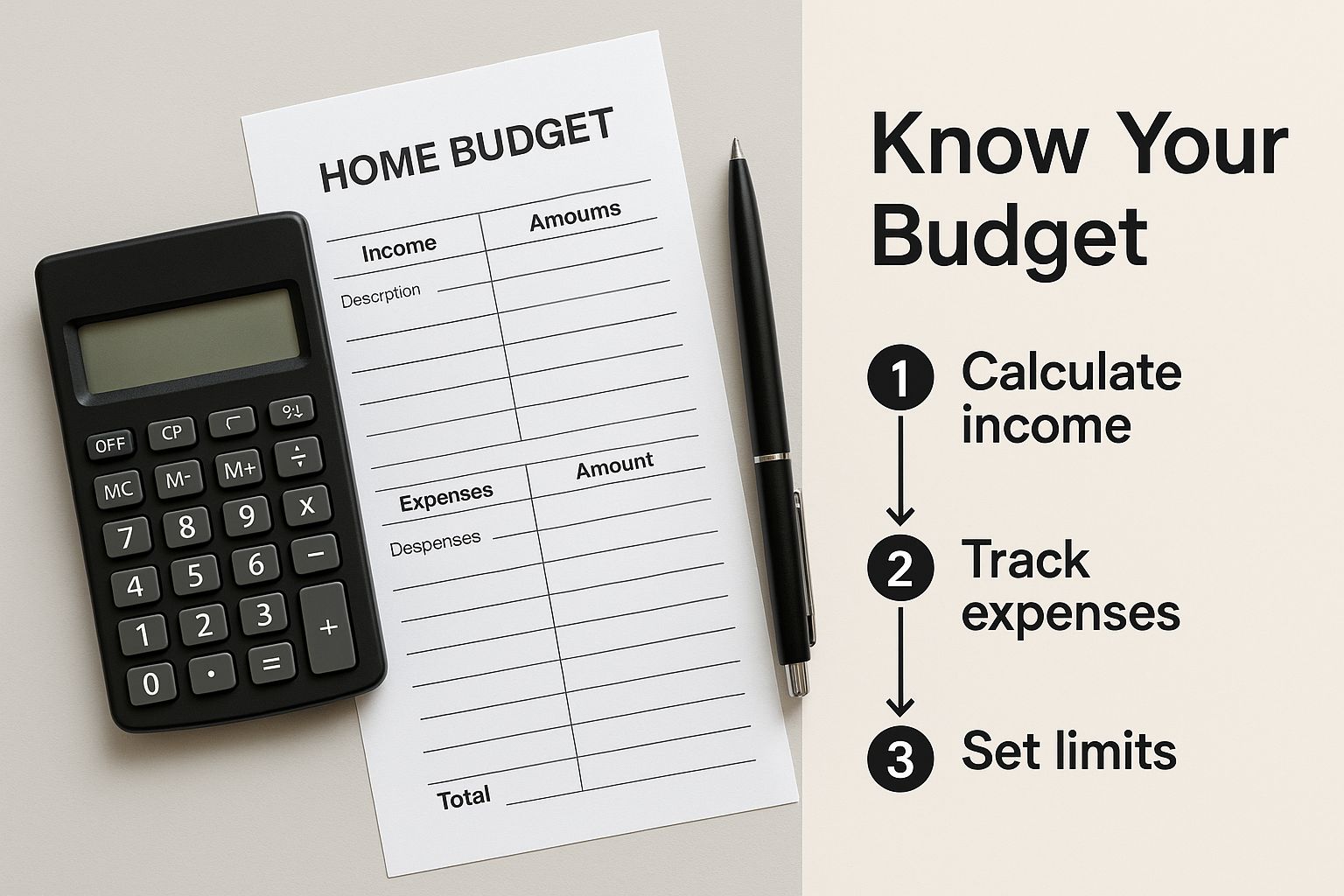
As the image shows, understanding your budget from the very beginning is the foundation for the entire home-buying journey.
Making a Formal Offer
Found a place in Mandurah you've fallen for? The next move is making a formal offer. In WA, this isn't just a casual chat. It’s done through a legally binding document called the Contract for Sale of Land or Strata Title by Offer and Acceptance. That’s a mouthful, so everyone just calls it the "Offer and Acceptance" or "O&A".
This document lays out everything: the price you’re offering, your preferred settlement date, and—most importantly—any conditions that must be met for the sale to proceed. This is where you put your cards on the table and kick off negotiations with the seller. For a deeper dive, check out The Ultimate Guide to Buying Your First Home in Western Australia, which breaks these steps down even further.
The Power of Conditions: "Subject To Finance" and More
The conditions in your Offer and Acceptance are your safety nets. They are clauses stating the contract is only locked in if certain things happen, protecting you from being stuck with a property you can't afford or one that has major hidden issues.
This is arguably the most critical part of your offer. Without these conditions, you could risk losing your deposit or even being sued if you can't go through with the purchase.
For any first home buyer, these two conditions are vital:
- Subject to Finance: This gives you a set timeframe (usually 14-28 days) to get unconditional, or formal, approval for your home loan. If the bank says no, this clause lets you walk away from the contract without penalty.
- Subject to a Building and Pest Inspection: This lets you hire a professional to check the property for major structural problems or termite damage. If they find something serious, you can often negotiate for the seller to fix it or you can choose to pull out of the deal.
The Final Steps to Getting Your Keys
Once your offer is accepted and all your conditions are met, you’re on the home stretch. Your settlement agent really steps up here, working with your bank and the seller’s agent to get everything ready for settlement day.
Right before settlement, you’ll do a pre-settlement inspection. This is your last chance to walk through the property to make sure it's in the same condition as when you first saw it and that any agreed-upon repairs are done.
On settlement day itself, the money changes hands, the legal documents are officially lodged, and the property title is transferred to your name. Your real estate agent then gets the green light to hand over the keys. This is the moment it all becomes real—you are officially a homeowner.
Why Mandurah Is a First Home Buyer Hotspot

When you start picturing your first home, what comes to mind? For most of us, it’s more than just bricks and mortar. It's about finding a community, a lifestyle, and making a smart financial move all at once. That’s precisely why Mandurah has become such a beacon for first home buyers across Western Australia.
It all comes down to a perfect balance. Here, you get that incredible coastal lifestyle—think stunning beaches, winding waterways, and that permanent holiday vibe—without the eye-watering price tags you’ll find in central Perth. This unique blend of liveability and affordability is the secret to Mandurah’s appeal, making it a brilliant choice for anyone ready to step onto the property ladder.
Value and Affordability
Let's be honest, the biggest drawcard for Mandurah is simple: you get so much more for your money. Compared to metro Perth where property prices can feel out of reach, Mandurah offers a far more accessible entry point into the market.
This breathing room in your budget means you could be looking at a family-sized home with a proper backyard, instead of having to compromise with a small apartment closer to the city.
The ongoing housing supply shortage across Australia keeps putting pressure on prices, especially in the major cities. A recent report from the National Housing Supply and Affordability Council highlighted that new home completions are falling short of national targets. This reality makes affordable regional hubs like Mandurah even more attractive for buyers who want value without giving up on their dream lifestyle. You can get more details by reading the full state of the housing system report.
A Diverse and Growing Property Market
Mandurah’s property market is incredibly varied, which is fantastic because it caters to almost every taste and budget. It’s not just one type of house on offer; it's a whole mosaic of opportunities.
- Family-Friendly Suburbs: Places like Lakelands, Halls Head, and Meadow Springs are magnets for families, known for their modern homes, great schools, and community parks.
- Waterfront Living: If you're dreaming of a life by the water, suburbs like Wannanup and Dawesville deliver with canal-front properties and a genuine resort-style atmosphere.
- Central Convenience: For those who love being in the thick of it, central Mandurah has modern apartments and townhouses just a stroll from the foreshore, cafes, and major shopping centres.
This diversity means you can find a home that actually fits your life right now, and where you see yourself in the future. Better yet, the market isn't just diverse—it’s growing. Consistent demand and smart local development point to a healthy future for property values. You can explore our deep dive into Mandurah's real estate growth to see exactly what’s driving the market forward.
Choosing Mandurah isn't just a lifestyle choice; it's a calculated investment in a region with proven growth potential and a bright future. The combination of affordability and strong community infrastructure makes it a standout choice in this first home buyer guide.
Infrastructure and Community Amenities
A great place to live is built on more than just houses, and Mandurah’s appeal is massively boosted by its top-notch infrastructure and local facilities. Significant investment in the road and rail networks has made the commute to Perth quicker and easier than ever. This opens up a world of employment opportunities while letting you retreat to your coastal home at the end of the day.
The city is well-equipped with modern medical centres, a major hospital, quality schools, and the huge Mandurah Forum shopping centre. These are the amenities that provide the real-world convenience and support that young professionals and growing families need.
It’s this complete package—the home, the community, and the lifestyle—that truly cements Mandurah’s status as a first home buyer hotspot.
Avoiding Common First Home Buyer Mistakes
In the property world, knowledge isn't just power—it's your protection against some very expensive mistakes. The journey to your first home is incredibly exciting, but it’s also easy to get sidetracked by common traps that have caught out others before you.
By understanding these pitfalls now, you can navigate the Mandurah market with confidence. Think of it like this: you wouldn't drive a car without knowing the road rules. Learning from the mistakes of others is a shortcut to making smarter, safer decisions for your own purchase.
Overstretching Your Budget
One of the most frequent and damaging errors is borrowing the absolute maximum a bank will offer you. It's so tempting to see that big pre-approval figure and imagine a bigger or more flash home, but doing so can leave you financially vulnerable down the track.
A pre-approval amount is a ceiling, not a target. Stretching your budget to its limit leaves no wiggle room for life's unexpected turns, like a job change, a new family member, or rising interest rates. A comfortable mortgage is one that lets you live, not just survive from one repayment to the next.
A great rule of thumb is to create a detailed post-purchase budget before you even think about making an offer. Map out your new mortgage repayment alongside council rates, strata fees, insurance, utilities, and a maintenance fund to see what you can truly afford without stress.
Underestimating the Hidden Costs
The purchase price is just the beginning. So many first-time buyers get caught out by the extra expenses needed to finalise the purchase and actually move in. These aren't small amounts, and they must be factored into your savings from day one.
Beyond your deposit, you'll need to have cash ready for:
- Building and Pest Inspections: An absolutely essential health check for your potential new home, costing several hundred dollars.
- Lenders Mortgage Insurance (LMI): If your deposit is under 20%, this insurance (for the lender, not you) can add thousands to your loan.
- Settlement and Legal Fees: These are the professional fees for the experts who handle the legal transfer of the property title into your name.
- Ongoing Expenses: Don’t forget council and water rates, plus strata fees if you're buying an apartment, unit, or townhouse.
This is exactly why hiring a settlement agent is crucial—they help you manage these costs and ensure a smooth, surprise-free transaction.
Skipping Essential Due Diligence
Falling in love with a property can create massive emotional blind spots. It’s far too easy to overlook potential red flags when you’re already picturing your furniture in the living room and hosting your first barbecue. But skipping your due diligence is a gamble you simply cannot afford to take.
This means always, without exception, getting a professional building and pest inspection. What looks like a simple cosmetic issue on the surface—a small crack or a bit of flaky paint—could be masking a major structural defect or a termite infestation that could cost you tens of thousands to fix later.
A few hundred dollars for an inspection report provides priceless peace of mind. It's a non-negotiable step in any smart home-buying journey.
Got Questions? Here Are Some Straight Answers for WA First Home Buyers
Jumping into the property market for the first time always brings up a heap of questions. It's completely normal. This section is all about giving you direct, no-nonsense answers to the things first home buyers in Mandurah and across WA ask us most, so you can move forward with a bit more confidence.
How Much Deposit Do I Really Need in WA?
Everyone seems to throw around the 20% deposit figure, but let's be real—that’s not the only way to get your foot in the door. Saving a 20% deposit is the gold standard, mostly because it means you get to sidestep Lenders Mortgage Insurance (LMI). Think of LMI as a one-off insurance policy that protects the bank, not you, in case you can't keep up with repayments.
The good news? Many lenders in WA get that saving that much cash is a massive ask. It's actually quite common to find a home loan with a deposit as low as 5%. Some government-backed schemes, like Keystart, can even get you started with as little as a 2% deposit. The trade-off is pretty clear: a smaller deposit means you're in the market faster, but you'll have a bigger loan and that extra cost of LMI to factor in.
Can I Use the First Home Owner Grant for an Established Home?
This is a classic point of confusion, and we hear it all the time. The Western Australian First Home Owner Grant (FHOG) is a $10,000 one-off payment, but it comes with a catch: it’s strictly for buying or building a brand-new home. You can't use it to buy an existing, established property.
But don't let that discourage you if you've found the perfect established home. You can still tap into huge savings with the First Home Owner Rate of Duty. This is basically a major discount on your stamp duty, and honestly, it can often save you much more than the $10,000 FHOG ever would.
This stamp duty relief is a game-changer for first-timers in WA and a critical part of any good first home buyer guide.
What Are the Biggest Hidden Costs I Should Watch Out For?
The price on the listing is just the headline act. A savvy first home buyer knows to budget for all the other costs that pop up during a property transaction. Forgetting about these can lead to some serious financial stress right when you're about to get the keys.
Make sure you've got these common expenses on your radar:
- Loan Establishment Fees: These are the one-off admin fees your bank charges to get your mortgage set up.
- LMI Premium: If your deposit is under 20%, this insurance premium will be a significant upfront cost you need to plan for.
- Building and Pest Inspection Fees: This is non-negotiable. You need a professional to check the bones of the house, and it usually costs a few hundred dollars.
- Settlement Agent Fees: You'll need a conveyancer to handle the legal side of transferring ownership, and they charge for their expert services.
- Ongoing Costs: Once you're in, the bills start! You'll have council rates, water rates, and if it's a unit or townhouse, probably strata levies too.
Factoring these costs in from day one makes for a much smoother, less stressful journey to settlement. Being prepared is half the battle won.
Ready to take the next step on your Mandurah property journey? The team at David Beshay Real Estate has the local know-how and personalised approach you need to tackle the market with confidence. From finding that perfect first home to closing the deal, we're here to help. Contact us today for a free, no-obligation chat about your homeownership goals.
Article created using Outrank


Pingback: Mortgage Broker vs Bank: Which is Best for Your Home Loan? - David Beshay Real Estate - The Agency
Pingback: Your Guide to Home Loan Pre Approval in Australia - David Beshay Real Estate - The Agency
Pingback: Real Estate Mandurah | Your Guide to the Best Property Deals - David Beshay Real Estate - The Agency
Pingback: Your Guide to Mandurah Real Estate WA - David Beshay Real Estate - The Agency
Pingback: Mandurah WA Real Estate An Insider's Guide - David Beshay Real Estate - The Agency
Pingback: What Is Body Corporate Fees a Guide for AU Homeowners - David Beshay Real Estate - The Agency
Pingback: Steps to Buy a House in Mandurah A Practical Guide - David Beshay Real Estate - The Agency
Pingback: Land for Sale Mandurah WA Your Expert Buying Guide - David Beshay Real Estate - The Agency