


When you're buying a property, one of the first hurdles is the deposit. But what if your cash is tied up somewhere else? A deposit bond is a clever way to handle this. It’s a substitute for the cash deposit you normally pay when you sign a contract, acting as an insurance-backed guarantee for the seller. Basically, it lets you secure your dream home without needing to find a huge sum of cash on the spot.
Understanding a Deposit Bond
Let's paint a picture. You've found the perfect home in Mandurah, but your savings are locked into your current property until it sells, or maybe they're in an investment you can't touch right away. It’s a common situation, and it can make coming up with the usual 10% cash deposit a real headache. This is exactly where a deposit bond steps in to save the day.
Think of it as a rock-solid 'IOU' from a fully regulated insurance company, made out to the seller on your behalf. So instead of transferring tens of thousands of dollars into a trust account, you simply hand over this certificate.
A deposit bond isn't a loan; it's a guarantee. It promises the seller that if you can't complete the purchase on settlement day, they'll still get their full deposit amount. No actual money changes hands until the final settlement.
This gives you massive flexibility. You can move quickly in a competitive market without having to liquidate assets or mess up your financial plans. For a lot of buyers here in Western Australia, it’s a strategic move that lets them make a strong offer while keeping their cash free for other things, like moving costs or starting those renovations.
Key Features at a Glance
To make it even clearer, let's break down what makes a deposit bond tick. Understanding these features really shows why it's becoming such a popular choice for savvy property buyers.
Here's a quick summary of what you get with a deposit bond.
| Feature | Description |
|---|---|
| Cash Alternative | It replaces the need for an upfront cash deposit, keeping your funds free until settlement day. |
| Insurance Guarantee | A proper underwriter gives the seller a legal guarantee for the full deposit amount. |
| One-Time Fee | You pay a single fee, typically around 1.3% of the deposit amount. There's no ongoing interest. |
| No Asset Security | Unlike a bank guarantee, you usually don't have to secure the bond against your property. |
This structure makes deposit bonds a powerful tool for buyers who have their finances sorted for the final purchase but just need a bridge for that initial deposit. By working with a local Mandurah expert like myself, David Beshay, we can figure out if this strategy is the right fit for your property goals and financial situation, giving you a real advantage in the market.
How a Deposit Bond Works Step by Step
So, you understand the concept of a deposit bond, but what does it actually look like in practice? Let's walk through the real-world process to see how it all comes together. We'll follow a hypothetical Mandurah buyer on her journey from finding the perfect home to securing it without needing to touch her cash savings.
The whole process is much more straightforward than people often think. It’s designed to be quick and efficient, keeping pace with the fast-moving property market. At its core, it's a simple, three-part flow.
This visual gives you a bird's-eye view of the journey, from the buyer's application all the way to the seller getting that all-important guarantee.
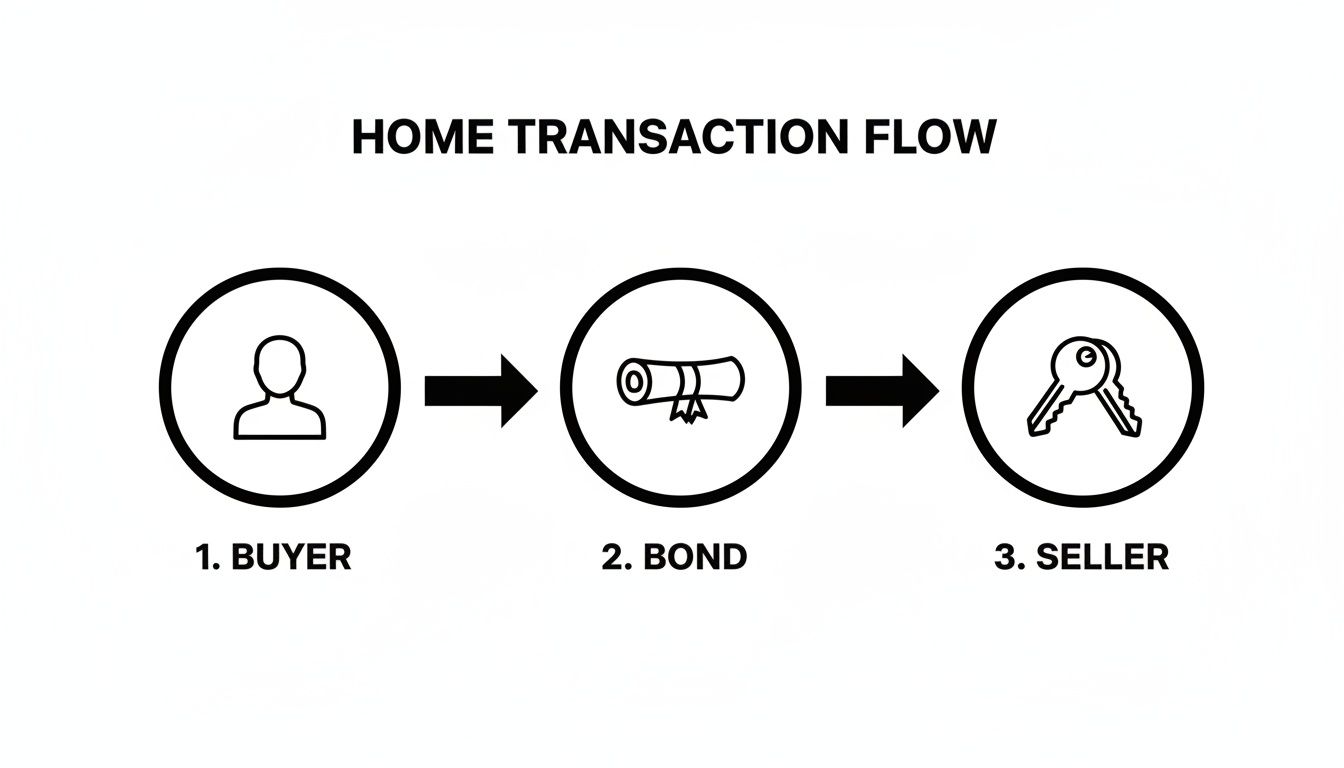
As you can see, the bond provider acts as a trusted middleman. They give the seller the security they need, while you, the buyer, get some crucial financial breathing room.
The Initial Steps: Finding and Offering
The journey starts when a buyer—let's call her Chloe—finds her dream home in Lakelands. She's got her home loan fully approved, but her cash is tied up in term deposits that she really doesn't want to break early and cop the penalties.
Instead of letting the property slip through her fingers, she puts in a competitive offer and states that she'll be paying the deposit with a deposit bond. This is a common and widely accepted practice here in Western Australia, so the seller's agent knows exactly what to do.
Once her offer is accepted, the clock starts ticking. The contract of sale will name a date for the deposit to be paid, which is Chloe's cue to get her bond organised. If you're not entirely sure what goes into this document, you can get all the details in our guide on what a contract of sale entails.
Applying For and Receiving the Bond
Chloe's next move is applying for the deposit bond. This is usually a quick online process, often sorted within a single business day. She’ll need to provide some key information:
- The Property: The address and purchase price of her new home in Lakelands.
- The Parties Involved: Her details, the seller's details, and their conveyancers or solicitors.
- Her Financial Position: Proof of her unconditional loan approval or enough assets to cover the full purchase.
The bond provider reviews her application to make sure she has the financial backing to see the purchase through to settlement. Since Chloe's finance is already unconditionally approved, she's seen as a low-risk applicant.
Once approved, the provider issues a legally binding certificate called a Deposit Guarantee. This is the deposit bond itself. Chloe pays a one-time fee to the provider—usually around 1.3% of the deposit amount—and gets the certificate, ready to hand over to the seller's agent.
Securing the Property Until Settlement
Chloe gives the Deposit Guarantee to the seller's real estate agent. This certificate officially secures the property for her. It's an unconditional promise from the insurer to the seller that the deposit amount, say $60,000, is guaranteed.
From this moment until settlement day, the seller has total peace of mind, and Chloe's cash stays put in her term deposit, happily earning interest. The bond has perfectly bridged the financial gap.
On settlement day, Chloe's conveyancer handles the final transaction. The full purchase price is sent to the seller, which includes the deposit amount. With that, the deposit bond's job is done, and the guarantee simply expires. No separate cash for the deposit ever changes hands, as it's all wrapped up in the final settlement payment.
Comparing Deposit Bonds to Cash and Bank Guarantees
When it comes to paying your property deposit, you’ve got a few options on the table. It’s a major financial decision, one that can really affect your cash flow and flexibility leading up to settlement. For years, the go-to has always been a straight-up cash deposit, but clever alternatives like deposit bonds are changing the game.
Getting your head around the key differences between a deposit bond, a cash deposit, and a bank guarantee is the first step to making the right call for your situation. They all get you to the same finish line—securing the property—but how they get you there is completely different. Your finances, your timeline, and how much you value having access to your own money will point you in the right direction.
Let’s put these three side-by-side to see how they really stack up.

The Classic Approach: The Cash Deposit
A cash deposit is as simple as it sounds. You transfer the agreed amount, usually up to 10% of the purchase price, into the seller’s real estate agent’s trust account. That money then sits there, safe and sound, until settlement day.
Simple, yes. But it comes with one massive catch: your money is completely tied up. For the entire settlement period—which could be 30, 60, or even 90 days—those funds are out of reach. That’s a huge opportunity cost. You can’t earn interest on it, invest it, or even use it to cover unexpected moving expenses.
The Bank Guarantee: A Formal Alternative
Think of a bank guarantee as a formal IOU from your bank. They promise the seller they’ll cover the deposit if you can’t follow through on the contract. To get one, you first need to give the bank the full deposit amount in cash, which they’ll lock away in a term deposit as security.
If that sounds a lot like a cash deposit, it’s because it is. Your funds are still locked up and completely unusable. On top of that, a bank guarantee can sometimes be held against your total borrowing capacity, as it’s a liability on the bank's records. The application process can also be a bit more drawn out than other options.
The Flexible Solution: The Deposit Bond
This is where things get interesting. A deposit bond flips the whole concept on its head by letting you keep your cash. Instead of handing over a huge chunk of money, you pay a one-off, non-refundable fee to a specialised insurer. In exchange, they issue a guarantee to the seller for the full deposit amount.
This means every dollar of your cash stays right where you want it—in your bank account. You can keep it earning interest, put it towards moving costs, or invest it while you wait for settlement. It keeps your options open.
The real power of a deposit bond is the financial freedom it gives you. You can secure the property you want without freezing your capital, giving you a serious strategic advantage in the property market.
To really see the difference, let's break it down in a simple table looking at what matters most to buyers.
Comparing Your Deposit Options
Here’s a direct comparison of the three main ways you can pay your deposit, highlighting the pros and cons of each.
| Factor | Deposit Bond | Cash Deposit | Bank Guarantee |
|---|---|---|---|
| Liquidity | Excellent: Your cash remains completely free and accessible. | Poor: Your funds are locked in a trust account until settlement. | Poor: Your funds are held by the bank as security. |
| Cost | One-time fee, typically ~1.3% of the deposit amount. | No direct cost, but you lose potential interest earnings. | Annual fees plus the opportunity cost of locked funds. |
| Application Speed | Very fast, often approved within 24-48 hours. | Instant, as it's just a bank transfer. | Slower, as it requires a formal bank application process. |
| Impact on Borrowing | None. It is not a loan and does not affect your borrowing power. | None. | Can sometimes reduce your overall borrowing capacity with the lender. |
At the end of the day, it all comes down to what you prioritise. If you have the cash sitting there and don't mind it being out of action for a few months, a traditional deposit is perfectly fine. But if you want to keep your financial options open and make your money work harder for you right up until settlement, a deposit bond is often the smarter choice.
To get a better feel for the numbers, you can play around with different scenarios using our handy house deposit calculator for Australia.
Who Can Get a Deposit Bond and How to Apply
So, is a deposit bond the right move for your property purchase? While they offer fantastic flexibility, they aren't a one-size-fits-all solution. Providers need to be absolutely confident you can complete the purchase at settlement, so eligibility is everything.
Put simply, deposit bonds are a perfect fit for buyers who have their finances sorted but just can't get their hands on liquid cash for the initial deposit. This is a game-changer in a few common scenarios. Think of downsizers who are using the sale proceeds from their current home to fund their next one, or property investors who'd rather keep their capital working hard elsewhere instead of sitting idle in a trust account.
Who Is Eligible for a Deposit Bond
It all comes down to one thing: proving you're in a strong financial position to finalise the purchase. Bond providers are looking for clear signals that you're a reliable applicant and a low risk.
You'll generally need to tick one of these boxes:
- Unconditional Finance Approval: You have a formal, no-strings-attached loan approval from your bank or lender for the full purchase amount.
- Sufficient Equity: You own another property with enough equity to cover the entire purchase price of the new home.
- Term Deposits or Investments: You have guaranteed funds in term deposits, managed funds, or even superannuation that will be available by the settlement date.
Essentially, the provider wants to see a clear, straightforward path for you to pay the seller in full on the big day. Having this proof ready to go makes the whole process incredibly smooth.
A deposit bond isn't about creating funds you don't have; it's about bridging the gap when your existing funds are temporarily out of reach. It demonstrates financial strength, not weakness.
The Application Process Step by Step
One of the biggest perks of a deposit bond is just how fast the application process is. In a hot market where timing is everything, this can give you a crucial edge. The whole thing, from sending in your documents to getting the guarantee certificate, can often be wrapped up in just one or two business days.
Here’s a quick rundown of how it works:
- Gather Your Documents: First up, you'll need to collect some basic info. This includes a copy of the signed contract of sale for the property you're buying and proof of your financial standing, like that unconditional loan approval letter or evidence of your equity.
- Complete the Application Form: Most providers have a simple online application. You'll fill in your details, the seller's details, the property information, and of course, the deposit amount you need.
- Pay the One-Time Fee: Once your application gets the green light, you'll pay a single, non-refundable fee. This is usually calculated as a tiny percentage of the deposit amount—typically around 1.3%.
- Receive Your Deposit Guarantee: After payment, the provider issues the formal Deposit Guarantee certificate. You hand this over to the seller’s real estate agent, and just like that, your new property is officially secured.
First-time home buyers in Western Australia, in particular, can use deposit bonds to get ahead of the competition. These bonds really took off in the early 2000s as property prices started to climb, offering a way to substitute cash deposits of up to 10% and are often issued within hours. With government programs like the Home Guarantee Scheme seeing huge uptake, buyers can get into properties with higher price caps without needing the full cash deposit upfront. You can discover more about these property exposure trends from APRA to see how the market is shifting. For more specific local advice, check out our comprehensive first home buyer guide.
Understanding the Costs and Risks Involved
While a deposit bond offers fantastic flexibility, it's crucial to treat it as the serious financial product it is. Think of it less as a "get out of jail free" card and more as a sophisticated tool with its own costs and potential risks. Getting your head around these details is the key to making a confident, informed decision.

The main cost you’ll encounter is a one-time, non-refundable fee paid to the insurer who provides the guarantee. This fee is simply a percentage of the deposit amount you’re securing. It's not a loan, so there’s no ongoing interest to worry about.
Breaking Down the Cost
For a standard six-month deposit bond, the fee is usually around 1.3% of the deposit's value. If you're buying off-the-plan, you can expect a higher fee. That’s because the settlement period is much longer, which means the insurer is on the hook for a greater length of time.
Let’s put that into a real-world Mandurah scenario.
- Property Price: $650,000
- Required Deposit (10%): $65,000
- Deposit Bond Fee (at 1.3%): $845
In this case, a one-off payment of $845 lets you secure your new home while keeping your $65,000 deposit in your own bank account until settlement day. That capital stays liquid and ready for anything else you might need it for.
For investors or those moving to Mandurah, this can be a game-changer. Some providers even offer fees starting from 1.15% for six-month terms if your finance is already sorted, scaling up for those longer off-the-plan purchases. Imagine you’re looking at an $800,000 investment property. A 10% bond of $80,000 could cost as little as $920 upfront, freeing up vital cash flow. You can dig deeper into how brokers view the cost-effectiveness of deposit bonds through industry analysis.
The Most Significant Risk: Buyer Default
The biggest risk with a deposit bond rears its head if you, the buyer, can't complete the purchase on settlement day. In property terms, this is called defaulting on the contract of sale.
If you default, the seller has a legal right to the deposit. Because the bond is an unconditional guarantee, the insurer will pay the full deposit amount straight to the seller, no questions asked. This protects the seller and makes sure the contract is honoured.
But the story doesn't end there.
The deposit bond is a guarantee to the seller, not an insurance policy for the buyer. Once the insurer pays the seller, you are legally obligated to repay the full deposit amount to the insurer. This becomes an absolute and immediate debt you have to settle.
This is the most critical detail to grasp. The bond shifts the immediate payment duty to the insurer, but the ultimate financial responsibility stays squarely on your shoulders.
Other Potential Considerations
Beyond the main risk of default, there are a few other things to keep in mind to make sure everything goes smoothly.
- Settlement Delays: If your settlement date gets pushed back, your original deposit bond might expire. You'll need to contact the provider to organise an extension, which usually comes with an extra fee.
- Seller Acceptance: While deposit bonds are widely used here in Western Australia, a seller isn't legally required to accept one. It’s always smart to have the agent confirm the seller is happy with a bond before you put in your offer.
- Contract Changes: Making big changes to the sales contract after the bond is issued—like altering the price or the names on the contract—might mean the bond needs to be amended or reissued. This could involve extra admin costs.
Alright, let's get you set up in the Mandurah property market.
So now you know what a deposit bond is, you've got another option up your sleeve when it comes to buying property. In a fast-moving market like Mandurah's, having that kind of flexibility can be the difference between securing your dream home and watching it slip away. The real trick, of course, is knowing when it’s the right tool for the job.
The next logical step is to get some advice that’s actually about you and your specific situation. Every buyer is in a different boat, and a one-size-fits-all approach just doesn't cut it in real estate.
Get Expert Local Guidance
We always recommend having a chat with a local expert—someone who lives and breathes the Mandurah market every single day. A quick, strategic conversation with a professional can clear things up fast, helping you decide if a deposit bond makes sense for you or if another path is better.
Securing a property is more than just a transaction; it's about making a smart, confident financial decision. Personalised advice from a local market expert is the best way to ensure your strategy aligns perfectly with your long-term objectives.
Working with an experienced agent like David Beshay at The Agency gives you that clarity. With his deep knowledge of the local area, David can walk you through every stage of your purchase, from putting together a strong initial offer to making sure settlement day goes off without a hitch.
Take Action Today
The property market doesn't wait around. To get ahead, you need to make decisive moves backed by solid information. Here’s what you can do right now:
- Request a Free Property Appraisal: If you need to sell your current place before you buy, finding out its value is the first thing you should do. It gives you a clear picture of where you stand financially.
- Schedule a Strategy Call: A no-obligation chat can help map out your options. You can talk through your finances, your property wish list, and see how a deposit bond might fit into your game plan.
- Get Your Finances in Order: Whether you end up using a deposit bond or cash, having your loan pre-approval and other paperwork sorted will put you in the strongest possible position to make a winning offer when you find the perfect home.
Frequently Asked Questions About Deposit Bonds
It's one thing to understand the concept of a deposit bond, but another to see how it plays out in the real world. You probably have a few specific questions buzzing around, especially when thinking about fast-moving situations like auctions or the occasional settlement delay.
Let's tackle the most common questions we hear from Mandurah buyers. These are the practical, need-to-know details that will help you use this tool with confidence.
Do All Sellers Accept Deposit Bonds?
This is a big one. Can you use a deposit bond for any property purchase? The short answer is: almost always, but you need to check first.
Most sellers and agents in Western Australia are completely comfortable with deposit bonds. They know it’s a secure, insurance-backed guarantee from a reputable provider. However, a seller isn't legally required to accept one instead of cash.
That’s why it’s always a smart (and courteous) move to have your agent confirm acceptance with the seller’s agent before you make a formal offer. A quick check upfront keeps everyone on the same page and ensures the whole process stays smooth and professional right from the start.
How Long Is a Deposit Bond Valid For?
Deposit bonds aren't open-ended; they have an expiry date that must cover you right through to settlement. The length of time they're valid for is tailored to the kind of property you're buying.
- For existing properties: The most common validity period is six months. This gives you plenty of breathing room for the typical 30, 60, or 90-day settlement periods we see here in Mandurah.
- For off-the-plan purchases: Because these involve construction, the bonds can last much longer. It's not unusual to see them issued for up to five years to match the extended settlement timeframe.
The key is to make sure the bond’s expiry date goes well beyond your expected settlement date, just to be safe.
Can I Use a Deposit Bond for an Auction?
Yes, absolutely! A deposit bond can be a huge advantage in a high-pressure auction environment.
To make it work, you'll need to apply for a pre-approved deposit bond before auction day. This certificate is approved for the maximum amount you're willing to bid, giving you a firm limit to stick to.
If you're the winning bidder, it's simple. You just fill in the final property and seller details on your pre-approved certificate and hand it straight to the agent. No need to stress about having a massive amount of cash ready to go on the spot.
What Happens if My Settlement Date Is Delayed?
Delays happen. It’s a part of property transactions, whether it's a hold-up with finance or a last-minute issue on the final inspection. If your settlement gets pushed back, there's a chance your deposit bond could expire before the new date.
If this looks likely, you need to act fast. Get in touch with your bond provider as soon as you know there’s a delay. You can apply for an extension to cover the new settlement period. Just be aware that there might be an extra fee for this, so clear communication is your best bet for keeping things on track.
Ready to explore how a deposit bond could give you a competitive edge in the Mandurah property market? Contact David Beshay Real Estate today for a free, no-obligation property appraisal and expert advice tailored to your buying journey. Find out more at https://realestate-david-beshay.com.au.

