


70.5% of occupied private dwellings in Mandurah were owned outright or with a mortgage at the 2021 Census, according to the Australian Bureau of Statistics' Mandurah profile. That's a substantial homeowner base, but it doesn't tell you what your particular home will sell for. The best home appraisal starts where broad market figures stop: with evidence you can check against your property, your competition and your selling plans.
Table of Contents
- Why a Mandurah Appraisal Needs More Than a Quick Number
- Why the Highest Estimate Is Not Always the Best One
- Choosing an Appraiser Who Knows Your Suburb
- Preparing Your Home Without Overcapitalising
- Documenting Improvements and Presenting Comparable Sales
- Avoiding the Most Common Appraisal Pitfalls
- Turning Your Appraisal into a Confident Pricing Decision
Why a Mandurah Appraisal Needs More Than a Quick Number
Consider a Halls Head homeowner weighing an encouraging appraisal against the cost of moving. The figure sounds reasonable. A nearby home advertised at a similar level, and the owner has recently refreshed the kitchen.
But an advertised price isn't a completed sale, and a refreshed kitchen doesn't make otherwise different homes comparable. Before that owner commits to another purchase, the useful question isn't whether the estimate feels right. It's whether the supporting evidence stands up.
Mandurah's established homeowner population provides context, not a shortcut to valuation. Long-term owners may remember what neighbours paid, what renovations cost and what an agent suggested previously. Those reference points can shape expectations without establishing today's likely selling range.
Start with the decision you need to make
An appraisal should answer a practical question. For a Lakelands family, that might be whether selling will support a move to Madora Bay. For a Meadow Springs investor, it could be whether to sell as presented or complete maintenance first.
Ask the agent to assess the property against your actual options:
- Sell in its present condition: What objections would buyers raise, and how should the price reflect them?
- Prepare before listing: Which changes deserve investigation before you commit money?
- Hold the property: What unresolved issues would still need attention when you eventually sell?
Broader Mandurah property growth context can help frame that conversation. It shouldn't replace an inspection or property-level analysis.
Keep investment ideas separate from existing value
Owners sometimes include potential improvements in their expectations before checking whether they're feasible. An additional dwelling, altered layout or upgraded outdoor space deserves its own assessment rather than an assumed premium.
If you're exploring compact accommodation, the tiny home investment insights from CozyCube can be a starting resource for considering that option. Keep it separate from the appraisal of your existing home, and investigate site suitability, approvals and costs before assigning any additional value.
Practical rule: Ask what the property supports today before discussing what it might support after further spending.
A useful appraisal gives you a basis for choosing between those paths. An unexplained number leaves the difficult decisions with you.
Why the Highest Estimate Is Not Always the Best One
A higher estimate is attractive because it appears to make every subsequent decision easier. The next purchase looks more affordable, the renovation feels justified and the moving budget becomes more comfortable.
None of that makes the estimate better supported.
When comparing reports, look beyond the headline figure and examine what each agent recommends.

Separate the selling range from the launch position
A likely selling range is an evidence-led opinion about where a transaction may occur. An asking-price strategy is a decision about how to approach buyers. They're related, but they shouldn't be presented as interchangeable.
An ambitious launch may suit an owner who has flexibility and understands the uncertainty. It's harder to justify when the owner needs a dependable result to coordinate another purchase.
Consider a Falcon seller whose recommended asking price sits above similar completed transactions. That recommendation needs a clear explanation. Is the home materially better? Is the agent testing an upper position? What happens if qualified buyers reject it?
This distinction also matters when a lender's assessment enters the conversation. The guide to bank valuations and real estate agent appraisals provides useful context before you treat different opinions as equivalent.
Test the commercial reasoning
A technically plausible range can still be unhelpful if the proposed campaign ignores the alternatives buyers can inspect.
Ask the agent:
- Current competition: Which listings would a buyer consider alongside your home in Mandurah, Lakelands or Falcon?
- Days on market: How long have similar listings been available, and what does that suggest about their positioning?
- Finance sensitivity: Does the strategy leave room for buyers whose borrowing capacity limits their offers?
- Review triggers: What buyer feedback would justify changing the launch position?
Don't accept unsupported claims about local selling times. Request the underlying listing history and distinguish time spent advertised from the timing of an eventual transaction.
The best home appraisal doesn't promise the most flattering outcome. It explains the conditions under which the recommended outcome is credible, along with the trade-offs if you choose a more ambitious approach.
Choosing an Appraiser Who Knows Your Suburb
Start by choosing the service that fits your purpose. Someone preparing a Halls Head home for sale needs a different conversation from someone requiring an independent report for a defined professional purpose.
Local knowledge matters, but so does clarity about the assignment. Familiarity with Madora Bay doesn't make every form of valuation interchangeable.
Which Valuation Fits Your Goal
| Valuation type | Main purpose | What it is based on |
|---|---|---|
| Rates-based statutory valuation | Government rating and taxation | Statutory valuation measures and the applicable assessment basis |
| Bank valuation | A lender's assessment for its lending decision | The lender's instructions and the valuation scope |
| Licensed valuation | An independent professional opinion for a defined purpose | Verified information, relevant evidence and stated assumptions |
| Agent market appraisal | Likely sale positioning and campaign planning | Comparable transactions, inspection findings and current competition |
Landgate explains that its valuations for rates and taxes serve government rating and taxation functions. A figure on a rates notice therefore shouldn't automatically become the asking price for your Dudley Park home.
For a bank-related requirement, ask the lender what it needs before commissioning anything independently. For a formal professional report, confirm the required purpose and who needs to rely on it.
Assess suburb knowledge through the explanation
An agent should explain why a particular comparison belongs in the report, not just point out that it shares your postcode. Ask how they've assessed your property's immediate setting, configuration and condition against the alternatives.
For Meadow Springs and Lakelands family homes, test the reasoning around layout, usable outdoor space and parking. For coastal properties in Madora Bay, Halls Head and Falcon, ask how the assessment handles outlook, orientation and the particular position within the suburb.
Beshay Realty offers complimentary market appraisals across these areas and surrounding suburbs, including Dudley Park. That's one option for owners seeking a selling assessment rather than a separately commissioned licensed valuation. The practical test remains the same: does the advice explain the evidence behind its recommended range?
Use these questions for choosing a real estate agent to compare the quality of the conversation, not just the proposed price.
If you need a licensed valuation, settle the fee arrangements first. Consumer Protection WA's guidance on using a land valuer says valuers set their own fees and must disclose service fees in writing before an agreement, with additional charges restricted unless the scope changes significantly.
Preparing Your Home Without Overcapitalising
Don't replace a kitchen just because you've booked an appraisal. An honest assessment of the home as it stands can be more useful than spending first and hoping the revised estimate justifies it.
The sensible preparation sequence is to identify condition issues, make the property easy to inspect, then assess optional cosmetic work. That order keeps presentation decisions from obscuring more important maintenance questions.
Walk through as a cautious buyer
Begin at the street and move through the home without explaining away familiar problems. Record what you see: damaged finishes, sticking doors, evidence of moisture, tired fittings or outdoor areas that are difficult to use.
Keep separate lists rather than treating every imperfection as a renovation project.
- Condition and maintenance: Investigate defects and obtain appropriate advice where the cause isn't clear. Painting over a stain isn't a substitute for understanding it.
- Presentation: Clean windows, clear circulation paths and remove excess furniture so the layout can be assessed properly.
- Optional upgrades: Seek an appraisal-based view before committing to replacement cabinetry, bathrooms or extensive landscaping.
For a coastal Falcon home, pay particular attention to the condition of external fixtures and outdoor finishes. For a Lakelands family property, make bedrooms, storage and living areas accessible rather than filling them with items moved out of sight.
These are inspection priorities, not promises of a particular increase in value.
Match the work to the likely sale
A restrained refresh and a substantial renovation create different commitments. The first may help buyers understand the existing home; the second introduces cost, timing and execution risk.
Ask for an assessment of the property as presented and a separate discussion of the proposed work. Require the agent to explain which buyer objection the work addresses and what evidence supports doing it.
Spending money and adding sale value are different things. Don't assume buyers will reimburse your renovation bill.
A Wannanup outdoor entertaining area may need cleaning, repairs and better furniture placement rather than replacement. A Meadow Springs kitchen might function well enough that wholesale renovation is difficult to justify before selling.
The practical ideas in preparing improvements that may increase home value are best treated as options to assess against your property, not a compulsory spending list.
Make access straightforward on appraisal day. Open storage areas, secure pets and identify anything the agent cannot inspect, so the assessment doesn't rely on assumptions.
Documenting Improvements and Presenting Comparable Sales
A renovation invoice proves that work cost money. It doesn't, by itself, prove how much that work contributes to the selling price.
Your job is to make the improvements verifiable. The appraiser's job is to assess their relevance against the property and its alternatives.
Use a concise checklist to organise the information before the inspection.
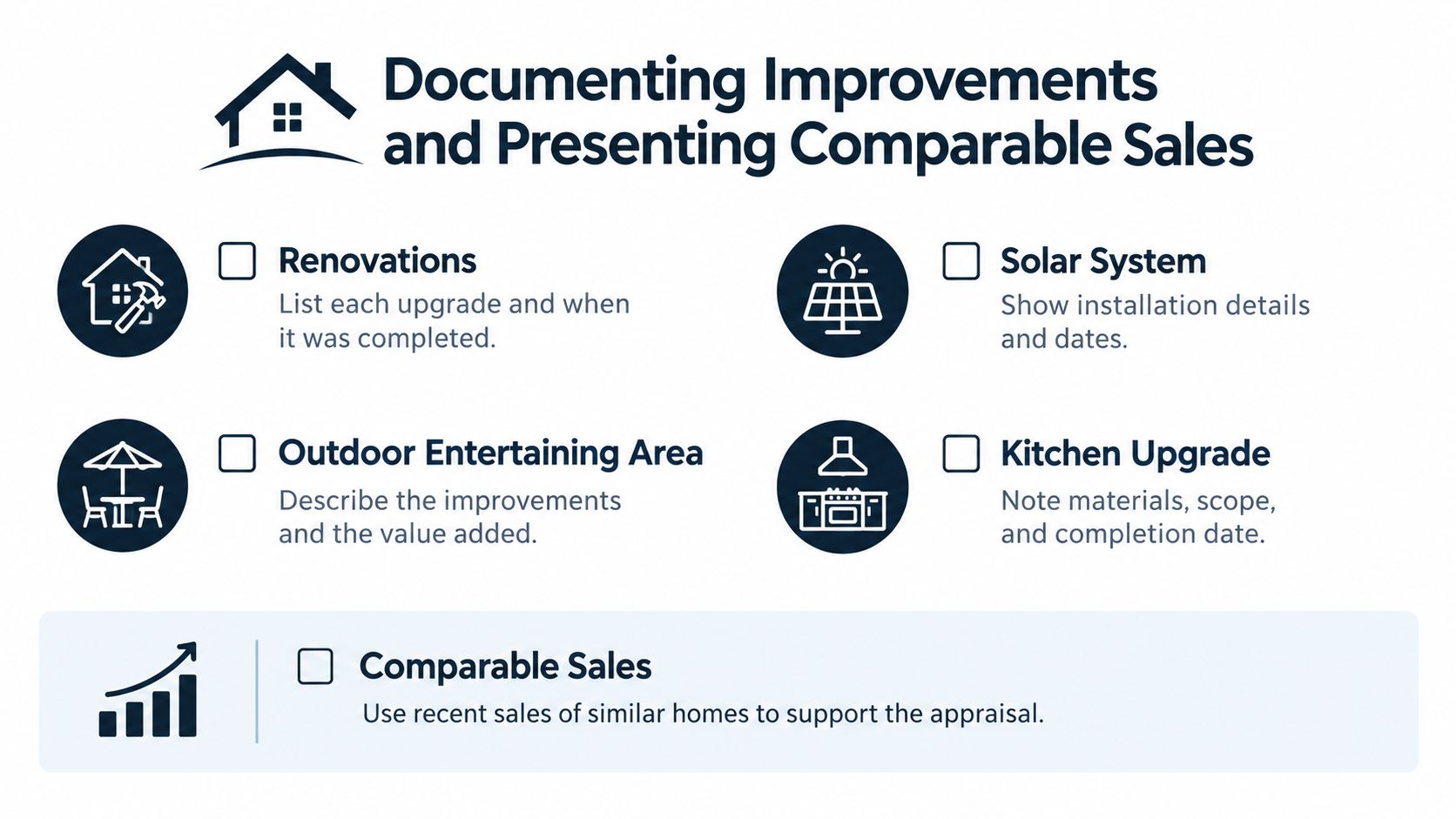
Build a property evidence file
A simple digital folder is sufficient. Group documents by improvement so the scope, timing and supporting material are easy to follow.
- Renovations: List what changed and when, with relevant approvals, invoices and dated photographs.
- Solar system: Include installation documents, equipment details and available warranty information.
- Outdoor entertaining: Describe the actual works, separating structural changes from furniture and styling.
- Kitchen upgrade: Record materials, appliances, completion details and whether the layout changed.
- Property basics: Supply the floor plan and flag any differences between the plan and the home as inspected.
For improvements without complete paperwork, say what's missing. Don't present an owner's recollection as independently confirmed information.
Check the transaction behind each comparison
Landgate's sales-evidence dataset combines registered property-sale information with valuation attributes such as sale price, sale date, parcel details and building characteristics. It also explains that sale dates generally refer to when the offer and acceptance was signed, with alternative dates used where that document is unavailable.
That distinction matters when comparing a sale with the market conditions at the time. The date a listing disappears from a portal isn't necessarily the date its price was negotiated.
For each proposed comparable, record the address, transaction price, relevant date, land attributes, accommodation, parking and known condition. Then note the important differences from your property rather than hiding them inside an average.
A renovated Madora Bay home shouldn't become the benchmark for an unrenovated property without an explicit adjustment discussion. Equally, don't discard a lower-priced sale just because its result is inconvenient.
The explanation of what a comparative market analysis involves can help you organise that discussion. Share owner-selected transactions openly, but let the appraiser test them rather than asking for a predetermined conclusion.
A useful evidence file supports scrutiny. It isn't a sales pitch designed to exclude anything that challenges your preferred figure.
Avoiding the Most Common Appraisal Pitfalls
An appraisal can look polished while relying on weak comparisons. Examine the reasoning before you accept the presentation.
Keep the property report, renovation record and comparison evidence together when reviewing the conclusion.
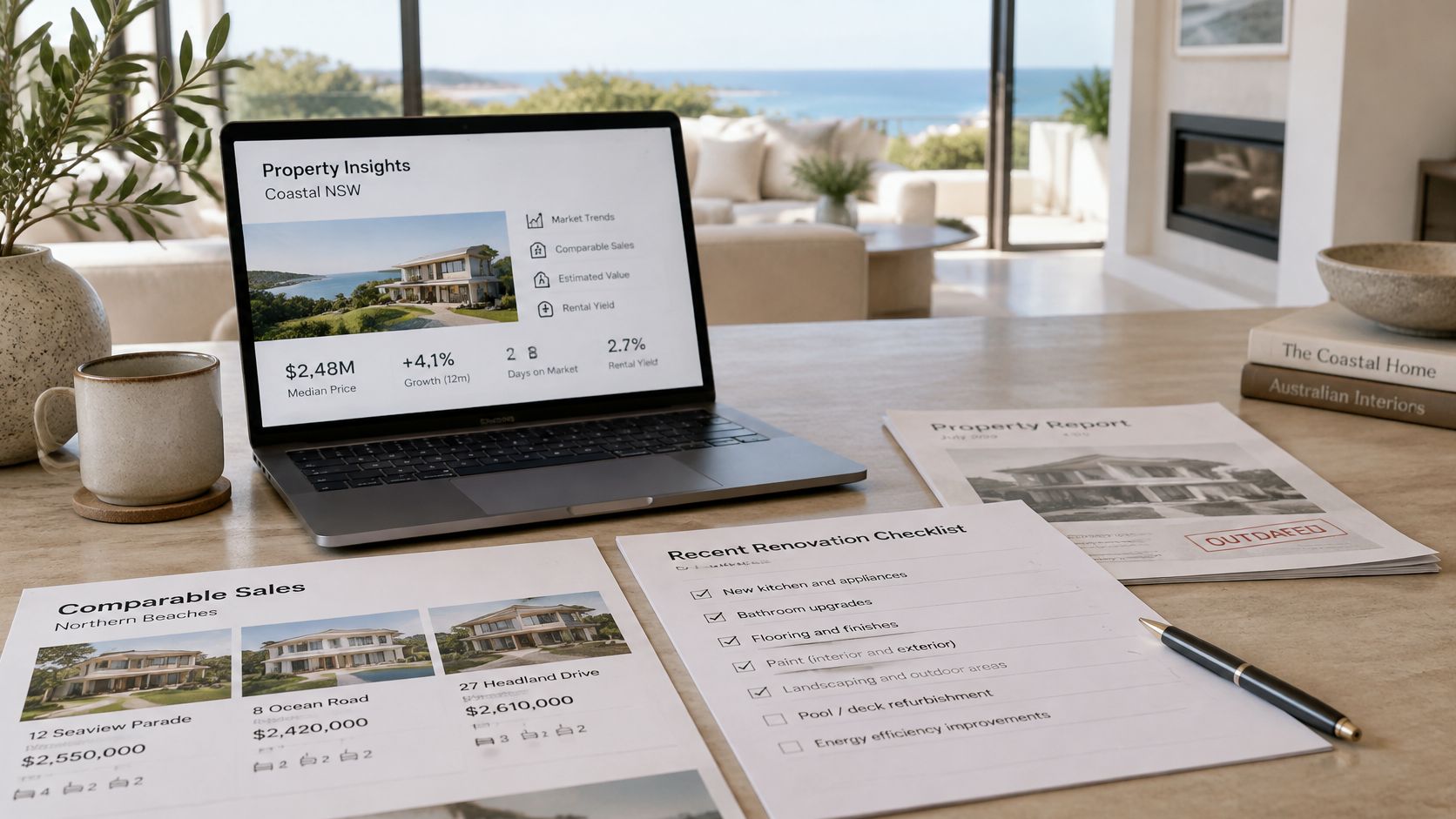
Look for unexplained adjustments
Stale transactions need an explanation of their relevance to present conditions. Renovated and unrenovated homes need a condition comparison, while different land sizes and coastal positions shouldn't disappear into a simple average.
The Australian Property Institute's professional-conduct rules require valuers to take reasonable steps to verify information, compile sufficient relevant facts and disclose evidence limitations. Those rules concern professional valuation work, but evidence traceability is also a sensible standard to request in an agent's appraisal.
Look for a clear distinction between observed facts and owner-supplied information. An inaccessible room, uncertain improvement approval or unverified property attribute should remain visible as a limitation.
Audit question: What would need to be different for this conclusion to change?
An agent who can answer that question is giving you something more useful than a confident-looking number.
Investigate coastal and insurance exposure
A waterfront setting in Dudley Park or Wannanup deserves more than a lifestyle description. Ask whether relevant hazard information, drainage, property features and insurance terms have been investigated.
The Climate Council's property-risk analysis provides national context for considering climate-related property exposure. It isn't a property-specific valuation or a reason to apply an automatic discount to a Mandurah home.
Use the following video as a discussion prompt alongside the written appraisal, not as a substitute for checking the property.
Request official hazard mapping where relevant and review insurance renewal terms or obtain property-specific quotes. Ask your settlement or legal adviser what requires disclosure rather than relying on a blanket statement about every coastal property.
Nearby homes may warrant different assessments because of elevation, construction, drainage and buyer perception. A good report distinguishes a desirable outlook from a physical exposure, then explains what evidence supports any pricing adjustment.
If the relevant evidence is incomplete, the answer should be a stated limitation or further investigation. False precision doesn't resolve uncertainty.
Turning Your Appraisal into a Confident Pricing Decision
The final output should be a documented decision, not merely a range saved in your inbox. You need to know what you're going to do, why that approach fits your circumstances and what would make you reconsider it.
Read the appraisal with your selling constraints beside you. A flexible owner considering a move from Halls Head has different priorities from an investor preparing a tenanted property in Meadow Springs.
Choose a launch approach you can explain
A lower launch position may suit a seller prioritising a timely transaction, but it shouldn't mean ignoring evidence of value. A competitive campaign needs a clear account of how buyers will compare the property with available alternatives.
A short hold may be sensible where a defined maintenance or presentation task remains unfinished. It's less useful when the delay has no clear purpose beyond hoping for a better number.
Put the decision into a short written record:
- Recommended position: Record the proposed selling approach and how it relates to the appraised range.
- Outstanding work: Identify what must happen before photography, inspections or launch.
- Buyer response: Decide which objections and enquiry patterns deserve attention.
- Review conditions: Agree what new evidence would justify revisiting the recommendation.
This gives both owner and agent a shared reference point when campaign feedback becomes emotional or inconsistent.
Revisit the evidence rather than defending the original figure
New completed transactions can change the comparison set. A competing listing can also alter a buyer's options without proving that your home's underlying attributes have changed.
Ask the agent to distinguish those developments. Don't change the price because someone offers an unsupported opinion, but don't defend the original estimate after its assumptions become difficult to support.
For buyers and investors, the same discipline helps assess a proposed purchase. Test the property against the evidence and its unresolved issues rather than treating the asking price as confirmation of value.
The best home appraisal gives you a decision you can defend without pretending the outcome is guaranteed. Bring your evidence file to the discussion, challenge unclear reasoning and leave with an agreed plan for acting on what you've learned.
David Beshay Real Estate offers a complimentary, no-obligation home appraisal to help Mandurah and coastal-suburb owners assess their likely selling range and campaign options. Visit David Beshay Real Estate to arrange an assessment, bring your improvement records and ask for the comparable addresses, adjustments and reasoning behind the recommendation.

