


When you're selling your house, budgeting for the solicitor's fees is a crucial step, but it's one that often catches people by surprise. In Australia, you can generally expect the cost of a solicitor to sell a house to be anywhere from $700 to $3,500. This fee covers all the essential legal work needed to make sure the ownership of your property transfers over smoothly and, most importantly, securely.
Understanding the True Cost of Selling Your House
The figure your solicitor quotes isn't just a single charge for their time. Think of it as a package deal that includes their professional expertise plus all the necessary third-party costs that pop up during the transaction. This total cost can shift depending on a few key factors, so it's vital to get a clear picture right from the start.
The final bill is a direct reflection of the work involved. A straightforward sale of a standard suburban home is naturally going to cost less than a complex one, like selling a property held in a trust or one with lingering council issues. This is exactly why you should always ask for a detailed, itemised quote.
What Makes Up the Final Bill?
The legal side of selling a house has several non-negotiable stages, and each one contributes to the final cost. These steps are there to protect you from potential legal headaches down the road.
Typically, your solicitor's fee will cover key services like:
- Preparing the Contract of Sale: This is the cornerstone of the whole deal. It's the foundational legal document for the entire transaction, and we've got a detailed guide on exactly what goes into a contract of sale.
- Conducting Property Searches: Your solicitor will perform all the necessary checks on the property title and other records to ensure everything is above board before the sale goes through.
- Liaising with the Buyer's Solicitor: This is all about the back-and-forth. They'll handle negotiations, answer questions, and make sure all the buyer's legal requirements are met.
- Managing the Settlement Process: This is the grand finale, where ownership is officially transferred and the funds are exchanged.
This visual breaks down the typical cost range you might see, from the simplest transactions to the more complicated ones.
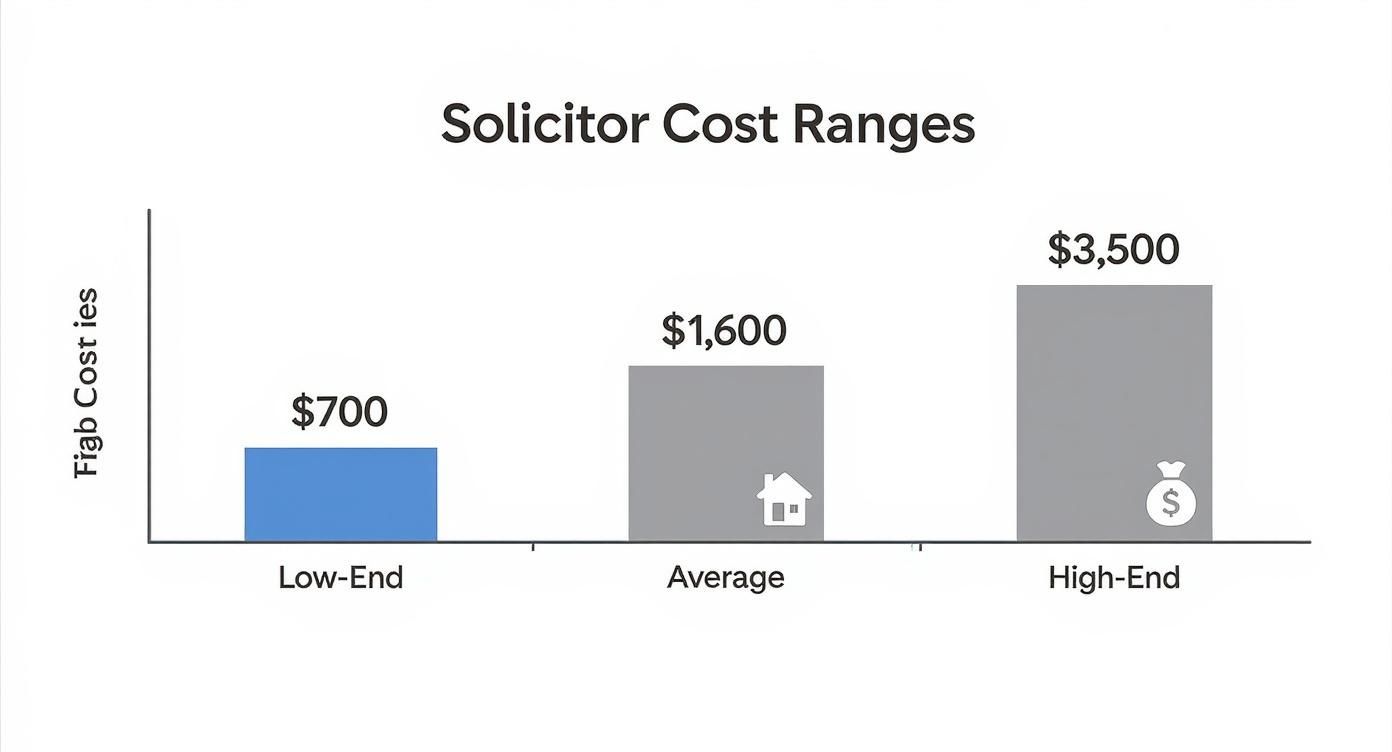
As the infographic shows, while you can find services at the lower end of the scale, the average cost usually sits somewhere in the middle. Those higher-end fees are typically reserved for sales that are particularly valuable or legally complex.
Average Solicitor vs Conveyancer Fees By Australian State
It's also helpful to see how fees can vary not just between solicitors and conveyancers, but also from state to state. Here’s a quick comparison of the typical ranges you might encounter for a standard residential property sale across Australia.
| State | Average Solicitor Fee Range | Average Conveyancer Fee Range |
|---|---|---|
| New South Wales (NSW) | $1,500 – $3,500 | $1,200 – $2,500 |
| Victoria (VIC) | $1,400 – $3,000 | $900 – $2,200 |
| Queensland (QLD) | $1,200 – $2,500 | $800 – $1,800 |
| Western Australia (WA) | $1,000 – $2,800 | $700 – $2,000 |
| South Australia (SA) | $900 – $2,200 | $700 – $1,600 |
Keep in mind these are just averages. In major cities like Sydney and Melbourne, where property values are higher and sales can be more intricate, it's not uncommon for fees to climb, sometimes reaching $5,000 for high-value or complex properties. Getting a few local quotes is always the best way to budget accurately.
Fixed Fee vs Hourly Rate: Breaking Down the Pricing Models
When you start your search for a solicitor to help sell your house, you’ll quickly find they generally work in one of two ways: a fixed fee or an hourly rate. Figuring out the difference is crucial if you want to keep your legal costs in check and avoid any nasty surprises down the track.
Think of it like choosing a mechanic. A fixed fee is like getting a quote for a standard service—you know the exact cost before they even touch your car. An hourly rate is more like tracking down a tricky electrical fault; the final bill depends entirely on how long it takes the mechanic to find and fix the problem.
Thankfully, most solicitors across Australia have moved towards offering a fixed fee for standard conveyancing, which is great news for sellers. It means the price you see is the price you pay for their professional services, even if a few minor hiccups pop up along the way.
The Certainty of a Fixed Fee
A fixed fee arrangement is designed to cover all the typical legal work involved in selling a property, from drafting the contract right through to the final settlement. This model has become incredibly popular with sellers for one simple reason: predictability. You know exactly what you're up for from day one, making it so much easier to budget for the entire sale.
But here’s the thing—you absolutely have to read the fine print. A fixed fee is usually for a "standard" sale. If things get messy and your sale becomes unexpectedly complicated—say, a boundary dispute suddenly rears its head or the buyer’s finances keep falling through—your solicitor will likely need to charge for that extra work. Before you sign anything, always ask them to clearly spell out what’s included and what sort of issues might trigger additional costs.
A fixed fee gives you peace of mind and cost certainty for a standard property sale. The price is locked in, helping you budget effectively for the entire selling process without worrying about mounting legal bills for routine tasks.
Getting Your Head Around the Hourly Rate Model
While it's less common these days for a straightforward house sale, some solicitors still charge by the hour. You'll usually see this model used for more complex or unpredictable situations, like sales involving a deceased estate, a messy family law settlement, or significant commercial property elements.
With an hourly rate, you’re billed for the actual time your legal team spends on your file. We’re talking every phone call, every email drafted, every document prepared, and every meeting attended. It all adds up.
The main upside here is that you only pay for the work that’s actually done. If your sale is surprisingly smooth and quick, you could end up paying less than you would with a fixed fee. The big downside, though, is the total lack of certainty. A couple of unexpected dramas can cause the hours—and your final invoice—to skyrocket, blowing your budget completely out of the water.
For most sellers, the choice boils down to a classic risk-versus-reward scenario:
- Fixed Fee: The best bet for straightforward sales. You get to lock in your costs and sidestep any nasty financial surprises.
- Hourly Rate: Better suited for complicated, unpredictable sales where the scope of work is a total unknown. Just be aware that it carries a much higher financial risk.
Before you make a final decision, make sure you get a crystal-clear cost agreement. It should lay out the pricing model, exactly what’s included, and any potential extra charges. This simple step ensures the solicitor fees for selling your house align perfectly with your expectations.
What Actually Influences Your Solicitor Fees
So, you’ve got a quote, but what really goes into that final number? Think of a standard house sale like a direct flight—it's predictable and the costs are straightforward. But if your property's journey involves a few detours or some extra baggage, the price will naturally go up to cover the additional work.
The single biggest factor is almost always the complexity of the sale. A standard, freehold house on a regular suburban block is pretty simple from a legal perspective. On the other hand, a property with unique characteristics needs a more specialised legal touch, and that’s going to be reflected in your bill.
For example, selling a strata-titled apartment or townhouse immediately adds more layers to the process. Your solicitor has to get their hands dirty digging through strata reports, by-laws, and meeting minutes, which all adds up to more time and required expertise.
Common Factors That Increase Costs
A few common situations can quickly turn a standard conveyance into a more complex legal puzzle. Knowing what these are ahead of time helps you understand why your quote might be on the higher side or why extra charges might pop up along the way.
Here’s a quick rundown of what we often see pushing up costs:
- Deceased Estates: Selling a property that's part of an estate isn't as simple as a normal sale. It involves extra legal steps like verifying the will and securing probate, which means more legal oversight is needed.
- Unapproved Structures: That shed or patio you put in without council approval? Your solicitor now has to manage the legal risks and disclosures that come with it, which is a much more involved process.
- Existing Tenancies: If you're selling a property with tenants, the sale needs to be handled carefully. This means dealing with lease agreements and making sure everything complies with tenancy laws, adding another layer of work.
The core principle is simple: the more non-standard elements your property sale involves, the more time and legal expertise are required. Each complication, from a boundary issue to a trust ownership structure, adds to the solicitor’s workload and, consequently, the final fee.
To make it even clearer, here's a checklist of common things that can bump up your conveyancing fees. If any of these apply to your property, it's a good idea to budget for slightly higher legal costs.
What Increases Conveyancing Costs: A Checklist
| Factor | Potential Cost Impact | Why It Costs More |
|---|---|---|
| Strata Title | Moderate | Requires reviewing strata reports, by-laws, and financials. |
| Unapproved Structures | Moderate to High | Involves navigating council regulations and potential legal risks. |
| Selling with a Tenant | Low to Moderate | Extra work to manage lease agreements and tenancy laws. |
| Deceased Estate | Moderate to High | Needs additional legal processes like probate verification. |
| Company or Trust Ownership | Moderate | More complex documentation and verification steps are required. |
| Boundary Disputes | High | Can involve significant negotiation and potential surveyor involvement. |
| Mortgage Discharge | Low | Standard add-on, but still extra administrative work for the solicitor. |
Essentially, the more boxes you tick on this list, the more specialised attention your sale will need from your legal team.
Location and Property Value
Your postcode definitely plays a part in what you’ll pay for legal fees. There are noticeable differences in conveyancing costs across Australia, mostly driven by local market conditions and state-specific regulations.
In New South Wales, for example, conveyancers typically charge between $1,300 and $2,200, while solicitors’ fees are a bit higher, ranging from $1,600 to $2,800 for a straightforward sale. Over in Victoria, you’ll see a similar spread, with conveyancers charging $1,100 to $2,100 and solicitors $1,500 to $2,700. You can explore more about these regional conveyancing cost differences to get a better idea of what to expect in your area.
Finally, the value of your property can also nudge the fee upwards. Some solicitors work on a sliding scale where higher-value properties attract a larger fee. The logic here is that the level of risk and professional indemnity insurance needed is greater when dealing with bigger sums of money, which justifies the higher cost for the increased liability the solicitor is taking on.
Uncovering Disbursements and Other Hidden Costs
The professional fee your solicitor quotes is a big part of the total cost, but it's rarely the final number you'll see on the invoice. On top of their service charge, you’ll also have disbursements. These are simply essential third-party costs that your solicitor pays on your behalf to keep the sale moving forward.
Think of your solicitor as the project manager for your house sale. While their fee covers their expertise and time, disbursements are the materials they need to buy to get the job done—things like government certificates and property searches. These costs are then passed directly on to you.
Getting your head around these extra expenses is crucial for accurately budgeting for the total cost of a solicitor to sell your house. If you don't factor them in, you could be in for a nasty surprise when the final bill arrives.
What Are Common Disbursements
The exact disbursements can vary a bit depending on your property's specifics and the state you're in, but there are several common ones you can pretty much guarantee will be on your final statement. These are non-negotiable costs needed to make sure the ownership transfer is legal and smooth.
Some of the most frequent disbursements you'll come across include:
- Title Search Fee: This is to confirm you are the legal owner of the property and to uncover any existing mortgages or caveats that need to be dealt with.
- Property Certificates: These are required from local councils and water authorities. They give the buyer up-to-date information on rates, zoning, and any outstanding orders.
- Land Registry Fees: This is a government charge for officially registering the change of ownership once the sale is all done and dusted.
- Bank Cheque Fees: Just as it sounds, these are the charges for drawing the bank cheques required at settlement.
These out-of-pocket expenses for searches, government charges, and bank fees typically add an extra $300 to $500 to your final bill.
Looking Out for Other Potential Fees
Beyond the standard disbursements, other "hidden" costs can pop up, especially if your sale isn't a straightforward one. For example, if you're paying off your mortgage early, your bank might hit you with an administrative fee, which gets tacked onto your costs.
The key to avoiding surprises is to ask for a fully itemised quote. Specifically ask your solicitor what is—and is not—included in their fixed fee and request an estimate for all anticipated disbursements.
Also, if unexpected complications come up—say, a dispute with the buyer or the need to amend the contract multiple times—your solicitor might need to charge for the extra work involved. This is exactly why having a crystal-clear cost agreement from the very beginning is so important. For more on the role legal professionals play, our guide on why hiring a settlement agent is crucial offers some really valuable context.
Where Solicitor Fees Fit in Your Total Selling Budget
It's easy to fixate on the legal bill when you're getting ready to sell, but where do solicitor fees actually land in the grand scheme of things? Getting a bit of perspective is key for smart budgeting and helps you see where your money is really going.
When you step back and look at the whole picture, legal fees are a necessary but surprisingly small slice of the pie. The real heavyweights in your budget are almost always the real estate agent's commission and the money you spend getting your home ready for sale.

This context is crucial. While you should absolutely get a fair and clear quote from your solicitor, trying to shave off a few hundred dollars on legal expertise can be a classic false economy. A good solicitor is your shield against expensive mistakes and ensures a smooth settlement, which is priceless when tens of thousands of dollars are on the line elsewhere.
Comparing the Major Selling Costs
To really get a feel for where your money goes, let's break down the usual costs. Picture this: you're selling a property for $1,000,000. The numbers quickly put the solicitor's fee into perspective.
- Real Estate Agent Commission: This is, by far, your biggest expense. At a conservative 2% commission, you'd be paying your agent $20,000.
- Marketing & Advertising: To get your property seen, professional photos, online listings, and signage can easily set you back $2,000 – $4,000.
- Property Styling/Staging: Making your home pop for potential buyers through professional staging can range from $3,000 – $6,000.
- Solicitor/Conveyancing Fees: For a straightforward sale, this might be around $2,000.
In this scenario, your solicitor’s fee is just a fraction of what the agent earns. All up, your selling costs could climb towards $30,000 or more, making the legal component a relatively minor part of your overall budget. All these costs and credits are itemised in your final paperwork, which you can learn more about by understanding what is a settlement statement.
Real estate agent commissions remain the single largest cost when selling a house in Australia, dramatically overshadowing legal and conveyancing fees. In 2025, agent commissions typically range from 1.0% to 3.5% of the final sale price, depending on location and agency.
For instance, in Sydney’s inner suburbs, commissions often hover closer to 2%, while you might see rates as high as 3.5% in some regional markets. You can discover more insights about the full cost breakdown for selling a house in Australia on titlespace.com.au.
A Smarter Approach to Budgeting
Seeing this hierarchy of costs helps you budget more effectively. Instead of obsessing over finding the absolute rock-bottom cheapest legal service, your focus should shift to securing value and expertise.
A reliable solicitor prevents delays and legal headaches that could jeopardise not just the sale itself, but also that $20,000 commission payment. It's much wiser to prioritise a professional who communicates clearly and has fantastic reviews over someone who simply offers the lowest price.
How to Choose the Right Solicitor Without Overpaying
Picking a legal expert to handle your house sale feels like a balancing act. You want top-notch expertise, but you don't want the cost of a solicitor to sell your house to spiral out of control. It's tempting to jump at the cheapest quote, but that can be a trap. A suspiciously low fee might signal inexperience or, worse, hide a bunch of extra costs that pop up later. Your goal is simple: find a reliable professional who is upfront about their pricing and delivers fantastic service.
A great first step is to get at least three detailed, itemised quotes. This isn't just about comparing the final price tag; it's about seeing what you're actually paying for. Look closely at each line item. What's included in their professional fee, and what's listed separately as a disbursement? A vague quote should set off alarm bells—it often means you'll be hit with unexpected charges down the track.
Evaluate Expertise and Reputation
Once you have a few quotes in hand, it's time to do a little digging. You need to find a solicitor or conveyancer who really knows your type of property. Selling a sprawling rural acreage involves completely different legal checks than offloading a modern apartment in the city, so finding someone with experience in your specific market is a huge advantage.
Next, head online and check out recent reviews on platforms like Google or Trustpilot. Don't just skim the star ratings; read what past clients are actually saying. Look for common themes, paying special attention to comments about:
- Communication: Was the solicitor easy to get in touch with? Did they keep clients in the loop with regular updates?
- Clarity: Did they take the time to explain complex legal jargon in plain English?
- Efficiency: Did the sale go through smoothly? Were deadlines met without any drama?
Finding the right solicitor is about ensuring you get real value, not just chasing the lowest price. Paying a little more for a professional with stellar reviews and clear communication can save you thousands by heading off costly delays or mistakes during the sale.
Ask the Right Questions Before Committing
Before you sign on the dotted line, have a list of questions ready to go. You should always insist on a detailed, written quote upfront, as murky pricing is the number one cause of surprise expenses. It’s also crucial to ask what happens if the sale falls through. Some firms will only charge you for the work they’ve already done, while others might slap you with a flat "cancellation" fee regardless of how far along things were. You can learn more about why transparent pricing is key on Newcastle Conveyancing Services.
By carefully comparing itemised quotes, checking for relevant experience, and asking direct questions about their process, you can confidently choose a solicitor who will protect your interests without breaking the bank.
Frequently Asked Questions About Solicitor Costs

It’s completely normal to have a few questions when you’re navigating the legal side of a property sale. Let’s clear up some of the most common queries about the cost of a solicitor to sell a house and what’s involved.
What Is the Real Difference Between a Solicitor and a Conveyancer?
Think of it like this: a conveyancer is a specialist, licensed to handle one thing exceptionally well—the legal transfer of property from one person to another.
A solicitor, on the other hand, is a fully qualified lawyer. They can do everything a conveyancer can, but they also have the expertise to handle broader legal issues. If your sale gets complicated with things like a family trust, a disagreement over a boundary line, or other legal disputes, a solicitor is your safety net.
For a straightforward sale, a conveyancer is often the more budget-friendly choice.
What Happens to the Fees if My House Sale Falls Through?
This is a critical question to ask upfront because it all comes down to the agreement you have with your chosen firm. Many now offer a ‘no sale, no fee’ arrangement for their professional time, which means if the deal collapses, you won’t be on the hook for their service fee.
Crucial Clarification: Even with a 'no sale, no fee' policy, you will almost always have to cover the disbursements. These are the out-of-pocket costs, like property searches, that the firm has already paid to third parties on your behalf. Always get this policy in writing.
Can I Do My Own Conveyancing to Save Money?
In some Australian states, it is legally possible to handle your own conveyancing, but it's a path that’s strongly advised against. The process is a minefield of complex legal documents, strict deadlines, and procedural traps where a single misstep can lead to disastrous financial consequences.
Trying to save a couple of thousand dollars on professional fees could expose you to risks that cost you far, far more in the long run. For the vast majority of sellers, the potential for error makes DIY conveyancing a gamble that just isn't worth taking.
Ready to understand your property's true market potential? At David Beshay Real Estate, we provide free, no-obligation property appraisals to help you make informed decisions. Get Your Free Property Appraisal Today.

