


The real secret to negotiating a house price isn’t some last-minute trick or clever line. It's all in the homework you do weeks before you even dream of making an offer. Your success is built on a solid foundation of research, financial readiness, and a deep understanding of the market. This is what gives you the confidence—and the leverage—to make a smart, justifiable offer that a seller simply has to take seriously.
Building Your Negotiation Foundation

Long before you put a number on paper, your main goal is to become a genuine expert on the specific neighbourhood you want to buy in. This knowledge is easily the most powerful tool in your negotiation toolkit. A buyer who has done their homework negotiates from a position of strength, not just hope.
Become a Local Market Analyst
Your first job is to get intimately familiar with comparable sales, or "comps." This means digging into properties that are similar in size, condition, and location that have actually sold within the last three to six months. This data shows you what buyers are really paying, which is often a world away from what sellers are asking for.
This research helps you lock in a realistic price range for the property you have your eye on. It shifts your offer from being a wild guess to an evidence-based proposal. For instance, if you see three similar homes in the same pocket of a suburb have sold between $750,000 and $765,000, an offer of $755,000 is grounded in market reality.
Of course, the overall market dynamics play a huge role here. In a hot, fast-moving market, your leverage as a buyer is naturally lower. Take Australia's national average house price, which has soared past the $1 million mark. Some capital cities are experiencing extraordinary growth that puts sellers firmly in the driver's seat.
Perth, for example, has seen annual growth rates over 10%. With Brisbane's prices rising 1.9% in a single month, you can bet sellers in these hotspots are less likely to entertain low offers. You can get a better feel for how these conditions affect your bargaining power by exploring detailed housing market research.
Uncover the Seller’s Motivation
This is your secret weapon. Finding out why the seller is moving can change everything. Are they relocating for a new job with a non-negotiable start date? Have they already bought another home and are feeling the financial pressure? Or are they just testing the waters with no real need to sell?
A seller on a tight deadline is almost always more flexible on price than one who can afford to wait for the perfect offer. Your agent can often gather this kind of intel just by building a good rapport with the listing agent. When you know the seller's 'why', you can frame an offer that solves their problem, which sometimes means more to them than just the highest price.
Pro Tip: A highly motivated seller might value a quick, unconditional settlement far more than an extra few thousand dollars. A clean offer with fewer conditions can often beat a higher offer that’s loaded with potential hurdles and delays.
Get Your Finances in Order
Walking into a negotiation without finance pre-approval is like showing up to a gunfight with a knife. It’s a rookie mistake. Getting pre-approved by a lender does two critical things for you:
- It proves you’re a serious buyer. Agents and sellers will immediately prioritise your offer over those from buyers who haven't sorted their financing.
- It sets your absolute price ceiling. Knowing your hard limit stops you from getting swept up in the emotion of the moment and making a decision you'll regret.
Having your finances sorted sends a powerful signal that you’re ready to act now. This credibility is priceless and gives you a massive edge, especially when you’re up against other buyers. It effectively removes the 'subject to finance' clause, which is one of the biggest risks for any seller.
To get a clearer picture of where you stand, it helps to see what strengthens or weakens your position.
Your Negotiation Power Checklist
This table breaks down the key factors that give you an edge—or put you on the back foot—when it comes time to negotiate.
| Factor | Strengthens Your Position | Weakens Your Position |
|---|---|---|
| Financing | You have full, unconditional pre-approval. | You need to sell your current home first ('subject to sale'). |
| Offer Conditions | Your offer is unconditional or has minimal conditions. | Your offer has many conditions (e.g., building, pest, finance). |
| Timeline | You can offer a flexible settlement date that suits the seller. | You have a rigid settlement timeline that doesn't align with the seller. |
| Market Knowledge | You can cite recent, relevant comparable sales to justify your offer. | Your offer is based on a 'gut feeling' or old data. |
| Seller's Motivation | The seller is on a tight deadline (e.g., job relocation, bought elsewhere). | The seller has no pressure to sell and can wait for the 'perfect' price. |
| Market Conditions | It's a buyer's market with lots of properties for sale. | It's a seller's market with low stock and high demand. |
Think of this as your pre-flight check. The more boxes you can tick in the "Strengthens Your Position" column, the more confident you can be when you step up to the negotiating table.
Making a Confident Opening Offer
Your first offer is more than just a number; it sets the entire tone for the negotiation. Think of it as the opening move in a strategic conversation. Get it right, and you're on the path to a great deal. Go too low, and you risk the seller refusing to engage. Go too high, and you've already shown your best hand.
The trick is to put forward a bid that's not just competitive, but undeniably justifiable. You need to anchor your figure in solid, cold-hard facts, not just wishful thinking. The goal is to show the seller, via their agent, that your offer isn't just a random number plucked from the air, but a logical figure based on what the market is actually doing.
Justify Your Price with Evidence
Never, ever table an offer without the story to back it up. When you submit your offer, it should come with supporting documents that build a rock-solid case for your valuation. This immediately shows you're a serious, well-researched buyer who has done their homework.
What kind of evidence works best?
- Comparable Sales: A neat list of 3-4 similar properties in the immediate area that have settled in the last 90 days.
- Repair Estimates: If your building inspection flagged issues, don't just mention them—get professional quotes for the repairs. This turns a vague "problem" into a clear, quantifiable price adjustment.
- Market Context: A brief, simple summary explaining why your offer is fair given the current market conditions.
This evidence-based approach strips the emotion out of the discussion and shifts the negotiation onto factual ground. For example, if comparable properties are all selling around $750,000 and the home you want needs a $15,000 roof repair, an offer of $735,000 becomes a completely logical starting point, not just a lowball tactic.
The Power of a Clean Offer
Sometimes, the most powerful offer isn't the highest one—it's the simplest. A ‘clean’ offer, one with very few conditions, can be incredibly appealing to a seller who just wants a straightforward, certain sale.
Removing hurdles like a ‘subject to finance’ clause (because you already have pre-approval) or asking for a standard settlement period can make your bid jump to the top of the pile.
A clean offer signals you are organised, committed, and ready to proceed without delays. For a seller juggling their own move, this peace of mind can be worth thousands of dollars.
Of course, you have to play the market you're in. In hot markets, sellers hold most of the cards. Recent data shows Perth and Darwin experienced double-digit annual price growth, which means sellers there are far less likely to negotiate down. In markets like these, as Domain notes, you'll need to come in with a strong, clean offer close to the asking price just to get a seat at the table. You can read more about how rising prices impact Australian capital cities to get a feel for these dynamics.
The actual structure of your offer is also vital, and it changes slightly from state to state. If you're buying in WA, for instance, it's a good idea to learn more about the offer and acceptance process in Western Australia to make sure your offer is compliant and effective.
By combining a well-justified price with favourable, clean terms, you craft an opening offer that commands respect and truly opens the door to a successful negotiation.
Mastering the Art of the Counter-Offer

First off, getting a counter-offer is great news. Seriously. It means the seller is serious about selling to you, and the real negotiation can finally begin. This isn't a rejection; it's an invitation to keep the conversation going. The key now is to respond with your head, not your heart.
The real skill in knowing how to negotiate a house price comes into play right here. It’s about carefully dissecting their move and planning your next one. So, take a breath and analyse what the seller has actually proposed. It’s always best to keep the chat calm and professional, letting your agent handle the back-and-forth to maintain a productive distance.
Deconstruct the Seller's Response
Before you fire back a response, you need to understand what their counter-offer is really telling you. Are they getting close to your initial offer, or are they barely budging from their original asking price? A small move in your direction shows they’re flexible, but a flat-out refusal to budge much suggests they’re pretty confident in their position.
This is your moment to decide what to do next. Are you going to hold your ground, give a little, or get a bit creative? You'd be surprised how often a stalemate is broken by something other than just throwing more money at it.
A classic mistake buyers make is getting laser-focused on the final price. Sometimes, the best negotiations happen when you find a non-monetary solution that’s a huge win for the seller but costs you next to nothing.
Creative Solutions Beyond Price
If you've hit a brick wall on the price, start thinking about other terms you could tweak to sweeten your offer. For a seller who’s keen to move, convenience can sometimes be worth more than a few extra thousand dollars.
Think about offering concessions like these:
- A flexible settlement period: Can you bring the closing date forward or push it back to line up with their moving plans? This can be a massive relief for a seller who has already bought their next place.
- An ‘as is’ purchase: If your building inspection only turned up minor issues, agreeing to buy the property ‘as is’ removes a major headache for the seller. It saves them the hassle of organising tradespeople for repairs.
- Covering a seller's cost: Offering to pay for a specific closing cost could be that small financial sweetener that gets the deal signed, sealed, and delivered.
When a Small Concession Wins the Day
Knowing when to give a little is just as crucial as knowing when to stand firm. If you and the seller are only a few thousand dollars apart on a property you absolutely love, digging your heels in over what is—in the grand scheme of things—a trivial amount can be a huge mistake.
Let’s say you’ve put in an offer for $750,000, and the seller comes back at $758,000. Instead of just walking away, a smart final counter of $755,000 shows you're willing to meet them in the middle. This small gesture signals goodwill and proves you're being reasonable, which is often all it takes to break a deadlock.
Remember, the aim isn't to 'win' the negotiation. It's to secure the right property for you at a fair market price. A minor, well-timed concession often achieves exactly that, turning a tense standoff into a successful purchase. Responding with a balanced mix of firmness and flexibility is the mark of a truly savvy negotiator.
Adapting Your Strategy for Auctions vs. Private Sales
The way a property is sold in Australia—either through a private sale or at auction—completely changes the rules of engagement. Your whole game plan needs to shift depending on the method. The tactics that can secure you a great deal in a private negotiation might fall completely flat in a heated auction room, and vice versa.
A private sale, sometimes called a private treaty, is much more of a strategic dance. It's a paced, deliberate exchange of offers and counter-offers between you and the seller, all managed through the real estate agent. This environment gives you more room to get creative. You're not just negotiating on the final dollar figure; you can also negotiate on the conditions.
For example, you might put in a slightly lower offer but sweeten the deal by agreeing to a settlement date that perfectly suits the seller's moving plans. Small things like that can make your offer far more appealing than a higher one with inconvenient terms.
Auctions, on the other hand, are a different beast altogether. They are fast, public, and high-pressure events where competition drives the outcome. Your negotiation power here is concentrated into a few critical moments.
Navigating the Auction Arena
If you’re heading to an auction, success almost always comes down to the homework you do beforehand. The most important thing you can do is set an absolute, non-negotiable bidding limit before you even think about raising your hand. This isn't just a guide; it’s your hard stop. On the day, the adrenaline and fear of missing out (FOMO) can easily cloud your judgement, leading to emotional bids and major overspending.
Your preparation should also include seriously considering a pre-auction offer. If a seller seems a bit nervous about the uncertainty of auction day, a strong, clean offer beforehand can sometimes be tempting enough for them to take the property off the market. Be careful, though—this move can also reveal your hand and show the agent exactly how much you're willing to pay. It’s a strategic play that needs careful handling.
Private Sales and Nuanced Negotiation
Private sales give you a different kind of leverage. The slower pace allows for more thoughtful, back-and-forth negotiation, giving you the chance to use various factors to your advantage. This is where the real art of the deal comes into play.
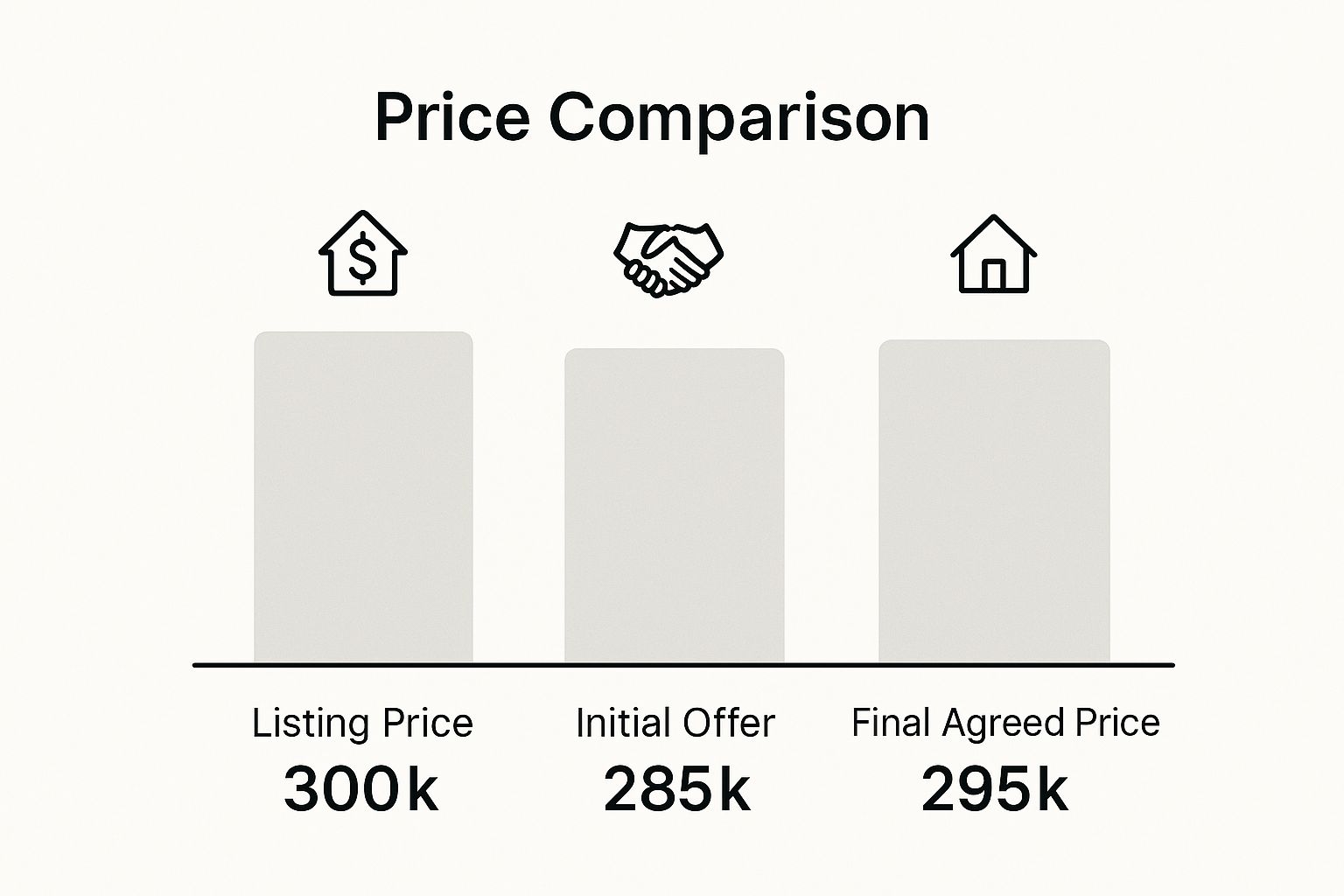
As you can see, the journey often involves a bit of give-and-take. An initial offer might come in below the listing price, and through a series of counter-offers, both parties meet somewhere in the middle.
These structural differences have a real impact on the final sale price. Research analysing the Australian market found that auction prices tend to reflect market information more quickly and are often better at forecasting trends. It makes sense, as the open competition between multiple buyers naturally pushes the price towards its true market value. In contrast, negotiated sales often adjust more slowly because they hinge on one seller's price expectations versus one buyer's offer. You can discover more about these pricing dynamics to sharpen your strategy.
To make it clearer, let's break down how your approach should differ between the two scenarios.
Auction vs Private Sale Negotiation Strategies
| Tactic | Private Sale (Negotiation) | Auction Day |
|---|---|---|
| Pacing | Slower, more strategic. Take your time to craft offers and consider counter-offers. | Fast-paced and immediate. Decisions must be made in the moment. |
| Conditions | Highly negotiable. Use settlement dates, deposit amounts, and inclusions as leverage. | Unconditional. All due diligence (inspections, finance) must be done beforehand. |
| Bidding | Submit confidential written offers. The seller doesn't know what other buyers are offering. | Public and transparent. You bid openly against other registered buyers. |
| Key Skill | Strategic negotiation and crafting an attractive, well-rounded offer. | Disciplined bidding, emotional control, and sticking to your pre-set limit. |
| Psychology | Focus on building rapport (via the agent) and finding a win-win with the seller. | Read the room, project confidence, and avoid getting swept up in the hype. |
Ultimately, adapting your strategy is non-negotiable. Knowing whether you're walking into a marathon or a sprint will put you in the best possible position to succeed.
Key Takeaway: For auctions, your power is all in the preparation and disciplined bidding. For private sales, your strength lies in crafting a clever offer that balances price with attractive conditions for the seller.
Understanding these fundamental differences empowers you to approach either situation with a clear head and a tailored plan, which massively improves your chances of securing the property you want at a price you’re happy with.
Securing the Deal and Avoiding Common Pitfalls

So, you’ve reached a verbal agreement on the price. That's a huge step, and it's definitely time for a small celebration! But hold on—the deal isn't legally yours until the ink is dry on the contract. This final stage is all about turning that handshake into a binding contract of sale, and frankly, it's where some of the most expensive mistakes can crop up.
Knowing how to negotiate house price is more than just haggling over the final number. It’s about getting every single one of those agreed-upon terms locked down in writing. Every detail—from the final price and the settlement date to specific inclusions like the fancy curtains or that new dishwasher—has to be documented. A verbal "yes" from the agent means absolutely nothing if it’s not in the contract.
The Power of the Written Word
At this point, your conveyancer or settlement agent becomes your most important ally. Their entire job is to pore over the contract of sale, making sure your interests are protected and there are no nasty surprises hidden in the fine print. They're the ones who translate the legalese and double-check that everything you negotiated has been recorded accurately.
Think of this document as your shield. If you forget to formalise a seemingly minor detail, like an agreement for the seller to fix a leaky tap before settlement, you could be facing frustration and unexpected repair bills later on. If it's not in the written contract, it effectively doesn't exist in the eyes of the law.
Watch Out for These Common Blunders
Even with a price agreed upon, a deal can still fall through. Getting through this home stretch means keeping a cool head and being aware of the common traps that can derail an almost-done deal.
Here are a few of the most frequent mistakes I've seen buyers make:
- Letting Emotions Take Over: It's easy to get swept up in the excitement of a 'yes' and drop your guard. Stay objective and laser-focused on the contractual details until everything is signed, sealed, and delivered.
- Forgetting Who the Agent Works For: The agent might be friendly and helpful, but their legal duty is to the seller. They want the deal to go through, of course, but their primary mission is getting the best possible outcome for their client—not for you.
- Revealing Your Budget Ceiling: Whatever you do, never tell the agent the absolute maximum you're willing to pay. This hands all your leverage back to them if any last-minute issues or negotiations pop up.
A verbal agreement feels like the finish line, but it’s really just the final lap. Remaining vigilant and detail-oriented is what truly secures the property and protects your investment.
Another non-negotiable step is the final walkthrough just before settlement. This is your last chance to confirm the property is in the same condition as when you agreed to buy it and that any agreed-upon repairs have actually been done. Our guide to a smooth transaction through a final inspection provides a detailed checklist for this crucial process.
By steering clear of these common blunders and working closely with your conveyancer, you can confidently move from a handshake deal to a legally binding contract. This careful, methodical approach is your best bet for avoiding eleventh-hour dramas and finally getting the keys to your new home.
Frequently Asked Questions
When you're in the thick of property negotiations, it's natural for specific questions to pop up. Even with a solid plan, some situations can leave you second-guessing the right move. Here are some quick, no-nonsense answers to the common queries I hear from buyers learning to negotiate house prices in Australia.
How Low Can My First Offer Be?
This is always a delicate balancing act. You might hear a rule of thumb about starting your offer 5-10% below the asking price, but honestly, that's not a rule I'd ever bet my money on. A much smarter approach is to ground your offer in solid market evidence, not just an arbitrary percentage.
Let's say your research shows comparable homes in the area have recently sold for $750,000, but the one you love is listed at $800,000. In this case, coming in with an initial offer of $740,000 is aggressive, but you can justify it with data. On the flip side, in a red-hot market, offering even 5% less could be seen as a lowball offer and might not even get you a reply. Always, always anchor your offer to the facts.
Should I Ask for Repairs or a Price Reduction?
This really comes down to convenience versus control. Getting the seller to handle repairs means you can, in theory, move into a home that's ready to go. The catch? You have zero say over the quality of the work. Sellers will almost always opt for the cheapest contractor, not the best one.
Expert Insight: I almost always advise my clients to opt for a credit or a price reduction. It’s the smarter financial move because it puts the cash directly in your pocket. This gives you total control to hire contractors you trust and oversee the repairs to your own standards.
For instance, if a building inspection uncovers a roof issue that needs $5,000 to fix, negotiating that amount off the price gives you the funds. You might then find a fantastic local roofer who can do a superior job for $4,500, saving you money and giving you peace of mind about the quality.
What if I’m in a Multi-Offer Situation?
Finding yourself in a bidding war is stressful, no doubt. The key is not to panic and blow your budget. This is where you need to make your offer shine for reasons beyond just the price tag.
Here’s how you can stand out from the competition:
- Present a "Clean" Offer: This means removing as many conditions as you can. An offer with finance already pre-approved and a flexible settlement date can look far more appealing to a seller than a slightly higher offer that's loaded with 'subject to' clauses.
- Write a Personal Letter: It doesn't always work, but sometimes, a heartfelt letter explaining why you've fallen in love with the home can genuinely resonate with a sentimental seller.
- Make Your Best Offer: In a competitive scenario, you might only get one chance. Put your best foot forward, but never go a dollar over the absolute limit you set for yourself during your research phase.
What Happens After My Offer Is Accepted?
Congratulations! Getting that verbal "yes" is a massive milestone. The very next step is to formalise the agreement in a written contract of sale and have your conveyancer look over it immediately. Don't even think about making big financial moves or giving notice on your rental until that contract is signed, sealed, and unconditionally exchanged. For a complete rundown, check out our first-home buyers guide on the steps after your offer is accepted for a clear roadmap.
Ready to make your next move in the Mandurah property market? Whether you're buying or selling, David Beshay Real Estate provides the expert guidance and local knowledge you need to achieve your property goals. Contact us for a free, no-obligation appraisal today at https://realestate-david-beshay.com.au.

