


You've found a four-bedroom house in Lakelands. The portal says the rent should be $650 a week, the purchase price is $560,000, and the headline yield appears to sit around 6%. It looks like the kind of Mandurah investment that ought to put money in your account.
Then the costs arrive. Loan repayments, management fees, insurance, maintenance, vacancy, council rates and water charges reduce the figure quickly. The property might contribute roughly $80 a week before tax, or turn negative if the finance assumption is too optimistic. That gap between headline yield and actual cash position is where many investment decisions fail.
Mandurah rewards investors who underwrite at suburb level. Lakelands, Madora Bay, Meadow Springs, Halls Head, Falcon, Wannanup and Dudley Park each attract different tenants, costs and levels of price pressure. Investment property cash flow isn't a national spreadsheet exercise. It's a local calculation that determines whether the asset remains comfortable to hold when conditions change.
Table of Contents
- Why Mandurah Investors Care About Cash Flow
- What Investment Property Cash Flow Actually Means
- The Four Drivers That Move Cash Flow in WA
- A Worked Lakelands Cash Flow Example
- Practical Levers to Improve Cash Flow Locally
- WA Tax and Financing Considerations
- Building a Cash Flow Improvement Checklist
- Choosing the Right Mandurah Property With Confidence
Why Mandurah Investors Care About Cash Flow
The portal figure isn't the bank balance
The Lakelands example is useful because it looks plausible. A $560,000 purchase rented at $650 per week produces gross annual rent of $33,800. Divide that by the purchase price and the gross yield is just above 6%, which appears attractive beside the broader Australian house average of 3.71% and the Western Australian house average of 4.1% reported in a 2026 WA investment market summary.
But gross yield only measures rent against the purchase price. It doesn't pay the mortgage, cover a vacant period or replace an ageing hot-water system. Once those costs are included, the amount reaching the investor's account can be modest.
That distinction matters in Mandurah because the market combines relatively accessible coastal housing with tenant demand from families, FIFO workers and sea-changers. A house in Lakelands may attract reliable family tenants, while Madora Bay and Wannanup appeal to renters prioritising newer homes and coastal living. Meadow Springs can offer practical access to established services, and Halls Head, Falcon and Dudley Park draw tenants who value lifestyle and proximity to the water.
The working rule: if the deal only works at full occupancy, the advertised rent and today's interest rate, it doesn't work.
Western Australia's cash-flow opportunities are real, but they're selective. The same national analysis found that only 38 Australian suburbs still delivered positive rental returns, with 69% located in regional Western Australia. High-yield examples included Port Hedland at 8.24%, Boulder at 8.60%, Bulgarra at 9.35% and Kununurra at 7.43%, according to the WA investment summary. Mandurah isn't automatically a high-yield market just because it sits in WA.
The investor's job is to identify the right price, rent and property type in the right suburb. That means testing the weekly bank position, not admiring a portal badge.
What Investment Property Cash Flow Actually Means
Investment property cash flow is the money left after the property has paid its own bills. The useful version is net pre-tax cash flow, calculated after vacancy, operating expenses and loan repayments.
Start with the rent you expect to collect. Then remove a vacancy allowance, property management, rates, insurance, maintenance, water charges and any other owner-paid costs. Finally, subtract the mortgage repayment. The result is the amount the property contributes or consumes before tax.
The formula in plain English
Net pre-tax cash flow = gross rent minus vacancy loss, operating expenses and mortgage repayments.
For a Lakelands house, the following illustration shows how to structure the calculation. The $650 weekly rent and $560,000 purchase price are the working assumptions from the local scenario, while the expense figures are an example for analysis rather than a market guarantee.
| Line Item | Weekly Amount ($) | Annual Amount ($) |
|---|---|---|
| Gross rent | 650 | 33,800 |
| Vacancy allowance | -32 | -1,664 |
| Operating expenses | -45 | -2,340 |
| Loan repayment | -535 | -27,820 |
| Net pre-tax cash flow | 38 | 1,976 |
This produces approximately $38 per week before tax. The point isn't that every Lakelands property will return that amount. The point is that the headline rent must pass through every cost line before you call the deal cash-flow positive.
Use the Mandurah property investment calculator to test your own purchase price, deposit, rent and expense assumptions.
Three figures investors must separate
Pre-tax cash flow is the money left after operating costs and debt service, before your personal tax position. After-tax cash flow adds the effect of deductions, taxable rental income and your individual marginal tax rate. The ATO's guidance makes clear that rental deductions depend on expenses incurred, so an investor can't treat a tax deduction as money received in the bank.
Break-even yield is the gross rental yield required for the property to cover vacancy, expenses and finance. A property may show a 5% gross yield and still lose money after debt service. Current investment loan rates around 6.2% to 6.5% mean guidance places the required gross yield for genuine positive cash flow at roughly 6.8% to 7.2% at 80% LVR, before a more conservative allowance for the full holding-cost picture, as outlined by this Australian rental yield calculator guide.
A Mandurah unit can illustrate the problem. Two properties may both advertise the same rent, but the unit with higher strata or body corporate costs, weaker tenant appeal and longer turnover periods can produce a negative bank balance. Identical gross yields don't create identical cash flow.
The Four Drivers That Move Cash Flow in WA
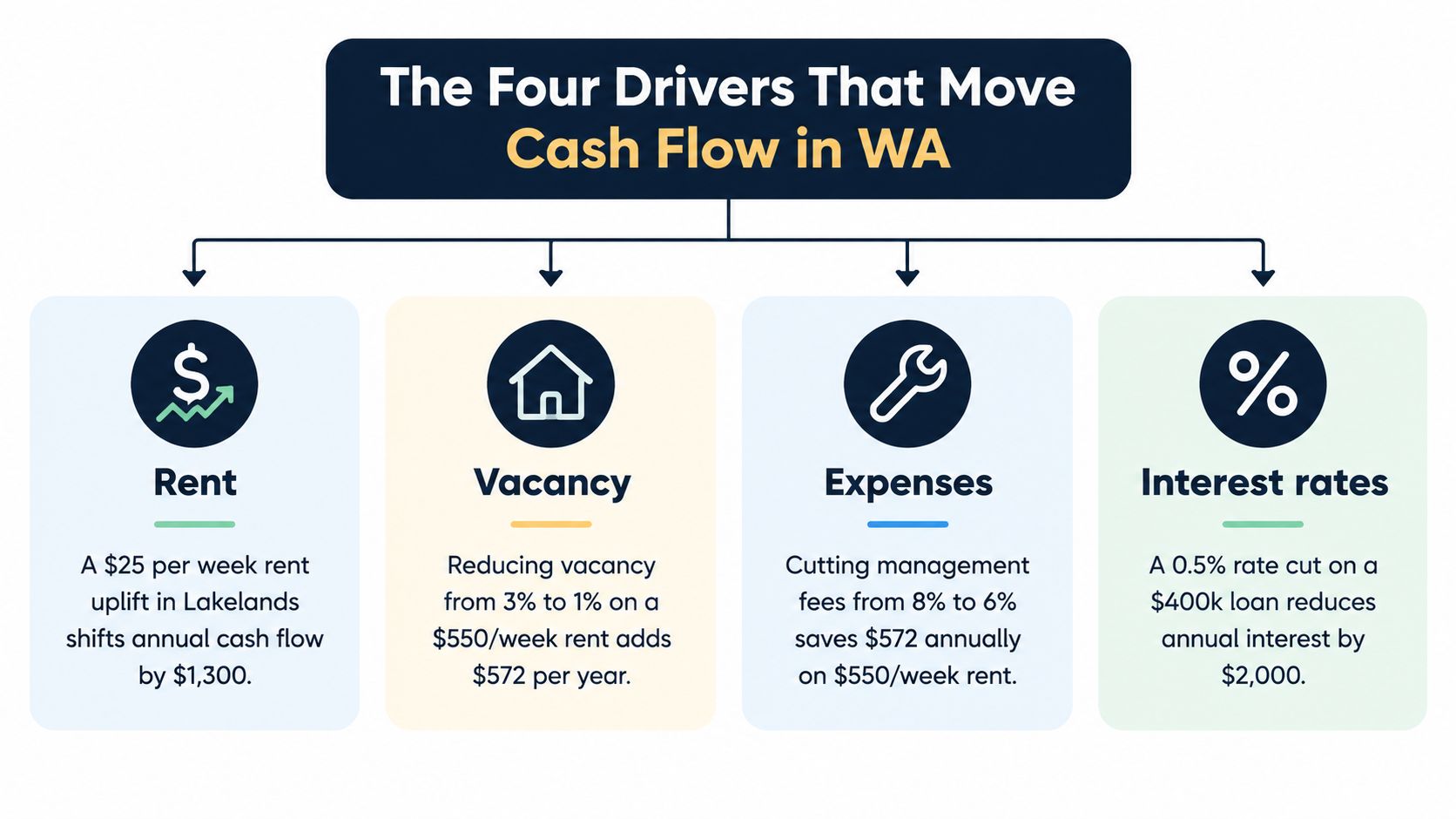
Cash flow moves through four levers: rent, financing, expenses and vacancy. An investor can improve one and still lose money if the other three are poorly estimated.
Rent
Rent is the most visible lever, but it must be evidence-based. A $25 weekly improvement in Lakelands changes annual gross income by $1,300, before tax and expenses. That can be the difference between a narrow deficit and a modest surplus.
Mandurah's published suburb data shows houses at a median rent of $520 per week and a gross yield of 4.92%, while units sit at $460 per week with a 5.32% yield, according to Mandurah rental and yield data. Those figures show why a lower-priced unit can produce stronger gross income relative to value, even when a family house collects more rent in absolute terms.
Financing
Loan structure usually has the largest recurring effect. A 0.25% rate change on a $450,000 loan can move annual repayments by about $1,125 under the working assumptions supplied for this analysis. A narrow Lakelands surplus can disappear without any change to the tenant or property.
Read the guide to understanding interest rates before choosing between variable, fixed and interest-only lending.
Expenses
Industry guidance places property management at 7% to 10% of rent, maintenance at approximately $1,500 to $5,000 annually, landlord insurance at $1,000 to $2,000, and council rates at $1,500 to $2,500, as set out in the rental yield calculator guidance. For a Mandurah investor, Emergency Services Levy, scheme water charges and owner-paid utilities can reduce the apparent yield.
Vacancy
Vacancy is income that never arrives. A $550 weekly rent produces a materially different result with two vacant weeks than with six, and the difference can approach $3,200 across a year under the supplied scenario.
Perth vacancy has been reported between 0.6% and 2.2%, below the balanced-market benchmark of 2.5% to 3.5%, while WA-wide median yields have been reported at 4.86% for houses and 6.28% for units in WA investment property market data. Tight conditions help landlords secure rent, but they don't remove property-specific vacancy risk.
A Worked Lakelands Cash Flow Example
A Lakelands three-bedroom, two-bathroom house bought for $560,000 and rented at $560 per week can look attractive at first glance. The gross annual rent is $29,120. Allow four vacant weeks, remove $2,240, and effective rental income falls to $26,880 before owner-paid costs. Check the rent against comparable Lakelands leases before making an offer.
Lakelands annual ledger
| Line Item | Lakelands House | Madora Bay House | Halls Head Unit |
|---|---|---|---|
| Purchase price | $560,000 | $600,000 | $430,000 |
| Weekly rent | $560 | $620 | $460 |
| Gross annual rent | $29,120 | $32,240 | $23,920 |
| Vacancy allowance | -$2,240 | -$2,480 | -$1,840 |
| Management and letting | -$2,038 | -$2,257 | -$1,674 |
| Maintenance allowance | -$2,000 | -$2,200 | -$1,500 |
| Insurance | -$1,400 | -$1,500 | -$1,000 |
| Council rates | -$1,800 | -$1,900 | -$1,600 |
| Water and other owner costs | -$500 | -$550 | -$400 |
| Net operating income | $20,002 | $21,353 | $17,906 |
| Interest-only finance | -$27,776 | -$29,760 | -$21,414 |
| Annual pre-tax cash flow | -$7,774 | -$8,407 | -$3,508 |
The Lakelands gross yield is approximately 5.2%. After the listed operating costs, the net yield is roughly 2.6% before finance. At an interest-only rate around 6.2%, the property runs at approximately -$149 per week before tax.
That gives you three separate tests:
- Pre-tax cash flow: -$7,774 annually, or approximately -$149 per week.
- After-tax cash flow: cannot be stated from this ledger alone. Your marginal tax rate, deductions and ownership structure determine it, so have your accountant calculate the result.
- Break-even yield: the gross rent required to cover the listed operating costs and interest. Using the same Lakelands purchase price and assumptions, the required gross annual income is $37,778, equal to approximately $727 per week, or a gross yield of roughly 6.7%.
The gross figure does not justify the purchase by itself. Assess the loan, vacancy and owner-paid costs together, then adjust the assumptions in this Lakelands investment property guide before verifying each line with your broker, property manager and accountant.
Suburb choice changes the risk
The Madora Bay house earns more rent but costs more to buy. Its extra income does not cover the larger debt and operating base, leaving a weaker cash result. That makes it a coastal property with a different tenant and resale profile, not a high-cash-flow asset.
The Halls Head unit produces less rent, yet its lower entry price reduces the interest burden. Its shortfall is smaller in this deliberately loaded example. Confirm strata levies, sinking-fund contributions, insurance arrangements and leasing restrictions before relying on that result.
Apply the same test to Falcon, Wannanup and Dudley Park. A lifestyle address is not automatically defensive, and a cheaper dwelling is not automatically efficient. Purchase price, rent, vacancy and owner-paid costs must be tested together.
Practical Levers to Improve Cash Flow Locally
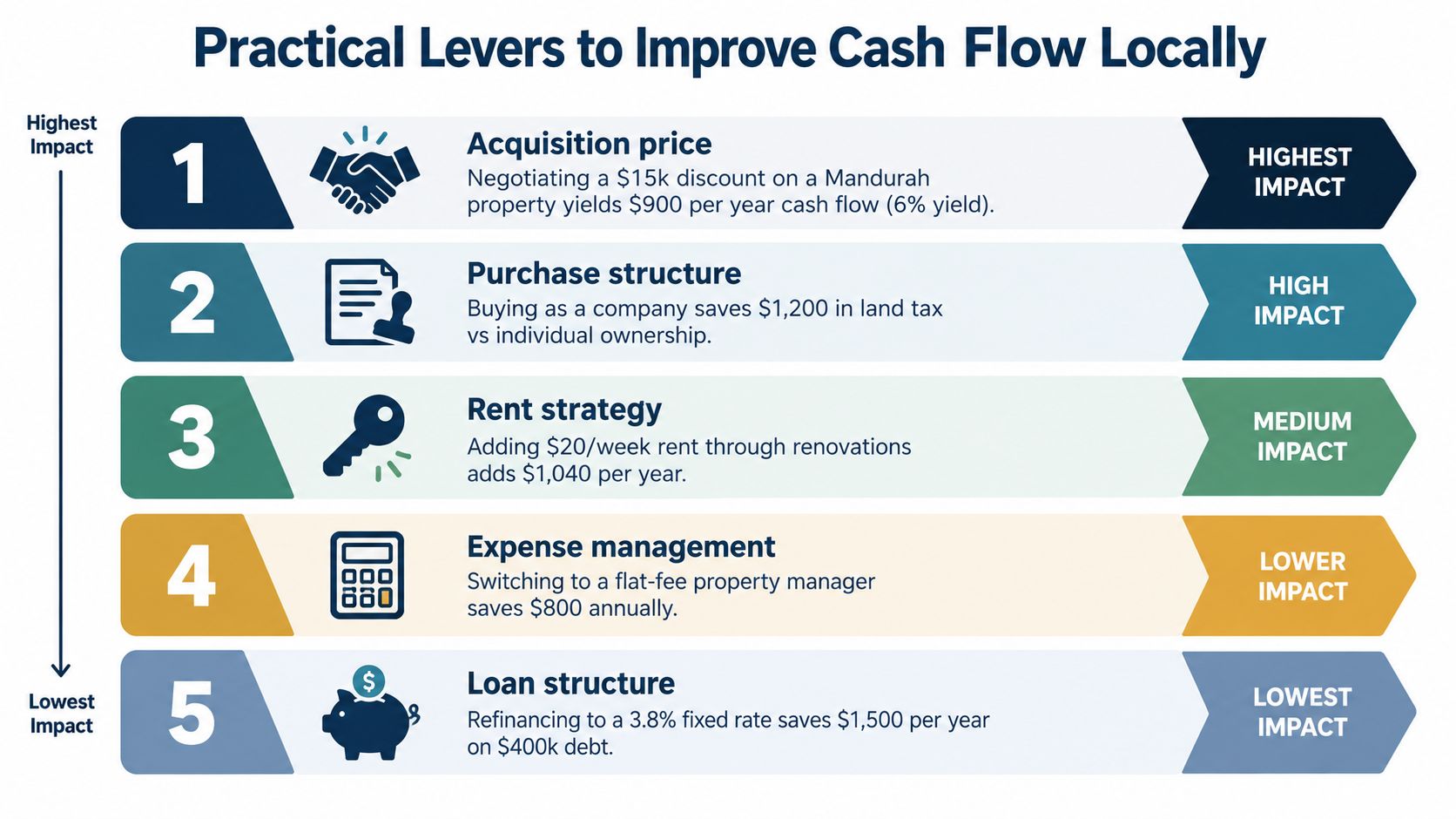
The strongest cash-flow lever is pulled before settlement. A better purchase price reduces debt immediately and improves the yield without relying on a future rent increase.
Rank the levers by control
Acquisition price comes first. Negotiating $20,000 better on a Lakelands purchase can move the annual cash position by roughly $1,200 under a 6% yield assumption. Comparable sales, building condition and days on market give your buyer's agent the evidence to negotiate. A discount isn't automatically a win if the property needs expensive work, so pair the offer with a building inspection and realistic repair allowance.
Purchase structure comes next. Deposit size, loan type and ownership structure affect repayments, tax and liquidity. Get the broker and accountant involved before signing, not after the property has settled.
Rent strategy follows. A $20 to $30 weekly improvement can materially change the annual result, but only if the property supports it. In Lakelands and Meadow Springs, presentation, air conditioning, secure outdoor areas and practical family layouts can influence tenant appeal more than cosmetic upgrades.
Expense management is measurable. Compare management proposals carefully. A lower percentage may come with letting, inspection or renewal charges that erase the apparent saving. DIY management can work for an organised owner close to Dudley Park or Halls Head, but distance, work commitments and after-hours repairs make it less attractive for an outer Lakelands asset.
Finance review protects the margin. Refinance when the market and your circumstances justify it. Don't fix a rate solely because the headline number looks appealing, and don't assume refinancing is free.
Depreciation can improve after-tax cash flow, but it doesn't repair a poor pre-tax deal. A quantity surveyor may identify deductions on eligible building components, while your accountant decides how those deductions apply to your circumstances. Treat tax as a supporting benefit, never as permission to overpay.
WA Tax and Financing Considerations
A Lakelands property can look attractive at the advertised rent and still produce weak cash flow after tax, land tax, interest and compliance costs. Underwrite the pre-tax position first. Tax benefits and loan structure should strengthen a sound deal, not disguise one that fails at realistic rent.
Land tax and ownership
Western Australian land tax applies to the combined unimproved value of taxable investment land. The threshold is $300,000, with no land tax payable below that combined value, according to the WA land tax guidance for property investors. If you already own property in Mandurah, Lakelands or Madora Bay, assess the portfolio total rather than each dwelling separately.
The resulting bill comes directly from annual property cash flow. Have your accountant model the ownership structure and existing holdings before committing to another purchase.
Deductions and after-tax cash flow
Eligible interest, rates, insurance, management, repairs and capital works may reduce taxable income, but the timing and treatment differ. A deduction lowers the income on which tax is calculated. It does not reimburse the entire expense.
Depreciation is a non-cash deduction. It may improve the after-tax result while the bank account remains negative before tax. Use a quantity surveyor where appropriate, then discuss the report with your accountant. This property depreciation guide explains the analysis process without replacing personal tax advice.
Finance and tenancy rules
Investment loan rates around the mid-6% range demand a stress test. At 80% LVR, guidance indicates that genuine positive cash flow can require gross yield around 6.8% to 7.2% after debt and operating costs. Interest-only repayments may improve short-term cash flow, but the principal balance stays unchanged. For a Lakelands model, run both repayment types and record the difference in monthly cash flow and debt reduction.
WA tenancy law also controls when higher rent can enter your forecast. A landlord must provide at least 60 days' written notice before increasing rent, and the increase cannot begin until at least six months after the tenancy started or the previous increase. For fixed-term agreements signed from 29 July 2024, increases are limited to once every 12 months under the Western Australian Residential Tenancies Act.
REIWA reports tight rental conditions across parts of WA, but low vacancy does not guarantee a strong investment. Its figures show different vacancy conditions between Perth, Bunbury, Geraldton, Albany, Karratha and Port Hedland in REIWA rental vacancy data. Compare the vacancy risk for a coastal Mandurah asset with a mining-linked property before relying on a high advertised yield. Include reletting time, advertising, cleaning and repairs in the Lakelands forecast.
Building a Cash Flow Improvement Checklist
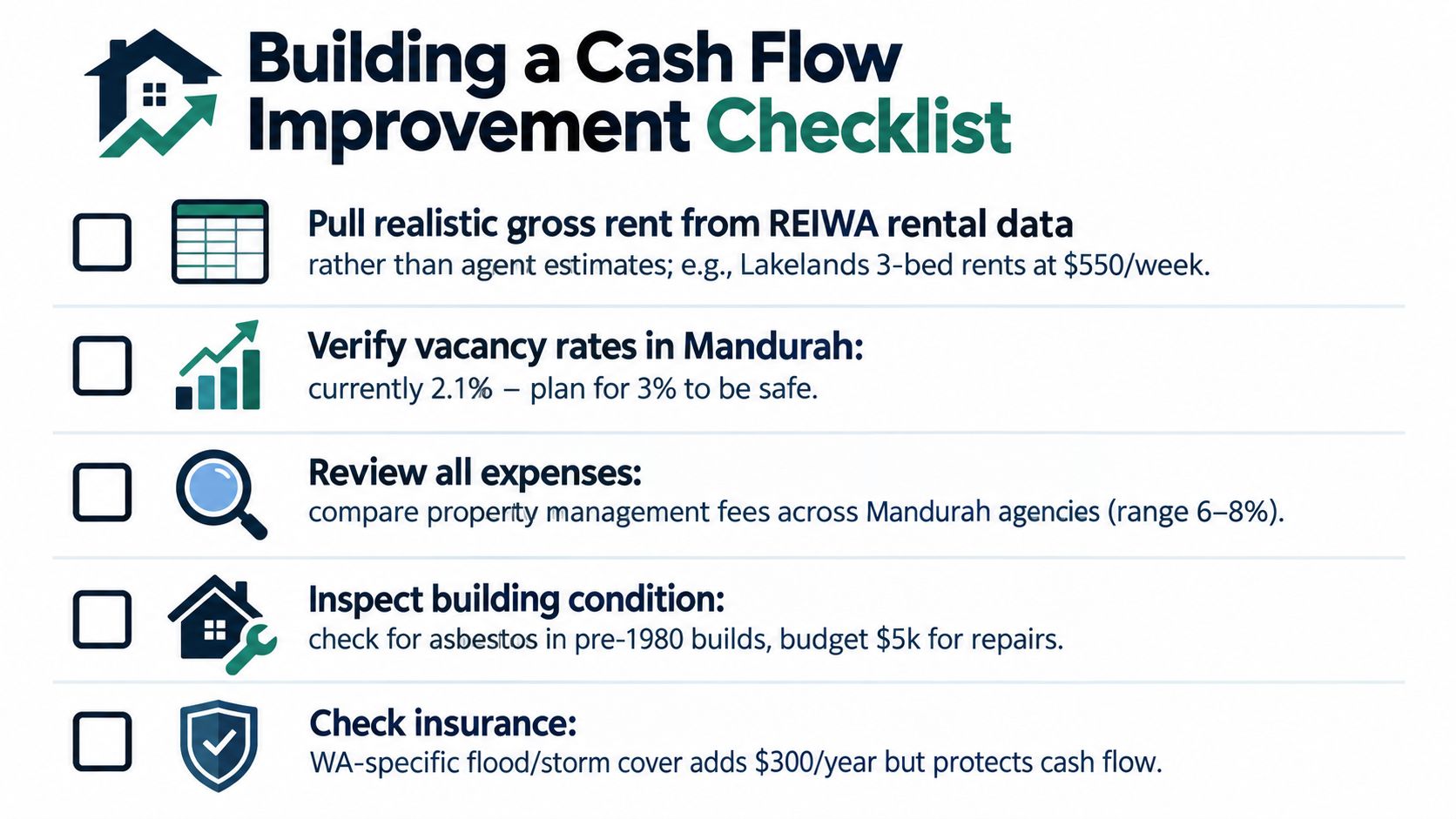
Run this checklist before making an offer and after each tenancy change. Assigning each task to the right person prevents optimistic assumptions from becoming permanent numbers.
Investor, verify the rent. Pull comparable leased evidence and REIWA rental data rather than relying on an advertised asking rent. Check whether the evidence matches the dwelling type and suburb, especially in Lakelands, Meadow Springs and Madora Bay.
Property manager, test vacancy. Build a vacancy allowance into every quarter of the annual model. A tight rental market supports leasing, but the owner still needs a buffer for advertising, cleaning, repairs and tenant changeover.
Property manager and investor, schedule rent reviews legally. Review the rent annually, then issue notice in line with WA tenancy requirements. A rent increase that can't legally start when expected doesn't belong in this month's cash-flow forecast.
Investor, audit expenses quarterly. Check management fees, letting charges, insurance renewals, council rates, water bills and maintenance invoices. Compare the actual ledger with the underwriting model and investigate every recurring variance.
Broker, monitor refinancing triggers. Set a review point when lender pricing changes, your loan balance improves or your income position strengthens. A refinance should reduce total cost after fees and restrictions, not merely produce a lower advertised rate.
Professional advice earns its place when the purchase is close to break-even, the property has complex strata or building issues, or the difference between two suburbs changes the borrowing decision. In a Lakelands or Madora Bay purchase, a buyer's agent can test comparable sales and negotiate the price, while a property manager validates rent and leasing risk. The investor should keep ownership of the assumptions.
Choosing the Right Mandurah Property With Confidence
Cash flow is decided upstream. If you overpay for the property, no management fee comparison or rent review will fully repair the position.
That makes local appraisal evidence more valuable than a national yield calculator. Lakelands, Madora Bay, Halls Head and Falcon don't share the same buyer depth, dwelling mix or comparable-sales evidence. A local analysis can distinguish a genuine under-market opportunity from a property that looks cheap because it needs work, has weak tenant appeal or carries costs not visible in the listing.
A five per cent purchase-price difference can materially change the Lakelands example. It affects the loan balance, interest bill and gross yield at the same time. That is why I would rather spend time establishing the right acquisition price than chasing an extra few dollars of theoretical rent.
Use a positive cash-flow suburb analysis as an initial screen, then verify the individual property. Suburb averages are useful for direction, but they can't tell you whether one Halls Head unit has excessive strata costs, whether a Falcon home needs immediate maintenance or whether a Madora Bay dwelling will attract the tenant profile assumed in the model.
Beshay Realty provides local appraisals, comparable-sales guidance and investment property advice across Mandurah and its surrounding coastal suburbs. Before committing to a purchase, get an independent view of the property's likely value and the price at which the cash-flow model works.
David Beshay Real Estate offers local property appraisals, suburb-specific sales guidance and practical investment analysis across Mandurah, Lakelands, Madora Bay, Meadow Springs, Halls Head, Falcon, Wannanup and Dudley Park. Visit David Beshay Real Estate before you make an offer, and have the purchase price, rental assumptions and cash-flow risks assessed locally.


Pingback: Mandurah Investment Property for Sale: A Local Guide - David Beshay Real Estate - Beshay Realty
Pingback: Investment Property Marketing in Mandurah That Works - David Beshay Real Estate - Beshay Realty