


When you sell your home, the real estate commission is the fee you pay your agent for getting the job done. It’s calculated as a percentage of the final sale price and only gets paid once the property actually sells. Think of it as a success fee.
For example, if your home sells for $800,000 and the commission rate is 2.25%, the total fee paid to the agent would be $18,000.
How Real Estate Commission Costs Actually Work
A real estate agent’s commission is what drives them. It's a performance-based model, which is great for you as a seller. They pour their time, money, and expertise into marketing your property and finding the right buyer without you paying a cent upfront. They only get paid when you do – once the sale is finalised and settled.
This system is designed to put your agent on the same team as you. Their goal becomes your goal: get the highest possible price for your property. The commission percentage is all agreed upon before you sign anything, so there are no surprises down the track.
Let’s run through a quick example for a home in the Mandurah area:
- Final Sale Price: $650,000
- Agreed Commission Rate: 2.4%
- Calculation: $650,000 x 0.024 = $15,600
So, in this case, the total commission payable to the real estate agency comes to $15,600. This amount is usually just taken out of the sale proceeds during the settlement process, so you won't need to pay it directly from your bank account.
Don't Forget About GST
Here’s a crucial detail that can catch people out: the Goods and Services Tax (GST). In Australia, real estate services are subject to GST, and you need to be crystal clear on whether your agent's quoted rate includes it or not.
Most of the time, the commission rate you're quoted will be exclusive of GST. This means an extra 10% GST will be added on top of the final commission figure.
Key Takeaway: Always ask your agent, "Is your quoted commission rate inclusive of GST?" Get their answer in writing in your agency agreement. It’s a simple question that can prevent a nasty surprise when you see the final settlement statement.
This infographic breaks down the basic agreement between a homeowner and their agent.
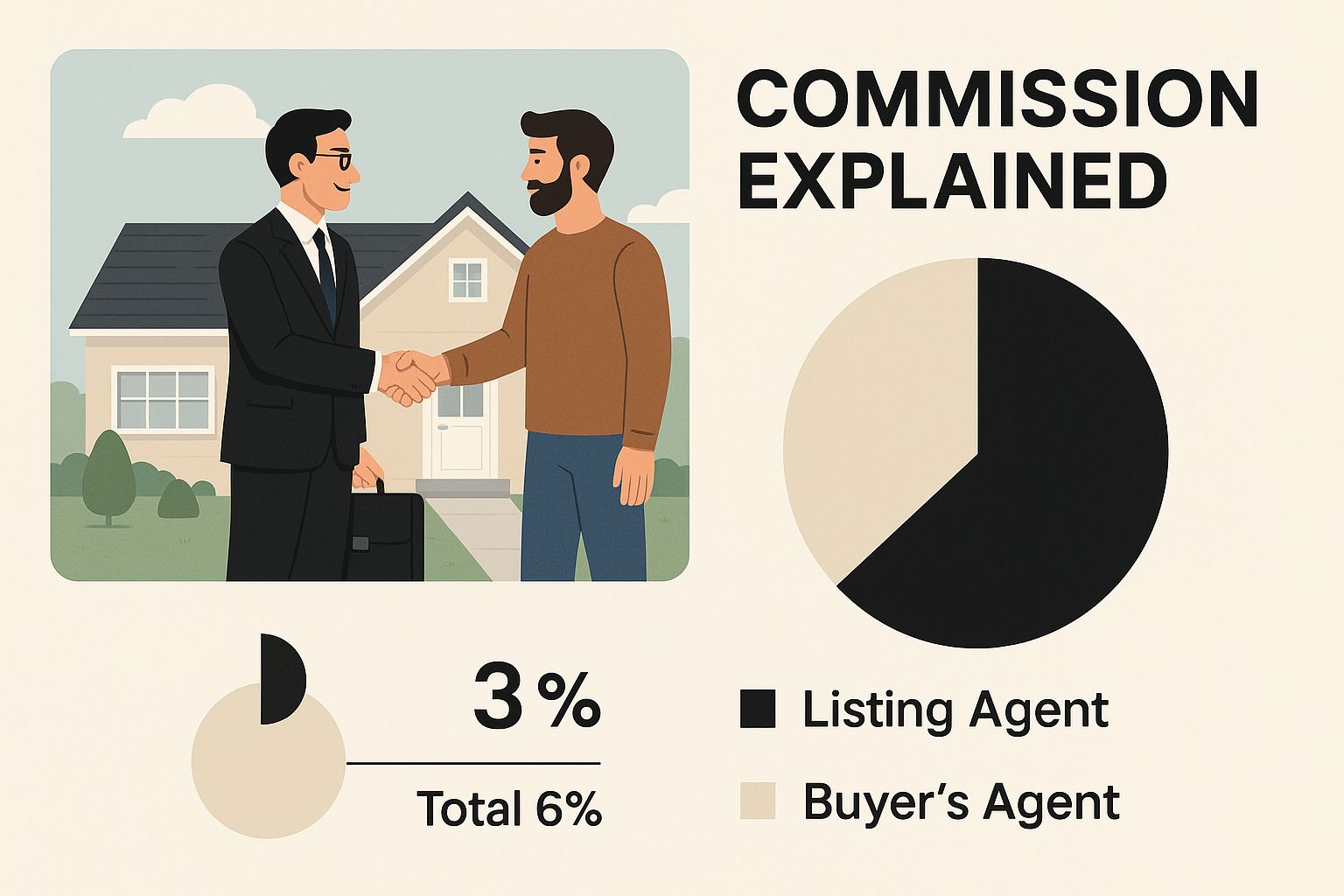
The image really highlights that the commission is a partnership fee, earned only when a successful sale goes through. Now that we have a solid grasp on how the costs are calculated, let's dive into what typical rates look like across Australia.
Average Real Estate Commission Costs Across Australia
To get a real sense of what's fair, it helps to zoom out and look at the bigger picture. Knowing the national averages for real estate commissions gives you a solid benchmark before you even start talking to local agents.
While every neighbourhood has its own rhythm, understanding the typical rates across Australia is your first step in gauging whether a fee is competitive or needs a second look.
Commission rates aren't locked in; they ebb and flow with the market. But looking at the data, you can spot clear trends from one state to the next.
Across the country, the average commission usually sits somewhere between 2% and 2.5% of the final sale price. That might not sound like much, but when you're talking about your home, it's a significant chunk of change.
State-by-State Commission Breakdown
Where you live plays a massive role in what you'll pay. An agent in a hyper-competitive city like Sydney or Melbourne, where agents are everywhere, will almost certainly have a different fee structure than one in a small regional town with only a few to choose from.
It all comes down to simple market dynamics. When lots of agents are vying for your business, rates tend to drop. On the flip side, with less competition, agents don't have as much pressure to lower their fees, so the average can creep up.
To give you a clearer idea of how much real estate commission costs can vary, here’s a snapshot of what sellers can generally expect across the country.
Average Real Estate Commission Rates Across Australia
The table below offers a comparative look at the average commission percentages sellers can expect in each Australian state and territory. It really highlights how your postcode can influence the cost of selling.
| State/Territory | Average Commission Rate (%) | Typical Range (%) |
|---|---|---|
| Western Australia | 2.44% | 2.0% – 3.25% |
| New South Wales | 2.10% | 1.8% – 2.5% |
| Victoria | 1.95% | 1.6% – 2.5% |
| Queensland | 2.45% | 2.0% – 3.0% |
| South Australia | 2.20% | 2.0% – 3.0% |
| Tasmania | 2.95% | 2.5% – 3.5% |
| ACT | 2.25% | 2.0% – 2.75% |
| Northern Territory | 2.70% | 2.5% – 3.0% |
As you can see, Tasmania often tips the scales with the highest average rates, a reflection of its unique market. Meanwhile, sellers in the bustling markets of Victoria and NSW usually benefit from more competitive fees thanks to the sheer number of agents.
Remember: these are just averages, not hard-and-fast rules. The final number will always come down to your specific property, its value, and the agent you choose to work with.
Think about it this way: with Australia's median home price nudging $1 million, the average commission can easily be around $20,000. Here in Western Australia, the average is 2.44%, but that can climb as high as 3.25% in regional areas outside of Perth. If you want to dig deeper, you can explore more about real estate agent fees in WA to get a better handle on these local differences.
Why Do Commission Rates Change From Place to Place?
Ever wondered why the commission an agent charges in bustling central Sydney is different from what you'd pay in a quiet country town? It’s not just you imagining things. Where your property is located has a massive impact on agent fees, and it all comes down to some basic economics.
Just like any service, the cost of selling a home is driven by supply and demand. In big cities, you’ve got hundreds, sometimes thousands, of agents all competing for your business. This fierce competition naturally pushes the average commission rate down as agents try to offer the most attractive deal to win your listing.
On the flip side, head out to a regional or rural area where there might only be a few real estate agencies in town. With less competition, agents have more control over their pricing. Because sellers have fewer options, commission rates in these areas tend to be higher.
How Your Property's Value Fits In
The value of your home also plays a big role in the commission percentage an agent will propose. It might sound counterintuitive, but an agent is often happy to accept a lower percentage on a high-value home because the final payout in dollars is still significant.
Think about it like this: a 2.0% commission on a $1.5 million property still earns the agent a $30,000 fee. But a higher 2.8% commission on a $500,000 home only brings in a $14,000 fee. The amount of work needed to sell both homes can be very similar, so agents often adjust their rates to make the potential payday worthwhile.
You can see this playing out all across Australia. In New South Wales, for example, the average commission sits around 2.31%. But in competitive Sydney suburbs, that rate can dip as low as 1.2%. Head out to smaller regional towns with lower property values and fewer agents, and you might see rates climb to 3.5%. You can discover more insights about NSW commission rates on OpenAgent.
Market Conditions and Your Power to Negotiate
The overall health of the property market also shifts the balance of power. The market's temperature directly affects commission costs and how open an agent might be to negotiation.
- Seller's Market: When there are more buyers than available homes, properties tend to sell fast. In a hot market like this, an agent’s job can be seen as a bit easier, which gives sellers more leverage to negotiate a lower fee.
- Buyer's Market: When there’s a glut of properties for sale and not enough buyers, a home can sit on the market for a long time. This means more marketing, more open homes, and more time from the agent, making them less inclined to drop their commission.
At the end of the day, a commission rate isn't just a number pulled out of thin air. It's a carefully calculated figure that reflects the local competition, your property's value, and what the market is doing right now.
Choosing Your Commission Structure
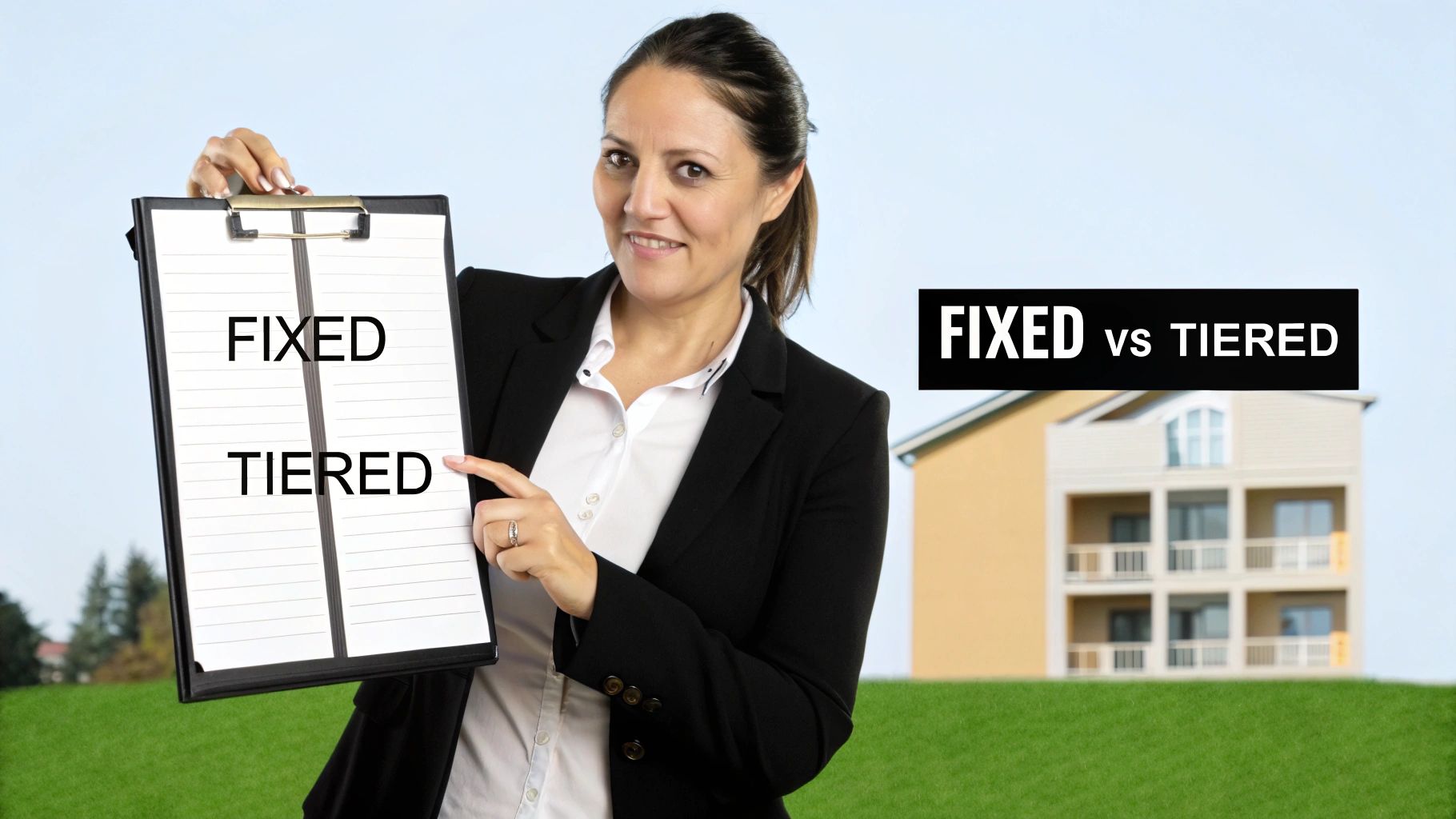
Figuring out real estate commission costs goes beyond just the percentage rate; you also need to get your head around the payment model. Not all commission agreements are the same, and the one you land on can have a real impact on your agent’s motivation and, ultimately, your final sale price.
The two main models you'll come across are the fixed-rate commission and the tiered commission. Each has its own pros and cons, and the best choice really boils down to what you want to achieve as a seller. This decision is just as critical as picking the right agent in the first place. If you're looking for pointers on that, our guide on how to choose a real estate agent is a great place to start.
The Simplicity of a Fixed-Rate Commission
A fixed-rate commission is the most common and straightforward way to do things. You and your agent simply agree on a single percentage. Whatever your home sells for, that percentage is applied to the final price. Easy.
For instance, if you agree to a 2.3% commission and your home sells for $750,000, the maths is simple: $750,000 x 0.023 = $17,250. It’s predictable and easy to calculate, which is why a lot of sellers prefer it.
The Power of a Tiered Commission
Now, a tiered commission structure is a different beast altogether. It's designed to really light a fire under your agent to get the absolute top dollar for your property. Instead of one flat rate, you have a baseline percentage up to an agreed-upon price, and then a much higher rate for anything achieved over that mark.
This performance-based model puts you and your agent on the exact same team, financially speaking.
A tiered commission is like offering a performance bonus. It says to your agent, "If you can smash the price record for me, you'll get a bigger slice of the pie." In a hot market, that can be an incredibly powerful motivator.
Let's break it down with a real-world example:
- Base Tier: 2% commission on the sale price up to $900,000.
- Incentive Tier: A juicy 6% commission on any amount you get above $900,000.
If your home sells for $950,000, the commission is worked out in two parts:
- Base Amount: $900,000 x 2% = $18,000
- Bonus Amount: $50,000 x 6% = $3,000
- Total Commission: $18,000 + $3,000 = $21,000
By understanding both options, you can pick the structure that makes the most sense for your property and your overall sales strategy.
Proven Strategies for Negotiating Agent Fees
One of the biggest misconceptions in real estate is that an agent's commission is set in stone. It's not. The fee an agent quotes is almost always a starting point for a conversation, not a final, take-it-or-leave-it price tag.
With the right approach, you can land a fair rate without sacrificing the quality of service you receive. Many sellers feel a bit awkward about haggling, but it's a completely standard part of the industry. Good agents expect it. The trick is to treat it as a collaborative discussion, not a confrontation.
Do Your Homework First
Before you pick up the phone to call an agent, arm yourself with some solid data. Knowing the typical commission rates in your specific Mandurah suburb gives you an immediate advantage and a realistic benchmark.
If you know the local average is hovering around 2.4%, you have a strong foundation for your discussion. Walking into that conversation blind is a surefire way to lose leverage, but when you can open with facts, you instantly shift the dynamic.
Remember, the goal isn’t just to find the cheapest fee—it's to secure the best value. An agent who can prove they have a killer marketing plan or a track record of selling for well above the asking price might justify a slightly higher commission.
Create Some Healthy Competition
This is the single most effective strategy you can use: interview multiple agents. Don't fall into the trap of speaking to one agent and simply accepting their terms. Set up meetings with at least three different agents from reputable local agencies.
This tactic accomplishes two crucial things:
- It creates competition: When agents know you're talking to their rivals, they're far more likely to put their best foot forward to win your business.
- It helps you compare value: You get a firsthand look at different marketing strategies, personalities, and fee structures, allowing you to make a genuinely informed decision.
Focus on Value, Not Just the Price Tag
While a lower commission is tempting, it shouldn't be the only thing you focus on. The cheapest agent isn't always the best choice, especially if they can't get you a top-dollar sale price for your home.
Think about it this way: a brilliant agent who secures an extra $20,000 on your sale is worth infinitely more than a discount agent who saves you $3,000 on their fee.
Ask every agent to justify their commission. What exactly are you getting for that fee? Get them to break down their marketing plan, show you examples of their professional photography, detail their online advertising budget, and prove their sales record in your area.
Use Effective Conversation Starters
When it's time to talk numbers, being prepared with a few phrases can make the whole process feel smoother and less awkward. You're not questioning their worth; you're simply opening a professional negotiation about the cost of selling your home.
Here are a few easy ways to kick off the conversation:
- "My research shows the average commission in this part of Mandurah is around X%. Could you walk me through how your service and marketing plan justify a different fee?"
- "I've spoken with a couple of other agents who've proposed a slightly lower rate. Are you able to match that for a similar level of service?"
- "If we work together on both selling this house and buying our next one, is there any flexibility on the commission for this listing?"
By using these strategies, you can navigate the negotiation confidently, making sure you not only secure a fair commission but also partner with an agent who will deliver the best possible result for your property.
Uncovering the Hidden Costs of Selling a Property
When you decide to sell your home, the real estate agent's commission is often the first expense that comes to mind. But focusing only on that figure is a bit like planning a holiday and only budgeting for the flights; you’ll get a nasty surprise when you have to pay for the hotel, food, and tours.
To get a true picture of your selling budget, it’s vital to account for all the other costs that pop up along the way. These are the expenses that ensure your property is legally transferred, professionally marketed, and looking its absolute best to attract those top-dollar offers.
Beyond the Commission: What Else Will You Pay For?
It’s important to remember that many of these fees are paid upfront. That means they come straight out of your pocket before you even see a cent from the sale, so planning for them from day one is key to a stress-free experience.
Here’s a look at some of the common additional costs:
- Marketing and Advertising Fees: This is a big one. It typically covers professional photography, floor plans, online listings on major portals like Domain and realestate.com.au, the "for sale" sign out front, and property brochures. A solid marketing campaign is essential to reach the widest pool of serious buyers.
- Legal or Conveyancing Fees: You’ll need a licensed conveyancer or solicitor to handle all the legal paperwork. They prepare the contract of sale and manage the entire settlement process, making sure the ownership transfer is smooth and legally airtight.
- Auctioneer Fees: If you decide to sell by auction, you’ll have a separate fee for the professional auctioneer who runs the show on the day.
Keep this in mind: the agent with the lowest commission might not save you money in the long run. A cheaper fee could mean they skimp on a comprehensive marketing package or suggest cutting corners on presentation, which can ultimately cost you a higher sale price.
Properly staging and preparing your home is another area where a small upfront investment can deliver a huge return. For a deeper dive, check out our guide on how to prepare a house for sale for some practical tips.
By understanding all the potential real estate commission costs and these related expenses, you can build a realistic budget and avoid any last-minute financial shocks.
Common Questions About Real Estate Commission Costs
When you're getting ready to sell, a few questions about commission costs always pop up. Getting clear answers upfront helps you budget properly and understand exactly what you're signing, so there are no nasty surprises down the track.
Let’s run through some of the most common queries we hear from sellers.
Is GST Included in the Commission Rate?
This is a big one, and you absolutely need to ask. In almost every case, the commission percentage an agent quotes is exclusive of GST. That means you’ll need to add an extra 10% on top of the final fee.
Always, always clarify this with your agent. Make sure the agency agreement you sign spells out whether the rate is inclusive or exclusive of GST to avoid a very expensive misunderstanding later on.
What Happens if My Property Does Not Sell?
Thankfully, real estate commission is what you’d call a success fee. The standard agreement is based on a "no sale, no fee" model. If your home doesn't sell by the time your agreement with the agent ends, you don’t owe them their commission. It’s as simple as that.
A quick heads-up, though: you might still be on the hook for any upfront marketing or advertising costs you agreed to. These are separate from the commission and cover things like professional photos and online listings, so be sure to read that part of your contract carefully.
For more answers to common real estate queries, you can find helpful information in our detailed real estate FAQ section. This resource can clear up other uncertainties you might have.
A performance bonus can be an alternative to a tiered structure, rewarding your agent for achieving a price above a certain target.
Ready to get a clear, no-obligation picture of your property's value and potential selling costs? Contact David Beshay Real Estate for a free, expert appraisal today at https://realestate-david-beshay.com.au.

