


You're scrolling Lakelands listings on your phone, perhaps after a home open, trying to work out whether a house is fairly priced or priced with confidence. A Mandurah-wide median won't answer that. Neither will a neighbour's sale from two years ago, or a coastal result from Madora Bay applied to an inland street.
A useful suburb profile report does something narrower and more honest. It fixes a boundary, matches comparable sales inside it, and checks who lives there, what they rent for, what's planned nearby, and what questions the site itself raises. Read that way, Lakelands stops being an average and becomes a set of price bands, buyer groups, and streets you can test before you sell, buy, or invest.
Table of Contents
- What a Suburb Profile Report Covers at a Glance
- Boundaries and Who Lives in Lakelands
- Price Bands and Recent Sales in Lakelands
- Lifestyle, Schools and Transport Links Worth Checking
- Growth Pipeline and Coastal Risk Over the Next Decade
- Choose Your Next Step Based on Your Profile
What a Suburb Profile Report Covers at a Glance
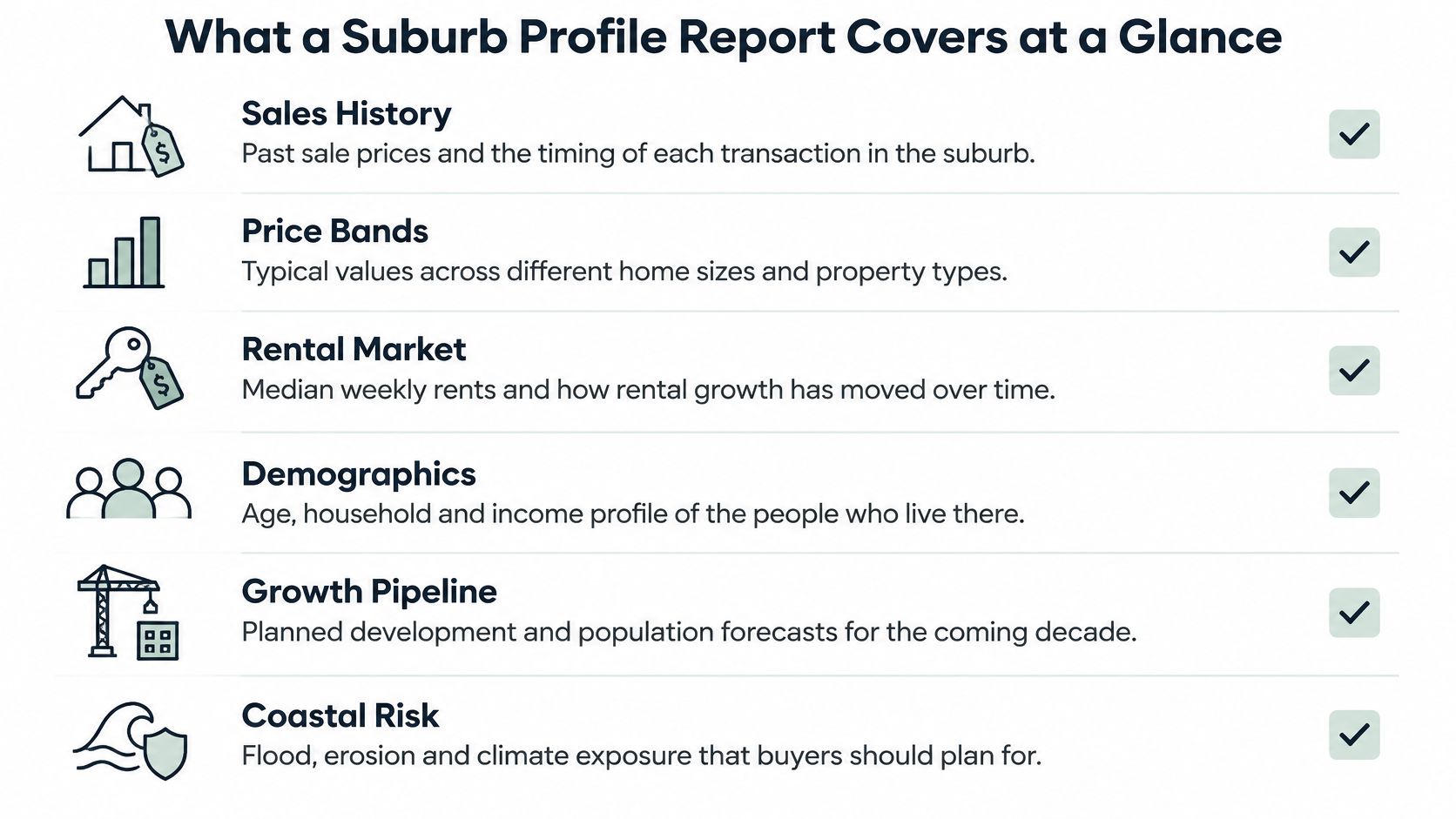
Say two Lakelands family homes are listed in the same month, one at $790,000 and one at $860,000. A buyer asks why. Bedrooms alone won't explain a $70,000 gap. You'd need the boundary behind the figures, recent sales of the same property type, price and rent movement, household makeup, school and lifestyle access, planned supply, and any coastal or flood exposure. A suburb profile report puts those pieces together so each number can be read against the others, much as Richard Maize's market analysis template organises a market into sections you can work through in order.
The checklist below sets out what a complete profile covers and where to verify it.
| Component | Question It Answers | Where to Source It |
|---|---|---|
| Boundary | Which streets and dwellings the figures actually cover | ABS Census SAL and Landgate boundaries |
| Recent sales | What comparable homes sold for in the last six to twelve months | Landgate Valuer General sales records |
| Growth and rent | Whether values and rents are rising, flat or softening | REIWA suburb statistics |
| Demographics | Who lives there and how households are built | ABS 2021 Census QuickStats |
| Lifestyle and schools | What daily life looks like within a short drive | Department of Education school catchment search and local operators |
| Planned supply | How many new dwellings and residents are expected | City of Mandurah Local Planning Strategy |
| Coastal and hazard exposure | Whether the site carries erosion, flood or insurance questions | City of Mandurah and WA Government CHRMAP documents |
Demand is real, but it's broad. According to REIWA, Mandurah recorded 363,786 specified-suburb searches for homes for sale during 2025, while its median house sale price was $600,000 for the 12 months to December 2025. That city house median measures something different from a suburb sales median, which is why every report should name its measure. The sections that follow work through each row for Lakelands.
Boundaries and Who Lives in Lakelands
A Peel-wide median works like a regional weather forecast. It describes the whole region, but it won't tell you whether you need a jacket for one walk around the Lakelands lakes. Pricing works the same way. If the boundary is wrong, every figure built on it is wrong too.
Buyers working from Mandurah figures meet at least three boundaries, and they aren't interchangeable. The Australian Bureau of Statistics 2021 Census QuickStats for the City of Mandurah local government area recorded 90,306 residents, comprising 48.0% males and 52.0% females. That count covers the whole council area, from the northern growth suburbs through to the estuary and coastal pockets, so it describes scale rather than one suburb's buyer pool.
The narrower statistical picture is very different. The ABS 2021 Census QuickStats for the Mandurah locality records 8,804 residents and 5,724 private dwellings inside the narrow boundary, set against 107,641 residents and 51,906 private dwellings across the broader Mandurah area the same release describes. Quote the council-wide count for a single suburb and you dilute the signal you're trying to read.
The North South Split Inside Mandurah
Mandurah isn't demographically uniform, even over short distances. The same Census release records Mandurah-North at 21,261 residents with a median age of 36, while Mandurah-South recorded 11,323 residents with a median age of 51.
That fifteen-year gap in median age changes what sells and who competes for it. The younger north, which takes in the Lakelands and Madora Bay growth corridor, draws first-home buyers, growing families and purchasers who want newer housing near schools and transport. The older south, closer in character to established pockets around Halls Head and Falcon, draws downsizers, retirees and lifestyle buyers who pay for single-level living and low-maintenance blocks. A four-bedroom family home and a compact villa can sit a few kilometres apart and face entirely different buyer pools, so the median that prices one correctly will misprice the other.
Boundary rule: If a report can't tell you which boundary its median age and population come from, don't use its pricing conclusions for your street.
Household Size and Occupancy
Household size points the same way. The Census figures cited above record an average household size of 1.8 people in the Mandurah locality against 2.4 people across the broader Mandurah area. Smaller households support demand for villas, apartments and low-maintenance homes, while larger households sustain the family market that dominates newer northern estates like Lakelands. Neither is better. They price different stock.
Occupancy adds another check. In the local government area count linked earlier, the City of Mandurah recorded 35,358 occupied private dwellings, or 83.0% of all private dwellings, against 89.1% across Western Australia. A lower occupancy share can reflect holiday homes, investor stock or homes between occupants, and it shifts street by street. In coastal pockets such as Wannanup or Dudley Park, that mix changes how a street feels in winter and how many comparable owner-occupier sales an agent can pull.
Coastal proximity is not an automatic premium either. A suburb near the water can carry a heavy share of seasonal or investor-held homes, which thins the owner-occupier buyer pool its median rests on. Lakelands sits in the northern growth corridor rather than the holiday-strip pattern, so its comparables should come from inside that corridor, matched by boundary and property type.
Relationship data reinforces the diversity. The local government area count also shows 47.6% of residents aged 15 years and over were registered married, 12.1% were in a de facto relationship and 40.3% were not married. There's no single dominant buyer group here, which is why a Mandurah-wide view of the local market is a starting point, not a pricing tool.
Three Checks Before You Quote Any Figure
- Confirm the boundary: Ask whether the figure covers the local government area, a statistical area, or the suburb itself.
- Confirm the household fit: Match median age and household size for that boundary to the property type you're pricing.
- Confirm the sales match: Make sure the comparable sales sit inside the same boundary and property type, not just the same postcode.
| Area and Boundary | Residents | What Else the Census Records |
|---|---|---|
| Mandurah City, local government area | 90,306 | 48.0% males, 52.0% females |
| Broader Mandurah area | 107,641 | Average household size of 2.4 people |
| Mandurah locality, narrow SAL boundary | 8,804 | Average household size of 1.8 people |
| Mandurah-North, statistical area | 21,261 | Median age of 36 |
| Mandurah-South, statistical area | 11,323 | Median age of 51 |
Price Bands and Recent Sales in Lakelands
Start with the snapshot, then question it. Lakelands recorded a median sales price of $820,000, annual sales-price growth of 19.7%, rental-price growth of 7.3% and a median rent of $665 per week. The REIWA suburb page for Madora Bay records a stronger result next door, with annual sales-price growth of 30.8%, a median sales price of $1.04 million and a median rent of $690 per week.
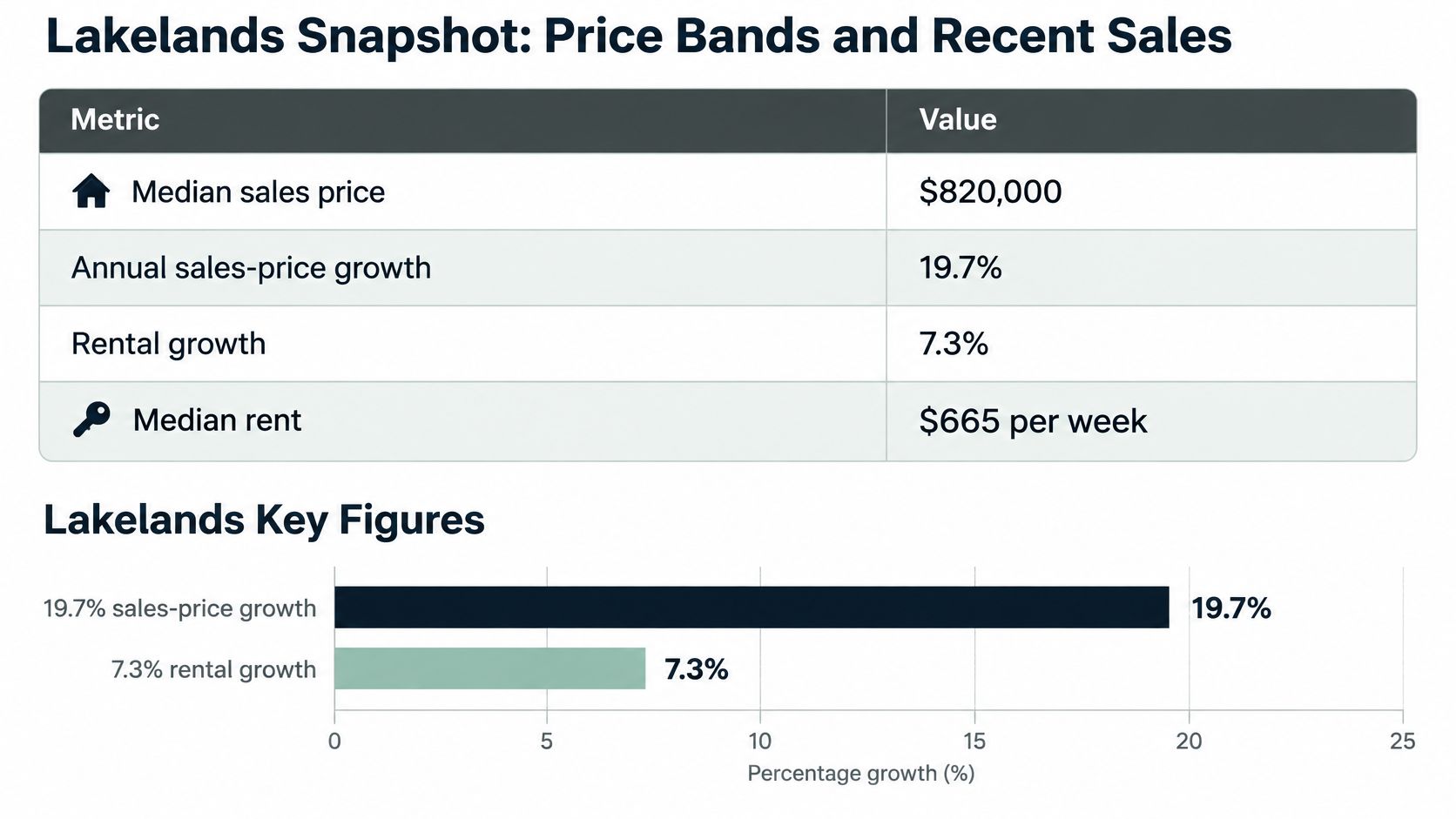
| Measure | Lakelands | Madora Bay | Mandurah |
|---|---|---|---|
| Median sales price | $820,000 | $1.04 million | $600,000 (house, 12 months to December 2025) |
| Annual sales-price growth | 19.7% | 30.8% | Not reported in cited figure |
| Median rent per week | $665 | $690 | Not reported in cited figure |
| Annual rent growth | 7.3% | Not reported in cited figure | Not reported in cited figure |
What the Spread Actually Tells You
Two gaps sit on either side of Lakelands, and they run almost equal in size. The suburb median sits roughly $220,000 above the Mandurah house median of $600,000, and roughly $220,000 below the Madora Bay median of $1.04 million. That middle position is why a Mandurah-wide median misleads as a pricing tool. Borrowing a Madora Bay benchmark imports a coastal premium your buyer may not pay, while quoting the city median understates what newer family stock in the northern corridor achieves. A family home in Lakelands, a newer coastal residence in Madora Bay and an established property in Meadow Springs each attract a different buyer pool.
Rent tells a quieter story. Madora Bay's median of $690 per week sits only $25 above Lakelands, despite a sales median more than $200,000 higher. Coastal proximity lifts the sale price far more than the weekly rent, so a beachside postcode is no guarantee of a yield premium. For an investor, that gap between capital growth and rental income is where the analysis starts, and it is the sharpest argument for matching comparables to the suburb boundary rather than to the wider city.
The short video below is a useful pause point before you test those numbers against individual sales.
Three Bands Around the Lakelands Median
Working bands built around the $820,000 median make the suburb easier to read. These are analytical bands, not official categories, and you should test them against settled sales.
- Lower band, below about $738,000: Roughly 10% under the median. Expect entry-level stock, smaller lots, homes needing work, or investor purchases where rent matters more than presentation.
- Core band, $738,000 to $902,000: The main family market. Most four-bedroom homes for upgraders and relocating families compete here, and this band usually holds the deepest set of comparable sales.
- Upper band, above $902,000: Homes need a clear reason to sit here, such as larger land, updated interiors, a second living zone, or outdoor entertaining that buyers can use year round.
A median tells you where the middle sale landed. It doesn't tell you what your home is worth, and it was never designed to.
How to Test a Band
Pull settled sales from the last six months, match property type and land size first, then note which homes settled at or below asking. Reading one month's sales against the last is the discipline that keeps a band honest. Jacky Levi's September 2026 sales update applies that same monthly read in the Vancouver market, and the habit transfers even though the prices do not. Locally, browsing recently sold homes in the Mandurah area gives you the raw settled-sales material. If your home only fits the upper band after generous adjustments, the band has already given you an answer.
Lifestyle, Schools and Transport Links Worth Checking
Daily anchors matter more than a list of attractions. For Lakelands, start with the Lakelands shopping precinct for everyday errands, Mandurah Forum for larger retail, Peel Health Campus for hospital and specialist care, and the Mandurah city centre for dining and the waterfront. None of that proves value on its own. What matters is how long each trip takes on a weekday morning, so confirm walking, cycling, and driving times yourself before quoting them to a buyer or relying on them as one.
Transport You Will Actually Use
Map the nearest Transperth Mandurah line station and the local bus routes that feed it, then check Kwinana Freeway and Mandurah Road access for trips to Perth and Rockingham. A station that's close on a map but awkward to reach at peak hour won't support a commuter premium. Drive it at the time you'd really leave.
Schools by Address, Not by Suburb Name
Use the Department of Education school catchment search for the exact address, not the suburb name. List the public primary and secondary options it returns, then the nearest independent schools, and remember that sitting inside a catchment doesn't guarantee enrolment. Boundaries can cut through a suburb, so two Lakelands homes a few streets apart may not share the same school options.
For lifestyle, check the drive to beaches at Madora Bay, Falcon, and Halls Head, plus the local lakes and bushland reserves for walking. The area's recreation facilities across Mandurah are worth reviewing, but test them as trips. Time a peak-hour drive from the front door to the station, the hospital, and the nearest primary school, and write the times down. A feature adds value only when it's easy to use every day, so a good profile describes trips rather than distances.
Growth Pipeline and Coastal Risk Over the Next Decade
The City of Mandurah Local Planning Strategy projects substantial population and dwelling growth across the district over the next two decades. Its coverage runs from Madora Bay and Lakelands in the north to Herron and Lake Clifton in the south, so its figures describe a far wider catchment than Lakelands itself. Read them as context for land release, infill, and infrastructure spending, then price against sales inside Lakelands' own boundaries rather than against the district headline.
That pipeline cuts both ways. More residents support demand for existing homes, but new estates and infill also compete with resale stock, especially where a buyer can choose a brand new build nearby. Before you appraise a Lakelands home, check for land releases near the street and read the local detail on growth in Lakelands real estate instead of assuming scarcity will hold your price up. Households weighing a longer term lifestyle move sometimes explore potential retreat communities as part of that same location thinking, comparing growth, amenity, and exposure together.
Coastal Proximity Is Not an Automatic Premium
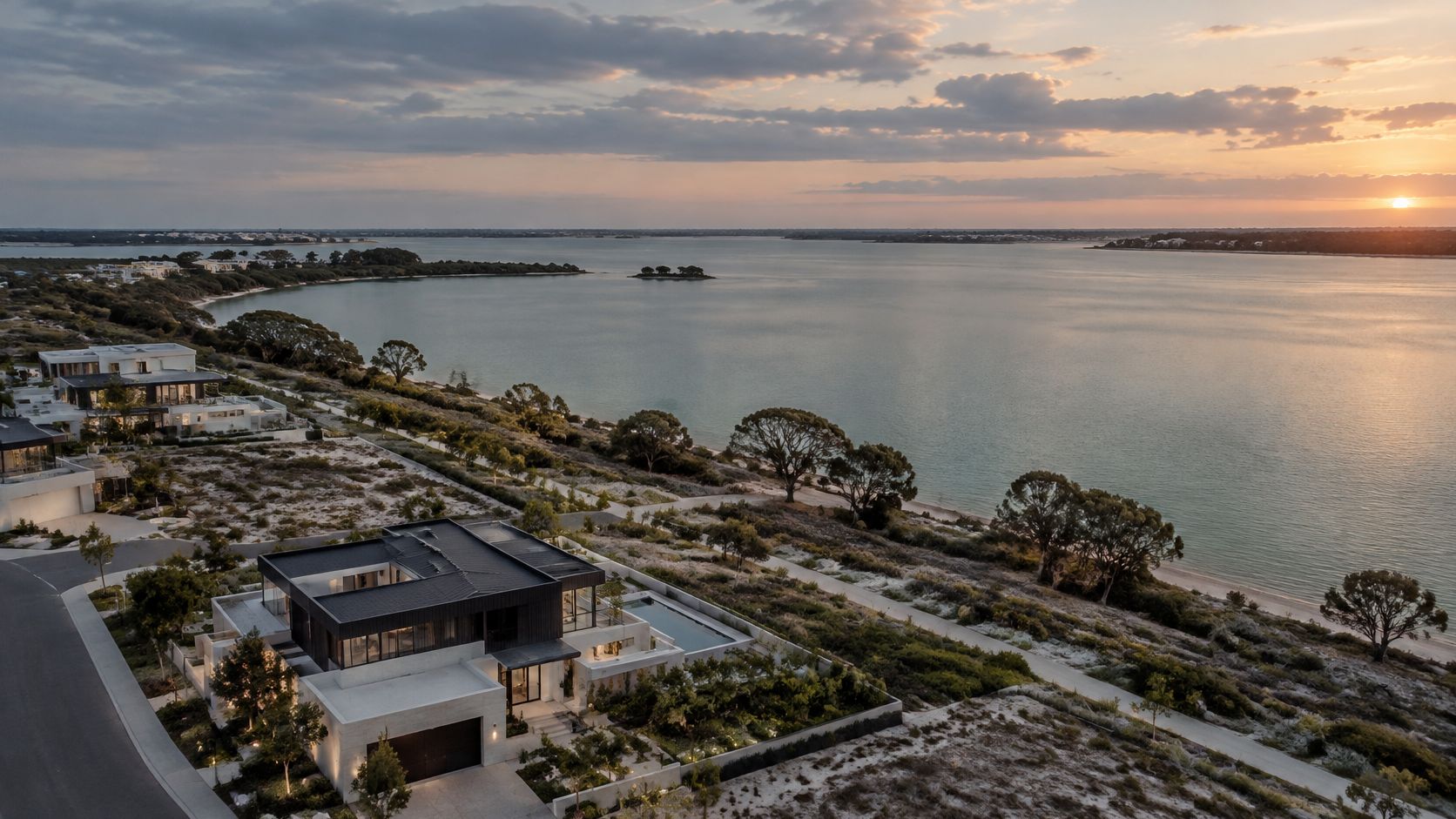
Coastal proximity attracts lifestyle buyers, and it can also narrow the future buyer pool while raising insurance and maintenance questions. The WA Government table of CHRMAPs in Western Australia sits behind the City of Mandurah's Coastal Hazard Risk Management and Adaptation Plan, which covers the developed coastline from Roberts Point to Madora Bay and identifies erosion and inundation risks, exposed infrastructure, and adaptation pathways.
The practical question isn't whether a suburb is coastal. It's whether this specific street or property is exposed, and what you should verify before making an offer.
For coastal streets in Madora Bay, Halls Head, and Falcon, work through hazard mapping, zoning, drainage, finished-floor levels, engineering advice where the mapping raises questions, and a direct insurance conversation. Conditions vary materially by elevation, frontage, and distance from waterways. Lakelands is inland, so its questions are usually drainage and nearby development rather than erosion, but confirm that on the City's mapping instead of assuming it. A profile that ties amenity to resilience holds up better, because resale buyers will ask the same questions.
Choose Your Next Step Based on Your Profile
The same report reads differently depending on where you sit. Use the boundary, bands, and household data as filters, then apply them to your situation.
First-Home Buyers
Start in the lower and core bands, and don't stretch to an upper-band price for a home that lacks upper-band features. Check settled sales from the last six months, and ask a local agent to confirm stock condition, because photos flatter tired interiors. Comparing Lakelands with Madora Bay is useful only if you'd really buy in both. If your budget only works in one, price against that suburb's sales and ignore the other suburb's growth headline.
Family Upgraders
Focus on the core band, school catchment by exact address, and the trade-off between land size and street quality. A slightly smaller block on a quieter street near the lakes can hold value better than a larger block on a through road. Weigh the price of the next home against what your current home will realistically achieve in its own band, in Meadow Springs, Lakelands, or wherever you're selling. The gap between the two, not either figure alone, is your real cost of moving.
Downsizers Selling in the Area
Read the median age and household size data as a demand signal. Smaller households and an older southern profile support single-level, low-maintenance homes, so if you're selling one, your buyer pool may be deeper than you expect. Compare sales of similar-sized homes rather than larger family houses on your street. Budget for presentation before the campaign launches, including garden work, minor repairs, and decluttering, because downsizer buyers often pay for ease and will discount visible work.
Investors
Compare median rent and rent growth against sales growth, suburb by suburb. Lakelands and Madora Bay show how a higher sales median doesn't always bring a proportionally higher rent. Check planned supply near the property, since new dwellings compete for tenants as well as buyers, and review the detail on Lakelands real estate investment alongside your own numbers. Near the water, complete the coastal due-diligence list before you buy, not at insurance renewal.
A range you can defend: Four to six comparable sales, adjusted honestly, will tell you more than any single figure quoted with confidence.
Building an Appraisal Range
However you sit, the method is the same. Choose four to six comparable sales from the same boundary and the same price band, using the band test method of matching recent settled sales by property type and land size. Then adjust each one for the differences that actually move Mandurah buyers.
- Land size: Adjust for usable area, not just the number on the title, and note corner or battle-axe configurations.
- Condition: Separate cosmetic wear from structural or dated wet areas, because buyers price them very differently.
- Street: Account for through traffic, proximity to the lakes or reserves, and the general presentation of neighbouring homes.
- Outdoor living: Covered entertaining that works in a Mandurah summer carries weight. An exposed patio carries less.
- Aspect: Northern light to main living areas and shelter from afternoon sea breezes both register at home opens.
Treat the result as a range rather than a single figure. If your adjustments keep pushing one way, your starting comparable set is probably wrong. The practical next step is a free property appraisal, where this profile gets run against your street, your comparable sales, and your timing, with the reasoning behind the range explained plainly. That's the point where a suburb profile report stops being reading material and becomes a pricing decision you can stand behind.
If you'd like this Lakelands profile tested against your own street, comparable sales, and timing, David Beshay Real Estate offers a free, evidence-based property appraisal for Mandurah homeowners, sellers, and investors. Visit David Beshay Real Estate to request your appraisal and talk through a defensible price range for your home.

