

Your neighbour in Halls Head has just sold, and you're mentally applying their sale price to your own home. Then the details emerge: their block is larger, their living room faces the water, and they've renovated the kitchen and bathrooms. Suddenly, the number you'd been relying on needs a closer look.
That's where a property value report should help. Not by handing you an impressive-looking figure, but by showing which sales matter, what makes your property different and how confidently you can use the resulting range.
Table of Contents
- What a Property Value Report Actually Is
- What Sits Inside a Property Value Report
- Which Number to Trust and How to Read It
- How a Mandurah Report Is Built From Sold Evidence
- Adjusting for Land, Condition and Coastal Position
- Turn Your Report Into a Price You Can Defend
What a Property Value Report Actually Is
A property value report is a written, dated assessment of likely market value, supported by comparable sales and property-specific evidence. For a homeowner considering a sale, its purpose is to make the reasoning behind the price visible.
Think of it as the working papers behind a tax return. The final number matters, but the receipts explain whether you can rely on it. A property report needs the equivalent: identifiable transactions, accurate property details and a clear explanation of the conclusions.

A working paper rather than a verdict
Return to that Halls Head neighbour. Their result may be useful evidence, but it isn't automatically your home's value. A credible assessment explains whether their extra land, outlook and renovation make their sale a useful upper benchmark rather than a direct match.
The report should also identify uncertainty. If your home has unusual architecture or an outlook that's difficult to match, the author should acknowledge the thinner evidence rather than disguise it behind an exact figure.
The useful question isn't simply what your home is worth. It's what evidence supports that conclusion.
Who can use the report
Different readers need the same evidence for different decisions:
- Sellers can use it before listing to discuss presentation, positioning and expectations.
- Buyers can use it to assess an asking price before making an offer.
- Homeowners can use it when reviewing equity, while recognising that a lender may require its own valuation.
- Investors can use it to compare individual opportunities in Lakelands, Madora Bay or Falcon without assuming neighbouring suburbs are interchangeable.
It isn't a guarantee of a sale result, an advertised listing price or a rates notice. Its usefulness comes from giving you a reasoned basis for a decision, including enough paperwork to question the assumptions before committing.
What Sits Inside a Property Value Report
Use the following checklist beside any report you receive. You shouldn't need specialist valuation knowledge to find the evidence, understand the limitations or ask why a particular property was selected.
Components of a credible property value report
| Component | What It Shows | What to Check |
|---|---|---|
| Effective date | The date the evidence was current | Is it recent enough for today's buyers? |
| Comparable sales | Settled sales with address, price, sale date, land area, dwelling type, bedrooms and bathrooms | Are they arm's-length sales in the same suburb and property type? |
| Adjustments | How each comparable is adjusted for condition, land, outlook and parking | Is every adjustment explained and tied to evidence? |
| Suburb context | Median and quartile range for the area | Is it used as a benchmark rather than the answer? |
| Current competition | Active listings, recent withdrawals and time on market | How many similar homes are competing right now? |
| Price range and confidence | The recommended band and how firm it is | Is a range given rather than one figure? |
| Sources and limitations | Data used, settlement status and known gaps | Are sources named and limits stated? |
The effective date needs a purpose
The effective date tells you when the assessment applies. It's different from the date someone emailed the document or printed the cover page.
Landgate's property sales reports provide sale prices and sale dates, allowing an author to show what sold and when. Landgate's reporting framework covers residential, industrial, commercial and rural property, so the report must still filter the records to the property you're assessing.
For a seller in Meadow Springs or Dudley Park, an older sale may remain informative, but it needs context. Ask what has changed since that transaction and what would trigger a refresh, such as a closely matched sale or a significant change in competing stock.
The comparable-sales page should explain relevance
Say a report for a Madora Bay home includes a larger, canal-adjacent property from elsewhere in the Mandurah area. That transaction shouldn't become a direct benchmark just because the accommodation looks similar.
The author needs to explain the different location, water relationship and usable land. Without that explanation, the sale may reveal more about another buyer segment than about your property.
You can browse recently sold properties around Mandurah to familiarise yourself with local homes, then ask which results were selected for your assessment and why. A gallery is useful background; the report should do the comparative work.
Quick check: Can you trace each material figure to a named sale, a dated source or a stated assumption?
A bare price band with no visible comparables isn't a helpful shortcut. Ask for the evidence before using it to set expectations, approve improvements or negotiate a purchase.
Which Number to Trust and How to Read It
Suppose the figure on your rates paperwork differs from an online estimate, and both differ from the appraisal discussed at your kitchen bench. That does not automatically mean one is wrong. Each figure answers a different question, so start by checking what it measures and what decision it is meant to support.
The Western Australian Government's land valuation guidance explains statutory land valuations used for rating and taxing purposes. Those assessments record values for those purposes, rather than recommending a price for a selling campaign.
Which property figure answers which question
| Figure | Who Produces It | What It Measures | Best Used For |
|---|---|---|---|
| Landgate GRV or UV | Valuer-General, for rates and taxes | Statutory gross rental or unimproved value | Checking rates and tax records |
| Landgate valuation extract | Valuer-General's official valuation roll | Latest and earlier GRV or UV with valuation dates | Verifying the statutory record |
| Online estimate | Automated valuation model | Statistical estimate, usually without inspection | A rough starting point only |
| Bank valuation | Lender's valuer | Security value for lending | Loan approval, not campaign pricing |
| Market appraisal | Local agent after inspection | Likely selling range from comparable sales and condition | Setting a price or framing an offer |
Landgate describes valuation extracts as reports drawn from the Valuer-General's official valuation rolls. They show gross rental value or unimproved value and the relevant valuation dates. Use an extract to check the statutory record, not to assume what a buyer will offer.
Match the figure to your decision
An online estimate can start a conversation, but it usually has not inspected the home. It may miss a renovation, awkward layout, deteriorating condition or the quality of an outdoor living area.
For example, a Falcon homeowner may have replaced a dated kitchen and added a north-facing alfresco space. An inspected appraisal can compare those features with relevant sold homes, while an automated estimate may still use an older property description.
That does not mean every improvement adds the same amount to a sale price. The assessment should show whether buyers have paid more for comparable features. An owner's renovation cost, on its own, does not establish a market premium.
A precise-looking digital estimate can create false confidence. A transparent range, with its assumptions stated, gives you a more useful basis for campaign planning.
A lender's valuation serves a different purpose: it assesses the property as security for a loan. The guide to bank valuations and real estate agent appraisals explains how those assessments differ. Compare each figure with its purpose and supporting evidence, rather than judging it only by whether it is higher.
Understand the median before applying it
The median is the middle sale price when transactions are arranged from lowest to highest. The average, or mean, adds the prices and divides by the number of transactions. An unusually high or low sale can affect the average more strongly.
For settled transactions in the 12 months ending September 2026, REIWA's Mandurah profile reports a median sales price of $701,000, a lower quartile of $638,000 and an upper quartile of $760,000. The difference between the quartiles is $122,000. These figures describe a suburb over a particular period; they do not value an individual home.
That spread is a reminder to look beyond the suburb figure. Land size, condition, parking, water access, views and micro-location can all affect which part of the range is relevant to a property.
REIWA also notes that sales figures are revised as more transactions settle. Check which release a report uses. A suburb statistic can change over time, so it should not be presented as a permanent fact.
Why apparently conflicting headlines can coexist
A suburb can record an annual rise and still have a fall in a single month. The figures cover different comparison periods, so they can describe different movements without contradicting each other.
A difference between one publisher's median and another's does not establish which figure applies to your home. Check the geographic boundary, property type, reporting date and method before comparing them.
Common misreadings are easy to avoid:
- Median versus average. These calculations answer different questions and should not share the same label.
- Settled sales versus listings. An asking price records a seller's position, not an achieved transaction.
- Rolling periods versus monthly movement. A longer reporting window can show a different pattern from a recent month.
- Mixed property stock. Waterfront residences, detached family homes and investment apartments should not be treated as one comparable-sales pool.
For a separate national perspective, read the discussion of Australian property value declines. Keep broad national context distinct from the local evidence needed to assess a Wannanup coastal home or a Dudley Park investment.
A property value report is working paper, not a verdict. Its value lies in dated comparable sales, clear adjustments and an honest range. A single precise-looking figure without evidence should prompt questions, not settle the price. Ask how many genuinely comparable sales were used, when they sold and whether they were arm's-length transactions. An arm's-length sale is between independent parties acting in their own interests, rather than a transfer whose circumstances may distort the price.
How a Mandurah Report Is Built From Sold Evidence
A sound appraisal starts with the property, not with a preferred price. The author then works through the evidence in a sequence that makes omissions and assumptions easier to identify.
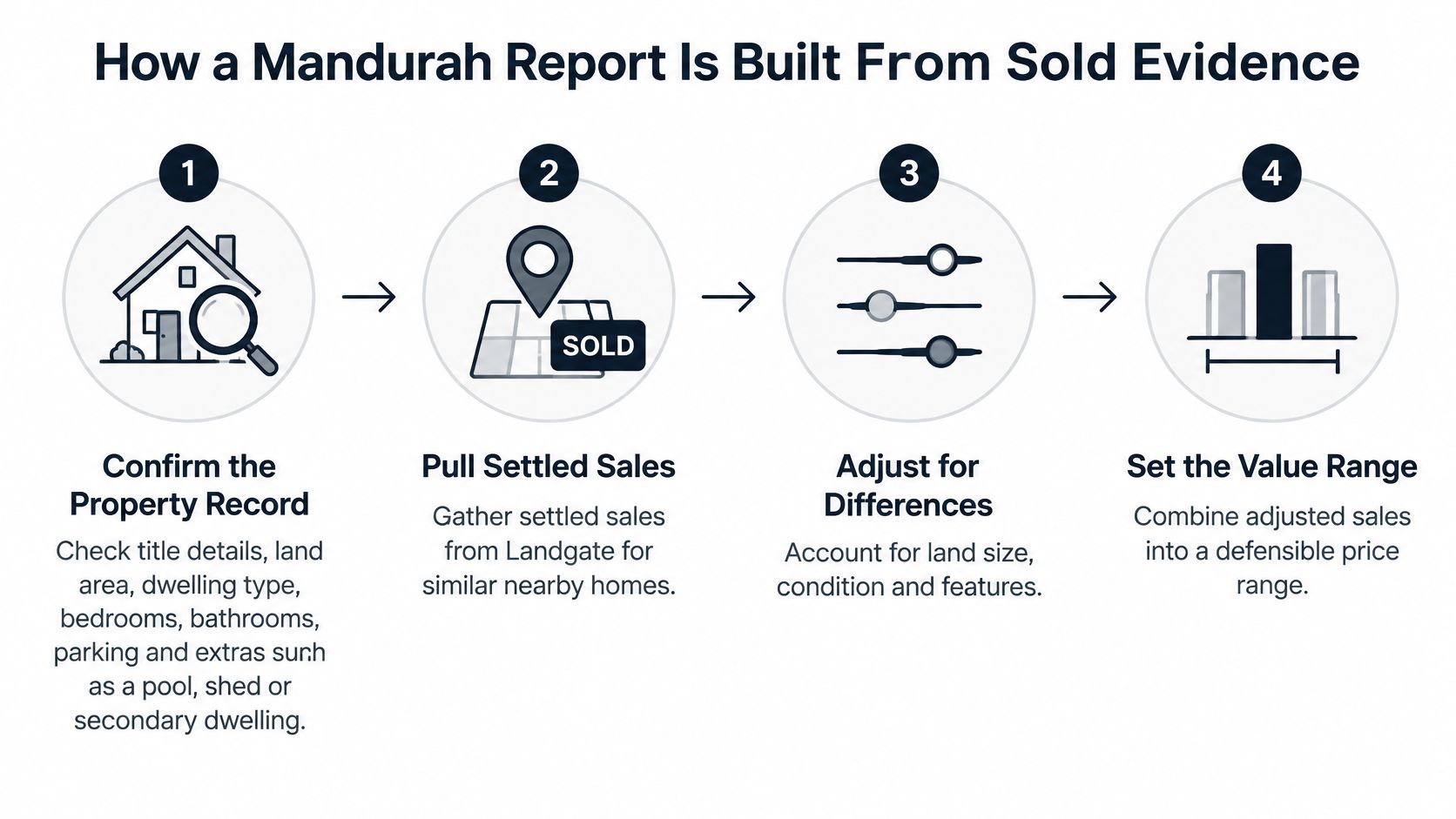
The process can be summarised visually before examining the individual checks.
From the property record to a shortlist
Confirm the property record. Check title details, land area, dwelling type, bedrooms, bathrooms and parking. Record extras such as a pool, shed or secondary dwelling, and investigate discrepancies before comparing prices.
Gather registered sales evidence. Landgate's Sales Evidence Data combines Transfer of Land registration information with valuation attributes, covers Perth metropolitan and Mandurah markets, and contains historical records dating back to 1988. That combination helps distinguish genuinely similar properties from homes that merely share a nearby address.
Filter by location and property type. Begin with the same suburb and dwelling category. Use adjacent-suburb evidence only when the coastal position, surroundings and likely buyer audience are demonstrably comparable.
Choose a relevant sale-date window. Prioritise recent settled evidence and identify any market movement since the transactions. An older but unusually close match may help, provided its limitations are explicit.
Shortlist the strongest matches. Record why each sale belongs, including its similarities and weaknesses. Don't pad the report with loosely related properties to make the evidence look more substantial.
From inspection to a supported range
Inspect the subject home. Assess condition, aspect, views, renovation quality and outdoor living. Photographs alone may not explain privacy, natural light or how comfortably the layout works.
Account for meaningful differences. Compare the subject property with each shortlisted sale and document the direction of each adjustment. The reasoning should remain readable to the owner.
Check available alternatives. Review current competition and recent local results in relevant streets, whether the property is in Lakelands, Halls Head or Meadow Springs. Keep active asking prices separate from achieved sales.
Write and explain the conclusion. State the range, effective date, assumptions and confidence level. Walk the owner through the strongest evidence rather than just presenting the final page.
A comparative market analysis provides a practical framework for organising this work.
Suppose a report for a Meadow Springs home uses a canal-side sale from another suburb because the interiors look similar. The author should investigate whether the water outlook attracted a different buyer audience; if it did, a less visually impressive local sale may be the stronger comparison.
Adjusting for Land, Condition and Coastal Position
Nearby homes can serve very different purposes for buyers. These are the differences to examine before treating a sold price as evidence for your own property.
Adjustment factors for Mandurah comparable sales
| Factor | Typical Effect | What to Verify |
|---|---|---|
| Land size and shape | Larger usable land often lifts value where space is scarce | Compare lot areas of settled sales in the same street or precinct |
| Water outlook and lot position | Waterfront or canal-side outlook can create a large gap against inland homes | Use sales with a similar outlook or evidence of the premium |
| Dwelling type | Detached houses, townhouses and apartments serve different buyer pools | Filter comparables to the same dwelling type |
| Condition and renovation | Dated kitchens, bathrooms and roofs can reduce value; quality upgrades can lift it | Inspection notes and recent sales with and without the upgrade |
| Layout and parking | Bedroom count, living zones and parking shape the buyer segment | Settled sales with the same configuration |
| Aspect and outdoor living | Northern light, alfresco areas and views can increase appeal | Photos, inspection and comparables with similar aspect |
| Planning and flood constraints | Restrictions can narrow the buyer pool and affect value | Planning records and hazard information |
| Sale date | Older sales may not reflect current market conditions | Evidence of movement during the period since the sale |
Move the comparable towards the subject property
Start with what the comparable sold for. If it's inferior to the home being assessed, an upward adjustment may be appropriate; if it's superior, the adjustment generally runs downwards.
There's no universal percentage for a renovated kitchen, water view or additional parking space. The amount needs support from relevant transactions, with any time adjustment kept distinguishable from physical differences.
Say a Lakelands comparable has a dated kitchen and no covered entertaining area, while the subject home has a quality renovation and usable alfresco space. The author should look for evidence that buyers paid more for those features, not assume the renovation invoice equals added value.
For project ideas, Western Bathroom Renovations offers a renovation guide for Melbourne homeowners. Treat it as renovation reading, not evidence of the resale premium a Mandurah buyer will pay.
Keep the buyer audience consistent
The ABS 2021 Census profile for Mandurah records 52.1% of occupied dwellings as separate houses, 33.2% as semi-detached, row or terrace houses, townhouses or similar dwellings, and 12.6% as flats or apartments. Those categories underline why dwelling type belongs in the initial filter, not as an afterthought.
A detached family home shouldn't be priced directly from a townhouse transaction. Coastal comparisons also need attention to shade, exposure, privacy, usable parking and verified planning or flood constraints.
The guide to what affects property value can help you prepare questions about your home's particular attributes.
Selection rule: If the adjustments outweigh the price difference you're trying to explain, find a closer comparable.
Dropping weak evidence is more defensible than attaching increasingly speculative allowances to a property that was never a good match.
Turn Your Report Into a Price You Can Defend
A property value report is working paper, not a verdict. Its value is in the dated sales, the adjustments made for differences and the range those details support. A precise-looking figure without evidence should prompt questions, not settle the price.

For sellers choosing a launch position
Suppose a Madora Bay seller receives a range whose upper end relies on sales with superior outlooks. Choosing a middle-range launch position may better reflect the home's own attributes. The seller can then explain the strategy by showing how buyers are likely to compare the property with those sales.
If you're deciding what to sell your house for, ask which comparable results support the proposed position and what adjustments account for the differences. A top-end price needs evidence that buyers can recognise in the property, not confidence alone.
The following video offers another way to engage with the property conversation.
For buyers framing an offer
A buyer considering a Falcon home may find its asking price sits above the range supported by comparable sales. Ask which sales justify the difference, then check whether the home's condition and features explain it. That evidence can help frame an offer and guide a discussion about suitable conditions with a conveyancer and lender.
Investors should assess rental evidence and ownership costs separately. A purchase-price report addresses value, not every question about an investment.
- Before listing. Refresh the assessment against relevant sales and competing homes.
- After major work. Arrange an inspection so the report reflects the completed property.
- When local evidence changes. Reconsider the range when a closely matched sale offers a stronger benchmark.
When discussing an appraisal with David Beshay Real Estate, ask to review the comparable sales, the adjustments made and the report's effective date. You can then test the supported range against your own knowledge of the street and ask how it informs a selling position.
David Beshay Real Estate provides property appraisals for Mandurah homeowners and surrounding coastal suburbs. Visit David Beshay Real Estate to arrange an assessment and discuss the sold evidence behind your home's likely selling range.

