

A coastal home in Mandurah can look every bit the part, with stone, glass, generous entertaining areas and carefully selected finishes, yet still feel too hot in summer and expensive to run. Owners in Halls Head, Madora Bay and Wannanup are increasingly asking a more useful question than “Does this home look luxurious?” They're asking whether it stays comfortable, manages water responsibly and remains attractive to the next informed buyer.
That's the point of sustainable luxury homes. Luxury is no longer limited to visual impact. It also includes quiet rooms, stable indoor temperatures, thoughtful shading, lower dependence on mechanical cooling and materials that cope with coastal conditions. For sellers, those qualities can influence how a home is presented and appraised. For buyers and investors, they can shape long-term ownership decisions.
Table of Contents
- Introduction to Sustainable Luxury Living in Mandurah
- What Defines a Sustainable Luxury Home Today
- Key Sustainable Features for Coastal Climate Homes
- Certifications and Energy Standards Shaping WA Homes
- Mandurah Market Demand and Value Implications for Sustainable Homes
- Marketing and Presentation Strategies for Sustainable Luxury Sellers
- Appraisal and Investment Considerations Across Mandurah Suburbs
Introduction to Sustainable Luxury Living in Mandurah
A premium homeowner in Falcon might start with a familiar concern. The house has a beautiful outlook, a large open-plan kitchen and generous glazing, but the western sun turns the living area into a heat trap. Cooling runs for much of the afternoon, outdoor planting needs regular water and the owner wonders whether buyers will see the same value in the home that they do.
That tension is changing the meaning of luxury in Mandurah. From Lakelands to Madora Bay, buyers are assessing lifestyle appeal alongside comfort, running costs, resilience and the quality of the building envelope. A sustainable home doesn't need to feel austere or technical. Done well, its performance sits behind the architecture, allowing the owner to enjoy the outlook, breezes and entertaining spaces without constant adjustment.
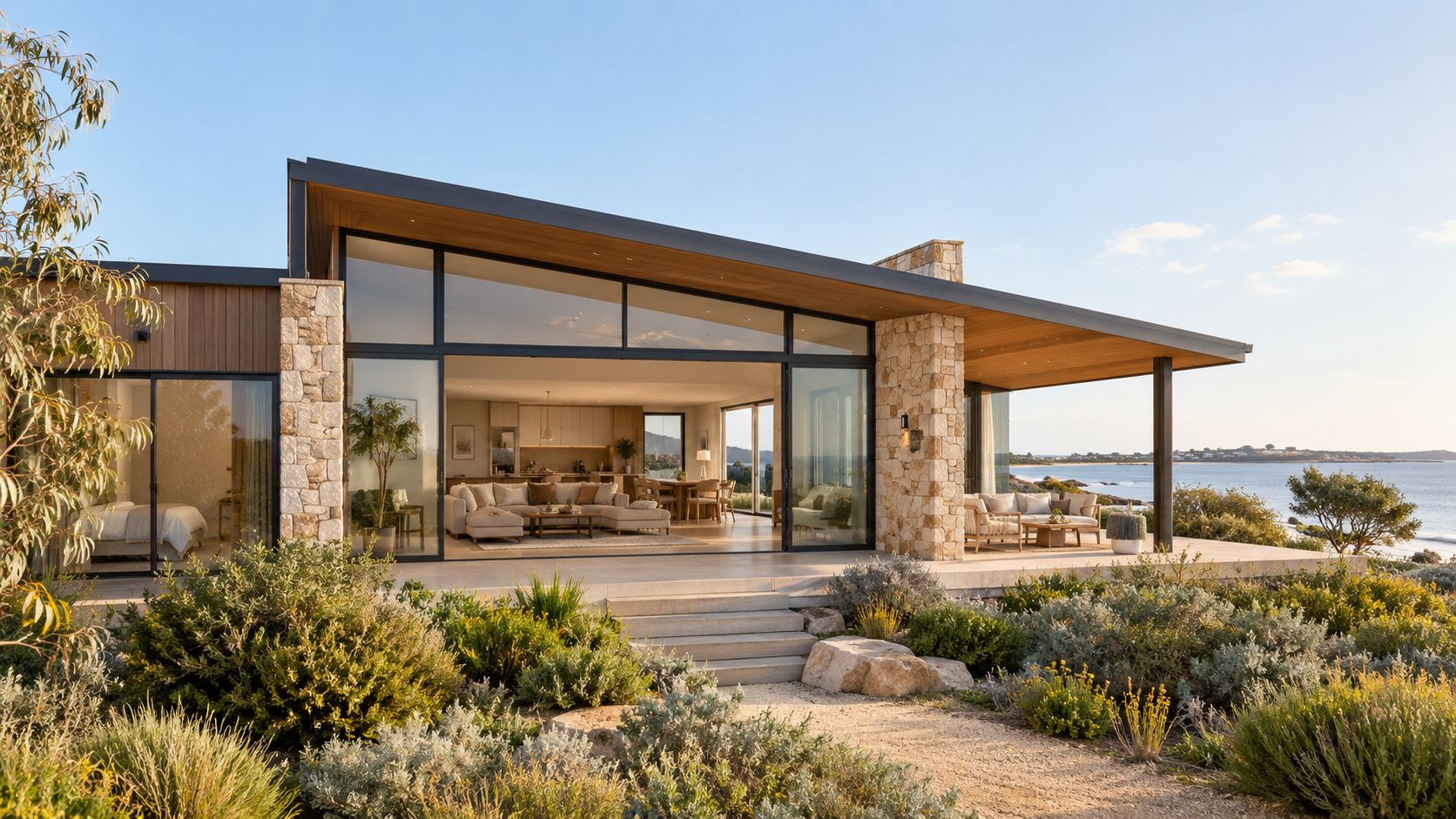
Western Australia's housing context makes this especially relevant. The BCEC's Building the Dream report records around 884,600 separate houses in WA, representing 77.4% of the state's total dwelling stock in the 2021 Census. That scale means sustainable upgrades such as solar, high-performance envelopes and passive cooling are relevant to the mainstream detached-home market, not only to specialist architectural projects. The BCEC report provides useful context for understanding why standalone homes have room for more integrated sustainability measures.
Local perspective: In Mandurah, sustainable luxury is best understood as coastal performance. The home should feel easier to live in, not merely easier to market.
This guide considers the subject from a homeowner's, buyer's, seller's and investor's perspective. It moves from the underlying idea of performance-led design to practical features, WA standards, market value and campaign presentation. For broader guidance on the local market, homeowners can also explore Mandurah real estate services, particularly when sustainability forms part of a wider sale or appraisal decision.
What Defines a Sustainable Luxury Home Today
A conventional luxury home often begins with appearance. A sustainable luxury home begins with how the building performs, then expresses that performance through elegant architecture.
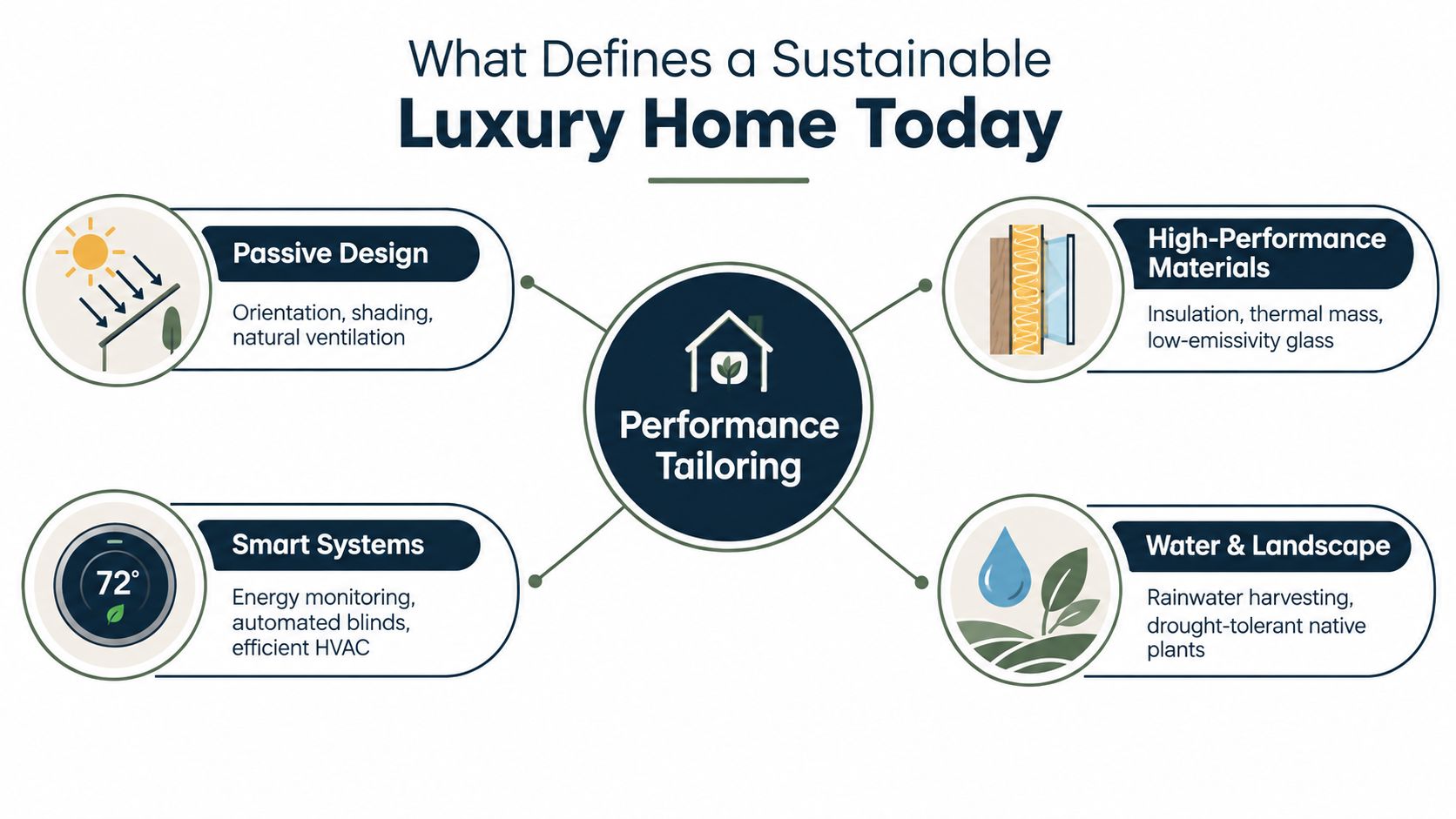
A useful analogy is clothing. Surface styling is like choosing an expensive fabric and attractive buttons. Performance tailoring considers the fit, movement, climate and purpose before the final finish. In a home, that means orientation, insulation, glazing, shading, ventilation, energy systems, water management and material selection should work together rather than appear as unrelated additions.
Luxury that works quietly
The best sustainable features often go unnoticed during a short inspection. Buyers may notice that a room feels calm, that afternoon glare is controlled or that the home remains comfortable without an air conditioner running constantly. They may not immediately see the insulation, thermal mass or airtight construction that creates that experience.
That doesn't make the hidden elements less valuable. A premium home should provide stable comfort, with fewer sharp temperature changes and less background noise from equipment working hard to compensate for poor design. Automated blinds, energy monitoring and efficient heating and cooling can add convenience, but they work best when the architecture has already reduced the building's demands.
A connected system, not a feature list
Solar panels alone don't define sustainability. Nor does a smart thermostat, a rainwater tank or a fashionable recycled finish. The meaningful question is whether the home's components support one another.
A detached residence generally offers more scope for this integration. WA's housing stock is dominated by separate houses, as the BCEC data cited earlier demonstrates, and homes in areas such as Meadow Springs, Halls Head and Dudley Park can often accommodate larger roof areas, considered window placement, planning and water infrastructure.
Look for these signs of a coherent approach:
- Passive response: The plan uses orientation, shading and breezes before relying on equipment.
- Thermal control: Walls, roofs, floors and windows limit unwanted heat transfer.
- Measured systems: Energy and water technology supports the building rather than disguising poor performance.
- Durable detailing: Materials and fittings suit exposure to salt air, sun and changing outdoor conditions.
- Clear evidence: Ratings, certificates, specifications and operating information support the claims.
For homeowners assessing an established property, a home may already have some of these qualities without being formally described as sustainable. A north-facing living zone, well-designed eaves, cross-ventilation and quality insulation can be valuable even when the original marketing focused only on views and finishes. More guidance on positioning these elements within a property campaign is available through green real estate guidance for Mandurah.
Key Sustainable Features for Coastal Climate Homes
Mandurah's coastal setting rewards design that responds to heat, glare, sea breezes, salt air and water use. The most valuable features aren't selected in isolation. Their benefit comes from the way they reduce the home's dependence on mechanical systems while improving the daily experience.
Start with orientation and airflow
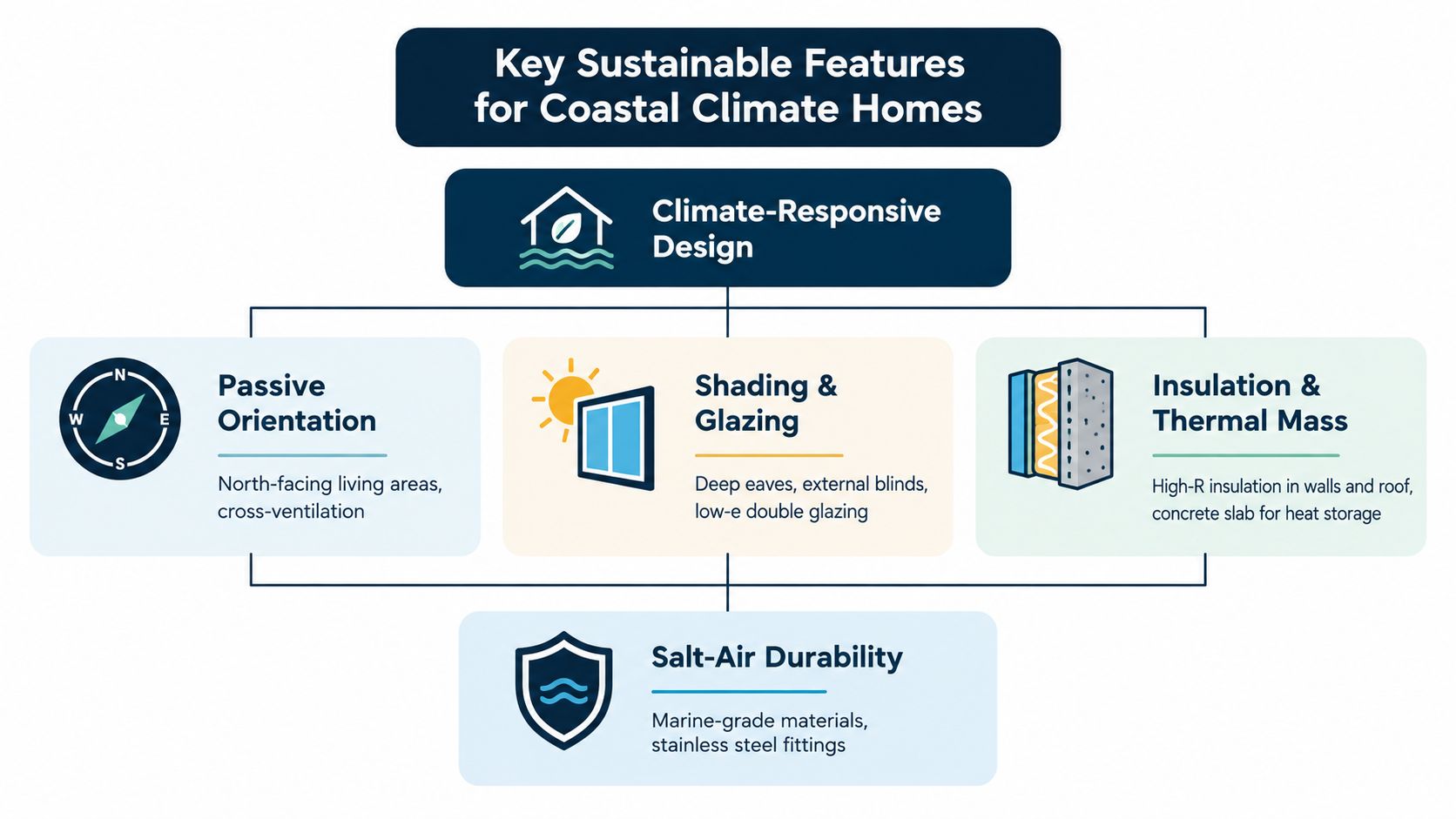
WA guidance recommends placing primary living areas and major glazing towards the north, while controlling east and west sun with shading. North-facing windows can admit useful winter sun, while carefully designed shading helps block high summer sun. In a premium home, deep eaves, pergolas, external blinds and screening should feel like part of the architecture rather than later additions.
Cross-ventilation is equally important. Windows positioned to capture sea breezes can help move warm air through the home, especially when rooms have openings on opposing or adjacent sides. This approach suits homes in Falcon, Wannanup and Madora Bay, where coastal outlooks and outdoor living are often central to the design.
Build a stronger thermal envelope
Insulation in the roof and walls reduces heat entering the home. Airtightness limits uncontrolled air movement, while double glazing and low-emissivity glass can reduce heat transfer and glare. These features matter most when combined with the orientation and shading strategy, because a highly glazed room still needs protection from intense solar gain.
Thermal mass, such as a concrete slab, can moderate temperature changes by absorbing and releasing heat gradually. The YourHome Perth case study reports a dwelling with heating demand of 0 MJ/m²/year and cooling demand of 3 MJ/m²/year, attributing the result to integrated measures including thermal mass, insulation, double glazing, solar systems, water reuse and sea-breeze ventilation. The Perth case study on YourHome offers a useful benchmark for understanding why combinations matter more than isolated products.
Add systems that support the design
Solar photovoltaic panels can generate electricity, while solar hot water can reduce the energy required for domestic hot water. Battery storage may help a household use more of its generated energy when solar production isn't available, but buyers will want clear information about system age, capacity, warranties and maintenance.
Water resilience deserves equal attention. Rainwater storage can support appropriate household or garden uses, while greywater systems may reduce demand for treated mains water where they're designed and maintained correctly. Drought-tolerant native planting can lower irrigation pressure without compromising a polished garden.
Low-embodied-energy materials also have a place in the specification. Their value should be considered alongside durability, maintenance, salt-air exposure and the overall design life of the home. In coastal suburbs, a material that looks sustainable but deteriorates quickly may not be a responsible premium choice.
For owners considering solar as part of a broader upgrade or sale strategy, solar panels in Mandurah can be assessed alongside insulation, glazing, shading and water systems.
A practical inspection should ask whether these elements work as one system. A house with solar but poor shading may still overheat. A home with a rainwater tank but an inefficient garden may still use excessive water. The premium lies in integration, quiet operation and evidence that the design suits the site.
Certifications and Energy Standards Shaping WA Homes
Energy ratings can confuse buyers because a star score is only one part of a home's performance story. The score provides a benchmark, while the design choices behind it explain how the home achieves comfort and energy efficiency.
WA's energy-code history shows a clear tightening of expectations. The State Building Code Council says the first statewide energy code was adopted in 1986, and notes that the 2018 residential code became effective on 1 February 2021. The 2021 WA State Energy Code became effective across all counties and cities on 15 March 2024. The State Building Code Council's energy-code information sets out this progression.
What the stars mean in practical terms
New-home energy efficiency in WA is commonly discussed as a 6-star rating on a 1-to-10 scale. That is a minimum reference point, not a description of premium performance. WA government guidance frames 10 stars as a home that needs no artificial heating or cooling even during WA's hot summers. The WA government's home energy guidance links this outcome to orientation, north-facing windows and shading.
From a buyer's perspective, a star rating should prompt practical questions:
- Where is the glazing located? Large west-facing glass needs careful control.
- How does the home ventilate? Natural airflow can reduce reliance on mechanical cooling.
- What supports the score? Insulation, thermal mass, glazing and shading should be understood together.
- What systems are included? Heating, cooling, hot water and energy generation affect whole-of-home performance.
The 2025 baseline and future expectations
WA adopted mandatory 7-star and whole-of-home energy-efficiency provisions for new homes from 1 May 2025, according to the Domain sustainability research cited in the verified market data. That change means a newly built home in Lakelands, Halls Head or Dudley Park may be assessed against a stronger baseline than an established prestige home nearby.
The difference matters when buyers compare properties. An older home may have exceptional architecture and a desirable position, but if it lacks effective shading, efficient systems or a well-performing envelope, buyers may price in future work. The policy trajectory also supports a long-term goal of increasingly energy-efficient homes by 2031, as noted by the State Building Code Council.
NatHERS and whole-of-home assessments should therefore be treated as useful evidence, not paperwork to hide in a file. A seller who can explain the rating, systems, maintenance history and comfort benefits gives buyers a clearer basis for comparison.
Mandurah Market Demand and Value Implications for Sustainable Homes
Sustainability can support value, but it shouldn't be treated as an automatic premium. Buyers respond to performance when they can understand it, verify it and connect it to their own costs and comfort.
Mandurah's pricing context also requires care. One independent snapshot placed the Mandurah SA3 median house price at $831,500 for the 12 months to May 2026. A separate suburb profile reported $765,000, with data updated 15 September 2026 for the 12 months ending August 2026. These figures differ because the geography and measurement windows differ, which is exactly why an appraisal should use comparable properties from the relevant suburb and period. The Mandurah market snapshot illustrates the importance of checking the definition behind any median.
Medium-term growth has also been substantial. One source reported the median house price rising from $291,000 in July 2021 to $651,000 in June 2026, a 123.5% increase over five years. The Mandurah market analysis provides context for the way sustained coastal demand can reshape local values, including in Lakelands, Madora Bay, Halls Head and Falcon.
What buyers can actually assess
Solar is no longer a novel feature. Domain's sustainability research says solar is present in nearly 38% of houses sold nationwide, while also reporting that energy-efficient homes sell for a premium of about $125,000 for houses, and green homes sell for $118,000 more on average. Domain's sustainability research supplies national context, not a direct Mandurah valuation formula.
For local premium buyers, the more useful question is whether the feature improves the property's lived experience and can be documented.
| Feature Category | Buyer Value Signal | Coastal Relevance |
|---|---|---|
| Solar and battery storage | Clear system details, installation records and operating information | Can support energy independence and resilience, subject to system condition |
| Low-emissivity glazing | Reduced glare, improved comfort and quieter interiors | Useful where large windows face strong afternoon sun or exposed coastal conditions |
| Water efficiency | Rainwater storage, sensible irrigation and appropriate reuse systems | Helps address garden demand and long-term water resilience |
| Gas-free design | Efficient electric systems with clear specifications | Aligns with buyers comparing newer homes and whole-of-home performance |
| Ratings and insulation | Verifiable performance rather than broad environmental language | Helps established homes compete with stronger new-build standards |
Sustainable improvements may support marketability, buyer confidence and resale differentiation, but their contribution depends on location, architecture, condition, presentation and comparable sales. Sellers should consider what affects property value before assuming that every green-labelled feature adds the same amount.
Marketing and Presentation Strategies for Sustainable Luxury Sellers
A sustainable home needs a campaign that translates technical performance into a clear coastal lifestyle. Listing “eco-friendly features” without evidence can sound vague. A better approach explains what the owner will notice, how the system works and what documentation supports the description.
Start with a fact sheet. Include the relevant rating, glazing specification, solar and battery details, hot-water system, rainwater storage, insulation information and any available energy or water records. Avoid promising savings unless the figures relate specifically to the home and can be substantiated.
Turn performance into lived experience
Premium buyers may respond to practical details such as:
- Afternoon comfort: Explain how eaves, external blinds or planting manage western sun.
- Natural airflow: Identify rooms designed for cross-ventilation and sea-breeze capture.
- Quiet interiors: Describe glazing and envelope features that contribute to a calmer indoor environment.
- Water management: Show tank locations, irrigation zones and choices during the inspection.
- System confidence: Keep warranties, service records and installation documents organised.
The inspection itself can demonstrate performance without theatrical claims. Open the appropriate windows, show automated blinds in operation and explain how the home is used on a hot day. If energy bills are available, present them as household-specific information rather than a guarantee for future owners.
Photograph the architecture, not the equipment
Sustainable luxury should still look luxurious. Use cinematic images that show shaded outdoor entertaining, controlled daylight, refined materials, coastal planting and the relationship between indoor and outdoor spaces. The visual direction should favour muted luxury tones, architectural composition and natural texture rather than bright, generic stock imagery.
Campaign language should also reflect the micro-market. A home in Lakelands may appeal to buyers seeking efficient family living, while a property in Halls Head, Falcon or Wannanup may place greater emphasis on coastal comfort, entertaining and outlook. Madora Bay and Meadow Springs require their own comparison set, rather than being grouped into a broad Mandurah description.
Evidence before adjectives: Describe the feature, show its documentation and connect it to comfort. Don't label a home “sustainable” unless the details support the claim.
A precise campaign can help qualified buyers recognise value before they compare the property solely on finishes or land size. It also gives the seller's agent a stronger basis for answering questions during inspections and negotiations.
Appraisal and Investment Considerations Across Mandurah Suburbs
Mandurah isn't one uniform property market. It contains 18 suburbs and localities, including Lakelands, Madora Bay, Meadow Springs, Halls Head, Falcon, Wannanup and Dudley Park, as recorded in the Mandurah suburb market overview. Each area contains different housing stock, buyer motivations, streetscapes and relationships with the coast, waterways, schools and services.
A sustainable luxury appraisal should therefore use a focused framework.
Assess the property in four passes
First, establish the baseline. Confirm the exact suburb, property type, land characteristics, age, renovation quality and presentation. A broad Mandurah median can't replace comparable sales from the same micro-market and a matching sales period.
Second, identify performance evidence. Review ratings, insulation, glazing, shading, solar, hot water, water storage, ventilation and maintenance records. Separate installed and functioning features from aspirational language.
Third, test future exposure. Consider whether overheating, water use, salt-air deterioration or outdated energy performance could affect buyer confidence. Established prestige homes may be compared with properties built under the stronger 2025 WA provisions, so compliance and comfort should form part of the discussion.
Fourth, prioritise improvements. Not every upgrade deserves immediate investment. A seller may gain more from repairing failed shading, improving presentation and documenting an existing solar system than from adding an expensive feature with little relevance to the home's buyer group.
Investors should apply the same discipline. Sustainable credentials may strengthen tenant appeal, resale positioning and resilience, but the decision still depends on purchase price, condition, suburb demand and the cost of bringing the property to an appropriate performance standard. In coastal locations, water management and overheating deserve as much attention as energy generation.
An in-person appraisal is especially useful because a digital estimate can't fully assess shade, airflow, materials, maintenance or the quality of a retrofit. Owners considering a sale can review in-person property appraisal insight in Mandurah before committing to upgrades or a campaign timetable.
David Beshay Real Estate offers local property appraisals, campaign strategy and premium sales guidance for sustainable luxury homes across Mandurah and surrounding coastal suburbs. Visit David Beshay Real Estate to discuss how your home's comfort, energy performance, water resilience and architectural appeal can be positioned accurately for today's buyers.

