


So, what exactly are strata fees?
Think of them as a shared fund for your apartment or townhouse complex. Everyone chips in regularly to cover the upkeep of all the common areas. It's a bit like a group kitty for a shared holiday house – the money goes towards essentials like insurance, gardening, and fixing the roof, making sure the entire property stays in great shape for everyone.
Understanding Strata Fees in Mandurah
When you buy a unit, apartment, or townhouse in Mandurah, you’re not just getting the space inside your own four walls. You're also buying a slice of the common property—everything from the lobby and lifts to the swimming pool, gardens, and the building's actual structure.
Strata fees are the lifeblood that keeps this whole system running smoothly. They ensure all these shared spaces are properly maintained, insured, and managed for the benefit of all owners. If you're new to this kind of ownership, getting your head around what a strata title property is is the perfect place to start.
These regular payments, often called levies, are a crucial part of protecting and growing your investment. Without them, shared facilities would quickly fall into disrepair, which could drag down the value of every single unit in the complex.
What Are Your Contributions Actually For?
It helps to think of strata fees not as just another bill, but as a proactive investment in your property and the lifestyle that comes with it. All the owners' contributions are pooled together and managed by a strata manager or body corporate to cover a whole host of running costs. The main goal is to keep the building safe, clean, and financially healthy.
So, where does the money go? Here’s a quick rundown of some of the essential expenses:
- Maintenance and Repairs: This covers everything from fixing a leaky roof and servicing the lift to keeping the swimming pool sparkling.
- Building Insurance: A massive one. This protects the entire building structure against damage from things like fire or storms.
- Gardening and Cleaning: Pays for keeping the lawns mowed, gardens looking neat, and shared spaces like hallways and lobbies clean.
- Utilities for Common Areas: This is for the power in the carpark, the water for the gardens, and the gas for the communal BBQ area.
Let’s quickly break that down.
Strata Fees At a Glance
This table gives you a simple overview of what strata fees are all about.
| Component | What It Is | Why It's Important |
|---|---|---|
| Administration Fund | Covers the day-to-day running costs. | Keeps the lights on and the property ticking over smoothly. |
| Sinking Fund | A long-term savings account for major future works. | Prevents huge, unexpected bills for things like roof replacements. |
| Building Insurance | Protects the entire building structure and common areas. | A legal must-have that safeguards everyone's investment. |
| Common Area Maintenance | Pays for cleaning, gardening, and pool upkeep. | Ensures the property stays attractive and enjoyable to live in. |
Essentially, these fees ensure your property is well-managed and maintained without you having to deal with the hassle yourself.
In Western Australia, strata fees (or body corporate levies) are usually paid quarterly. It's worth noting that strata insurance premiums, which are a big slice of the pie, saw a modest national increase of 2.8% in the year to June 2025. You can dig deeper into these trends in the CHU 2025 State of the Strata Market report. This kind of careful financial planning is what helps everyone avoid getting hit with sudden, massive bills for unexpected repairs down the track.
Decoding Your Strata Fees: What You Actually Pay For
When you hand over your strata fees, that money doesn’t just vanish into one big account. It’s actually split into different funds, each with a very specific job to do, all aimed at keeping your property running smoothly—not just for today, but for years to come. Getting your head around this is the key to understanding the real value behind your strata contributions.
A good way to think about it is like managing your own household budget. You’ve got your everyday account for groceries and bills, a long-term savings account for that big holiday or new car, and maybe an emergency fund tucked away for when the unexpected happens. Strata schemes are run in a surprisingly similar way, using a few different types of levies to keep the property financially healthy.
This flowchart gives you a clear picture of how your total contribution is typically broken down.
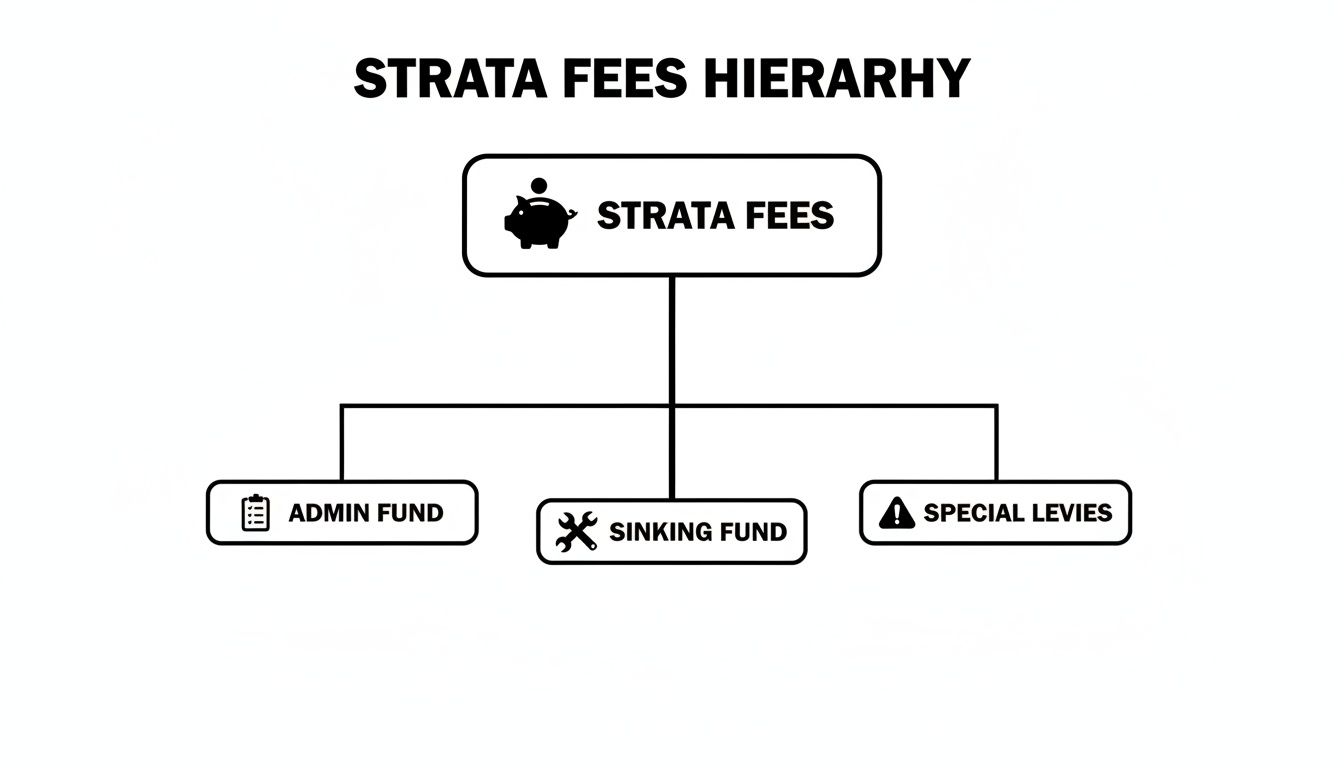
As you can see, your fees are carefully divided to cover everything from the daily grind to major future projects and those out-of-the-blue emergencies. It’s all about creating a balanced financial plan for the building.
The Administrative Fund: The Day-to-Day Operations
First up is the Administrative Fund. This is the real workhorse of your strata scheme, covering all the regular, predictable costs needed to keep the property clean, safe, and humming along every single day.
Think of it as the 'running costs' account for the entire complex. This fund is what pays for all the essential services that make strata living work.
Here’s a look at what the Administrative Fund usually covers:
- Building Insurance Premiums: A major, non-negotiable cost to protect the whole structure.
- Common Area Utilities: This is the power for lights in hallways and carparks, plus water for the gardens or pool.
- Regular Maintenance: Think contracts for gardeners, pool cleaners, lift servicing, and cleaners for the common areas.
- Strata Management Fees: Paying the professionals who handle the admin, chase up finances, and run the meetings.
- Minor Repairs: For fixing the little things, like a busted light in the lobby or a dripping tap in the shared laundry.
Building insurance is often the single biggest line item in this fund. With claims costs jumping by nearly 50% in just five years due to major weather events and rising material costs, insurance can easily eat up 40-60% of the total admin budget. A sharp strata manager in Mandurah will use this data to negotiate better renewal terms, helping to keep owner fees as reasonable as possible.
The Sinking Fund: Planning for the Future
Next, we have the Sinking Fund, which in Western Australia is also known as a Reserve Fund. This is the strata's long-term savings account, and frankly, it's one of the most critical parts of protecting your investment.
This fund is set aside purely for major capital works—the big-ticket items. We’re talking about replacing the roof, repainting the entire building, or overhauling the lift when they eventually wear out. A healthy sinking fund is the clearest sign of a well-run, forward-thinking strata scheme.
By putting money aside for future expenses, a strong sinking fund stops owners from getting slammed with a massive, unexpected bill when a major part of the building inevitably needs replacing.
The idea is to build up the funds bit by bit, so the cash is ready and waiting when it's needed. This avoids financial stress and keeps the building in top shape, which directly props up your property's value. You might find our guide on what are body corporate fees useful, as it touches on similar financial planning concepts.
The Special Levy: The Unexpected Emergencies
Finally, there are Special Levies. These aren't your regular, planned payments. Instead, they are one-off contributions demanded from all owners to cover urgent and unforeseen costs that the other two funds simply can't handle.
Let's be honest, nobody likes getting a special levy. It’s an extra, unbudgeted hit to the wallet. They are usually only raised when it’s absolutely essential to get critical work done.
A special levy might be needed if something like this happens:
- Emergency Repairs: Urgent structural damage after a massive storm that goes beyond what the insurance will cover.
- Legal Costs: An unexpected legal battle that the strata company has to fund.
- Project Cost Overruns: When a big job, like that roof replacement, ends up costing more than what was saved in the sinking fund.
While a special levy can be a pain, it’s a necessary tool to deal with serious issues quickly. However, a history of frequent special levies is a major red flag. It often points to poor long-term financial planning or a sinking fund that has been seriously neglected.
How Strata Fees Are Calculated

It’s a common misconception that strata fees are just a flat rate split evenly between everyone in the building. That’s not quite how it works. The system is actually designed to be much fairer, ensuring your contribution is proportional to the slice of the property you own.
This whole calculation boils down to a key concept called unit entitlement. You can think of it as your lot’s official "share" of the entire strata complex. This isn't just a number pulled out of thin air; it’s carefully determined when the strata plan is first registered, based on several factors.
Essentially, your unit entitlement reflects the relative value of your property compared to others in the scheme. A bigger, more valuable apartment will naturally have a higher entitlement, meaning it contributes a larger portion of the total fees.
Understanding Unit Entitlement
The logic behind unit entitlement is all about fairness. It makes sure that owners of larger or more premium units—which often use more common resources and get a bigger benefit from the property's overall value—pay a proportionally larger share of the upkeep.
So, what goes into deciding this value?
- Lot Size: It stands to reason that a sprawling three-bedroom apartment will have a higher unit entitlement than a compact one-bedder in the same building.
- Location within the Complex: A top-floor penthouse in Mandurah with sweeping ocean views will always carry a higher entitlement than a ground-floor unit facing the car park.
- Exclusive Use Areas: If your unit has special perks like a private courtyard or an oversized balcony, those features will also bump up its entitlement value.
Your unit entitlement is the key that unlocks how strata fees are calculated. It's a number that defines your financial stake and responsibility within the strata community, ensuring everyone pays their fair share of the shared expenses.
To work out your exact levy, the body corporate takes the total approved annual budget and divides it by the total unit entitlement of all lots added together. This gives them a cost-per-entitlement unit. Your individual fee is then found by multiplying this cost by your lot’s specific unit entitlement number.
A Practical Mandurah Example
Let's make this real. Picture a small, ten-unit apartment complex right on the Mandurah foreshore. The owners have agreed on an annual budget of $50,000 to cover all the admin and sinking fund costs for the year.
The total unit entitlement for the entire complex is 1,000.
Now, let's look at two different apartments in this building:
- Unit 2: A standard two-bedroom apartment with a unit entitlement of 90.
- Unit 10: The spacious penthouse with those stunning views, which has a higher unit entitlement of 140.
Here’s how the annual levy for each is calculated:
- Unit 2's Annual Fee: (90 / 1,000) * $50,000 = $4,500 (or $1,125 per quarter)
- Unit 10's Annual Fee: (140 / 1,000) * $50,000 = $7,000 (or $1,750 per quarter)
As you can see, the penthouse owner contributes significantly more to the building's upkeep, which perfectly reflects their larger share and greater value within the scheme.
Who Is Responsible for Paying Strata Fees
This one is simple: the legal responsibility to pay strata fees lies squarely with the current registered owner of the lot. It's not optional, and the obligation kicks in from the very day of settlement.
If you're selling your property, it's absolutely crucial that all your strata levies are paid up. Any outstanding fees will be flagged during the settlement process and must be cleared before the sale can go through, which usually means they're deducted from the sale proceeds.
A Local Look at Strata Fees in Mandurah and WA
When you start looking at property in Mandurah, strata fees stop being a vague concept and become a very local, practical matter. What you'll pay is shaped by everything that makes this part of Western Australia special, from the coastal lifestyle to the specific regulations we follow here. The costs aren’t just plucked out of thin air; they’re a direct reflection of the building itself, the perks it offers, and its place in our stunning city.
It makes sense that a high-rise apartment overlooking the Mandurah Ocean Marina will have completely different financial needs than a quiet townhouse complex back in Halls Head. Being close to the coast, for example, means higher maintenance costs are a given. The constant battle with salt spray corrosion on buildings, windows, and balustrades requires a seriously well-funded maintenance plan, which feeds directly into your regular levies.
Navigating the Strata Titles Act in WA
Here in Western Australia, every single strata scheme falls under the Strata Titles Act 1985 and its various updates. You don't need to be a lawyer to get the gist of it. At its core, the Act is simply a framework to make sure strata properties are managed fairly and that every owner's rights are protected.
This legislation lays down the ground rules for everything important, including:
- How owners' meetings (like the AGM) have to be conducted.
- The legal necessities for setting up and topping up both administrative and reserve funds (what we often call sinking funds).
- The proper way to pass by-laws that manage day-to-day life, covering things like pet policies or where you can park.
- Clear procedures for resolving disputes if disagreements pop up between owners or with the strata council.
Knowing this legal safety net is in place should give you real confidence as a buyer. It means there are formal, transparent processes for managing money and making decisions, so you’re not just stepping into a free-for-all.
What to Expect for Strata Fees in Mandurah
While every building has its own unique budget, we can definitely look at some typical ranges to help you get a feel for the numbers. A property's age, its overall condition, and the list of amenities are always the biggest cost drivers. An older building might have higher fees to cover more frequent repairs, while a brand-new complex with a pool, gym, and security will naturally charge for the upkeep of those luxury extras.
To give you a clearer picture, here’s a general guide to what you might expect to pay weekly for different types of properties around Mandurah.
Estimated Weekly Strata Fees in Mandurah (By Property Type)
This table breaks down some realistic budget estimates for different kinds of strata properties you'll find in the area.
| Property Type | Typical Weekly Fee Range (Low-End) | Typical Weekly Fee Range (High-End) | Common Amenities Included |
|---|---|---|---|
| Basic Townhouse Complex | $40 – $70 | $70 – $100+ | Basic gardening, building insurance, rubbish collection. |
| Modern Apartment (No Lift) | $60 – $90 | $90 – $130+ | Secure entry, common area cleaning, insurance. |
| High-Rise Apartment (With Lift & Pool) | $100 – $150 | $150 – $250+ | Lift maintenance, pool/gym upkeep, security, full-time caretaker. |
| Waterfront/Canal Property | $120 – $180 | $180 – $300+ | Jetty/boat ramp maintenance, seawall repairs, higher insurance. |
Keep in mind, these are just estimates, but they clearly show how much things can vary. A canal-front home in the Venetian Canals with its own private jetty will have far higher costs than a simple villa in Greenfields.
It’s absolutely crucial to look beyond the weekly cost and think about the value you're getting. High fees aren't automatically a red flag if they mean your property is impeccably maintained, fully insured, and has a healthy reserve fund for whatever the future holds.
This kind of forward-thinking is more important now than ever. With extreme weather events on the rise, repair and insurance costs have climbed nationally, hitting a staggering $22.5 billion over just five years. In a coastal city like Mandurah, a strata scheme that actively manages these risks and stays on top of building maintenance is essential to keep insurance premiums from going through the roof. For anyone wanting to dig deeper, MBCM's 2025 outlook on strata insurance trends is a great read. Ultimately, this proactive financial management is what protects your investment for the long haul.
Your Pre-Purchase Strata Investigation Checklist

Before you fall in love with a strata property and sign on the dotted line, it's time to put on your detective hat. A thorough investigation into the strata scheme's health is non-negotiable. It’s the single best way to avoid stepping into a financial minefield of special levies and spiralling costs.
Think of this process like getting a car inspected before you buy it. You wouldn’t just look at the paint job; you’d get a mechanic to check the engine, the transmission, and the service history. Reviewing strata documents is the property equivalent, giving you a clear view of what’s happening under the bonnet.
This checklist will guide you through the essential documents you need to request and review. Knowing what to look for will empower you to make a smart, informed decision, ensuring your dream Mandurah property doesn’t come with a nightmare of hidden financial issues.
Key Documents to Request and Scrutinise
Your first step is to get copies of the strata scheme's key records. These documents are your window into the financial and social health of the building. Don't be shy about asking for them; a transparent and well-managed strata scheme will have this information ready for serious buyers.
Here’s what you need to get your hands on:
- Recent AGM Minutes: The minutes from the last couple of Annual General Meetings are a goldmine of information.
- The Current Budget: This shows you exactly where the money is going right now, detailing all income and expenditure.
- The 10-Year Sinking Fund Plan: This long-term forecast is crucial for understanding how prepared the scheme is for major future expenses.
- The Strata By-laws: These are the rules of the community, covering everything from pets to parking.
A comprehensive review of these files can seem daunting, but it's an essential part of your due diligence. For a deeper understanding of the entire process, you might be interested in our guide on what a strata report is and why it's so valuable.
What to Look For in the Meeting Minutes
AGM minutes are more than just boring records; they are the unfiltered story of the building. As you read through them, you're looking for patterns and clues about the community's health.
Look specifically for discussions around:
- Ongoing Disputes: Are there repeated arguments between owners or with the strata council? Constant conflict can create a toxic living environment and may signal deeper management issues.
- Major Works: Pay close attention to any mention of upcoming projects like roof replacements, lift upgrades, or concrete cancer repairs. These are expensive jobs that could lead to a special levy if the sinking fund is short.
- Building Defects: Look for reports of water leaks, structural cracks, or other persistent problems. These can be incredibly costly to fix and are a major red flag if they aren't being properly addressed.
- Voting Patterns: Note how decisions are made. Are votes often contentious and narrowly passed, or is there a general consensus? This gives you a feel for the harmony (or lack thereof) within the community.
Think of the AGM minutes as the building's diary. They reveal not just the official decisions, but also the tensions, worries, and future challenges that the sales brochure will never mention.
Analysing the Financials and Spotting Red Flags
Once you have the budget and sinking fund plan, it’s time to crunch the numbers. You don’t need to be an accountant, but you do need a critical eye for signs of financial stress.
A poorly funded sinking fund is arguably the biggest red flag you can find. It’s a ticking time bomb, signalling that owners will almost certainly be hit with a large special levy when a major component of the building fails. Cross-reference the amount in the fund with the 10-year plan. If the balance is far below what’s projected, ask why.
Other financial warning signs include:
- High Arrears: A large number of owners being behind on their levy payments can starve the scheme of essential cash flow.
- Unrealistic Budgets: Does the budget seem too low for a building of its size and amenities? This could mean maintenance is being deferred to keep fees artificially low, which only kicks the can down the road.
- A History of Special Levies: If the scheme has a track record of raising special levies, it’s a clear sign of poor long-term financial planning.
What to Do About High Strata Fees
Knowing what strata fees are is one thing, but knowing what to do about them is where the real power lies. Whether you're a buyer spotting a potential red flag, a current owner watching costs creep up, or a seller prepping your property for the market, you have options.
It’s all about moving from being a passive observer to an active participant. This is how you manage these costs effectively and protect your investment.
For Current Mandurah Homeowners
If you're looking at your latest levy notice and wondering why the fees seem unreasonably high or have suddenly jumped, you have every right to get answers. Remember, you're a part-owner of the corporation, and transparency isn't just good practice—it's a legal requirement.
Your best and most powerful tool is your voice at the Annual General Meeting (AGM). This is the official forum where the budget gets debated, pulled apart, and ultimately approved.
Here’s how to make your presence count:
- Do Your Homework: The strata manager has to send out the proposed budget before the AGM. Don't just glance at it—scrutinise it. Look for big increases or line items that seem out of place.
- Ask the Tough Questions: At the meeting, don't be shy. Ask the strata council or manager to justify any significant cost hikes. Did the insurance premium double? Is there a pricey new maintenance contract? Make them explain it.
- Use Your Vote: Your vote is your power. If you and other owners feel the budget is bloated or irresponsible, you can vote against it and push for amendments.
- Get in the Driver's Seat: For maximum influence, think about running for a spot on the strata council. This puts you right at the centre of the decision-making process.
The strata council works for the owners, not the other way around. Getting involved ensures your money is spent wisely and that decisions serve the whole community, not just the path of least resistance.
For Prospective Buyers
As a buyer, your power is in your due diligence. You do it before you even think about making an offer. Asking the right questions upfront can save you from a world of financial headaches down the track.
Here are the non-negotiable questions to ask the real estate agent and strata manager:
- Are there any special levies on the horizon that have been planned or even just discussed?
- How healthy is the reserve (sinking) fund right now? What’s the exact balance?
- Have the regular levies gone up in the last three years? If so, by how much each year?
- Is the strata company involved in any legal disputes or major building defect claims?
- What percentage of owners are behind on their fee payments? (A high number is a major red flag).
Common Questions About Strata Fees
Stepping into the world of strata ownership often brings up a heap of questions, especially around the money side of things. It's completely normal. To help you feel confident and clear, we've tackled some of the most common queries we hear from buyers and owners right here in Mandurah.
Think of this as your quick-reference guide to reinforce what we've covered and clear up any of those lingering "what ifs."
Are Strata Fees Tax Deductible in Australia?
This is a fantastic question, and the answer really boils down to one thing: how you use the property.
If you're an investor renting out your strata unit, then generally, yes. The ATO typically views strata fees—both the day-to-day admin levies and the contributions to the sinking fund—as a necessary expense for earning rental income. That makes them tax-deductible.
But, if you live in the property as your main home, the fees are just part of your personal living costs. In this scenario, your strata contributions are not tax-deductible. It’s always a smart move to have a chat with your accountant for advice tailored to your personal situation.
Can Strata Fees Increase Without Warning?
In a word, no. Strata levies can't just be jacked up on a whim. Any proposed change to your regular fees has to be laid out in the annual budget.
This budget is then presented to every single owner for a vote at the Annual General Meeting (AGM). It takes a majority vote to get the new budget—and the new levy amounts—across the line.
This democratic process guarantees total transparency and gives every owner a voice in the building's financial future. The same rules apply for those unexpected special levies; they also need to be formally proposed and voted on.
What Happens If I Stop Paying My Strata Fees?
Falling behind on strata fees is something to avoid, as it can have serious consequences. These payments are the financial lifeblood of the entire complex.
Initially, the body corporate will likely charge interest on the overdue amount to encourage you to catch up.
If the debt continues to go unpaid, they can take legal action to recover the funds. This could escalate to a lien being placed on your property, which is a legal claim that must be paid in full before you can ever sell.
Do I Pay for Facilities I Never Use?
Yep, you do. Strata fees are designed to cover the maintenance and running costs of all common property, whether you personally use it or not.
Your contribution is worked out based on your unit entitlement, not how many laps you do in the pool or how often you use the lift. The upside is that these fees ensure every amenity is kept in top-notch condition, which boosts the value and appeal of every single property in the complex, including yours.
Feeling more clued-in on strata fees but still have questions about navigating the Mandurah market? As a local real estate specialist, David Beshay Real Estate can give you the clarity and expert guidance you're looking for. For a personalised strategy or a free property appraisal, get in touch at https://realestate-david-beshay.com.au.

