


When you're selling your house, the agent's fee is almost always the biggest single cost you'll face. It typically falls somewhere between 1.6% and 3.5% of your home's final sale price. The best way to think about it is as a 'success fee'—your agent only gets paid their commission when your property actually sells.
So, let's break down what that commission really covers.
What's Really Included in a Real Estate Commission?
At its heart, an agent's commission is their payment for a massive suite of services, all geared towards a single goal: getting you the best possible price for your home. It's so much more than just unlocking the front door for a few home opens. You're paying for their deep market knowledge, a strategic marketing plan, and sharp negotiation skills to steer the entire sale from listing to settlement.
This fee covers a huge range of critical jobs that happen behind the scenes, including:
- Carrying out a detailed property appraisal and crafting a smart pricing strategy.
- Developing and paying for a marketing campaign that reaches buyers across multiple channels.
- Organising professional photography, floor plans, and sometimes home staging.
- Fielding every single buyer enquiry and running all the inspections and home opens.
- Negotiating with potential buyers to push for the highest sale price.
Here in Australia, residential real estate commissions generally hover between 1.6% and 3.5%, with the national average sitting around the 2% to 2.5% mark. To put that in perspective, on a $700,000 sale, you could expect to pay anywhere from $11,200 to $24,500 in commission, depending on your location and the rate you've negotiated.
This chart gives you a quick visual on the typical low, average, and high commission rates you might come across.
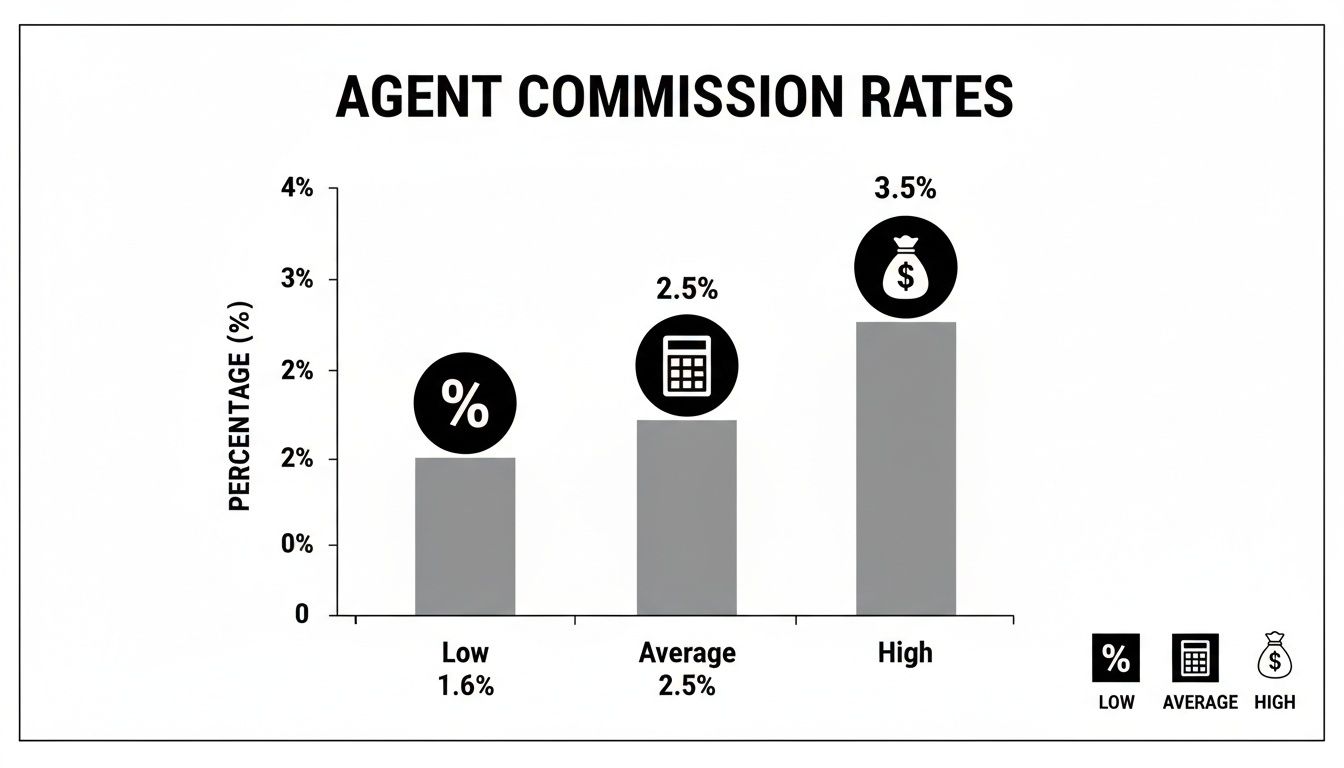
As you can see, while some rates can dip as low as 1.6%, the average is closer to 2.5%, which is the common ground for most agency agreements in Mandurah and across WA.
Key Takeaway: The agent's fee isn't just a random percentage. It’s a direct investment in professional expertise, resources, and a dedicated effort to secure a successful and profitable sale for you.
Of course, commission rates can vary quite a bit from state to state, influenced by local market conditions and property values.
Typical Real Estate Commission Rates Across Australian States
Here’s a quick-glance table to give you an idea of what to expect in different parts of the country.
| State / Territory | Typical Commission Range (%) | Estimated Fee on a $750,000 Sale |
|---|---|---|
| Western Australia | 2.0% – 3.0% | $15,000 – $22,500 |
| New South Wales | 1.8% – 2.5% | $13,500 – $18,750 |
| Victoria | 1.6% – 2.5% | $12,000 – $18,750 |
| Queensland | 2.5% – 3.0% | $18,750 – $22,500 |
| South Australia | 2.0% – 3.0% | $15,000 – $22,500 |
| Tasmania | 2.5% – 3.5% | $18,750 – $26,250 |
| ACT | 2.0% – 2.5% | $15,000 – $18,750 |
| Northern Territory | 2.5% – 3.0% | $18,750 – $22,500 |
Keep in mind these are just averages, but they paint a clear picture of the different fee structures nationwide.
However, the commission is just one piece of the puzzle. To get the full financial picture, it's crucial to be aware of other potential expenses like marketing and settlement costs. You can dive deeper into the complete breakdown in our detailed guide on how much selling a house costs. Understanding all these moving parts will empower you to have much more informed and confident conversations with potential agents.
Understanding Different Commission Structures
The percentage an agent quotes you is really just the starting point. When you’re digging into an agent's fee for selling a house, you have to look at how that fee is structured. This is super important because it directly impacts your agent's motivation and, ultimately, your final sale price.
Not all commission models work the same way. In Mandurah and across WA, you'll mostly come across two types: the standard fixed percentage commission and the more performance-driven tiered commission. Getting your head around the difference is crucial before you sit down to chat with potential agents.
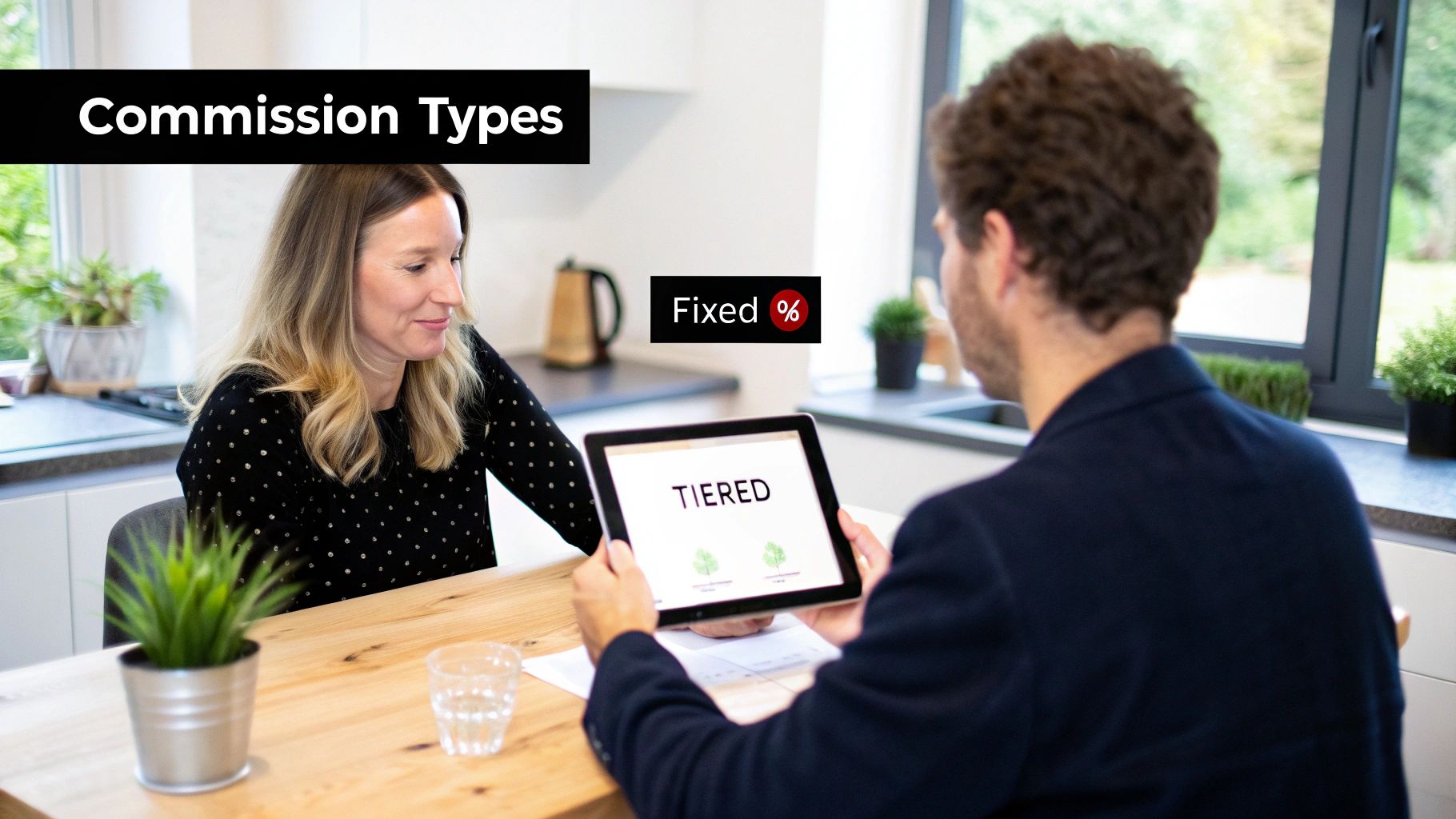
Here's a simple way to think about it: a fixed fee is like paying a straightforward salary, whereas a tiered fee is like a salary plus a hefty performance bonus. Both have their place, but one is specifically designed to reward an agent for knocking it out of the park.
Fixed Percentage Commission
A fixed percentage commission is the bread and butter of the real estate world in Australia. It’s simple, predictable, and easy to understand.
If you and your agent agree on a 2.5% commission and your home sells for $700,000, their fee is a flat $17,500 (plus GST). No surprises.
This model makes it easy to budget. The agent gets the same cut whether the final price is a little under, right on, or just over your target. While it's clear and simple, some sellers argue it doesn't give the agent a powerful enough reason to squeeze every last dollar out of a buyer.
Tiered Commission Structures
This is where things get interesting. A tiered commission (sometimes called an incentive or bonus commission) is built to get your agent fired up to smash your price goals. The model sets a target price, and the agent earns a much higher commission rate on any amount they achieve above that line.
A tiered commission lines up your financial goals perfectly with your agent's. When you get a fantastic sale price, they get a bigger payday—it creates a real partnership where everyone is pushing for the absolute best result.
Let's break down a real-world example:
- Base Rate: You might agree to a 2.2% commission on the sale price up to a target of $750,000.
- Bonus Tier: Then, you put a kicker in place—a juicy 10% on any amount achieved above $750,000.
If your home sells for $780,000, the agent’s fee is calculated in two parts. First, they get 2.2% of $750,000 ($16,500). Then, they get 10% of that extra $30,000 they fought for ($3,000).
Their total commission comes to $19,500, but you’re walking away with an extra $30,000 in your pocket. This structure gives agents a massive incentive to negotiate harder and aim for a premium price, because their own earnings jump significantly when they deliver for you.
Exploring Agent Fees in Western Australia
When you start looking into the agent's fee for selling a house in Western Australia, you’ll notice things are a bit different. While you might hear about national averages, the reality on the ground here in WA, from the Perth CBD to right here in Mandurah, is that commission rates can often be a touch higher. It’s not an arbitrary difference—it’s a direct reflection of our state’s unique economy and sprawling geography.
So, what’s driving this? A few key factors come into play. Property values, the level of competition between local agents, and the sheer scale of WA all have a part to play. Think about it: an agent selling apartments in a dense Perth suburb has very different costs and pressures compared to an agent who covers a much larger, more spread-out regional area.
Local Market Dynamics and Their Impact
One of the most important relationships to understand is the one between a property's value and the commission percentage. In areas with lower median house prices, it’s common for agents to negotiate a slightly higher percentage. This isn't about making more money; it’s about making sure the fee is enough to cover a comprehensive, high-quality marketing campaign and see the sale through to the end.
On the flip side, in Perth suburbs where property values are hitting eye-watering highs, you'll often see intense competition among agents for those top-tier listings. This can actually push the average commission rate down. As a seller in a premium market, you might find you have a bit more room to negotiate. Knowing where your own property fits into this picture is the first step in figuring out if the quotes you’re getting are fair. For a deeper dive, our guide on how much real estate agents cost breaks these factors down even further.
Why WA and NT Commissions Can Be Higher
Look at the data, and you’ll often see Western Australia and the Northern Territory reporting commission averages sitting somewhere in the 2.8%–3.5% range. This is often a result of those lower average sale prices in certain regions combined with higher operational costs for agents. A higher percentage is simply what’s needed to sustain a full-service agency. You can find more state-by-state insights from OpenAgent's analysis.
The Mandurah Context: Here in the Mandurah property market, sellers usually find a pretty balanced situation. We don't quite hit the peak prices of Perth's most exclusive suburbs, but strong, consistent buyer demand and healthy property values mean it’s a competitive field for agents. The result? Fair and negotiable commission rates for sellers.
Let’s put this into a real-world scenario. Selling a $500,000 home in a regional town might reasonably attract a 3.0% commission ($15,000), which properly reflects the agent's investment. In contrast, a $1.2 million property in a hot metro suburb could secure a 2.2% rate ($26,400). Even though the percentage is lower, the much higher sale price means the final fee still fairly compensates the agent for their work.
Uncovering Costs Beyond the Commission
Thinking the agent’s fee is the only major expense when selling your house is a common and easy mistake to make. While the commission is definitely the largest piece of the financial puzzle, there are several other costs that pop up along the way.
These can catch sellers by surprise if they haven't budgeted for them. Often, they’re upfront expenses you’ll need to pay out of pocket before you even get to settlement day.
Most of these extra costs fall under the banner of marketing and advertising. Let’s be honest, to attract the best buyers and get a top-dollar price, your property needs to be presented professionally and seen by as many people as possible. This is where a dedicated marketing budget comes in, completely separate from the agent's commission.
It's important to understand that these advertising costs aren't profit for the agent. They are direct payments to third-party suppliers—photographers, sign makers, online portals—to make your listing shine. Think of it as a necessary investment to maximise your final sale price.
Breaking Down the Marketing Budget
A solid marketing campaign isn’t just one thing; it's a multi-faceted strategy designed to capture buyer attention from day one. Your agent will propose a plan, but it’s crucial you understand exactly what you're paying for.
Common marketing expenses usually include:
- Professional Photography and Videography: High-quality visuals are non-negotiable in today's market. This means crisp photos, a detailed floor plan, and often a compelling video tour to engage those scrolling online.
- Premier Online Listings: To stand out on major portals like realestate.com.au, a premier or feature listing is vital. It pushes your property to the top of the search results, ensuring it gets seen first and by more people.
- Signage: A professional "For Sale" board is still a powerful local marketing tool. It grabs the interest of neighbours and passers-by who might know someone looking to move into the area.
- Print Advertising: Depending on the type of home and the likely buyer, advertising in local property guides or newspapers can still be an effective way to reach a specific audience.
While commission rates are a significant part of the transaction, these additional marketing expenses are what give your property the competitive edge it needs to secure a top-dollar offer.
Common Additional Costs When Selling a House
To give you a clearer picture, here’s a breakdown of some of the typical marketing and administrative costs you might encounter. Keep in mind these are separate from the agent’s commission.
| Expense Item | Description | Estimated Cost Range (AUD) |
|---|---|---|
| Professional Photography | A package including high-resolution images of the interior, exterior, and key features. | $400 – $800 |
| Videography/Virtual Tour | A walkthrough video or 3D tour to give potential buyers an immersive online viewing experience. | $500 – $1,500 |
| Floor Plan | A professionally drawn floor plan with room dimensions, essential for helping buyers visualise the space. | $150 – $300 |
| Online Portal Advertising | Fees for premium or feature listings on major real estate websites like realestate.com.au or Domain to boost visibility. | $800 – $3,000+ |
| For Sale Signboard | The cost to design, print, and install a professional signboard at the front of your property. | $150 – $500 |
| Print Advertising | Placements in local newspapers or real estate magazines, which can be effective for certain properties. | $300 – $2,000+ |
| Auctioneer Fee | A separate fee paid directly to the auctioneer if you choose to sell your property via auction. | $500 – $1,000 |
| Conveyancing/Legal Fees | The cost for a licensed conveyancer or solicitor to handle all the legal paperwork for the transfer of ownership. | $800 – $2,200 |
| Home Staging/Styling | Optional service where a professional furnishes and decorates your home to appeal to the widest range of buyers. | $2,000 – $8,000+ |
These costs are a crucial part of building a realistic budget. Being prepared for them ensures there are no financial surprises as you move towards a successful sale.
Other Potential Selling Costs
Beyond the marketing, a couple of other fees can come into play. If you decide to sell your home via auction, you will need to pay an auctioneer’s fee, which is completely separate from your agent’s commission.
And of course, don't forget the legal side of things. You'll need a solicitor or conveyancer to handle all the legal paperwork. Our guide on the cost of a solicitor to sell a house gives you a much more detailed breakdown of what to expect there.
The real estate services sector is a massive industry in this country, with 2024–25 revenue estimated at a staggering $30.9 billion in Australia alone. This just goes to show how many moving parts and different professionals are involved in every single property sale. You can discover more insights about the Australian real estate services industry on ibisworld.com.
Knowing about all these potential costs from the start helps you build a realistic budget and avoids any last-minute financial stress.
Of course. Here is the rewritten section, crafted to sound like an experienced human expert while adhering to all your requirements.
How to Negotiate Your Agent's Fee
Let's be honest, talking about money can feel a bit awkward. Many sellers feel uncomfortable discussing an agent's commission, but it's a conversation you absolutely need to have. Negotiation is a standard, expected part of the real estate world, and any agent worth their salt will be ready to talk openly about their fee structure and the value they bring to the table.
The trick isn't just to ask for a discount. A smart negotiation is about understanding exactly what you’re paying for and making sure the fee aligns with the agent’s strategy, service, and the result you're aiming for. Remember, a cheap agent often isn't a good one. The real goal is to land on a fair fee without sacrificing the quality of service that will get you the best possible sale price.
Come Prepared for the Conversation
Walking into a meeting with an agent without doing your homework is like going into an exam without studying—you’re immediately on the back foot. To negotiate with confidence, you need to show you understand the local market and have clear, realistic expectations.
Before you even think about talking numbers, get these ducks in a row:
- Know Your Local Market: Jump on the property portals and research what similar homes in your suburb have sold for recently. When you have a solid grasp of comparable sales, you can base your discussion on facts, not guesswork.
- Understand Current Conditions: Is it a seller's market where homes are flying off the shelf, or a buyer's market where things are a bit sluggish? The state of the market has a huge impact on an agent’s strategy and how flexible they might be with their fees.
Your strongest negotiating tool is being an informed seller. When you can speak confidently about property values and market trends, you shift the conversation from simply asking for a lower rate to collaborating on a fair partnership.
The Power of Multiple Proposals
Here's the single most effective strategy for negotiating your agent's fee: interview multiple agents. Don't just pick one and try to haggle them down. By getting proposals from at least three different local agents, you naturally create leverage for yourself.
This approach instantly gives you a clear picture of the typical commission range in your area. If two agents propose a rate around 2.5% and a third comes in at 3.2%, you have every right to ask why theirs is higher. It also lets you compare their marketing plans and budgets side-by-side, which is arguably just as important as the commission rate itself.
Focus on Value, Not Just Price
While a lower percentage looks great on paper, don't let it be the only thing you focus on. An agent who drops their commission at the first sign of pressure might be just as quick to pressure you into dropping your asking price for a quick sale.
Instead, frame the negotiation around the value they deliver. Get them to justify their fee by asking sharp, probing questions:
- What is your specific marketing plan for my property?
- Can you show me results from recent sales you've managed in my area?
- How will you handle negotiations with buyers to get me the highest possible price?
When you link the fee directly to their performance and marketing investment, you ensure you’re not just picking the cheapest agent, but the one who offers the best return. Sometimes, paying a slightly higher fee to a top-performing agent with a killer strategy can mean walking away with tens of thousands more in your pocket at settlement.
Of course, percentages and fee structures are one thing, but seeing how it all plays out in the real world is another. To really get a handle on what an agent's fee for selling house means for your final payout, let's walk through a couple of practical scenarios.
This is where the numbers become tangible. We'll look at how different commission models and marketing costs affect the bottom line for different types of properties. Seeing the final amount left in a seller's pocket really drives home how important these decisions are.
Scenario One: The Suburban Family Home
Let’s imagine the Jacksons, who are selling their four-bedroom home in a popular Mandurah suburb. Their agent has quoted a straightforward fixed commission of 2.5% and proposed a marketing budget of $2,500. After a great campaign, the home sells for $750,000.
Here’s how their costs would look:
- Agent's Commission: $750,000 x 2.5% = $18,750
- Marketing Costs: $2,500
- Total Selling Costs: $18,750 + $2,500 = $21,250
After these expenses are deducted (not including other costs like conveyancing), the Jacksons walk away with $728,750. This simple, fixed structure is easy to understand and predictable right from the start.
Scenario Two: The City Apartment with a Tiered Fee
Now, let's consider Chloe. She's selling her modern two-bedroom apartment, and her agent wants to use a performance-based tiered commission to really push for a top-dollar sale. They agree on a 2.2% commission up to her target of $550,000, with a juicy 10% incentive on anything achieved above that. The marketing package comes in at $1,800.
Thanks to some sharp negotiation from the agent, the apartment sells for a fantastic $575,000.
This is exactly where a tiered model proves its worth. It gives the agent a powerful reason to smash expectations because their financial success is tied directly to the seller's. A great result for one is a great result for both.
Let’s run the numbers on Chloe's total fee:
- Base Commission: $550,000 x 2.2% = $12,100
- Bonus Commission: $25,000 (the amount over $550k) x 10% = $2,500
- Total Commission: $12,100 + $2,500 = $14,600
- Marketing Costs: $1,800
- Total Selling Costs: $14,600 + $1,800 = $16,400
Chloe’s net proceeds before other costs are $558,600. While her total fee is higher than a simple fixed rate might have been, she's actually $25,000 better off on her sale price. These examples prove there's more to consider than just the headline percentage.
Of course. Here is the rewritten section, adopting a natural, expert tone that aligns with the provided examples.
Frequently Asked Questions About Selling Fees
Even after we’ve walked through commissions and marketing costs, a few practical questions always seem to pop up. It’s completely normal. Let’s tackle some of the most common queries I hear from sellers about the agent’s fee for selling a house. My goal is to give you clear, straight-up answers so you feel confident and prepared.
Is The Agents Fee for Selling a House Inclusive of GST?
That's a great question, and the answer is almost always no. The commission rate an agent quotes you won't include GST. You’ll need to account for an extra 10% on top of whatever the final commission amount is.
So, if the calculated commission works out to be $20,000, the actual amount you'll pay at settlement is $22,000. It's a critical detail to lock down early. Always ask your agent to confirm this and check that the final agreement clearly states whether GST is included or excluded. A simple check now can save you a nasty surprise later on.
Do I Have to Pay a Commission If My House Does Not Sell?
For the most part, no. The vast majority of real estate agents here in Australia work on a "no sale, no fee" basis. This structure means the agent only gets paid their commission once your property successfully sells and the deal settles. It’s what keeps us motivated to get the best result for you.
Important Distinction: While you won't pay the commission if there's no sale, you will likely still be on the hook for any marketing and advertising costs you agreed to upfront. These are real expenses paid out to third parties like photographers or property websites and are typically non-refundable.
Can I Sell My House Privately to Avoid Agent Fees?
Yes, you absolutely can. Selling your home yourself, often called a For Sale By Owner (FSBO), is one way to completely avoid paying an agents fee for selling a house. On the surface, it seems like a straightforward way to save money.
However, going down this path means you're taking on every single job an agent would normally handle. We're talking about everything from accurately pricing your home and funding a professional marketing campaign to running open homes, handling all the buyer negotiations, and navigating the complex legal paperwork. While you save on the commission, it’s a massive commitment of your time and expertise—and studies often show that properties sold with an agent achieve a higher final sale price anyway.
Feeling clearer about the costs involved? The next step is getting a precise, data-backed valuation for your property. At David Beshay Real Estate, we provide a complimentary, no-obligation property appraisal to help you understand your home's current market value in Mandurah.
Start your selling journey with confidence by booking your free appraisal.

