


Most sellers are told to chase the highest headline price and treat everything else as detail. That advice is backwards. In Mandurah, the format you choose shapes who competes, how clean the contract is, and whether settlement happens. Direction matters before price does.
Table of Contents
- Why Auction Direction Matters More Than the Final Price
- Understanding Forward and Reverse Auction Foundations
- Comparing Control Transparency and Price Discovery
- How Each Residential Auction Process Actually Works
- Weighing Seller and Investor Trade-Offs
- Choosing the Right Method by Property and Buyer
- Apply a Practical Auction Choice Framework
Why Auction Direction Matters More Than the Final Price
A seller in Halls Head recently weighing up campaign options faced a simple question with a complicated answer. Should buyers be encouraged to bid upward for a coastal home, or would asking competing parties to sharpen offers downward somehow produce a better result? The lower final offer isn't automatically the smarter outcome, and for a home sale it usually points the competition in the wrong direction.

The forward auction vs reverse auction choice isn't just about whether a number rises or falls. It determines who sets the terms, who does the competing, and what information everyone can see. It also affects how much control a seller keeps once bidding starts and whether the winning party is ready to settle.
Price Is Only Part of the Outcome
A strong result in Falcon, Madora Bay or Meadow Springs combines several things at once. You need a defensible price, but you also need finance certainty, workable conditions, a realistic settlement window, and buyers who've inspected properly and read the contract. A format that produces a number while undermining any of those elements hasn't served you well.
For residential sales, the forward model is the standard mechanism for a reason. One home is offered, qualified buyers compete, and rising bids show you what the market will pay in real time. Reverse auction logic belongs mainly in procurement, where a buyer defines a scope and suppliers compete to deliver it for less.
That doesn't make reverse thinking useless to a Mandurah owner. It's highly useful when you're comparing building quotes, maintenance providers, campaign suppliers, or agent services against a clear specification. Used there, downward competition can protect your budget. Used to sell the home itself, it can anchor expectations lower and weaken the sense of scarcity that premium coastal stock depends on.
Judge a campaign by the quality of the contract it produces, not only by the number on the day.
Sellers, buyers and investors should therefore assess format against transparency, buyer confidence, and transaction quality together. When those three align, price discovery tends to take care of itself. When they don't, even a lively auction day can leave you renegotiating from a weaker position.
Understanding Forward and Reverse Auction Foundations
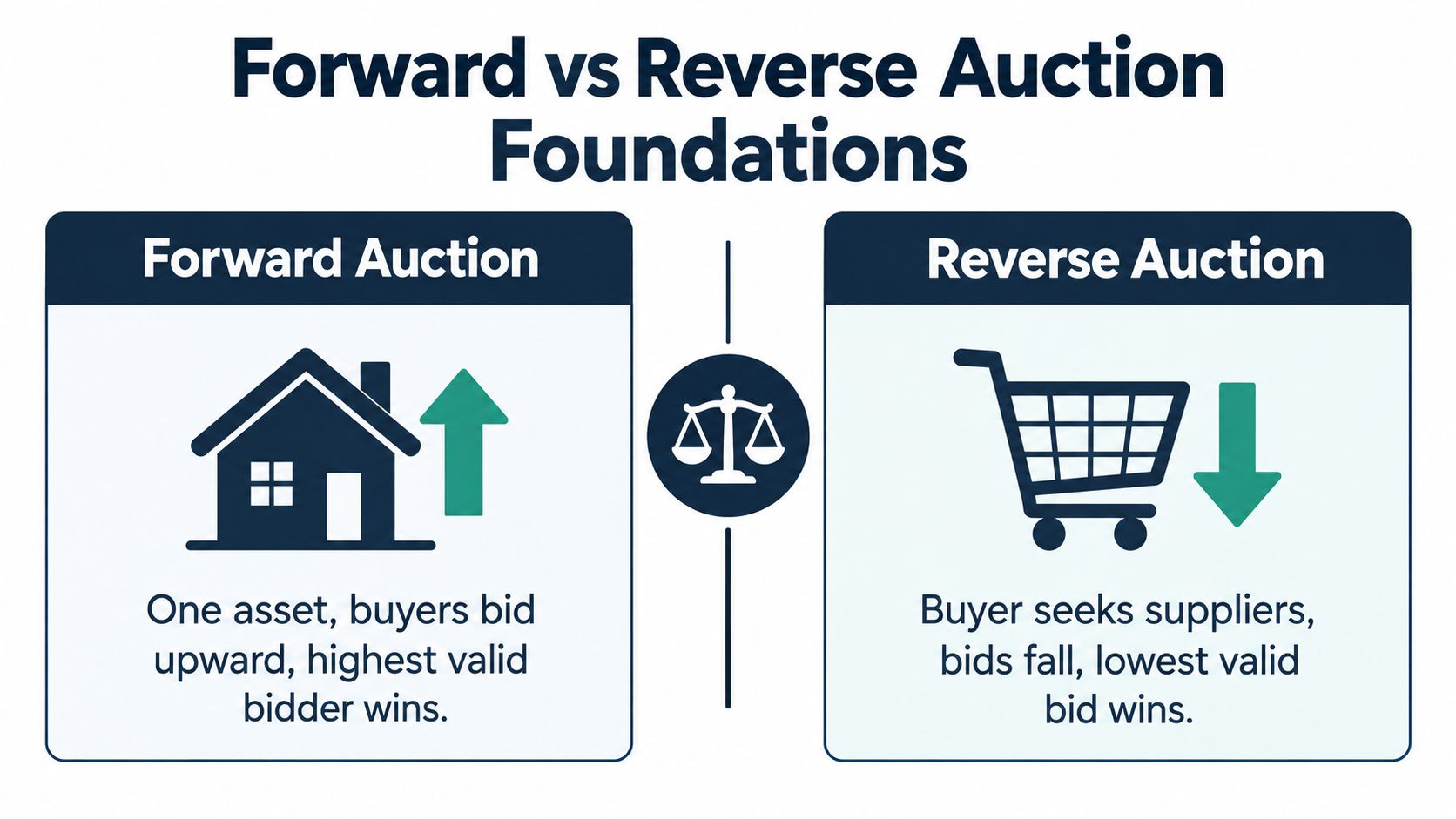
Start with who holds the scarce item. In a forward auction, the seller offers one asset and multiple buyers compete for it. Bids normally rise, and the highest valid bidder wins once the seller's reserve is met. That's the model you see when a family home in Lakelands or a waterfront property in Wannanup goes under the hammer.
In a reverse auction, the buyer holds the scarce opportunity instead. One buyer states what they need, whether that's construction work, a service contract, or a defined outcome, and suppliers compete by lowering their price or improving their terms. The award typically goes to the lowest compliant bid, not the cheapest number submitted.
Who Sets the Terms and Who Competes
That distinction in control changes everything that follows. A forward auction is seller-led, with the seller setting conditions and buyers revealing demand through sequential public bidding, a structure described in the academic comparison of forward and reverse auction incentives. A reverse auction is buyer-led, with the buyer controlling the specification and screening suppliers before price competition begins.
Compliance matters more than expected in the reverse model. A supplier's offer can be the lowest on paper and still fail on capability, insurance, timing, or contract conditions. Sensible buyers run a prequalification gate first, checking scope, capacity and non-price requirements, then let eligible suppliers compete on price.
What WA Law Recognises
Western Australian law is broader than everyday practice. The WA Auction Sales Act 1973 and its definition covering increasing and decreasing bids recognises competition through rising bids and through offers at successively decreasing prices. Residential sales in Mandurah ordinarily use the increasing-bid model, because the seller wants buyers to reveal the highest price they'll pay for a specific home.
Consider an investor renovating in Dudley Park. Selling the finished property calls for forward competition among buyers. Hiring painters, electricians and tradespeople to complete the work calls for the opposite discipline, with defined scopes put to competing trades. Both uses are legitimate. Problems start when the two are confused.
The Australian Capital Territory shows the reverse model working as intended in its proper setting. Between 2012 and 2016, the ACT Government held four renewable-energy reverse auctions securing 40 megawatts of solar capacity and 600 megawatts of wind capacity, with feed-in tariffs fixed for 20 years, according to reporting on the ACT reverse auction program and its outcomes. One public buyer, many competing suppliers, a defined outcome. That's procurement, executed well.
Comparing Control Transparency and Price Discovery
Direction of bidding is the visible difference, but it's not the most important one. The deeper differences sit in control, screening, and how each format treats quality. Put the two side by side and the right use for each becomes clearer.
| Criterion | Forward Auction | Reverse Auction |
|---|---|---|
| Seller or buyer control | Seller sets reserve and conditions | Buyer sets specification and eligibility |
| Bidder motivation | Buyers compete to secure one asset | Suppliers compete to win one contract |
| Transparency | Public sequential bids visible to all | May be sealed, ranked, or open by design |
| Quality screening | Buyer finance and contract readiness checked | Capability, insurance and timing prequalified |
| Price discovery | Rising bids reveal demand for scarce attributes | Falling bids reveal supplier cost efficiency |
| Settlement mechanics | Highest bidder signs contract if reserve met | Buyer awards contract to lowest compliant offer |
Why Scarcity Changes the Calculation
Forward bidding works because a home can't be reduced to an identical specification. Two houses in Madora Bay might share a floor plan and still differ completely in outlook, renovation quality, water proximity, block character and presentation. Queensland's procurement guidance defines a reverse auction as a real-time online price negotiation between a buying agency and pre-qualified suppliers, as set out in the Queensland Government procurement guide to reverse auctions. That works when suppliers bid against the same defined scope. It translates poorly to unique homes.
When buyers bid upward, they're pricing attributes that no spreadsheet captures, including morning light, a short walk to the beach in Falcon, or a backyard that suits a growing family. That emotional and lifestyle value is real money. A downward process has no mechanism to surface it, because participants are rewarded for conceding less, not for valuing more.
Reverse competition earns its place where scopes are comparable. If you're obtaining marketing, building or maintenance quotes, define the deliverables tightly and let suppliers compete. Campaign teams comparing content production options can see repurposing platform rates as one example of pricing a defined service scope before committing. The discipline is identical. Specify first, compete second.
Transparency also runs in opposite directions. A forward auction shows every bidder what rivals are doing, which builds confidence that the price is market-tested. Buyers preparing for that environment should understand the mechanics in advance, which is why reading a practical guide on how bidding at a WA property auction works is worthwhile before auction day. A reverse process may deliberately restrict visibility to protect supplier pricing.
Practical rule: use upward competition to price scarcity, and downward competition to price a specification.
How Each Residential Auction Process Actually Works
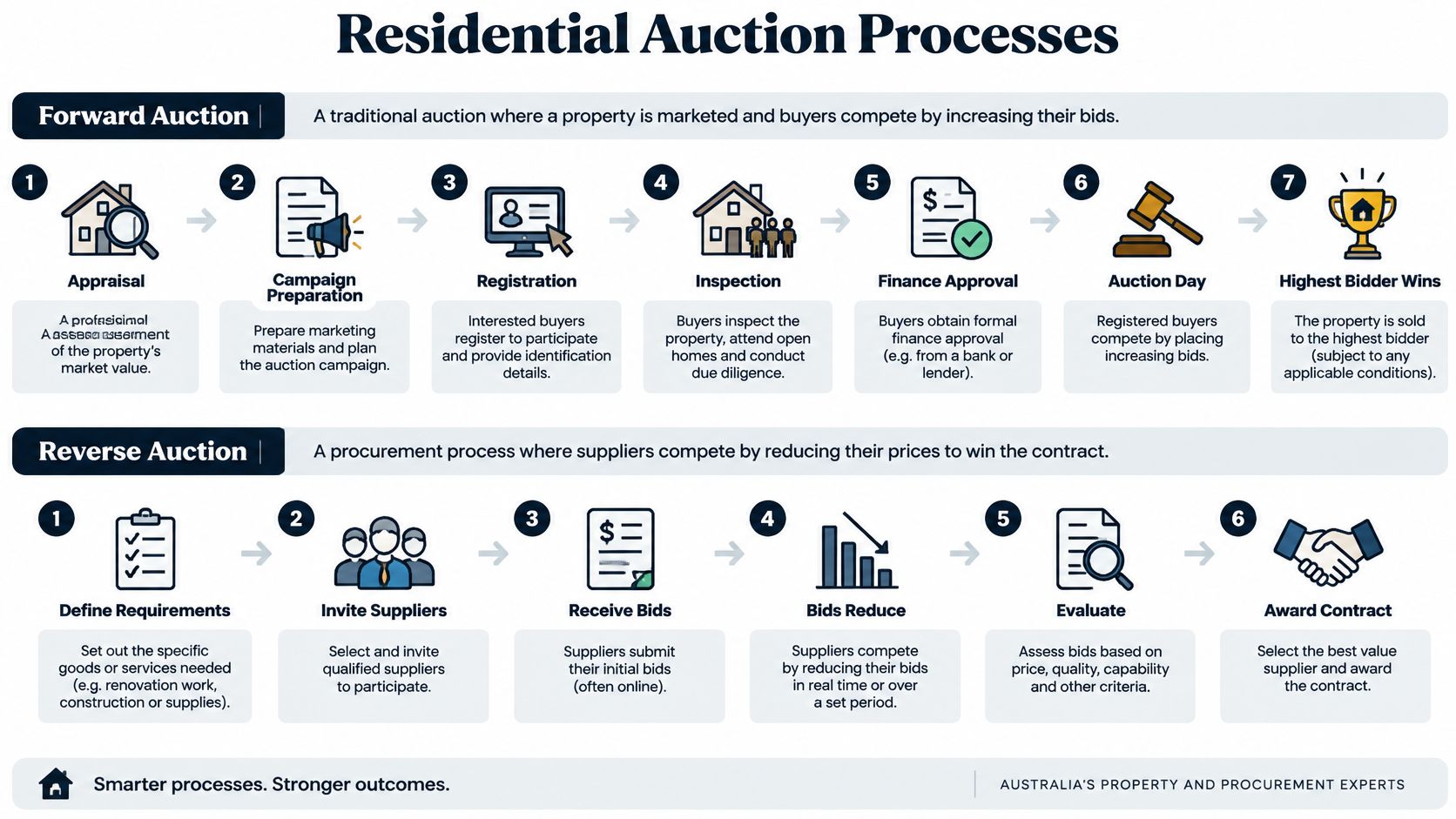
Mechanics decide whether a format suits your property, so it's worth tracing each journey from preparation to contract. The image below maps the two processes side by side before we walk through them.
The Forward Path in Western Australia
A conventional Mandurah campaign starts well before auction day. The seller obtains an appraisal grounded in comparable local sales, prepares presentation and marketing, opens the home for inspections, and gives buyers time to organise finance and review the contract. Only registered bidders can bid, which keeps the room, or the online equivalent, limited to people who've identified themselves and accepted the conditions.
The seller sets a confidential reserve price before bidding begins, being the minimum they'll accept, and the auctioneer cannot sell below it, as explained in Consumer Protection WA guidance on selling property by auction. Bidding usually opens below the reserve and rises as buyers compete. If the reserve is reached, the highest bidder wins and signs the contract. If it isn't, the property is passed in and negotiation typically continues privately with the highest bidder first.
Vendor bidding sits inside strict rules. A seller or their agent may bid up to the reserve, but the intended number of vendor bids must be stated in the conditions of sale before the auction begins, and dummy bidding is prohibited under Consumer Protection WA guidance on buying property at auction. The ACCC also confirms vendor bidding is permitted only when the auctioneer announces the bidder represents the vendor, and vendor bids must stop once the reserve is reached, per the ACCC guidance on real estate sales practices. Ask for the conditions early. Never discover them on the day.
The short video below is a useful visual run-through of how auction day unfolds in practice.
The Reverse Path in Procurement
A reverse process runs in mirror image. The buyer writes the specification, sets eligibility requirements covering capability, insurance and timing, invites qualified suppliers, receives proposals, clarifies details, evaluates price against non-price criteria, and awards the contract. The Australian Government's Emissions Reduction Fund used single-round, pay-as-bid, sealed-bid tenders from 2015, and by the end of 2018-19 eight auctions had contracted 192 million tonnes of carbon abatement through 479 contracts involving 529 projects, according to the Clean Energy Regulator annual report on Emissions Reduction Fund auctions.
At the eighth auction on 10 to 11 December 2018, the government committed $45 million across 34 contracts for 3.27 million tonnes, at an average of $13.97 per tonne compared with $12.00 per tonne across all eight auctions, from that same regulator reporting. One buyer, defined outcomes, competing suppliers. Nothing about that structure maps onto selling a family home in Meadow Springs.
Sellers wanting the full local sequence, from appraisal to fall of the hammer, should work through the detailed overview of selling a Mandurah home at auction before committing. And if buyer depth looks thin at any point, a negotiated private treaty isn't a failure of the auction plan. It's often the more disciplined outcome, reached with better information than you had at launch.
Weighing Seller and Investor Trade-Offs
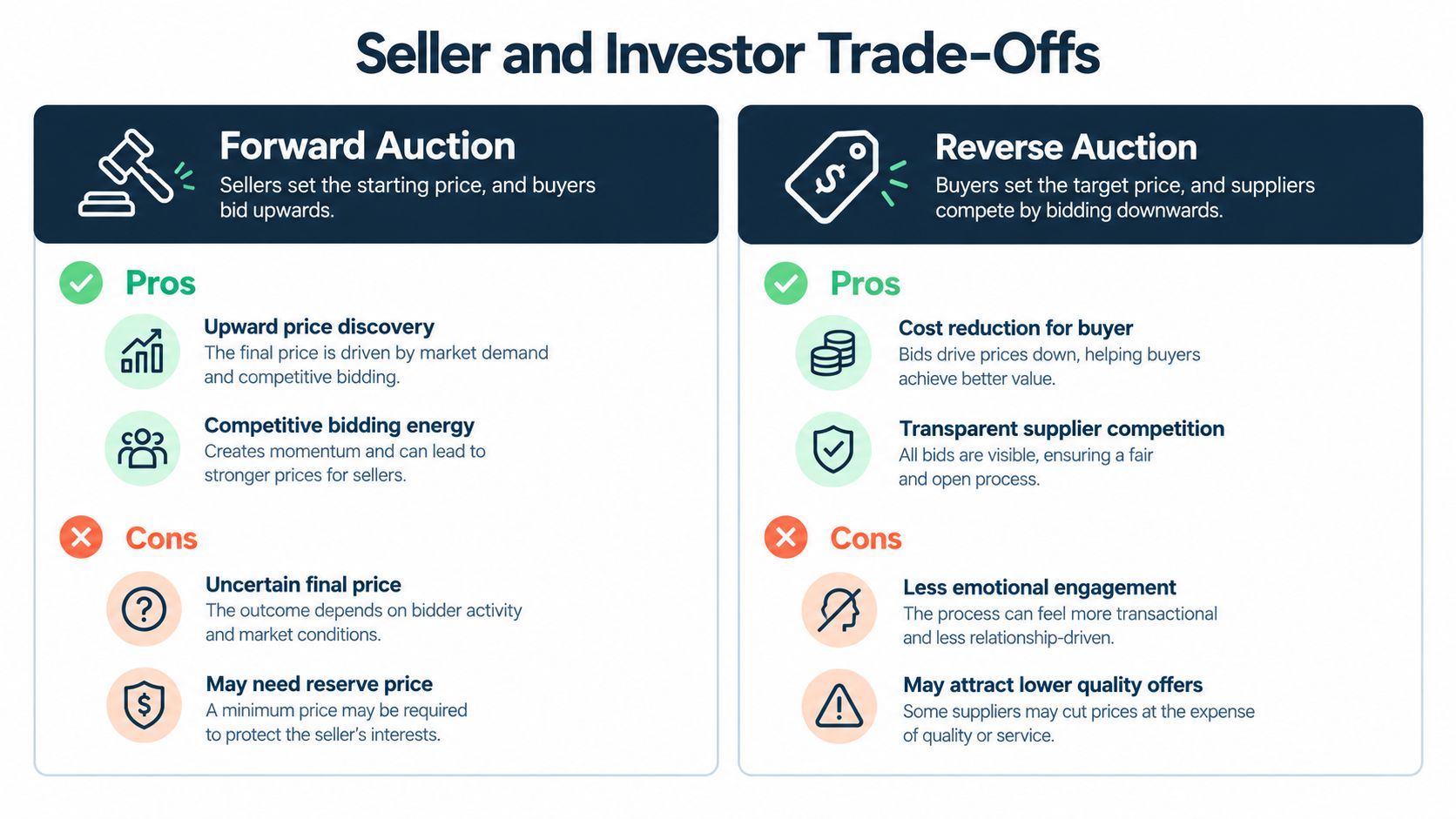
Headline price dominates most auction conversations, and it's the least complete measure available. A Mandurah seller should weigh at least five variables together. Campaign costs, buyer depth, conditionality, finance risk and settlement certainty all change what a result is really worth.
What Upward Competition Gives and Costs You
A forward auction compresses competition into a defined window. Buyers must complete inspections, finance checks and contract review before the day, which tends to produce cleaner, less conditional outcomes when the reserve is met. The trade-off is exposure. If qualified buyer depth is shallow, bidding can stall below the reserve, and you'll negotiate afterward with the market having watched the property pass in.
Private treaty trades that intensity for control and flexibility. You can consider conditions, settlement timing and buyer circumstances individually, and adjust pricing as feedback arrives. The cost is that you lose the visible, time-bound tension that pushes committed buyers to reveal their ceiling. Neither route is universally superior. The property and the buyer pool decide.
Reserve discipline is where many campaigns are won or lost, so sellers should understand exactly how a reserve price at auction is set and used before launch. A reserve built on comparable sales and genuine campaign feedback protects you. A reserve built on hope invites a pass-in.
Where Reverse Thinking Helps Investors
Investors get real value from reverse auction logic on the cost side of a project. When you're selecting renovation trades, maintenance providers or marketing suppliers in Dudley Park or Lakelands, define the scope, prequalify on capability and insurance, then let price competition run. That's disciplined procurement, and it protects margin.
Don't import procurement conclusions into the sale itself. Available WA sources provide procurement transparency but don't publish a directly comparable Mandurah benchmark, such as sale-price uplift or bidder conversion, for forward versus reverse auctions, as the WA Government procurement business intelligence reporting makes clear through its focus on tenders and awarded contracts. Anyone quoting you a percentage advantage for one format locally is guessing.
Build your own benchmarks campaign by campaign instead:
- Qualified bidders: count buyers who are finance-ready and contract-ready, not just registered.
- Reserve achievement: record whether bidding reached a reserve supported by comparable evidence.
- Price against appraisal range: compare the final result with the independent range set at launch.
- Days to unconditional contract: measure speed to certainty, not just speed to an offer.
- Fall-through rate: track how often accepted outcomes fail before settlement.
For premium coastal positioning, visible competition among genuine buyers usually protects value better than any downward mechanism. Scarcity presented calmly, with qualified bidders competing openly, signals confidence. A process that trains buyers to wait for reductions signals the opposite.
Choosing the Right Method by Property and Buyer
Suburb-wide rules fail quickly in Mandurah because buyer pools differ street by street. The right question isn't whether auctions work in a suburb. It's whether your specific property, at your price point, right now, can attract several finance-ready buyers who want the same home at the same time.
Family Homes With Broad Appeal
A well-presented family home in Lakelands or Meadow Springs often suits a transparent forward auction. These areas draw owner-occupiers comparing similar homes, and comparable local sales usually give both seller and buyers a shared evidence base. When multiple qualified buyers emerge during inspections, upward bidding lets that demand express itself cleanly and quickly.
Presentation still does the heavy lifting. Buyers competing for a home they've inspected twice, in good light, with maintenance handled, behave differently from buyers doing mental renovation maths at the door. Auction amplifies whatever the campaign has built. It can't substitute for it.
Coastal and Lifestyle Properties
Distinctive homes in Halls Head, Madora Bay, Wannanup and Falcon depend more heavily on scarcity, privacy and careful presentation. The buyer pool may be smaller but more motivated, often including downsizers and lifestyle buyers who value water access, outlook and low-maintenance living. Timed private inspections and a composed campaign can serve those buyers better than a crowded auction format.
That said, don't assume privacy always wins. If enquiry during the campaign reveals several qualified buyers circling the same coastal property, a forward auction can convert that quiet interest into visible competition before someone drifts to another listing. Let the enquiry data decide, not a fixed preference.
Highly specialised homes need the most caution. Unusual layouts, very large blocks, or properties with a narrow use case face genuine pass-in risk if the two or three plausible buyers aren't ready in the same week. A custom private campaign with room to negotiate terms often produces the stronger net outcome there. Comparing the structural differences in auction versus private sale for Mandurah homes is a sensible step before you commit either way.
Test qualified buyer depth before you choose the format. The format should follow the evidence, never precede it.
Investors Wearing Two Hats
An investor in Dudley Park illustrates the cleanest division of labour. Use reverse auction principles when you're the buyer of services, comparing agent offerings, building quotes and campaign suppliers against written scopes. Then sell the asset itself through a conventional market process, forward auction or private treaty, judged on buyer depth. Keeping those two roles separate stops cost-side discipline from becoming sale-side discounting.
Apply a Practical Auction Choice Framework
Here's the recommendation, stated plainly. For most Mandurah homes with healthy comparable demand, favour a forward auction when the appraisal is defensible, several qualified buyers are likely, and transparent upward bidding supports the property's positioning. Favour private treaty when buyer depth is uncertain, access is constrained, or the home is specialised enough that a negotiated approach offers a cleaner path to an unconditional contract.
Use reverse auction thinking only where it belongs, as a disciplined comparison tool for buying services. Agent selection, building work, maintenance and campaign supplies can all be specified, prequalified and priced competitively. Your home can't be specified that way, and pretending otherwise costs sellers money.
Questions to Ask Before You Commit
Work through this checklist with your agent before any format is locked in. Sellers refining their approach can also draw on the detailed guidance in this auction strategy framework for Mandurah sellers, then test each answer against local evidence.
- Reserve support: which comparable sales justify the reserve, and how recent are they?
- Finance readiness: how many interested buyers have confirmed finance capacity, not just enthusiasm?
- Vendor bid conditions: are vendor bids permitted, how many, and is that stated in the conditions of sale?
- Conditionality: what conditions, if any, will the contract allow, and how do they affect certainty?
- Campaign costs: what will preparation and marketing cost under each format you're considering?
- Settlement risk: what happens if the property passes in, and who's the first negotiation call?
- Fallback timing: at what point does the campaign convert to private treaty, and at what price guidance?
Landgate publishes WA data on median prices and new lot activity, which provides a neutral check on whether local supply and demand support competitive auction conditions for your segment. Use that kind of evidence. Don't assume every property benefits from auction because auction worked two streets away last spring.
The final word on forward auction vs reverse auction is simpler than the terminology suggests. Compete buyers upward for a scarce home. Compete suppliers downward for a defined scope. Get a local appraisal, verify buyer depth, and let that evidence choose the format. Sellers who follow that order rarely regret the campaign they run.
If you're weighing up auction against private treaty for a home in Halls Head, Lakelands, Madora Bay or anywhere across Mandurah, David Beshay Real Estate can appraise your property, test likely buyer depth, and build a reserve and campaign strategy grounded in comparable local evidence. Visit David Beshay Real Estate to book an appraisal and talk through the format that best protects your price, your timeline, and your settlement certainty.

