


To have any chance of success at a property auction, you need to do your homework long before the big day. I'm talking about securing finance pre-approval, getting thorough building inspections done, and digging deep into the property's true market value.
Winning isn't about having the deepest pockets. It's about walking into that auction room with a rock-solid strategy and an unshakeable walk-away price.
Your Pre-Auction Preparation Checklist
Winning an auction often happens before you even raise your bidder's paddle. The buzz and excitement on the day can be completely overwhelming, but a solid foundation of preparation will keep you grounded, strategic, and in control.
Think of this pre-auction period as building your defence against emotional decisions and the temptation to overpay in the heat of the moment. Without it, you're not bidding; you're gambling.
And it all starts with one non-negotiable step: your finances.
Get Your Financial Ducks in a Row
Before you even think about bidding tactics, you must know exactly how much you can spend. Getting a formal home loan pre-approval is the single most critical piece of your preparation puzzle. This isn't just a casual chat with your bank—it's a conditional approval for a specific loan amount, based on a detailed assessment of your financial position.
We've put together a comprehensive guide that breaks down the essentials of home loan pre-approval if you need to get up to speed.
This pre-approval letter is crucial for two reasons:
- It clearly defines your absolute financial ceiling, which is the bedrock of your walk-away price.
- It gives you the confidence to bid decisively, knowing your funds are already secured.
Do Your Due Diligence—Seriously
An auction contract is almost always unconditional. That means there's no cooling-off period and absolutely no backing out once the hammer falls. This is what makes your pre-auction inspections and legal reviews so essential.
Your first move should be to book a professional building and pest inspection. These reports are worth their weight in gold, uncovering hidden nightmares—from serious structural defects to termite damage—that could cost you tens of thousands down the track.
Next, get a solicitor or conveyancer to review the contract of sale. They'll hunt for any unusual clauses, hidden easements, or zoning restrictions that could throw a spanner in the works. Don't even think about skipping this; what’s buried in the fine print can have massive consequences for you as the owner.
A property auction is one of the few situations where you're expected to make a massive financial commitment with no safety net. Your due diligence is your only parachute.
Research the Market to Nail Down the Real Value
Never, ever rely solely on the agent’s price guide. Your job is to figure out the property’s genuine market value based on hard data.
Start by analysing recent sales of comparable properties (or 'comps') in the same suburb. You're looking for homes with similar land size, the same number of bedrooms, and in a similar condition. This research helps you establish a realistic price range and stops you from getting sucked into a bidding war fuelled by adrenaline rather than logic.
The Australian property market is fiercely competitive, and being unprepared is a costly mistake. The intensity is clear, with national auction clearance rates hitting 74.4% in July 2025, with an average of 3.1 active bidders per property. You can learn more about how these auction market peaks impact buyers. By doing your homework, you can confidently spot the exact moment when the bidding has gone past fair value, empowering you to walk away without a single regret.
Setting a Realistic Walk-Away Price
Your most powerful tool on auction day isn’t the bidding paddle in your hand—it’s a number you decided on long before you even arrived. This is your walk-away price, your absolute limit. It’s your shield against getting swept up in the emotional frenzy of the auction, preventing you from making a costly decision you’ll regret later. Nailing this number is a mix of cold, hard data and an honest look at your finances.
It all starts with your finance pre-approval, but that's just the baseline. You need to dig deeper into what the market is actually doing. Things like auction clearance rates and weekly auction volumes are the vital signs of the market's health. They tell you if you're stepping into a ‘seller’s market,’ where competition is fierce, or a ‘buyer’s market,’ where you might have a bit more breathing room.
Interpreting Market Signals
Understanding market trends is crucial for bidding effectively. A high clearance rate is a dead giveaway that competition is strong. It means properties are consistently selling at or, more likely, well above their reserve price. In this kind of environment, a hesitant, slow-start bidding strategy just won’t cut it.
Recent data shows just how hot the Australian property market has become. Bidding at Australian property auctions is definitely heating up, with clearance rates jumping from 62% in early 2024 to a national average of around 66% by mid-2025. This is especially true in big cities like Sydney, where house clearance rates recently soared to 76.2%. You can get a better feel for these pivotal auction market trends on cockatoo.com.au.
This infographic gives you a quick snapshot of the key numbers shaping today's auction scene.
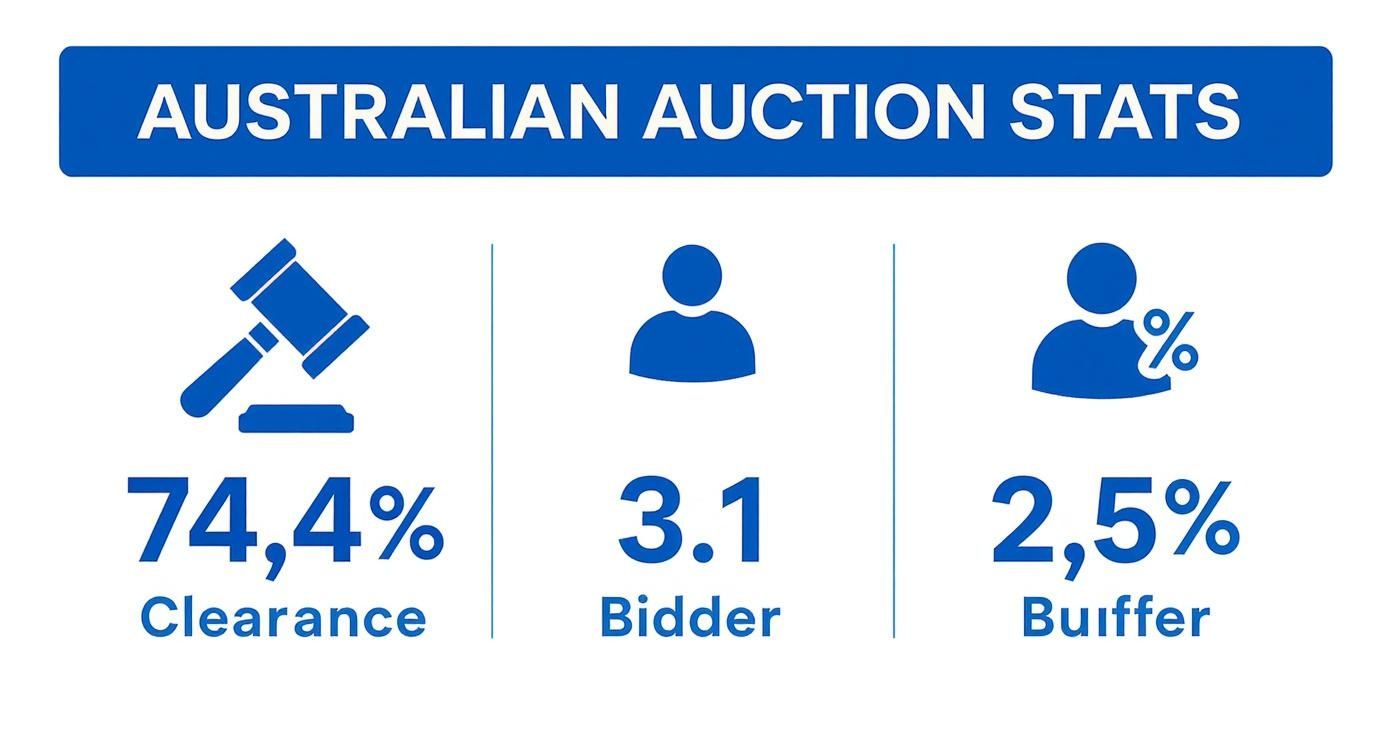
These figures paint a clear picture: it's a seller-friendly market out there. High clearance rates are being driven by a solid number of bidders all competing for the same properties.
The data below offers a more granular look at the weekly auction activity across Australia's major capital cities, highlighting the regional differences you'll need to consider.
Weekly Auction Activity Snapshot Across Australian Capitals
| Capital City | Auctions Held (Week Ending Sep 7, 2025) | Week-on-Week Change | Clearance Rate (Recent Average) |
|---|---|---|---|
| Sydney | 815 | +5% | 76.2% |
| Melbourne | 940 | +3% | 71.5% |
| Brisbane | 210 | -2% | 68.0% |
| Adelaide | 155 | +8% | 79.1% |
| Canberra | 75 | +10% | 65.4% |
| Perth | 50 | -5% | 73.3% |
As the table shows, markets like Adelaide and Sydney are particularly strong, suggesting bidders there need to be prepared for intense competition.
Calculating Your Final Number
Remember, your walk-away price is not just your pre-approval limit. It's a carefully calculated figure that takes every single associated cost into account. This is where all that property research and due diligence really pays off.
To lock in your final walk-away price, you have to add these costs to your budget:
- Stamp Duty: A major government tax that varies significantly between states and is based on the property’s value. Don't underestimate this one.
- Legal Fees: You'll need to pay your solicitor or conveyancer for reviewing the contract and handling the settlement.
- Renovation Costs: If your building inspection flagged essential repairs or you're planning some immediate upgrades, that money has to come from somewhere. Factor it in now.
- Contingency Fund: Always, always build in a buffer. I recommend around 5% of the property price for those little (and sometimes not-so-little) surprises that pop up after you move in.
Your walk-away price should be an odd, specific number—think $783,500 instead of a nice, round $780,000. It’s a small psychological trick, but it can help you land one last decisive bid that another buyer, who is likely thinking in round numbers, isn't prepared for.
Once you have this number, write it down. Memorise it. Commit to it. On auction day, when your adrenaline is pumping and emotions are high, this pre-determined limit will be your anchor. It’s the tool that gives you the power to bid with confidence and, just as importantly, to walk away without regret if the price goes past your maximum.
Mastering Auction Day Bidding Tactics

This is it. Auction day is where all your preparation hits the pavement. It’s a fast-paced, high-energy environment that absolutely demands a clear head and a bulletproof strategy. Winning isn't just about having the deepest pockets; it’s about projecting confidence, reading the room, and executing your game plan without a hitch.
Your body language says a lot before you even open your mouth. Stand tall, look the auctioneer in the eye, and when you bid, do it with a clear, assertive voice. Hesitation is like blood in the water for seasoned bidders—it signals you’re getting close to your limit and practically invites them to push the price just that little bit higher.
You’re here to buy a property, not just to watch. Get into the mindset of a serious contender from the moment you arrive.
Choosing Your Bidding Style
There's no single "best" way to bid, and anyone who tells you otherwise is selling something. The right approach depends on the vibe of the auction—how much competition is there? How fast is the auctioneer moving? And just as importantly, what's your own personality?
Here are a few common strategies to have in your back pocket:
- The Strong Opening Bid: Kicking things off with a bold, confident bid right at the top of the agent’s price guide can be a massive psychological play. It screams "I'm serious" and can sometimes spook less confident buyers, thinning the competition from the get-go.
- The Patient Observer: This is the opposite approach. You hang back and let others do the initial running. You watch, you learn, you see who the other serious players are, and you only jump in once the first flurry has died down. It’s a great way to conserve your emotional energy.
- The Incremental Controller: By making small, consistent, and quick bids, you dictate the pace. This tactic can really frustrate bidders who prefer big, bold jumps and it keeps you in the driver's seat without making massive financial leaps. Just be careful you don't get sucked into a tit-for-tat battle that blows your budget.
The key is to be flexible. If an auction is moving at a lightning pace, be ready to make bigger, more decisive bids. If it’s slow and dragging, use smaller increments to keep things moving on your terms without revealing how much you’re really willing to spend.
The Knockout Bid and When to Use It
A "knockout bid" is exactly what it sounds like—a massive price jump designed to shatter the confidence of your competitors and bring the auction to a sudden close.
Imagine the bidding is climbing in steady $5,000 rises and just hit $750,000. Instead of meekly offering $755,000, you jump straight in with a powerful $770,000. The silence that follows is often deafening.
This move is a high-risk, high-reward play. It sends a powerful message that you have very deep pockets and you're not messing around. Often, that’s all it takes for other bidders, who are probably hovering near their own limits, to just drop out.
Only pull this move out when:
- You are still comfortably within your pre-approved budget.
- You’ve got a strong read on the room and can see the other bidders are starting to falter.
- The auctioneer has declared the property is "on the market" and will definitely be sold.
Understanding Auction Jargon
The auctioneer will throw around specific terms to guide the process. One you absolutely must understand is the vendor bid. This is a bid made by the auctioneer on behalf of the seller. It’s a tool they use to get the auction started or to nudge the bidding along if things stall below the reserve price.
Legally, vendor bids have to be announced as such, and they can’t be made once the property has hit its reserve. Knowing this helps you tell the difference between a real bid from a competitor and a strategic move by the auctioneer to build momentum.
Don't let it rattle you. Stay focused on your own strategy and stick to your walk-away price, no matter who—or what—is bidding against you.
How to Handle Different Auction Scenarios
No two auctions are ever the same. You might walk into a room that’s quiet and hesitant one Saturday, and the next you’re in a frantic bidding war between a handful of determined buyers. The real skill is learning to read the room and adapt your strategy on the fly.
Being prepared for the different ways an auction can play out is what separates a successful bidder from a frustrated one.
So, what happens when the bidding stalls? Imagine it: the auctioneer opens with a strong bid, a few more follow, and then… silence. The agent's price guide is still a long way off, and the tension is palpable as the auctioneer calls for another bid that never comes. This is a classic scenario, and the worst thing you can do is panic.
If bidding grinds to a halt below the seller's reserve price, the property will be 'passed in'.
When this happens, the highest bidder is usually given the first, exclusive right to go inside and negotiate directly with the seller. This is exactly why all your pre-auction research is so vital. You already know what the property is worth, giving you a powerful, fact-based position to negotiate from, far from the pressure of the auction floor.
Navigating a Fast and Aggressive Auction
On the flip side, you could find yourself in a lightning-fast auction with several aggressive bidders all jumping in. In these high-pressure moments, your pre-determined walk-away price isn't just a number—it's your lifeline. The absolute key is to stay calm, stick to your bidding increments, and project confidence, even if your heart is pounding.
If the rapid-fire bids start to feel overwhelming, you've got a few strategic moves:
- Throw in a larger jump bid. A bold, significant increase can completely disrupt the rhythm. It forces other bidders to stop and really think about their own limits.
- Slow the pace right down. You don't have to bid instantly. Take a deliberate pause before placing your next bid. This can break the momentum and give you a crucial second to think clearly.
- Reassert your presence. Make your bids loud and clear. Look the auctioneer directly in the eye. It’s a simple act, but it shows everyone you’re still a serious contender.
Understanding Vendor Bids
In a slower auction, you're almost guaranteed to come across a vendor bid. This is a bid made by the auctioneer on behalf of the seller. It’s a perfectly legal tactic used to kick-start bidding or nudge the price closer to the reserve. The auctioneer has to declare it clearly by saying "vendor bid."
Don't let this throw you off your game. Just treat it like any other bid in the room and stick to your strategy, always keeping that walk-away price in the front of your mind.
Understanding the dynamics between an auction and a private sale is invaluable here. When a property passes in, it essentially becomes a private sale on the spot, and that requires a different set of negotiation skills. You can dive deeper into the differences with our detailed guide on auction vs private sale strategies.
The rhythm of the property market dictates the kind of auctions you'll likely face. To give you an idea of the volume, in a single week in early September 2025, a massive 2,159 homes were scheduled for auction across Australia. Melbourne alone, a major auction hub, had 1,030 properties going under the hammer. You can get a feel for the market's pulse by checking out reports like the national auction market preview on Cotality.com.
By thinking through these different scenarios beforehand, you'll be ready to respond with confidence, no matter what happens on auction day.
Common Bidding Mistakes You Must Avoid
Learning from others' mistakes is far cheaper than making your own, especially when hundreds of thousands of dollars are on the line. Knowing how to bid at auction also means knowing what not to do. It's a high-pressure environment, and I've seen plenty of buyers—both new and experienced—fall into predictable traps that cost them their dream property or, worse, lead them to overpay.
The single biggest error is emotional bidding. It’s so easy to get swept up in the drama and let the fear of missing out (FOMO) take over your senses. Suddenly, that carefully planned walk-away price you set feels more like a vague suggestion than a hard limit. This is where discipline becomes your greatest asset.
Letting Emotions Dictate Your Budget
When you’re emotionally invested, you stop seeing the property as a financial asset. It becomes a prize to be won at any cost. This is a dangerous mindset that leads directly to overpaying, sometimes by tens or even hundreds of thousands of dollars. An auctioneer is an expert at creating a high-energy, competitive environment designed to fuel this exact feeling. It's their job.
Your best defence is that logical, non-negotiable walk-away price you set during your preparation. Think of it as your anchor in the emotional storm of auction day.
Remember this: there will always be another house. There won't always be another chance to recover from a major financial misstep. Stick to your numbers, no matter how much you love the property.
Another classic blunder I see all the time is showing hesitation. When the bidding gets close to your limit, it's natural to pause and reconsider. But to your competitors, that hesitation is a bright, flashing sign that you're on your last legs. A confident bidder will often seize that moment to place a strong, decisive bid, knowing you’re unlikely to fire back.

Revealing Too Much Information
This might sound obvious, but it’s a surprisingly common rookie mistake: telling the real estate agent your maximum budget before the auction. While agents are there to facilitate a sale, their primary duty is to the seller—to get the highest possible price for their client.
Sharing your limit basically hands them a roadmap to extract every last dollar from you. They can use this information to:
- Place strategic vendor bids to push the price closer to your maximum.
- Advise other potential buyers on what it might take to knock you out.
- Encourage you to stretch "just a little bit more" when you're teetering on your pre-disclosed limit.
Keep your cards close to your chest. The only people who need to know your absolute walk-away price are you and anyone bidding with you. Maintaining that privacy is a core part of any successful bidding strategy.
Your Auction Bidding Questions Answered
Even with all the prep in the world, it's natural to have a few questions buzzing around your head before auction day. Let's tackle some of the most common ones so you can walk in feeling cool, calm, and ready to execute your strategy.
Getting these details straight demystifies the whole affair, letting you focus on what really matters—bidding smart—without second-guessing the rules.
What Happens the Moment I Win?
The second that hammer falls and the auctioneer points in your direction, the property is legally yours. It’s an unconditional sale, which means there’s no turning back. You’ll be ushered into a quiet room to sign the contract of sale on the spot.
Right then and there, you’ll also need to pay the deposit, which is typically 10% of the purchase price. Make sure you’ve arranged how you'll pay this beforehand, whether it's a bank cheque or an electronic transfer. There's zero time to sort out finances after the auction; it all has to be ready to go.
Can I Make an Offer Before the Auction?
Absolutely. Putting in a pre-auction offer is a common tactic, but it’s a double-edged sword. A strong, unconditional offer can be very tempting for a seller who wants a quick, guaranteed sale, letting you sidestep the stress and competition of the auction floor.
But here's the catch: making an offer early can also show your cards. If the seller says no, they and the agent now have a very good idea of your budget. They might use that intel to set the reserve price or to fire up other buyers. Your offer needs to be seriously compelling to convince them not to take their chances on auction day.
A strong pre-auction offer isn’t just about the price. To be truly attractive to a vendor, it must be clean and unconditional—no finance clauses, no funny business.
What Exactly Is a Vendor Bid?
A vendor bid is simply a bid made by the auctioneer on the seller's behalf. It's a completely legal and transparent move used to kick things off or to build momentum if bidding stalls below the reserve price. The auctioneer has to announce it clearly, usually by saying "vendor bid."
Don't let it throw you. A vendor bid can't be the winning bid; it's just a tool to nudge the price toward a level where real buyers are ready to jump in. Treat it like any other bid and stick to your game plan. Understanding different sale types can also give you useful context, as you’ll see similar tactics in other situations. You can learn more about what happens in a mortgagee in possession sale on our blog.
Should I Use a Buyer's Agent?
Hiring a buyer's agent can be a genuine game-changer, especially if you're a first-timer or just strapped for time. These pros are at auctions every single weekend. They get the psychology, know the local market values inside and out, and are masters at negotiating if a property passes in.
The biggest plus is having an experienced, impartial expert bidding for you, which takes all the emotion out of the equation. Of course, there's a cost involved, either as a flat fee or a percentage of the purchase price. You just need to weigh that expense against the very real risk of overpaying or missing out on a great property because of inexperience.
At David Beshay Real Estate, we provide the expert guidance and local market knowledge you need to navigate the Mandurah property market with confidence. Whether you're buying or selling, our personalised strategies are designed to help you achieve your goals. Get in touch for a free property appraisal today!


Pingback: Auction Tips and Tricks for Mandurah in 2026 - David Beshay Real Estate - Beshay Realty
Pingback: Forward Auction vs Reverse Auction in Mandurah - David Beshay Real Estate - Beshay Realty