


Think of an auction reserve price as the seller's secret walk-away number. It's the absolute minimum they're willing to accept for their property, set in stone before the first bid is even called. If the bidding doesn't hit this magic number, the property simply doesn't sell.
This confidential figure acts as a crucial safety net. It ensures a seller isn't forced to part with their home for a price that just doesn't stack up.
Understanding the Auction Reserve Price
Imagine you're selling a prized possession, maybe something that's been in the family for years. You wouldn't just let it go for any old price, would you? You'd have a figure in your head—a line in the sand—and you wouldn't accept a cent less. That's exactly what a reserve price is for your home.
This price is decided between you (the seller) and your agent well before auction day. Crucially, it's kept completely under wraps from the bidders. Why? To let the true market competition drive the price up naturally. The reserve is there purely as a backstop, protecting you from a worst-case scenario.
Who’s Who in the Reserve Price Game
Setting and reaching the reserve involves a few key people, and each has a distinct role to play:
- The Seller: You're the one in the driver's seat. You set the reserve based on what you need financially, the property's valuation, and the expert advice from your agent. Your goal is to get the best possible price, but that reserve is your bottom line.
- The Agent/Auctioneer: This is your guide and strategist. They'll help you set a realistic reserve that attracts bidders. Come auction day, their job is to build momentum and push the bidding past that figure. The moment it does, they can declare the property is officially "on the market" and will be sold.
- The Bidders: These are the potential buyers competing for your property. They have no idea what the reserve is, so they have to bid based on their own budget and what they believe the home is worth.
The reserve price is the seller's ultimate protection at an Australian property auction. It guarantees they don't have to accept an offer below their minimum financial threshold, providing peace of mind throughout the high-stakes process. You can learn more about how this works in practice by reading this guide on Australian property auctions on cockatoo.com.au.
Reserve Price vs Starting Bid and Price Guide
Jumping into a property auction can feel like learning a whole new language. You’ll hear terms like ‘reserve price’, ‘starting bid’, and ‘price guide’ thrown around, and it's easy to get them mixed up. But these numbers aren't interchangeable; each one plays a completely different role in the auction process.
Think of it like a negotiation with three key numbers. One is the seller's absolute bottom line, another is just an opening gambit to get things moving, and the third is a ballpark estimate of the property's value.
The Seller's Secret Bottom Line
The reserve price is the most critical number for the seller. It’s their confidential, non-negotiable minimum amount they are willing to accept for their property. If the bidding doesn’t reach this magic number, the property is "passed in," which simply means it doesn't sell on the auction floor.
This price is the seller’s ultimate safety net, ensuring their home isn’t sold for a cent less than they’re comfortable with.
Getting the Bidding Started
On the other hand, the starting bid is just the auctioneer's opening call. It’s often set deliberately low to create an easy entry point for bidders, encouraging more people to raise their paddles and build some early momentum.
This figure has absolutely no connection to the property’s true value or the seller's reserve. It’s purely a strategic move to kickstart the bidding and get the action going.
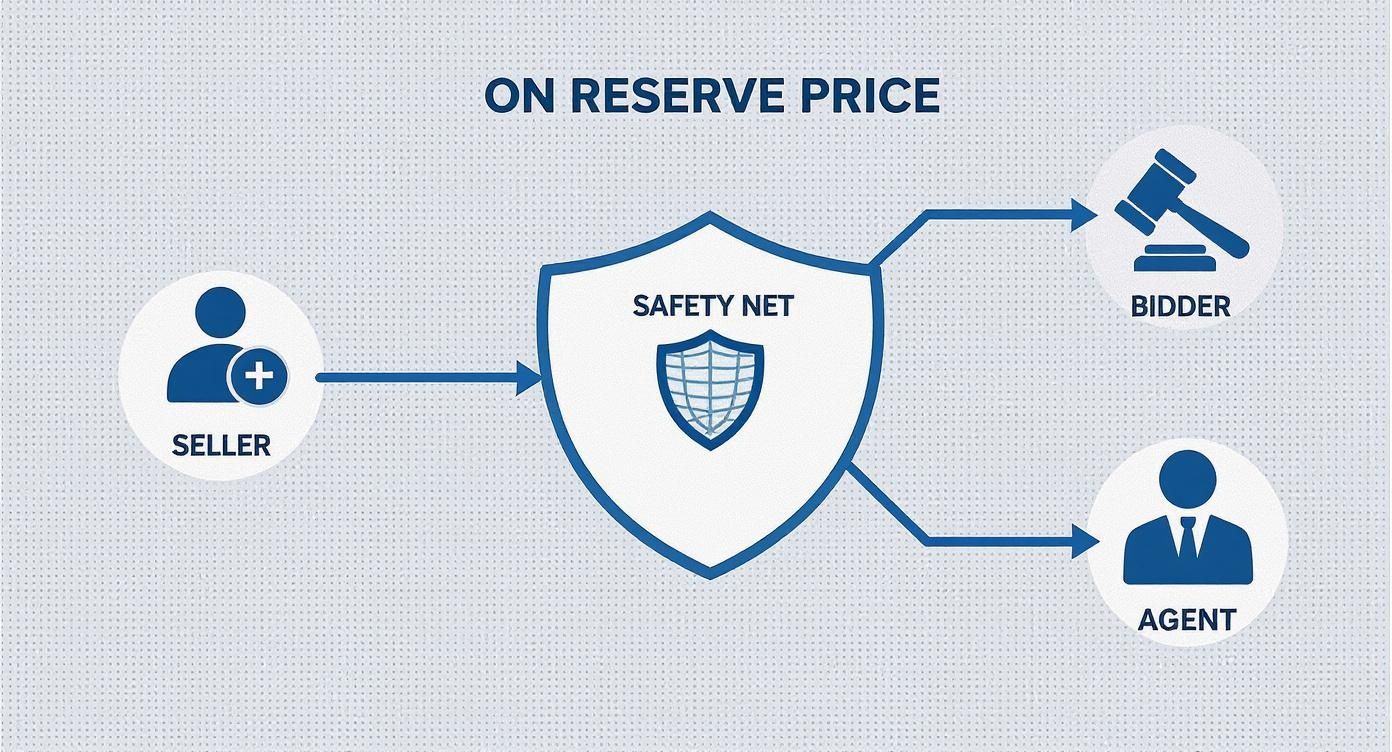
As you can see, while everyone has a role to play, the reserve price is the core mechanism protecting the seller's financial interests.
The Agent's Estimated Value
Finally, you have the price guide, also known as the estimated selling price. This is the agent’s legally required estimate of what the property is likely to sell for. It’s based on hard data from recent, comparable sales in the local area.
The goal of the price guide is to give potential buyers a realistic indication of value. While it’s not the reserve price, a well-researched guide should give you a pretty good idea of the ballpark the seller is playing in.
Key Takeaway: The price guide gives you a clue, the starting bid gets you in the game, but only the reserve price determines if a sale actually happens. The fundamental differences between auction and private sale methods often come down to how these price points are managed, which can significantly impact your strategy.
How Sellers Set the Right Reserve Price

Choosing a reserve price isn't about plucking a number out of thin air or pinning your hopes on a dream figure. It's a strategic decision that can genuinely make or break your auction day.
Think of it like finding the perfect altitude for a plane. Fly too high with an unrealistic reserve, and you won’t attract any passengers (bidders). Fly too low, and you risk leaving a lot of money on the table.
Hitting that sweet spot requires a cool head, some expert guidance, and a very realistic grasp of the current market. The goal is to set a figure that protects your bottom line but is still seen as achievable, creating the perfect environment for competitive bidding to take over and drive that final price skyward.
Ultimately, a winning reserve is born from a partnership between you and your real estate agent, grounded in solid data and hyper-local market knowledge.
Analysing the Market Data
First things first: we need to look at the evidence. Your agent will dive deep into a comprehensive market analysis, which is much more than a quick online search. This is all about gathering hard data to build a crystal-clear picture of your property's current value.
This data-driven approach is crucial for taking the emotion out of the equation. It ensures your reserve is based on what the market is actually doing, not just what you hope it will do.
Key data points we'll look at include:
- Recent Comparable Sales: We'll examine what similar properties in your suburb—whether that's Mandurah, Lakelands, or surrounds—have sold for recently, both at auction and through private treaty.
- Current Listings: It’s vital to see what you're up against. We'll assess the competition to understand what other homes buyers will be comparing yours to.
- Market Trends: Are we in a "hot" seller's market with prices on the up, or a cooler buyer's market that calls for a more conservative strategy?
A detailed and accurate valuation is the foundation of a smart reserve price. An in-person appraisal provides the most nuanced view of your home's unique features and position in the local Mandurah market, which is crucial for setting an effective reserve. You can explore the benefits of a professional property appraisal in Mandurah to get the most accurate insights.
The Art of Setting the Reserve
With all the data laid out, the real strategy begins. This is where your personal situation comes into play, because your financial needs or timeline for selling are just as important as the market stats. A seller who needs to move quickly, for example, might set a more competitive reserve to guarantee a sale on the day.
The balancing act between the reserve price and bidder interest is what makes Australian auctions tick. Set the reserve too high, and you can scare off potential bidders, leading to a flat auction with few bids. On the other hand, a low reserve can generate a buzz and attract more interest, but you need to be confident it will kickstart the bidding frenzy you're after.
To help nail down this crucial number, your agent will work through several key considerations with you.
Factors That Influence Your Reserve Price
| Factor | Why It Matters | Actionable Tip |
|---|---|---|
| Market Data | Provides an objective baseline for your property's value based on recent sales and current competition. | Trust the numbers. Let the data guide your expectations away from emotional attachment. |
| Buyer Feedback | What are potential buyers saying during the inspection period? High interest can support a firmer reserve. | Ask your agent for a weekly summary of buyer feedback and price indications. |
| Personal Circumstances | Your financial 'must-haves' and timeline for selling are non-negotiable parts of the equation. | Be transparent with your agent about your bottom line and any deadlines you're working towards. |
| Agent's Recommendation | Your agent has their finger on the pulse of the local market and can offer invaluable strategic advice. | Listen to their expert opinion, but remember the final decision is yours. |
Ultimately, the final figure is your call to make, but it must be an informed one. Your agent is there to provide the expert analysis and professional recommendation, but you always have the final say on the minimum price you're prepared to accept for your home.
The Role of the Reserve Price on Auction Day

There’s nothing quite like the energy of auction day. All the marketing, the open homes, and the late-night preparations culminate in this one high-stakes event. Right before the action kicks off, the seller and their agent will have a final, quiet chat to lock in the reserve price. This is the moment the seller’s absolute bottom line is set in stone.
Once confirmed, that confidential figure becomes the invisible benchmark for the entire auction. It's the magic number that decides whether the auctioneer’s hammer falls on a successful sale or if the property gets "passed in."
The Magic Moment On the Market
As the bidding begins, the auctioneer’s job is to build momentum. They work the crowd, encouraging offers and driving the price higher and higher. They know the reserve price, but they are legally forbidden from disclosing it. Their real skill lies in creating a competitive atmosphere where bidders feel compelled to push past that unseen threshold.
The most exciting part of any auction is when a bid finally meets or climbs above the reserve. The auctioneer will pause, command the attention of the room, and make a powerful announcement: "The property is on the market!"
This declaration is a huge turning point. It’s a signal to every person there that the home will be sold today to whoever places the highest bid from that point forward.
When an auctioneer declares a property "on the market," the dynamic in the room instantly shifts. It confirms the seller's minimum price has been met, removing all uncertainty and often triggering a fresh wave of competitive bidding from serious buyers who know the property is now guaranteed to sell.
What Happens When Bidding Stalls
Sometimes, despite everyone’s best efforts, the bidding might lose steam and stall out below the reserve price. This is a common scenario and definitely doesn't mean the day is a failure. If no more bids come forward, the auctioneer will "pass in" the property.
This simply means the property didn't sell under auction conditions. But what it really does is open the door to a new phase of negotiation, right then and there.
- First Right to Negotiate: In Western Australia, the highest bidder is typically given the exclusive first right to negotiate with the seller. This is a huge advantage, offering them a private opportunity to try and bridge the gap between their last bid and the seller's reserve.
- Private Treaty Sale: The agent steps in to facilitate these one-on-one discussions, aiming to find a price both parties can agree on. More often than not, a deal is struck just moments after the auction wraps up.
- Opening to Other Buyers: If the highest bidder and the seller can't reach an agreement, the agent is then free to open up negotiations with any other interested buyers who were at the auction.
This seamless transition from a public auction to a private negotiation is a standard and effective part of the process. It ensures every possible opportunity is taken to secure a sale on the day, even if the reserve isn't met under the hammer.
Legal and Ethical Rules for Reserve Prices
When you’re dealing with something as valuable as a house, fairness and transparency aren't just good manners—they're the law. Across Australia, and right here in WA, there are specific legal rules that dictate how reserve prices are used in auctions. These laws are there to protect both buyers and sellers from dodgy or misleading behaviour.
Think of these rules as creating a level playing field, making sure the auction is run with integrity. The biggest thing they aim to stamp out is underquoting. That’s the sneaky practice of advertising a property at a price way below what the seller would ever actually accept, just to lure in hopeful buyers and create a buzz.
Stamping Out Underquoting and Keeping Things Honest
Agents have a legal duty to give a fair and honest price guide based on recent, comparable sales in the area. This isn't just a number plucked from thin air; it’s an estimated selling price that gives buyers a realistic idea of the property's value.
Now, while the reserve price itself is kept under wraps, the advertised price guide can't be lower than it. This is a crucial protection that stops agents from wasting a buyer's time, money, and emotional energy on a home they were never really in the running for.
For sellers, these laws offer peace of mind by making sure their agent represents the property's true value. It builds trust and holds the agent accountable to their professional duty: to act in your best interests and get the best possible price, without resorting to deceptive tricks.
At its heart, the goal of these regulations is to maintain the integrity of the market. By making agents accountable for their price guides, the law ensures buyers can bid with confidence and sellers are represented ethically from start to finish.
State governments are always tweaking these laws to improve transparency. For example, some big changes are set for Victoria in 2025, where agents and sellers will have to publicly state the reserve price at least seven days before the auction. While the idea is to boost fairness, some in the industry are a bit worried it might cool off competitive bidding and lead to fewer properties selling under the hammer. You can read a bit more about these new Victorian auction rules and what they might mean for the market here.
The Role of Vendor Bids
Another key piece of the legal puzzle is the vendor bid. You’ve probably seen this happen at an auction. It’s a bid made by the auctioneer on behalf of the seller, usually to get the ball rolling if bidding is slow or has stalled below the reserve.
But there are very strict rules about how and when they can be used:
- They Must Be Declared: The auctioneer has to be upfront and clearly announce, "I'm placing a vendor bid."
- Only Below the Reserve: Vendor bids are only allowed while the bidding is still below the reserve price. Once the reserve is met or passed, they can't be used.
- No Faking It: It is completely illegal for an agent or seller to plant friends or family in the crowd to make fake bids (this is called "dummy bidding") just to drive the price up.
These rules ensure that any bid made for the seller is transparent and used ethically to help the auction along, not to trick genuine bidders. Understanding these legal protections helps everyone—buyers, sellers, and agents alike—take part in a fair, transparent auction process.
Smart Bidding Strategies for Buyers
Walking into an auction can feel like you’re playing a high-stakes game where the rules aren't totally clear—especially when the seller’s reserve price is a closely guarded secret. But you don't have to go in blind. With the right strategies and a solid game plan, you can bid with confidence.
Do Your Homework Before Auction Day
Your prep work should start weeks before the big day. The most important thing you can do is get a handle on the property's real market value. Dive deep into recent, comparable sales in the same neighbourhood. This isn't just about looking at listing prices; it's about what properties actually sold for.
This research does two things: it gives you a realistic price range to work with and helps you make an educated guess about where the seller’s reserve might be set.
Once you have a number in your head, set your absolute, non-negotiable limit. This is your personal reserve—the maximum price you’re willing to pay, full stop. Get this sorted before the auction, and promise yourself you’ll stick to it. It’s the single best way to protect yourself from getting carried away by the adrenaline of the moment.
Reading the Room and Making Your Move
When the auction kicks off, listen carefully to what the auctioneer is saying. Their choice of words and tone can give away subtle clues. The magic phrase you're waiting for is "on the market." As soon as you hear that, it's game on—the reserve has been met, and the property is officially going to sell to the highest bidder.
So, how should you play it? There are a couple of popular tactics.
You could come out swinging with a strong, confident opening bid. This move signals to everyone that you’re a serious buyer and can sometimes intimidate less prepared bidders right out of the running.
Alternatively, you could play the waiting game. Let the early bidders battle it out, observe the flow, and only jump in once the property is declared "on the market."
No matter your strategy, staying calm is the key. It's easy to get swept up in "auction fever," but remember your goal: to buy a great property at a fair price, not just to win at any cost. A cool head always makes better financial decisions.
Different approaches work for different people, so it's smart to explore all the options. For a deep dive into the nitty-gritty of bidding with authority, check out our comprehensive guide on how to bid at auction. At the end of the day, success comes down to a simple formula: be well-researched, financially disciplined, and strategically composed.
Got Questions About Reserve Prices? We've Got Answers
Even when you've got the basics down, the heat of an auction can throw up some curly questions. What happens in this scenario? What about that one? Knowing the answers ahead of time means you can act with confidence, whether you're buying or selling.
Here’s a quick rundown of the common queries that pop up on auction day.
Can the Reserve Price Change Mid-Auction?
Yes, absolutely. A seller can give their agent the green light to lower the reserve at any point while the auction is live.
This is actually a powerful and pretty common strategy, especially when the bidding starts to lose steam just below the original reserve. By dropping the figure, the auctioneer can declare the property is officially 'on the market'. That single phrase often injects a whole new wave of energy into the room and can be the key to getting a sale across the line on the day.
What if the Highest Bid Is Exactly the Reserve?
If the bidding stops and the final offer lands precisely on the reserve price, the property is sold. Simple as that.
There’s no grey area here. The auctioneer's hammer will fall, and the highest bidder has just bought themselves a property for that exact amount. It’s a clean sale because the seller's minimum price has been met.
A key takeaway for sellers: While the reserve is your safety net, it's not set in stone. The real pros know that flexibility is crucial. Being ready to adjust your reserve based on the live feedback you're getting from the auction floor can be the difference between a 'pass in' and a successful sale.
Do Sellers Have to Tell Their Agent the Reserve?
While the reserve price is the seller's confidential number, you’ll almost always share it with your real estate agent and auctioneer. It's not a legal requirement, but from a practical standpoint, it’s a must.
Think about it – how can your agent run the auction effectively without this crucial piece of information? Sharing the reserve allows them to guide the bidding with a clear goal, know the exact moment to announce the property is 'on the market', and negotiate smartly if the property ends up being passed in.
Ready to navigate the Mandurah property market with an expert on your side? David Beshay Real Estate offers free, no-obligation property appraisals to help you understand your home's true value and set a winning auction strategy. Get in touch today.

