


Ever received a notice for 'land tax' and felt a wave of confusion? What exactly is it, and is it something you need to worry about? Let's clear the air right away.
Demystifying Australian Land Tax
Here's the most important thing to remember: land tax almost never applies to your family home. That's because of a key exemption known as the Principal Place of Residence (PPR) exemption, which protects the vast majority of homeowners. You can think of it like a council rate, but it’s collected by the state government to fund essential services we all rely on—like hospitals, schools, and roads.
So, who does it affect? This tax primarily targets property investors, people with holiday homes, and businesses that own land. It’s a major source of revenue that helps keep our communities running.
The Core Concepts of Land Tax
To get your head around land tax in Australia, you just need to understand a few key ideas. The whole system really boils down to two main things: the value of your land and a tax-free threshold.
- Unimproved Land Value: This is simply the market value of your land without any buildings or improvements on it. Imagine an empty block of dirt—that's the value the government is looking at for tax purposes.
- Tax-Free Threshold: Every state (except the Northern Territory, which has no land tax) sets a threshold. You only start paying land tax if the total unimproved value of all your taxable land adds up to more than this amount.
- Aggregation: The tax office doesn't look at each property individually. Instead, it adds up the unimproved value of all the investment properties you own in that state. If that combined total goes over the threshold, you’ll get a tax bill.
A great way to think about it is like the tax-free threshold for your income. You only pay income tax on what you earn above a certain level. Land tax works the same way—it only kicks in once the value of your land holdings exceeds the state's threshold.
Who Needs to Pay Attention?
If you only own the home you live in, you can generally put this topic out of your mind. However, if you're in one of the following situations, it's definitely something you need to understand:
- You're a property investor with one or more rental properties.
- You own a holiday house or a weekender that isn't your main residence.
- You own land through a business or company.
- You're holding onto a block of vacant land.
This guide will break down everything you need to know about Australian land tax, with a special focus on how it works for property owners and investors here in Mandurah and across Western Australia. We’ll cover exactly who pays, who doesn’t, and how it’s all calculated, so you can manage your portfolio with complete confidence.
Who Pays Land Tax and Who Is Exempt?

So, who actually gets the land tax bill? The answer comes down to a simple question: what do you own, and what are you using it for? In Australia, this determines whether you can expect that annual notice from your state's revenue office.
The tax is designed to apply to land held for investment or commercial reasons. Think of it this way: if you own a property that’s earning you an income or is sitting there purely for capital growth—and it’s not the home you live in—then you're likely on the hook.
This means the main groups who pay land tax are usually:
- Individual Property Investors: Anyone with one or more rental properties in their portfolio.
- Companies and Corporations: Businesses owning the land their offices, warehouses, or shops are built on.
- Trusts: This includes family trusts and self-managed super funds (SMSFs) that hold property as an investment asset.
- Holiday Home Owners: A beach house or weekend getaway isn’t considered your main home, so it’s taxable.
At the end of the day, if a property isn't your primary home, it’s probably going to be subject to land tax once its value (along with any other taxable land you own in that state) crosses the official threshold.
The Most Important Exemption: Your Home
The absolute cornerstone of the land tax system is the Principal Place of Residence (PPR) exemption. This is the one rule every homeowner should know, as it shields the family home from this yearly tax. It's the reason most Australian homeowners never even think about land tax on the property they live in.
To qualify as your PPR, a property needs to be the main home you live in day-to-day. It’s where your stuff is, where your mail goes, and the address you're registered to vote at. Simple.
But life isn’t always simple, is it? State revenue offices have rules for those grey areas, like temporary absences. If you have to move for work or are doing major renovations, you can often rent out your home for a set period (some states allow up to six years) and keep the PPR exemption, as long as you don’t claim another property as your main residence during that time.
For property owners, the PPR exemption is the most valuable one out there. It’s vital you make sure it's correctly claimed on your home to avoid being slugged with a bill for thousands of dollars you shouldn't have to pay.
Other Major Land Tax Exemptions
Beyond the family home, a few other big exemptions exist to help specific types of landowners. These recognise that some land is used for the broader community or economic good, so it makes sense to exclude it from the tax.
Getting your head around these can be a game-changer, especially if you have a diverse property portfolio.
Common Exemptions Across Australia
- Primary Production Land: Land used for farming—growing crops, running livestock, or even growing grapes for wine—is typically exempt. This is a practical way to support our agricultural sector by lowering the holding costs for farmers. The key condition is that the land's main use has to be for primary production.
- Charitable and Non-Profit Organisations: Properties owned and used by registered charities, religious groups, non-profit schools, and hospitals are generally exempt. This frees up their funds to be spent on their community missions instead of on taxes.
- Retirement Villages and Aged Care Facilities: Land used to provide housing and care for seniors often gets a full or partial exemption.
These rules ensure the tax is aimed squarely at land held for private financial benefit, not land that serves as someone's home or provides a vital community service. If you own land that fits into one of these categories, you need to apply for the exemption through your state’s revenue office to make sure you’re not overpaying.
How Australian States Figure Out Your Land Tax Bill
Working out your land tax bill isn't as straightforward as just slapping a percentage on your property's value. It’s a specific formula that state revenue offices use, pulling together a few key numbers to land on your final assessment. For any property investor, getting your head around this is non-negotiable if you want to accurately predict your costs and manage your portfolio.
The whole calculation boils down to three main ingredients: the unimproved value of your land, the state's tax-free threshold, and the different tax rates that kick in. Each plays its own part, and how they interact determines whether you pay nothing or get a hefty bill each year. Let's walk through it step-by-step.
The Starting Point: Unimproved Value
The first and most important piece of the puzzle is the unimproved value of your land. The easiest way to think about this is imagining your property as a completely empty block of dirt. No house, no shed, no landscaping—just the land itself.
This isn't a number you just pluck out of the air. It's officially set by a state government body, usually known as the Valuer General. They assess land values right across the state, typically every year, to make sure the figures are in line with what the market is doing. This value is the bedrock of your land tax calculation.
Thresholds and Rates: The Numbers That Really Matter
Once the unimproved value is locked in, the next things to consider are the tax-free threshold and the marginal tax rates. These are the figures that change the most from one state to another, which is why an investor might face a very different tax outcome depending on where their properties are located.
- Tax-Free Threshold: This is the magic number. It's the total value of land you can own in a state before you even have to think about paying land tax. If your total holdings are under this amount, you're off the hook.
- Marginal Tax Rates: If your land value tips over that threshold, you’ll pay tax based on a tiered system. It works just like income tax—the more your land is worth, the higher the rate you pay on the value above the threshold.
These thresholds and rates aren't set in stone; governments tweak them based on what the economy and property market are doing. South Australia is a great example of this, having significantly indexed its land tax rates to keep up with property price growth. Between 2014-15 and 2025-26, their indexed land tax rate shot up, including a massive 25% jump in the 2023-24 year alone. You can even explore the history of these adjustments to see how states react to market shifts.
The Power of Aggregation
A common trap for new investors is thinking that land tax is calculated on each property one by one. The reality is that state revenue offices use a method called aggregation. This simply means they add up the unimproved value of all the investment properties you own within that single state or territory.
Think of it like this: owning three small investment properties might not seem like a big deal individually. But when their values are added together, the total could easily push you over the tax-free threshold, triggering a land tax bill you weren't expecting.
It’s this combined total that’s used to work out what you owe. This is a critical point for anyone with multiple properties in their portfolio. It’s the total value within a state that counts, not the value of a single block. This is also why some investors strategically buy property in different states—to take advantage of a separate tax-free threshold in each one.
A State-By-State Breakdown Of Land Tax Rules
If you’re trying to get your head around land tax in Australia, you need to think of it not as one single system, but as a patchwork quilt. Each state and territory sets its own rules, creating a mix of different thresholds, rates, and exemptions. For property investors, this is a crucial detail—what you pay in one state can be wildly different from another, directly impacting your holding costs.
Understanding these costs is vital for calculating your net rental yield and the overall performance of your investment. Get it wrong, and you could be facing an unexpected tax bill that eats into your profits. Some states are generous with their tax-free thresholds, while others start charging much sooner.
This diagram shows the basic flow of how a land tax bill comes to be.
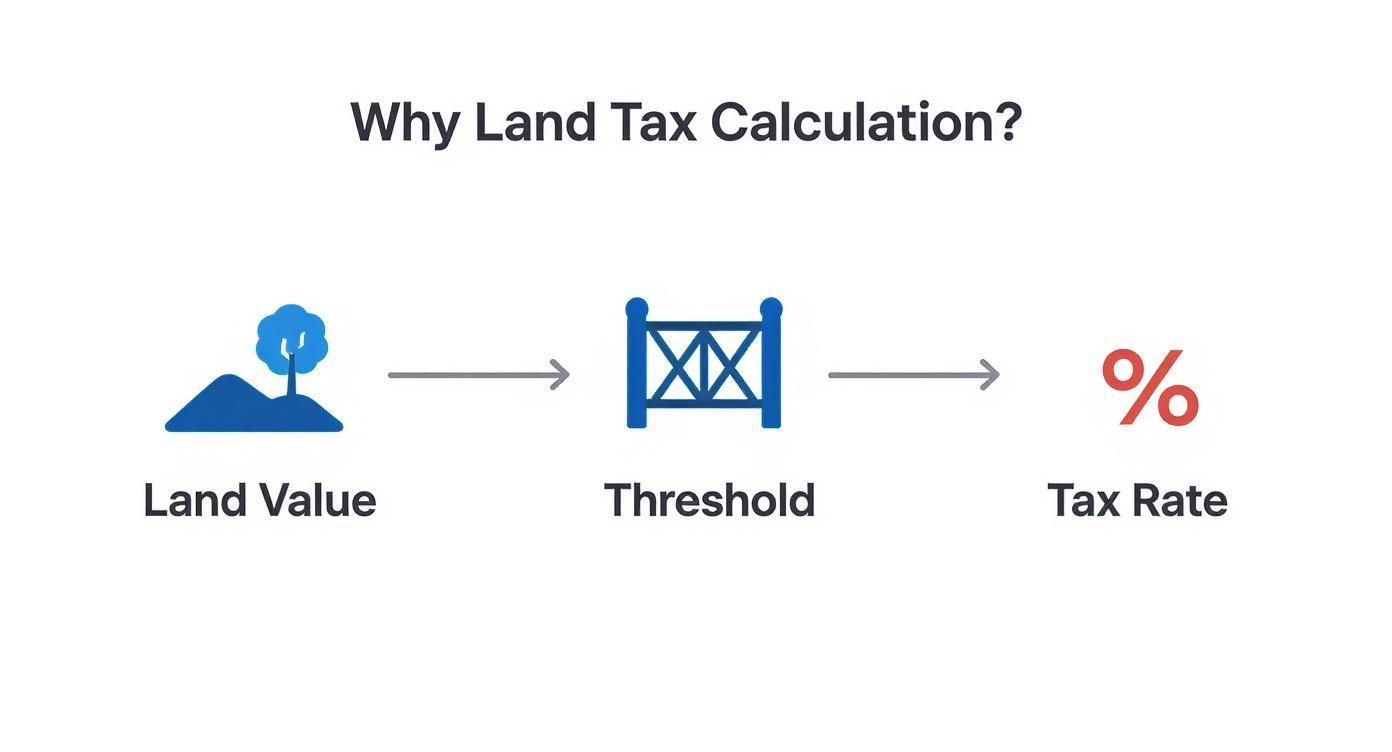
As you can see, it starts with the total value of your landholdings. This value is then checked against the state's tax-free threshold, and if you’re over that line, the relevant tax rate is applied to figure out what you owe.
Key Differences Across The States
The two numbers that matter most are the tax-free threshold (how much land value you can own before tax kicks in) and the marginal tax rates (what percentage you pay once you've crossed that line). A higher threshold is obviously better, as it gives you more room to grow your portfolio tax-free.
These differences aren't random; they’re a direct reflection of local property markets and government policies. Take New South Wales, for example. In 2025, the tax-free threshold for individuals is $1,140,000, with a top rate of 2% hitting land valued over $6.85 million. This is a world away from what you’d find in other states, proving you can’t apply a one-size-fits-all approach to your investment strategy.
The bottom line for any investor is simple: don’t assume the rules you know from one state apply in another. Every time you buy in a new state, you need to do your homework on the local land tax laws to avoid any nasty surprises.
A Special Focus On Western Australia
For our clients here in Mandurah and across WA, getting familiar with the local rules is essential. Western Australia has one of the lower tax-free thresholds in the country, currently set at just $300,000. This means property investors in WA are far more likely to get a land tax assessment than their counterparts in states like NSW.
Once the total unimproved value of your taxable properties goes over that $300,000 mark, a progressive, tiered rate kicks in. It’s designed so that those holding more valuable land contribute a larger share.
- The tax rates start low and climb as your total land value increases.
- The top marginal rate in WA is 2.67%.
- A key point for foreign owners: WA also applies a 7% surcharge on property purchases. While this is a one-off duty paid at settlement (like stamp duty), not an annual tax, it’s a significant upfront cost to factor into your budget.
Getting a handle on these initial purchase costs is just as important as the ongoing ones. If you're planning your next acquisition, our guide on investment property stamp duty is a great resource for budgeting all those government charges.
A Glance At The Other Jurisdictions
To give you the full picture, here’s a quick tour of how other parts of Australia tackle land tax. The differences are striking and can genuinely shape where you decide to invest.
To make it easier to compare, here's a simple table showing the thresholds and top rates for individuals.
Australian Land Tax Thresholds and Top Rates for Individuals
| State/Territory | Tax-Free Threshold | Top Marginal Rate |
|---|---|---|
| New South Wales | $1,140,000 | 2.00% |
| Victoria | $300,000 | 2.55% |
| Queensland | $600,000 | 2.75% |
| Western Australia | $300,000 | 2.67% |
| South Australia | $755,000 | 2.40% |
| Australian Capital Territory | $0 (No Threshold) | Rates-based system |
| Tasmania | $100,000 | 2.00% |
| Northern Territory | No Land Tax | N/A |
As the table shows, the landscape varies dramatically from place to place.
- Victoria: Known for its complex system, a low threshold, and extra surcharges for absentee owners. The government recently lowered the tax-free threshold, which has pulled more landlords into the tax net.
- Queensland: Offers a relatively high $600,000 threshold for individuals, making it an attractive option for investors with smaller portfolios.
- South Australia: Uses an aggregation model and has adjusted its rates and thresholds to keep up with soaring property values.
- Australian Capital Territory (ACT): Plays by its own rules. There’s no tax-free threshold because land tax is baked into the general rates system, meaning every single property owner chips in.
- Northern Territory: The true outlier. It's the only place in Australia with no land tax at all, making it a unique spot for investors focused on minimising holding costs.
This state-by-state rollercoaster just highlights how important it is to get local advice. The rules in Perth are not the rules in Parramatta, and knowing the difference is fundamental to making smart, profitable investment decisions across the country.
Strategies To Manage Your Land Tax Liability
Knowing the rules of land tax is one thing. But using them to your advantage? That’s how you build a smarter, more profitable property portfolio. Legally minimising your land tax bill isn't about finding sneaky loopholes; it's about smart, strategic planning and knowing every tool in your belt.
This kind of proactive approach means more of your investment returns stay right where they belong—in your pocket. This boosts your cash flow and fuels your long-term capital growth. So, let's dive into some of the most effective strategies property investors use to keep their land tax liability in check.
Maximise Your Exemptions
The simplest and most powerful strategy is to make absolutely sure you've claimed every single exemption you're entitled to. The most common slip-up is failing to correctly register your Principal Place of Residence (PPR), which can land you an unnecessary and often substantial tax bill.
Look beyond your own home and review your entire portfolio for other potential exemptions. Do you own rural land that might qualify for a primary production exemption? Is one of your properties used by a charitable organisation? Double-checking these details every year can literally save you thousands.
Consider Your Ownership Structure
How you own a property can dramatically change your land tax assessment. The structure you choose from day one has huge implications because it directly affects how the tax-free threshold is applied to your holdings.
- Individual Ownership: You get one tax-free threshold per state.
- Joint Tenancy: Spouses or partners are usually assessed as a single unit, which means they share just one threshold.
- Trusts and Companies: These entities are often hit with different, and sometimes much harsher, tax rates and lower (or even zero) thresholds.
For example, two partners might think about buying separate investment properties in their own individual names instead of buying one jointly. This simple move could allow each person to claim a full tax-free threshold in that state, effectively doubling the land value they can hold before any tax kicks in. Getting the ownership structure right from the start is crucial, as trying to change it later can trigger other nasty costs like stamp duty.
A common misconception is that different ownership structures are only for large-scale developers. In reality, even for investors with just two or three properties, a thoughtful ownership strategy can be the difference between paying thousands in tax or paying nothing at all.
Diversify Across State Lines
For investors with a growing portfolio, one of the most effective strategies is geographical diversification. Because land tax is a state-based tax, each state or territory assesses your holdings within its borders completely independently of the others.
This means you get to benefit from a separate tax-free threshold in each state where you own property. An investor holding $1 million of land in New South Wales would be well over the threshold. But if that same investor held $500,000 of land in NSW and $500,000 in Queensland, they would likely fall below the threshold in both states and pay no land tax at all. It's a savvy approach that not only minimises tax but also spreads your market risk. Understanding the full picture of your finances is key, and it's worth exploring the various investment property tax benefits available to you.
Monitor and Challenge Valuations
Finally, never just assume the land valuation you receive from the Valuer General is set in stone. These are mass valuations, and frankly, errors can and do happen. If your assessed unimproved land value seems way out of line compared to similar properties in your area, you absolutely have the right to object.
Successfully challenging a valuation can directly slash your land tax bill for that year and potentially for many years to come. Always keep a close eye on your annual assessment notice and be ready to gather evidence—like recent sales data for similar vacant blocks—to back up your claim.
How Land Tax Impacts Your Investment Returns
So, why should an investor really care about land tax? Simple. It’s not just another line item on a form—it's a direct holding cost that eats into your investment's bottom line. It has a real impact on everything from your monthly cash flow to your final profit when you decide to sell.
Think of it as an unavoidable annual bill, right up there with council rates and insurance. Every single dollar you pay in land tax is a dollar that isn't going towards paying down your mortgage, funding renovations, or landing in your own bank account. For any serious investor, factoring this cost into your financial projections isn't just a good idea; it's non-negotiable.
A surprise land tax bill can be a nasty shock. It has the power to flip a positively geared property into a negative one, putting a strain on your finances and potentially derailing your entire investment strategy. That’s why you have to treat it as a core part of your annual budget from day one.
The Bigger Picture Your Tax Dollars Paint
While it feels like a direct hit to your pocket, land tax is also the lifeblood for state governments. It’s a crucial revenue stream that funds the very public services that make our communities, especially here in Mandurah, such fantastic places to live and invest. The quality roads, schools, and hospitals that attract great tenants and future buyers are all partly paid for by these taxes.
And the revenue it generates is huge. For the 2022–23 financial year, states and territories collected almost $14.75 billion in land tax. New South Wales was at the top with $5.96 billion, closely followed by Victoria with $5.37 billion—no surprise given the value of their property markets. You can dive into the nitty-gritty and read the full Commonwealth Grants Commission data to see how each state stacks up.
Seeing this dual role—a personal expense on one hand, a public benefit on the other—helps put it all in perspective. Your tax dollars are actually helping to build and maintain the infrastructure that underpins the long-term capital growth of your investment.
At the end of the day, getting a handle on your tax obligations is just as vital as finding the perfect property. A solid understanding of land tax leads to more accurate financial planning and helps you forecast your returns with confidence. It's a key piece of the puzzle when you’re learning how to calculate rental yield and making the sharp, informed decisions that build a profitable portfolio.
Your Land Tax Questions, Answered
When you're investing in property, questions around ongoing costs like land tax are bound to pop up. To give you a bit more clarity and confidence, we’ve put together some straightforward answers to the questions we hear most often from Mandurah property owners.
This is all about the practical, day-to-day stuff that really impacts your budget and investment strategy. Let's clear up the confusion.
Is My Family Home Subject To Land Tax?
This is the big one, and thankfully, the answer is almost always no. Your main home, officially known as your Principal Place of Residence (PPR), is completely exempt from land tax in every state and territory that has one.
This exemption is the bedrock of Australian land tax law, designed to protect homeowners from being taxed on the land their family home is built on. Land tax is really aimed at investment properties, holiday homes, or vacant blocks you’re holding onto.
How Often Do I Have To Pay?
Land tax is an annual tax. You can expect to receive an assessment notice from your state revenue office once a year. The tax year generally aligns with the financial year (1 July to 30 June), and your bill is calculated based on the taxable land you own on a specific date, which is typically midnight on 30 June.
Think of it as a recurring annual expense, just like your council rates or insurance. It's crucial to budget for it, because failing to pay on time can lead to some hefty penalties and interest charges.
Can I Claim Land Tax As A Tax Deduction?
Yes, you can! But there’s a key condition: the property must be generating rental income. For any of your investment properties, the land tax you pay each financial year is considered a holding cost, making it fully tax-deductible against your income.
This deduction is a huge help in reducing your overall tax bill and is a vital part of making sure your investment is as profitable as possible. Just remember, you can't claim a deduction for land tax on a property you don't rent out, like a private holiday home or an empty block of land.
What Happens If I Own Properties In Multiple States?
This is where things get interesting for savvy investors. Land tax is handled state by state, completely independently. This means your property holdings here in Western Australia are assessed entirely separately from any properties you might own over in New South Wales or Queensland.
Each state has its own tax-free threshold that only applies to the land you own within that state. So, you could theoretically own land valued just under the threshold in three different states and pay no land tax whatsoever. It’s one of the big reasons why spreading your property portfolio across state lines can be a really smart tax-minimisation strategy.
Ready to make your next move in the Mandurah property market? Whether you're buying your first investment or looking to grow your portfolio, having a local expert in your corner makes all the difference. Contact David Beshay Real Estate for a free, no-obligation property appraisal and see how our deep local knowledge can help maximise your returns. Visit us at https://realestate-david-beshay.com.au to get started.

