


When you’re budgeting for an investment property in Western Australia, there's a big, one-time cost you absolutely can't forget: stamp duty. Think of it as a government fee you have to pay to get the property's title officially transferred into your name. It's a hefty upfront expense, calculated based on the property’s value, and it’s a crucial part of your initial financial planning.
What Exactly Is Stamp Duty for Investment Properties in WA?

When you buy a property, the purchase price isn't the only major payment you'll make. The government also requires a fee to legally process the change of ownership. This fee is officially called ‘transfer duty’, but just about everyone knows it as stamp duty. Because it's a state-based tax, the rates and rules here in Western Australia are different from what you'd find in New South Wales or Victoria.
For an investor, this isn't a small detail. It's a significant financial hurdle that has to be cleared right at settlement. Unlike council rates or water bills that you can pay off over time, stamp duty is a substantial, single payment needed to finalise your purchase.
Why It’s a Bigger Deal for Investors
The reason you're buying a property—whether to live in it or to rent it out—makes a huge difference when it comes to stamp duty. Owner-occupiers, especially first-home buyers, often get a helping hand from the government with concessions or even full exemptions, like the First Home Owner Rate of Duty.
But for someone buying a property purely as an investment? Those benefits usually don't apply. Investors are typically required to pay the full, standard rate of stamp duty. This can dramatically increase the amount of cash you need to have ready to go, so understanding this distinction is the first step in building a realistic investment strategy.
Stamp duty is a massive chunk of your initial acquisition cost. It’s not just a good idea to factor it in—it's absolutely essential. Getting this number right from the start is critical for accurately forecasting your budget, cash flow, and eventual return on investment.
A Key Source of Government Revenue
Stamp duty isn't just a cost for buyers; it's a major pillar of funding for the state government. When the property market is hot, the revenue collected can be staggering. To give you an idea, in the 2020-21 financial year alone, Australian state and local governments collected a record-breaking $23.97 billion from this tax.
This heavy reliance on stamp duty revenue is why you don't see major reforms happening overnight. For an investor, it means this is a cost you have to meticulously plan for because it directly impacts your borrowing capacity and overall purchasing power.
Failing to account for it properly can leave you scrambling for funds at settlement, putting your entire investment at risk. For a closer look at recent discussions around this tax, you can explore more about stamp duty reforms in Western Australia and how they might shape the real estate market.
It’s easy to look at stamp duty today and think it’s always been this massive financial hurdle for investors, but that’s just not the case. Go back a few decades, and it was little more than an administrative fee—a minor blip on the radar when you bought a property. Now? It’s one of the biggest upfront costs you'll face, big enough to completely reshape your budget or even stop an investment plan in its tracks.
So, what happened? The main culprit is a sneaky little thing called bracket creep. Think of stamp duty brackets like a set of stairs, with each step up representing a higher tax rate for a more expensive property. The problem is, while property prices have been sprinting up those stairs for decades, the stairs themselves—the tax thresholds—have barely budged.
What this means is that a property that was once considered average is now being pushed into the top-tier tax brackets, the ones originally meant for only the most luxurious real estate.
The Impact of Stagnant Thresholds
As property values have soared, investors are now handing over a much larger slice of their purchase price in tax. A once-manageable cost has bloated into a serious financial obstacle. This isn’t just an inconvenience; it tangibly eats into an investor's buying power and can even slow down the entire property market.
You’ll often hear this criticized for putting the brakes on market activity. When you have to find such a huge chunk of cash just to pay the tax bill, it makes many investors think twice or delay their plans altogether.
The real sting of investment property stamp duty isn't just the final number. It's the share of your hard-earned income it now takes to pay it. That proportion has multiplied over the years, making it a far heavier burden to carry than it was for previous generations.
A Generational Shift in Cost
When you look at the numbers over time, the scale of this increase is pretty staggering. In Australia's major cities, the cost of stamp duty on investment properties has jumped more than fivefold in nominal terms over the last 40 years.
Take Sydney, for example. The median stamp duty has blown out to around $44,500. That’s about six months of an investor's take-home pay—a 5.4 times increase from what it was in the early 1980s. Melbourne has seen a similar story, with the duty on a median-priced home now sitting at roughly $42,500, which is a 6.1 times rise over that same period. You can dig into the full analysis of how these costs have changed at the Property Council Australia.
Understanding this history is crucial. It shows exactly why stamp duty is no longer a simple fee but a formidable hurdle that needs serious strategic planning right from the start of your investment journey.
Calculating Stamp Duty On Your WA Investment Property
Alright, now that we’ve covered the what and why of stamp duty, let's get down to the brass tacks. Calculating the exact amount you’ll owe might seem intimidating, but it’s really just a step-by-step process. This is where the theory turns into real numbers, helping you build a solid and realistic budget for your next investment in Western Australia.
First things first, you need to understand the term dutiable value. In most cases, it's refreshingly simple: it's the purchase price of the property. So, if you've agreed to buy an investment property for $600,000, then that's the dutiable value the government will use to work out your stamp duty bill.
Understanding the WA Stamp Duty Rates
In Western Australia, stamp duty works on a marginal or tiered system. A great way to think about it is like income tax—you don’t pay one single rate on the whole amount. Instead, different parts of the property's value get taxed at progressively higher rates. As an investor, you'll be paying the standard rate, as most concessions are designed for people who plan to live in the home themselves.
The table below breaks down the current rates for residential properties in WA.
WA Residential Stamp Duty Rates
| Dutiable Value Range ($) | Rate of Duty Calculation |
|---|---|
| $0 – $120,000 | $1.90 per $100 or part thereof |
| $120,001 – $150,000 | $2,280 plus 2.85% for every dollar over $120,000 |
| $150,001 – $360,000 | $3,135 plus 3.80% for every dollar over $150,000 |
| $360,001 – $725,000 | $11,115 plus 4.75% for every dollar over $360,000 |
| Over $725,000 | $28,453 plus 5.15% for every dollar over $725,000 |
This tiered structure is key. It means that the more expensive the property, the higher the percentage of tax you'll pay on the value that falls into those upper brackets.
The infographic here gives you a great visual of how this all comes together, from finding your property's value to applying the right rates.
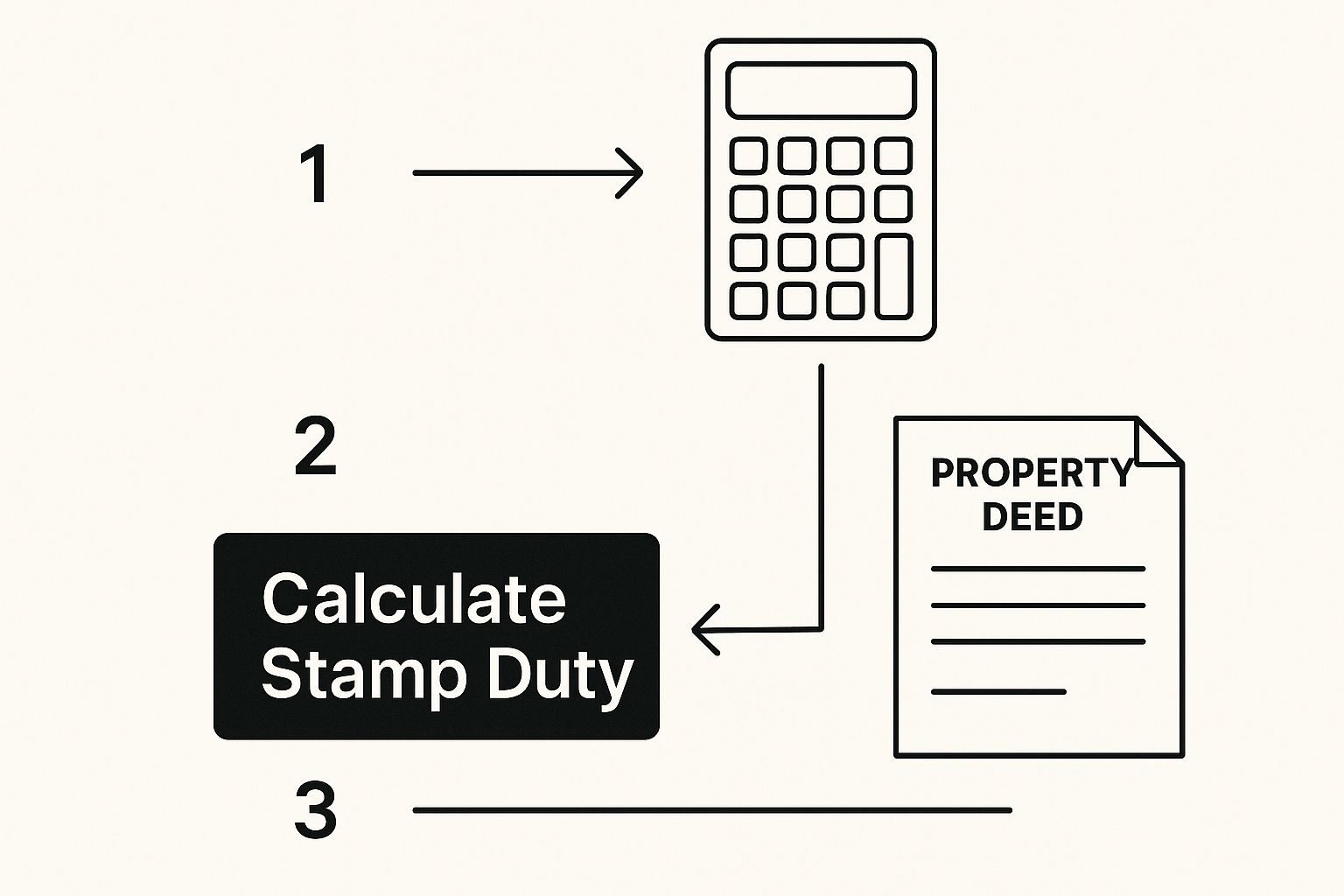
It really shows how each tier adds up to create the final duty you’ll need to pay. It’s a bit like building blocks, which is why it's so important to do the calculation step-by-step.
Real-World Calculation Examples
Let's walk through a few practical examples to see how this plays out in the real world. Laying out the maths like this takes away all the guesswork and shows you precisely how that final figure is reached.
Example 1: Investment Property Purchase Price of $500,000
A $500,000 property falls squarely into the $360,001 – $725,000 bracket.
- Base Amount: The duty on the value up to $360,000 is a set $11,115.
- Marginal Amount: Now, find the value above that threshold: $500,000 – $360,000 = $140,000.
- Marginal Rate: Apply the 4.75% rate to that slice: $140,000 x 0.0475 = $6,650.
- Total Duty: Finally, add them together: $11,115 + $6,650 = $17,765.
So, for a $500,000 investment property, you'd need to have $17,765 ready for stamp duty.
Example 2: Investment Property Purchase Price of $800,000
An $800,000 property pushes into the top bracket of Over $725,000.
- Base Amount: The duty for everything up to $725,000 is $28,453.
- Marginal Amount: Calculate the remaining value: $800,000 – $725,000 = $75,000.
- Marginal Rate: Apply the top rate of 5.15%: $75,000 x 0.0515 = $3,862.50.
- Total Duty: Add the base and marginal amounts: $28,453 + $3,862.50 = $32,315.50.
The stamp duty on an $800,000 investment would come to $32,315.50.
Example 3: Investment Property Purchase Price of $1,100,000
Let's look at a higher-value property to really see the impact.
- Base Amount: Again, the duty up to $725,000 is $28,453.
- Marginal Amount: Figure out the value above the threshold: $1,100,000 – $725,000 = $375,000.
- Marginal Rate: Apply the 5.15% rate to this portion: $375,000 x 0.0515 = $19,312.50.
- Total Duty: Add it all up: $28,453 + $19,312.50 = $47,765.50.
As you can see, once you're dealing with seven-figure properties, the stamp duty can easily climb towards $50,000 or more. It’s a serious cost to factor in.
While running these numbers by hand is fantastic for understanding how it all works, there's a much easier way to get a precise estimate for any property price. To save time and avoid any little maths errors, it's always smart to use a dedicated tool. For a quick and accurate figure, check out our easy-to-use WA stamp duty calculator—it does all the heavy lifting for you.
Finding Potential Concessions and Exemptions
For most investors, paying the full whack of investment property stamp duty is just part of the deal. It's a non-negotiable cost you factor into your purchase. But it's worth knowing that the Western Australian government does offer a few specific ways to bring this cost down, even if they're often tied to very particular circumstances.
While almost every first-time buyer has heard of the First Home Owner Rate of Duty, it's designed exclusively for people buying a home to actually live in. This means if you're a pure investor buying a rental property from day one, you won't qualify. But what about some of the more modern property strategies?
The First Home Owner Rate and 'Rent-Vesting'
A strategy that's gained a lot of traction is 'rent-vesting'. This is where you buy a property in a more affordable area to get your foot on the ladder, while you continue to rent in a suburb you prefer to live in. If you're a first-time buyer doing this, it's natural to wonder if you can claim the first home owner concession.
Unfortunately, the answer is almost always no. A key condition for the First Home Owner Rate in WA is that you must live in the property as your main residence for at least six continuous months, starting within a year of settlement. Because an investment property has tenants, you simply can't meet this requirement, and the standard residential stamp duty rates will apply.
The rule is crystal clear: if you don’t plan to live in the property yourself, you aren't eligible for the First Home Owner Rate of Duty. It doesn't matter if it's your first ever property purchase.
Off-the-Plan Apartment Rebate
Now for some good news. To encourage new construction and boost housing supply, the WA government has offered a stamp duty rebate for buyers of new, off-the-plan apartments. This scheme has been a game-changer for many investors, representing one of the best opportunities to slash upfront costs.
The rebate is for buying a brand-new residential unit or apartment in a multi-level development. The key features of the current scheme are:
- A 50% rebate on the stamp duty you have to pay.
- The rebate is capped at a maximum of $50,000.
- It only applies to pre-construction contracts signed within specific government timeframes.
Crucially, this rebate is open to both owner-occupiers and investors, making it a seriously powerful incentive. Let's say you're an investor buying a $600,000 off-the-plan apartment. Your stamp duty bill would be around $23,915. A 50% rebate cuts that by $11,957.50—a huge saving that makes the numbers on your investment look a whole lot better from the get-go.
Other Niche Exemptions
Beyond rebates, there are a few very specific situations where stamp duty might not apply at all. These are usually tied to personal circumstances, not your investment strategy, but they're still important to be aware of.
- Spousal Transfers: Transferring a property between married or de facto partners is generally exempt from stamp duty, as long as it's their shared home.
- Deceased Estates: If you inherit a property through a will, the transfer is typically exempt from stamp duty.
While these exemptions rarely come into play for a standard investment purchase, they show that the rules around stamp duty aren't always set in stone. It's always a smart move to check the specific conditions with the WA government or your settlement agent to see if your unique situation might qualify for some relief.
Strategies to Manage and Minimise Stamp Duty
Knowing how to calculate your investment property stamp duty is one thing, but the real power comes from knowing how to strategically manage this significant cost. Smart investors don’t see stamp duty as just another fee tacked on at the end; they weave it into their buying strategy right from the start. This proactive mindset can shape your budget, the properties you target, and ultimately, your investment’s profitability.
When you treat stamp duty as a core part of the purchase price, your entire financial outlook shifts. It forces you to think about the total capital you need to get the keys, which helps you avoid any last-minute financial surprises and ensures your investment is built on solid ground.
Negotiate a Smarter Purchase Price
One of the most straightforward ways to shrink your stamp duty bill is to lower the property's dutiable value—which is almost always the price you pay for it. Every single dollar you manage to negotiate off the sale price is a dollar that isn't being taxed. This direct link between your negotiation skills and tax savings is often missed, but it can save you a bundle.
Think about it this way: successfully negotiating a $15,000 price drop on a $600,000 property doesn't just save you $15,000 on the purchase itself. In WA, that reduction also shaves an extra $712.50 off your tax bill—money that can go straight back into your pocket or towards other buying costs.
This really highlights the value of sharp negotiation skills or working with a real estate agent who knows how to get you the best possible price. It’s a win-win that lowers both your mortgage and your tax liability.
Rethink Your Investment Strategy and Location
The way stamp duty affects your bottom line heavily depends on your investment goals. Your chosen strategy, whether it’s for long-term growth or a quick flip, completely changes the impact of this hefty upfront cost.
A ‘buy and hold’ strategy, for instance, is far more resilient to the sting of stamp duty. When you hold a property for many years, that initial tax hit gets spread out over a long period of capital growth and rental income. Over time, it becomes a much smaller slice of your total return.
On the other hand, a ‘flipping’ strategy—where you buy, renovate, and sell quickly—is extremely sensitive to stamp duty. Since you’re paying the tax on the way in and it eats into your net profit on the way out, it can seriously dent your margins. A $30,000 stamp duty bill on a property you only hold for six months has a much bigger bite than the same bill on a property you hold for a decade.
The most effective way to manage investment property stamp duty is to align your purchase decisions with your long-term financial goals. A high stamp duty cost can make short-term strategies unviable, while a buy-and-hold approach can absorb the cost over time.
This kind of strategic thinking might also lead you to look at different locations. Instead of zeroing in on high-priced, blue-chip suburbs, exploring more affordable areas with strong growth potential can be a very clever move.
Let's compare two scenarios:
- Option A: High-Value Suburb: You buy an $850,000 investment property. Your stamp duty would be roughly $34,890.
- Option B: Growth Suburb: You buy a $550,000 property in an up-and-coming area. Here, the stamp duty is around $20,390.
By going with Option B, you’ve instantly saved over $14,500 in upfront tax. That's capital you could use for a deposit on another property, renovations to boost your rental yield, or simply to lower your overall debt. It’s an approach that lets you build your portfolio more efficiently while keeping your tax burden down on each purchase.
The Broader Economic Debate Around Stamp Duty
When you zoom out from your own settlement statement, you start to see that investment property stamp duty is much more than just a personal expense. It’s a powerful economic tool that sparks some pretty intense debates among economists, policymakers, and investors. The way it’s structured sends ripples through the entire economy, well beyond your individual budget.
A lot of experts argue that stamp duty essentially acts like a handbrake on the property market. Think about it: because it’s such a hefty upfront cost, it can stop people from making moves that would otherwise be great for them and the broader economy. This might be a growing family hesitating to upsize, retirees putting off downsizing, or even a worker thinking twice about moving for a fantastic job opportunity.
An Unpredictable Revenue Stream
For state governments, stamp duty is a real double-edged sword. Sure, it rakes in billions, but its income is completely tied to the whims of the property market. This makes it an incredibly volatile and unpredictable source of cash.
When the market is firing on all cylinders, government coffers are overflowing. But the moment things cool down, that revenue stream can dry up alarmingly fast.
You can see this playing out in the real world. In Victoria, for instance, stamp duty revenue hit a massive $10.361 billion during the hot market of 2021-22. Fast forward to 2023-24, and projections dropped to $8.427 billion as the market shifted. You can dig into the yearly land transfer duty statistics yourself to see just how dramatic these swings are. This kind of instability makes long-term state budgeting a serious headache and explains why the current conditions are so closely watched. It's also why so many are interested in understanding what's behind the booming WA real estate market in our guide.
In short, this tax penalises mobility. Every time a property changes hands, the government takes a huge slice, creating a barrier that can stifle an efficient market and lock people into homes that no longer suit them.
The Land Tax Alternative
All of this has sparked a national conversation about ditching stamp duty for something completely different: a broad-based annual land tax.
The idea is to get rid of that massive one-off payment when you buy and swap it for a smaller, ongoing annual fee based on the unimproved value of the land itself.
- Potential Pros: For governments, a land tax would create a much more stable and predictable stream of revenue. For property investors, it removes a major upfront hurdle, which could make it easier to get into the market.
- Potential Cons: On the flip side, investors would have a new, ongoing holding cost to worry about, which would need to be carefully factored into their annual cash flow. There are also some really tricky questions about how to switch from one system to the other without being unfair to existing or new owners.
Frequently Asked Questions About Stamp Duty
Diving into an investment property purchase always brings up a lot of questions, especially around a major cost like stamp duty. To give you a bit more confidence, we've put together some quick, clear answers to the things investors ask us most often here in Western Australia.
When Do I Pay Stamp Duty in WA?
In Western Australia, there’s a firm deadline for paying your stamp duty. You have exactly one month from the property’s settlement date to get it paid. If you let that date slide, you could be facing some unwelcome penalties and interest charges.
The good news? This isn’t usually something you need to juggle yourself. Your settlement agent or conveyancer will typically handle the payment for you. They’ll collect the funds from you as part of the final settlement figures, making sure everything is paid on time.
Can I Include Stamp Duty in My Investment Loan?
This is a really common question, and the short answer is often yes. Many lenders are happy to let you capitalise the stamp duty, which simply means rolling it into your total loan amount. However, whether you can do this depends entirely on the lender's policies and your loan-to-value ratio (LVR).
Be careful with your LVR. If adding the stamp duty to your loan amount pushes your LVR over the 80% mark, you'll almost certainly have to pay Lenders Mortgage Insurance (LMI). It's a smart move to chat with your mortgage broker about this early on to get a clear picture of the total costs involved.
Is Investment Property Stamp Duty Tax Deductible?
Stamp duty isn't something you can claim as an immediate tax deduction each year, unlike council rates or property management fees. Instead, the Australian Taxation Office (ATO) sees it as a capital cost.
What this means is you add the stamp duty amount to the ‘cost base’ of your property. It might not feel like a win right away, but here’s how it helps you down the track:
- It Increases Your Cost Base: The purchase price plus your stamp duty (and other buying costs) creates a higher starting value for your investment on paper.
- It Reduces Your Capital Gains Tax (CGT): When you eventually sell, this bigger cost base is what you'll use to calculate your capital gain. A higher cost base means a smaller taxable profit, which directly cuts down the final Capital Gains Tax bill you’ll have to pay.
Tax rules can get a bit tricky and are unique to everyone's situation, so we always suggest getting personalised advice from a qualified accountant. They can make sure you’re accounting for every cost correctly and maximising your returns.
Are you thinking of buying or selling an investment property in Mandurah? The team at David Beshay Real Estate offers expert local knowledge and personalised service to help you achieve your property goals. For a free, no-obligation property appraisal and strategic market advice, visit us at https://realestate-david-beshay.com.au.
Article created using Outrank


Pingback: What Is Property Investment in Mandurah: A Local Guide - David Beshay Real Estate - Beshay Realty
Pingback: Investment Property Criteria in Mandurah: A 2026 Guide - David Beshay Real Estate - Beshay Realty