


Owning an investment property isn't just about collecting rent; it's also about the powerful tax benefits that come with it. These perks let you deduct most of the property's running costs against the income it generates, which can significantly lower your taxable income.
Think of your investment property as a small business. The Australian government offers these incentives to encourage people like you to invest in real estate, which helps increase the supply of housing for everyone.
The Real Value of Property Tax Benefits
Treating your investment property like the business it is unlocks its full financial potential. The Australian Taxation Office (ATO) allows you to claim its various running costs against your rental income. This isn't about finding secret loopholes; it's about understanding the legitimate investment property tax benefits that are fundamental to your success as an investor.
Getting your head around these concepts is the key to improving your cash flow, shrinking your annual tax bill, and ultimately, getting the best possible long-term return on your investment. Let's walk through each critical element so you can start making smarter financial decisions.
Before we dive deep, let's get a quick overview of the main tax benefits available to you as a property investor in Australia.
Key Investment Property Tax Benefits at a Glance
| Benefit Type | What It Covers | Primary Financial Impact |
|---|---|---|
| Deductible Expenses | The day-to-day running costs like loan interest, council rates, insurance, and management fees. | Directly reduces your taxable rental income, lowering your overall tax bill for the year. |
| Depreciation | The natural wear and tear on the building's structure (Capital Works) and the assets within it (Plant & Equipment). | A "non-cash" deduction that reduces your taxable income without you spending money in that year. |
| Negative Gearing | The situation where your total deductible expenses (including depreciation) are greater than your rental income. | Allows you to offset the property's net loss against your other income (like your salary), reducing your total taxable income. |
| Capital Gains Tax (CGT) Discount | A discount on the tax you pay when you sell the property for a profit, provided you've held it for over 12 months. | Reduces your capital gains tax liability by 50%, helping you keep more of the profit from your sale. |
This table gives you a bird's-eye view, but the real power comes from understanding how each one works in practice.
Core Concepts You Need to Know
The main benefits really boil down to a few key areas that work together:
-
Deductible Expenses: These are the straightforward, day-to-day costs of keeping your property up and running. Think of things like the interest on your home loan, council rates, water bills, strata fees, and the fees you pay your property manager. Every dollar you spend on these essentials helps chip away at your taxable rental income.
-
Depreciation: This one is a game-changer because it’s a "non-cash" deduction. You get to claim a deduction for the general wear and tear on your building and the assets inside it (like carpets, ovens, and blinds) as they age. The best part? You can claim it every year without actually spending any extra money.
-
Negative Gearing: You've probably heard this term thrown around a lot. It simply happens when your property's total expenses, including all those deductions and depreciation, add up to more than the rent you're bringing in. This creates a net rental loss, which you can then use to offset your other income, like your salary, potentially leading to a bigger tax refund.
And don't fall for the myth that these strategies are just for the super-rich. Far from it. Treasury data from 2012-13 revealed that around 1.3 million Australians reported a net rental loss. What’s more, nearly 70% of those investors had a taxable income under $80,000.
You can explore these findings on the Treasury website. This just goes to show that everyday Aussies are the ones successfully using these very real benefits to get ahead and build wealth through property.
Claiming Your Core Deductible Expenses

Once you start seeing your property as a small business, the next logical step is getting to know the everyday running costs you can claim at tax time. These are your deductible expenses, and they're your first line of defence in reducing your taxable income. The Australian Taxation Office (ATO) is quite clear: you can deduct any expense directly tied to earning your rental income.
Think of it this way—for every dollar you spend on a legitimate expense, your taxable income shrinks by that same dollar. This has a direct impact on your tax bill, putting more money back in your pocket or freeing it up for your next investment goal.
The biggest ticket item for most investors is the interest on their investment loan. In fact, a review by the Reserve Bank of Australia found that interest payments typically chew up about half of all rental property expenses. That really highlights just how valuable this single deduction is for property investors.
The Most Common Deductible Expenses
While loan interest is the heavyweight champion of deductions, a whole host of other costs add up to make a significant difference. This is why keeping meticulous records is non-negotiable.
Here are some of the most common and worthwhile expenses to track:
- Council and Water Rates: Any rates you pay to your local council or water authority for the property are fully deductible.
- Property Management Fees: If you have a real estate agent managing your property, their fees are a direct cost of earning income and are completely claimable.
- Insurance: Your premiums for building, contents, and specific landlord insurance policies are all deductible.
- Land Tax: If your property portfolio grows valuable enough to attract state land tax, this is also a claimable expense.
- Body Corporate Fees: For apartments, townhouses, or units, these regular fees are a standard deduction.
- Advertising for Tenants: Any money you spend finding new tenants, like paying for online listings, can be claimed.
Key Takeaway: As a rule of thumb, an expense is generally deductible as long as it was paid during a period when the property was genuinely available for rent and it directly relates to managing or maintaining that rental.
Repairs vs. Improvements: A Critical Distinction
This is an area where so many new investors get tripped up, and it’s a distinction the ATO watches like a hawk. You have to get this right: is your spending a repair or an improvement?
A repair is all about restoring something to its original state. It’s fixing wear and tear or damage that happened while you were renting the property out. Fixing a leaky tap or replacing a single broken fence paling are perfect examples of repairs. These costs are 100% deductible in the same financial year you pay for them.
An improvement, on the other hand, makes something substantially better than it was, or it adds something entirely new. A full kitchen renovation or building a new deck are clear-cut improvements. You can’t claim these instantly. Instead, these are considered capital works, and you must claim their cost over several years through depreciation—a topic we'll dive into next.
Unlocking the Power of Depreciation

Beyond the day-to-day running costs of your property, there's a powerful ‘non-cash’ deduction that far too many investors miss out on: depreciation. This is easily one of the most significant tax benefits available because you can claim it without actually spending a dollar during the tax year.
Think of it like the natural, gradual wear and tear on your building and everything inside it. The Australian Taxation Office (ATO) recognises that these things lose value over time, and they allow you to claim that decline as an annual tax deduction. This can make a huge difference to your taxable income and, ultimately, your cash flow.
To get the most out of it, you need to understand that depreciation is split into two distinct categories.
Capital Works for the Building's Structure
The first type is Capital Works, which is all about the building’s core structure. This covers the original construction cost of the property, as well as any major extensions or structural improvements you might make down the track.
We're talking about the big-ticket items like the concrete slab, the walls, the roof, and even built-in cupboards. These elements lose value slowly and steadily, and you can claim this loss at a rate of 2.5% per year for up to 40 years from the day construction was completed. It’s a long-term deduction that really adds up over the life of your investment.
Plant and Equipment for Internal Assets
The second, and often more lucrative, category is Plant and Equipment. This covers all the easily removable items inside your property—the assets that have a much shorter lifespan than the building itself.
Just think about all the things in a typical rental:
- Carpets and blinds
- Ovens and cooktops
- Dishwashers
- Air conditioning units
- Hot water systems
These items depreciate much faster than the structure. Their decline in value is calculated based on an "effective life" for each specific asset, as determined by the ATO. This means you can claim larger deductions in the earlier years of owning the property, giving your tax return a more immediate boost.
The sheer number of investors taking advantage of this proves just how valuable it is. ATO stats from the 2016/17 financial year showed that over two million investors claimed an average of $1,363 for plant and equipment alone. You can discover more about these ATO property investment trends to see how common this strategy is.
Your Golden Ticket: The Quantity Surveyor's Report
To claim these deductions properly and maximise your return, getting a tax depreciation schedule from a qualified quantity surveyor is non-negotiable. This report is your golden ticket, giving you a detailed breakdown of every single eligible asset and its depreciable value for the next 40 years.
A quantity surveyor will physically inspect your property, identifying hundreds of claimable items you’d probably miss, and calculate the deductions for both Capital Works and Plant and Equipment. The best part? The fee for the report is 100% tax-deductible, making it an investment that pays for itself many times over. If you don't have one, you are almost certainly leaving thousands on the table every single year.
You’ve probably heard the term "negative gearing" thrown around, but what does it actually mean for your bank account?
Simply put, negative gearing is what happens when the total running costs of your investment property are more than the rental income it brings in. This isn't just about cash costs; it also includes non-cash deductions like depreciation.
When your expenses are higher than your income, you end up with a net rental loss. This isn't a bad thing—in fact, for many savvy investors, it’s a deliberate strategy. The real magic is that this "on-paper" loss can be used to reduce your other taxable income, like the salary you earn from your job. This can lower your overall tax bill and often results in a nice tax refund from the ATO.
This visual breaks down the simple flow of identifying, recording, and claiming these crucial expenses.
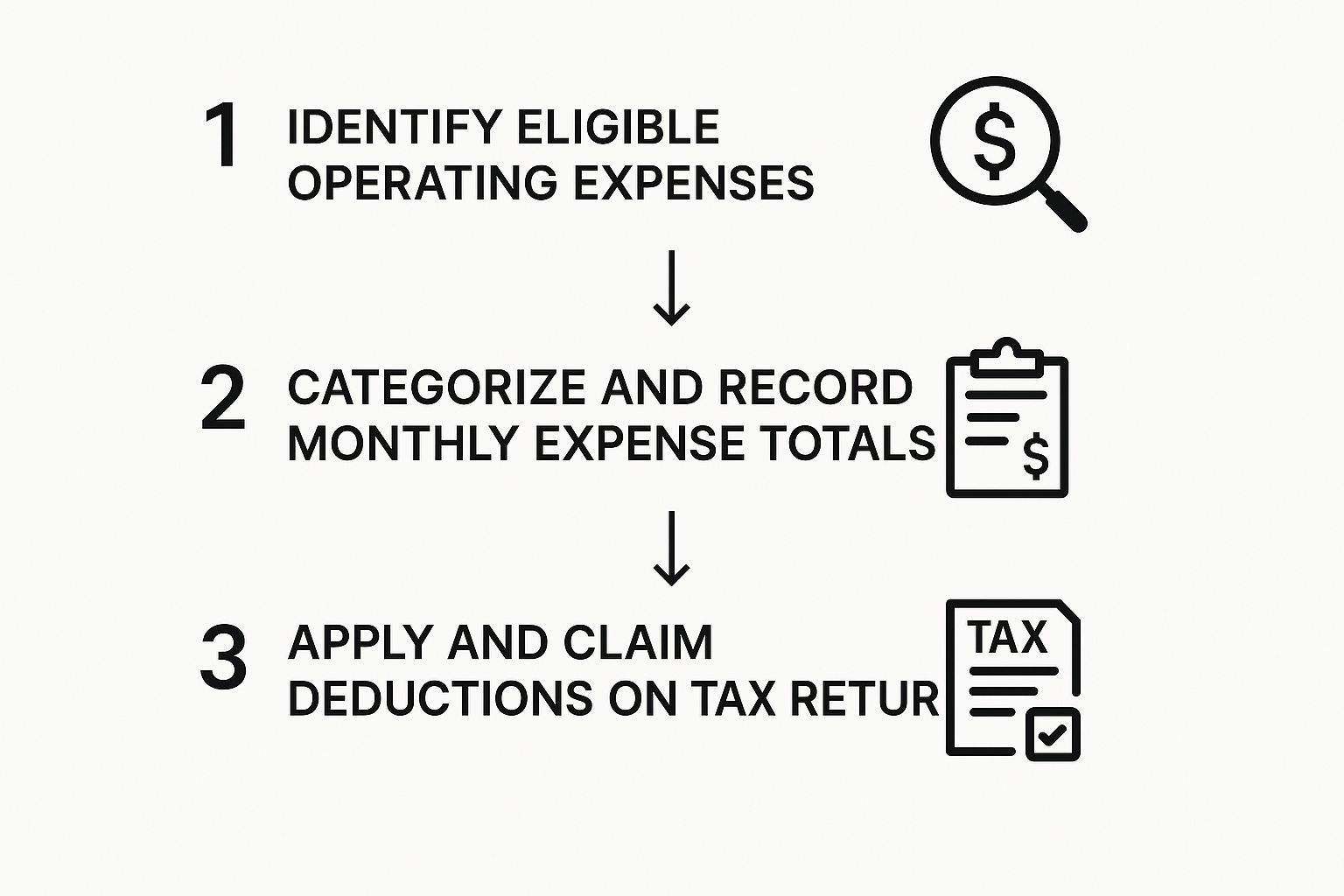
As you can see, making the most of your tax benefits starts with meticulously tracking every single eligible expense throughout the financial year.
A Practical Example of Negative Gearing
Let's walk through a real-world scenario to see how this plays out. Meet Sarah, an investor with a property in WA.
- Salary: $90,000 per year
- Rental Income: $26,000 per year ($500 per week)
Now, let's tally up her property's annual expenses:
- Loan Interest Payments: $20,000
- Council and Water Rates: $3,000
- Insurance: $1,500
- Property Management Fees: $2,000
- Repairs and Maintenance: $1,000
- Depreciation (from a Quantity Surveyor's Report): $7,500
Sarah's total deductible expenses come to $35,000 for the year, while her rental income is only $26,000.
Let’s do the maths:
$26,000 (Rental Income) – $35,000 (Total Expenses) = -$9,000 (Net Rental Loss)
Sarah now has a net rental loss of $9,000. She can subtract this loss from her salary when lodging her tax return. Her taxable income effectively drops from $90,000 to $81,000 ($90,000 – $9,000). By lowering her taxable income, she pays less tax and receives a significant refund.
The Long-Term Strategy
Negative gearing is much more than just a short-term tax tactic; it's a long-term strategy for building wealth. The annual tax refunds help manage the property's cash flow shortfall, making it more affordable to hold onto the asset for the long haul. Since interest payments are a huge part of the equation, keeping up with the latest news about rising interest rates in Australia is vital for any investor.
The ultimate goal here is capital growth. The idea is that the property's value will appreciate significantly over time, so the short-term paper losses you claim each year are eventually dwarfed by the profit you make when you decide to sell.
Minimising Your Capital Gains Tax
When you’re investing in property, your exit strategy is every bit as important as how you enter the market. After years of careful management and growth, the day will eventually come when you decide to sell. If you sell your investment property for more than you paid for it, that profit is considered a capital gain—and it's subject to Capital Gains Tax (CGT).
It’s a common misconception that CGT is a separate tax. It’s not. Instead, the net capital gain you make from the sale gets added directly to your taxable income for that financial year. This can easily bump you into a higher tax bracket, leading to a surprisingly large tax bill if you’re not prepared.
Thankfully, the Australian government offers a powerful incentive for long-term investors. Understanding this is one of the most critical investment property tax benefits you can know, as it directly impacts your final profit.
The 50% CGT Discount Explained
The single most effective strategy for slashing your CGT bill is remarkably simple: patience. If you own an investment property for more than 12 months before you sell it, you’ll generally be eligible for the 50% CGT discount.
This rule is a game-changer. It allows you to instantly cut your taxable capital gain in half. This isn't just a minor tweak; it’s a massive reduction that can save you tens of thousands of dollars. The government’s logic is to reward investors who contribute to the long-term stability of the housing market, rather than those just looking to make a quick flip.
For a deeper dive into all the specifics, our detailed guide on capital gains tax for property in Australia is an excellent resource.
Let’s look at a clear, side-by-side example to see just how dramatic the difference can be.
Example: The Power of 12 Months
An investor, Alex, sells a property and makes a capital gain of $200,000. We'll assume Alex’s marginal tax rate is 37%.
- Held for 10 months: Alex doesn't qualify for the discount. The full $200,000 is added to their income. The CGT payable would be $74,000 ($200,000 x 37%).
- Held for 13 months: Now, Alex qualifies for the 50% discount. The taxable gain is halved to $100,000. The CGT payable is just $37,000 ($100,000 x 37%).
By simply holding onto the asset for a few more months, Alex saves a whopping $37,000. This perfectly illustrates why long-term thinking is absolutely essential. Rushing a sale can be one of the costliest mistakes an investor can make, wiping out a huge chunk of the wealth they worked so hard to build.
Your Action Plan for Maximum Tax Returns
Knowing the theory behind tax benefits is one thing, but actually putting it into practice is what builds real wealth. Think of this as your practical playbook for turning that knowledge into action and making sure you claim every single dollar you're entitled to.
The foundation of any great tax strategy is simple but completely non-negotiable: you absolutely must keep meticulous records. See yourself as the dedicated bookkeeper for your own property business. Whether you use a simple spreadsheet or a digital tool, track every single expense—from a $5 tube of sealant to your annual insurance premium. This one habit is the key to maximising your deductions.
Assemble Your Professional Team
While a bit of DIY is great for weekend projects, your tax strategy isn't the place to cut corners. Hiring specialists isn’t a cost; it's a powerful investment in your financial future. Best of all, their fees are almost always tax-deductible, and their know-how can save you thousands.
- Specialist Property Accountant: These experts live and breathe property tax law. A good one will help structure your finances correctly from the start and ensure you’re claiming everything legally possible.
- Quantity Surveyor: This is your secret weapon for unlocking massive depreciation claims. They’ll visit your property and create a detailed depreciation schedule, a report that often uncovers tens of thousands of dollars in deductions over the property's life.
The most expensive advice is often the advice you didn't get. A small fee for a quantity surveyor's report can pay for itself many times over in the first year alone through increased deductions.
Be Tactical with Your Timing
Here’s a smart tactic many seasoned investors use: time your expenses strategically. If you have some necessary repairs or maintenance on the to-do list, try to get them completed and paid for before the 30th of June. This little move allows you to claim the deduction in the current financial year, giving your tax return an immediate boost.
And don't forget, even those big upfront costs like stamp duty have tax implications down the line. While you can't claim it year-to-year, it does affect your 'cost base' when it comes time to calculate Capital Gains Tax. Taking the time to learn about investment property stamp duty right from the start helps you see the full financial picture. This kind of proactive management is what builds true confidence and control.
Got Questions About Property Tax Benefits? We've Got Answers

Even when you feel you've got a handle on the big picture, property tax can throw some real curveballs. Let's tackle some of the most common questions we hear from investors. Getting these right can save you a lot of headaches (and money) with the ATO.
Can I Claim Travel Costs to My Investment Property?
In a word: no. The rules on this changed back on 1 July 2017, and the ATO has been crystal clear ever since. You can no longer claim deductions for any travel expenses you rack up to inspect, maintain, or collect rent for a residential rental.
That means flights, car expenses, and accommodation are all off the table. It's a surprisingly common mistake, but one that can put you on the fast track to an ATO audit. Best to leave these claims off your tax return entirely.
What's the Difference Between a Repair and an Improvement?
This is one of the most important distinctions to get right. It trips up even seasoned investors.
A repair is all about restoring something to its original state. Think of it as fixing what’s broken—a leaky tap, a cracked window pane, or a faulty oven element. These costs are fantastic because they are 100% deductible in the financial year you pay for them.
An improvement, on the other hand, makes something substantially better than it was before. We're talking about a full kitchen renovation, adding a deck, or installing a modern air-conditioning system where there wasn't one. These are considered capital works, so you can't claim them upfront. Instead, you'll claim their value over several years through depreciation.
A great way to think about it is to ask yourself: "Am I just fixing it, or am I making it better?" Your answer dictates how you claim the expense, and it’s a critical part of staying compliant.
Does CGT Apply If I Move into My Investment Property?
Yes, and this is where things can get a bit tricky. When you move into your rental property and make it your primary home, that portion of time you live there is generally exempt from Capital Gains Tax (CGT).
However, you'll almost certainly be on the hook for a partial CGT bill. This is calculated based on the period it was rented out and generating income. The formula for working out this partial exemption is complex. It's not something you want to guesstimate, so we strongly recommend getting advice from a qualified tax professional to avoid any nasty surprises down the line.
Navigating the world of property investment is always easier when you have an expert in your corner. If you're looking for a realistic, professional appraisal of your property's value in the Mandurah market, get in touch with David Beshay Real Estate. Let's build a strategy that works for your financial goals. Get your free property appraisal today.
Article created using Outrank


Pingback: What Is Negative Gearing? Your Essential Guide for Investors - David Beshay Real Estate - The Agency
Pingback: How to Calculate Rental Yield in Australia - David Beshay Real Estate - The Agency
Pingback: What Is a Good Rental Property Investment: Guide 2026 - David Beshay Real Estate - Beshay Realty
Pingback: Property Investment for Beginners: Mandurah Guide 2026 - David Beshay Real Estate - Beshay Realty