


When you’re thinking about selling your home, one of the first questions that pops up is, "how much commission do real estate agents actually get?" In Australia, there’s no single answer—it’s more of a range. Typically, agent commissions fall somewhere between 1.0% and 3.6% of your property's final sale price, which means their fee is directly linked to the result they get for you.
Understanding Real Estate Commission in Australia
It’s helpful to think of a real estate agent's commission not as a fixed cost, but as a success fee. An agent puts their time, expertise, and money into marketing and selling your property, but they only get paid once the sale is a done deal. This performance-based model keeps everyone’s goals aligned: getting you the best possible price for your home.
The fee is simply a percentage of that final sale price. Unlike some other professional services, real estate commissions aren't set by law here in Australia. That means rates are often shaped by things like local competition, property values, and what’s considered normal in each state.
How Averages Vary Across the Nation
Looking at the big picture, the national average for a percentage-based commission sits between 1.0% and 3.6% of the final sale price. To give you a real-world example, if your home sells for $600,000, the commission could be anywhere from $6,000 to $21,600, not including any separate marketing costs.
It's important to see this commission as more than just a fee; it's an investment in professional expertise that handles a whole lot of critical work behind the scenes.
An agent's commission reflects their commitment to managing every detail of the sale, from strategic marketing and buyer inspections to complex negotiations and settlement coordination.
What Does the Commission Cover?
So, what are you actually paying for? The percentage you agree on covers a full suite of services, all designed to get you the highest sale price. This includes:
- Market Analysis: Deep-diving into local data to price your home accurately right from the start.
- Marketing Strategy: Building and running a custom plan to get your property in front of the right buyers.
- Buyer Management: Handling all the enquiries, running open homes, and vetting potential purchasers so you don't have to.
- Negotiation: Using their skills to negotiate with buyers and push for the best possible price and terms.
- Sale Administration: Managing all the complex paperwork and liaising with solicitors to make sure everything goes smoothly through to settlement.
While the commission is the main fee, it’s only one part of the equation. Our guide on the total cost of selling a house gives you a broader look at the other expenses you might come across. Getting your head around this is the first step toward a successful and profitable sale.
A Closer Look at Commission Rates in Western Australia
While a national average gives you a decent ballpark figure, the real estate market in Western Australia really does move to its own beat. If you're selling a home in Perth, Mandurah, or anywhere else in our great state, getting a handle on the local norms is crucial to understanding what an agent’s commission will look like for you.
You might notice that WA's average commission rates often sit a little higher than in the fiercely competitive metro markets of the eastern states. This isn't a bad thing; it’s simply a reflection of our unique geography, property values, and the different costs of doing business here.
There’s no "one-size-fits-all" number. The rate for selling a coastal apartment in Scarborough could look very different from a sprawling family home in a fast-growing suburb like Lakelands.
Perth vs. Regional WA: A Tale of Two Markets
Where your property is located plays a massive part in determining the agent's fee. The market dynamics, typical property types, and level of agent competition can vary wildly between the Perth metro area and the rest of WA.
Even within Perth, you’ll find differences. Suburbs south of the Swan River, for instance, might see average commissions in the 2.5% to 2.65% range. This just goes to show how vital that hyperlocal knowledge is when you're trying to figure out what’s a fair and competitive fee.
Once you head outside the city, the gap can widen. In regional hubs, agents often cover much larger territories and face higher operational costs, so it’s not unusual to see average commission rates climb.
The key takeaway for anyone selling in WA is this: location is one of the biggest factors influencing an agent's commission. The fee is directly tied to their expertise and ability to get results in your specific local market.
Real Dollars: How WA Commissions Add Up
Let's put this into perspective with some real numbers. Say you're selling a home for $750,000.
- Example 1 (A Perth Suburb): With a competitive rate of 2.4%, the total commission would come to $18,000.
- Example 2 (A Regional Centre): If the local average is closer to 3.2%, the commission on that same sale price would be $24,000.
That $6,000 difference really highlights why asking "how much commission do realtors get?" needs a local answer. The extra investment in a regional sale often covers specialised marketing needed to reach a more spread-out pool of buyers and reflects an agent's deeper involvement in a less transactional market.
Why Local Averages Matter
In Western Australia, average real estate commissions tend to hover around 2.4% of the sale price, which is a touch above the middle of the national range. However, this can shift significantly depending on where you are. Some regional areas like Bunbury have seen averages climb over 3.5%, proving just how much location matters. For a more granular breakdown, you can explore detailed commission data for Perth and Western Australia.
Ultimately, these percentages aren't just abstract figures; they represent the value and local expertise an agent brings to the table. An agent with a proven track record in your suburb knows the buyer demographics, recent sales trends, and the best marketing channels to use. It’s this specialised knowledge that empowers them to negotiate a premium price for your property, making their commission a worthwhile investment for the best possible outcome.
Key Factors That Influence Agent Commissions
So, what goes into an agent's commission rate? It’s not just a number plucked from thin air. Think of it less as a fixed cost and more as a tailored service plan. The final percentage is shaped by a handful of factors unique to your property, the local market, and your goals.
When an agent quotes you a fee, they’re weighing up the work, expertise, and resources needed to get your home sold for the best possible price. Let’s break down exactly what those factors are.
The Value of Your Property
One of the biggest drivers of the commission rate is your property's estimated market value. You might be surprised to learn there’s often an inverse relationship here: the higher the property value, the lower the commission percentage can be. It seems a bit backward, but it makes perfect sense when you look at the numbers.
For example, an agent selling a $1.2 million waterfront home can earn a healthy $26,400 fee even with a lower rate of 2.2%. On the other hand, for a $450,000 apartment, a higher rate of 2.8% is needed to make the agent’s time and effort worthwhile, bringing in a $12,600 fee. The workload to sell both properties is often very similar, but the commission structure reflects the different price points. This is why getting an accurate valuation is the first step in understanding what a fair commission might look like. You can learn more about the process with our detailed guide on how to get your house valued professionally.
Location and Local Market Competition
As we’ve touched on, where your property is located plays a massive role. An agent’s fee in a high-demand Mandurah suburb where agents are all competing for listings will likely be sharper than in a regional area with only a few agents covering a huge territory.
Let's look at two scenarios:
- A Hot Suburban Market: In a popular suburb like Lakelands, you'll find plenty of agents eager for your business. This competition naturally drives rates down as agents know sellers have plenty of choices.
- A Niche Rural Property: Selling a large rural estate is a different ball game. It requires a specialised skill set and a much wider marketing net to find the right buyer. The agent might propose a higher commission to cover the specialised effort and time involved.
The commission reflects the agent's deep understanding of your local market's dynamics. A fee in a competitive urban area is based on volume and efficiency, while a regional fee accounts for specialised marketing and logistical challenges.
The Scope of the Marketing Campaign
It's important to know that the commission you pay covers the agent's expertise, negotiation skills, and time. The marketing budget—for things like professional photography, floor plans, and online ads—is usually a separate, upfront cost.
However, the complexity of the marketing strategy needed can definitely influence the commission negotiation. A standard three-bedroom family home in a well-known suburb might sell perfectly well with a straightforward marketing plan. But a unique, architecturally designed home will likely need a more sophisticated campaign, perhaps involving:
- High-end videography and drone footage.
- Targeted social media advertising campaigns.
- Features in premium lifestyle publications.
This kind of high-impact marketing takes more of the agent's strategic input and time. An agent confident in their ability to create more value with a bespoke campaign might justify a higher success fee because they are aiming for a significantly better result.
The Agent’s Experience and Reputation
Finally, you can't overlook the agent's experience and track record. A top-performing agent with a long history of achieving record prices in your area brings a huge amount of value to the table. You're paying for their sharp negotiation skills and their extensive database of qualified buyers.
A newer agent might offer a lower commission to build their reputation, which can be a valid option. But a seasoned professional's higher fee is usually backed by a long list of proven results. They’ve seen it all, navigated countless tricky sales, and can spot a problem before it even arises. When you're asking "how much commission do realtors get?" remember, you're not just buying a service; you're investing in expertise.
Calculating Your Commission: Fixed vs. Tiered Rates
When an agent puts a commission proposal in front of you, it’s not always just a single, straightforward percentage. The way that commission is structured can make a big difference to the final fee you pay, and it can even change how motivated your agent is to get you the best possible price.
Let's break down the two main models you'll come across: the traditional fixed percentage and the increasingly popular tiered rate. Understanding both is the key to picking an approach that works for your bottom line.
The Standard Fixed Rate Explained
The most common structure by a long shot is the fixed percentage rate. This is the simple, flat percentage we've all heard about, like 2.4% or 2.8%. The maths is dead simple: the agreed-upon percentage is applied to the final sale price of your home, whatever that ends up being.
There's a good reason this model is so popular—it's predictable. You know exactly what the deal is from day one, which makes it much easier to budget for the costs of selling.
With a fixed rate, the agent gets the same slice of the pie whether your home sells for the asking price or for $50,000 more. For example, on a $700,000 sale with a 2.4% commission, the agent’s fee is $16,800. Simple. If a surprise bidding war drives the price up to $750,000, the fee is still 2.4%, which comes out to $18,000.
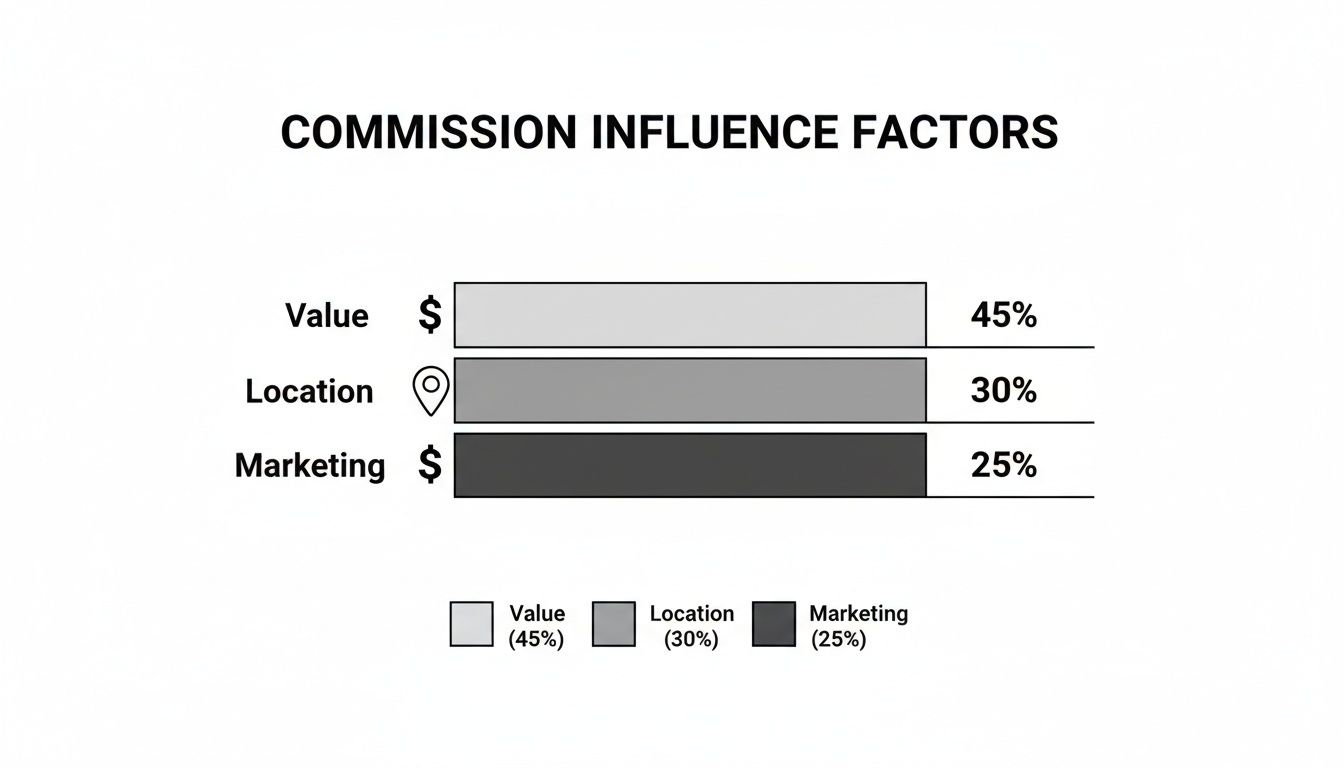
As you can see, an agent considers a few key things when setting their rate, but the property's value is usually the biggest piece of the puzzle.
Unpacking the Tiered Rate Model
The alternative is what's known as a tiered rate or 'commission accelerator'. Think of it as a performance bonus for your agent. It’s a structure designed to give them a massive incentive to push for the absolute highest price they can get for you.
Here's how it works: you agree on two different commission rates. A standard rate applies up to an agreed-upon sale price, but a much higher 'kicker' rate applies to any amount they secure above that line. It’s a direct answer to the classic seller’s question: "How do I know my agent is fighting for every last dollar?"
A tiered commission structure creates a powerful partnership. It aligns the agent's financial reward directly with the seller's goal of achieving a premium sale price, turning a good result into a great one for both parties.
It’s a smart way some Australian agents reward a top-tier result. For instance, you might agree to 2.0% on any price up to $830,000, but a juicy 6% on any amount achieved above that. If the property sells for $860,000, the agent earns 2% on the first $830,000 ($16,600) plus 6% on the extra $30,000 ($1,800). That’s a total commission of $18,400. You can find more detail on how different structures affect the total cost of selling a house over at OpenAgent.
Commission Calculation Fixed vs Tiered Model
To really see the difference these models can make, let’s put them side-by-side with a real-world example. Imagine your home sells for $860,000.
| Sale Scenario | Fixed Rate Commission (2.4%) | Tiered Rate Commission (2% up to $830k, 6% above) | Final Agent Fee |
|---|---|---|---|
| $860,000 Sale | 0.024 x $860,000 = $20,640 | (0.02 x $830k) + (0.06 x $30k) = $16,600 + $1,800 | Tiered model saves $2,240 in this case. |
| $900,000 Sale | 0.024 x $900,000 = $21,600 | (0.02 x $830k) + (0.06 x $70k) = $16,600 + $4,200 | Fixed model is $800 cheaper in this case. |
In this specific scenario, the tiered structure actually resulted in a lower overall fee for the $860,000 sale. But look what happens when the agent pushes harder and gets $900,000. The tiered fee climbs to $20,800, making it slightly more expensive than the fixed rate.
Ultimately, the best choice depends entirely on your property's market potential and what you negotiate with your agent.
How to Negotiate Commission with Your Real Estate Agent
Bringing up an agent's commission shouldn't feel like a standoff. The best way to look at it is as a collaborative chat about value, service, and working towards the same goal.
Yes, the commission is negotiable. But a smart negotiation isn’t just about pushing the percentage down—it's about truly understanding what you’re paying for.
Before you even think about talking numbers, the very first step is to do a bit of homework. Look into the typical commission rates in your specific Mandurah or Perth suburb. Knowing the local average gives you a realistic starting point and shows agents you’ve come to the table prepared.
Once you’ve got a shortlist of agents, the conversation should quickly move from "what's your rate?" to "what does your fee actually include?". A great agent will be more than happy to walk you through their entire service package, and this is your chance to see what they really bring to the table.
Preparing for a Productive Discussion
To get the most out of this conversation, have some specific questions ready. This helps you compare agents on what matters, not just their fee. A lower commission might look tempting on paper, but not if it means skimping on essential services that could have secured you a much higher sale price.
Here are a few key points to dig into:
- Marketing Breakdown: Ask for a detailed list of every marketing activity they plan to use. Are professional photos and videos included? What about social media campaigns?
- Experience and Track Record: Find out about their recent sales right there in your area. Can they show you examples of properties similar to yours that they sold for a fantastic price?
- Communication Plan: Get clear on how often you'll get updates. You need to know you'll receive timely feedback from open homes and buyer enquiries.
Getting into these details is a crucial part of the process. For more pointers on what to look for, our article on how to choose a real estate agent has a comprehensive checklist to help you make a confident decision.
Why the Lowest Fee Is Rarely the Best Deal
It’s so easy to get fixated on that commission percentage, but honestly, it can be a costly mistake. Choosing an agent just because they have the lowest fee can easily lead to a lower final sale price, which could cost you far more than you "saved" on the commission.
Think of it like this: a top-tier agent who negotiates an extra $25,000 for your property is worth every cent of their fee. Their expertise in pricing, marketing, and sharp negotiation skills directly translates into more money in your bank account at settlement. An agent who immediately agrees to a rock-bottom fee might not have the confidence or the skills to fight for you when it really counts—at the offer table.
The most expensive agent is often the one who costs you a premium sale price. Focus on the agent who can demonstrate the most value, not just the one with the lowest percentage.
At the end of the day, you're looking for a professional you can trust with one of your biggest financial assets. A fair commission ensures your agent is motivated and fully invested in getting the absolute best outcome for you. It’s about creating a partnership for a successful sale, not just finding the cheapest service. When you frame the discussion around value and results, you set the stage for a positive and profitable experience.
Planning Your Next Steps to a Successful Sale
Wading through the world of real estate commissions can feel a bit overwhelming, but you should now have a solid grip on how it all works. You know that asking "how much commission do realtors get?" doesn't come with a simple, one-size-fits-all answer. Instead, it’s a moving target, shaped by your property's value, where it is in Western Australia, and the agent's track record.
The most important thing to remember is that you're in the driver's seat. The commission isn't set in stone; it's a conversation point between you and your agent, a figure that should reflect the service and value you expect to get. Whether you go for a simple fixed rate or a tiered structure designed to incentivise a top price, the goal is always the same: to build a partnership that gets you the best possible result.
Turning Knowledge into Action
Getting your head around the numbers is the first big step, but real confidence comes from seeing how they apply to your home. To move forward with any real strategy, you need a clear, accurate, and professional take on what your property is worth in today's market. Everything else is built on this foundation.
A professional property appraisal does more than just give you a potential sale price. It gives you the context you need to make every other decision, including:
- Smarter Negotiations: When you know exactly what your home is worth, you can have a much more meaningful conversation about commission rates.
- Clear Budgeting: An accurate valuation lets you properly calculate potential agent fees and the other costs of selling, with no nasty surprises.
- A Winning Strategy: It helps you and your agent agree on an ambitious but realistic sale price right from the get-go.
Get Your Free, No-Obligation Appraisal
The best way to kick things off is with a professional, data-driven property appraisal. It's a completely free, no-obligation step that arms you with the hard facts needed to plan your sale with confidence. An expert appraisal gives you a realistic snapshot of your home’s value, helping you understand how local Mandurah and Perth market trends affect you directly.
Your home is your most valuable asset. A professional appraisal isn't just about getting a number; it's about gaining the strategic insight you need to maximise your return.
This valuation is your starting line for a smooth and profitable sale. With this one key piece of information in hand, you can confidently interview agents, discuss commission structures, and ultimately pick the right professional to deliver an outstanding result.
Ready to find out what your property is worth? Book a free, no-obligation appraisal with David Beshay today and take the first real step towards a successful sale.
Got Questions About Agent Commissions? We've Got Answers
Even when you think you have a handle on the basics, a few questions about agent commissions always pop up. It’s completely normal. These details can make a real difference to your bottom line at settlement, so let’s clear up some of the most common queries sellers have.
Is GST Included in an Agent's Commission?
Yes, in Australia, a real estate agent's commission is a professional service, which means it’s subject to Goods and Services Tax (GST). When an agent tells you their rate is, say, 2.4%, you absolutely need to ask if that figure includes GST.
Most good agents will quote you a GST-inclusive rate to keep things simple and transparent. But don't just assume—get it in writing in your agency agreement. This one small step can save you from a nasty surprise when you see the final breakdown of costs.
Who Actually Pays the Real Estate Agent?
The seller is always the one responsible for paying the agent’s commission. Think of it as the fee for their expertise in marketing your home, finding the right buyer, negotiating the best price, and steering the whole process to a successful finish.
The great thing is, the commission isn't an upfront cost. It’s usually taken from the buyer's deposit—which is held securely in a trust account—and the rest is paid to you when the sale is finalised at settlement.
The buyer doesn't pay your agent a cent. Their costs are the purchase price, stamp duty, and their own legal fees. This setup ensures your agent is paid from the proceeds of the sale they worked to secure for you.
Are Marketing and Advertising Costs Part of the Commission?
Generally, no. Marketing and advertising costs are typically separate from the agent's commission. The commission pays for the agent's time, skill, and negotiation power. The marketing budget, on the other hand, covers the direct, out-of-pocket expenses needed to get your property in front of as many potential buyers as possible.
These costs often include things like:
- Professional photography, video tours, and floor plans.
- Upgraded listings on major property websites like realestate.com.au.
- The classic 'For Sale' sign out the front and printed brochures.
- Targeted ad campaigns on social media.
Before you sign anything, your agent should walk you through a detailed marketing plan with a clear list of these costs. Some agents might offer packages that bundle everything together, so it's always worth asking exactly what’s included.
Can I Sell My House and Pay Zero Commission?
You certainly can. It’s called a 'For Sale By Owner' (FSBO) sale, where you handle everything yourself without an agent. On the surface, avoiding the commission fee sounds like a great way to save a stack of cash.
However, going it alone means you're taking on every single job an agent would normally handle. That includes pricing your home correctly (a big one!), paying for and running all the marketing, hosting open homes, negotiating with buyers, and managing all the tricky legal paperwork. While you save the commission, many sellers find that a professional agent’s connections, market insight, and negotiation skills often lead to a higher final sale price and a much less stressful experience, ultimately putting more money in their pocket.
Ready to take the next step with confidence? The expert team at David Beshay Real Estate can provide a clear, no-obligation property appraisal to help you understand your home's true market value and plan your sale effectively. Get your free appraisal today.

