


Figuring out your home's worth isn't a one-size-fits-all process. You've got a few different paths you can take, from using free online calculators for a quick ballpark figure to getting a real estate agent in for a market appraisal. For something more official, you can hire a certified valuer for a formal, legally recognised assessment.
Each method has its place, depending on whether you're just curious, gearing up to sell, or need a solid number for the bank.
Understanding What Your Home Is Really Worth
Before we get into the "how," it's really important to get clear on what a "valuation" actually means. It’s a term that gets thrown around a lot, but it can refer to very different numbers.
A property’s value isn't some fixed, set-in-stone figure. It shifts depending on who's asking and why. This is probably the most critical thing to grasp when you're trying to get an accurate house value.
Knowing the difference between these figures helps you pick the right tool for the job and keeps your expectations realistic.
Different Types of Valuations
You’re likely to come across three main figures, each with a very different job:
- Market Value: This is what everyone wants to know when they're selling. It’s the price your home would realistically fetch on the open market right now, based on what a willing buyer would pay a willing seller.
- Bank Valuation: If you’re getting a mortgage or refinancing, the bank will order one of these. It's usually a more conservative figure because it represents the bank's assessment of risk—what they could get back if they had to sell the property in a hurry.
- Council Rateable Value: This one is used by your local council purely to calculate your rates. It's often determined using mass appraisal methods and can be quite different from the true market value.
The Australian property market is always on the move, with prices changing based on the suburb, city, and wider economic trends. By February 2025, for example, national median dwelling values had seen some big shifts. Cities like Perth experienced a massive 17.60% year-on-year jump, while others grew more steadily.
This kind of regional performance has a huge impact on any valuation. For a deeper dive into the nuts and bolts, you can learn more about what is property valuation in our detailed guide.
A home’s true value is a moving target, influenced by everything from local buyer demand and recent sales to broader economic confidence. A valuation is simply a snapshot of that value at a specific moment in time.
Key Valuation Methods at a Glance
To make it easier, here's a quick rundown of the main ways to value your home.
| Valuation Method | Best For | Accuracy Level | Cost |
|---|---|---|---|
| Online Calculators (AVMs) | Quick, initial estimates and general research. | Low to Moderate | Free |
| Real Estate Agent Appraisal | Getting a feel for the current market before selling. | Moderate to High | Free |
| Formal Bank Valuation | Securing a mortgage or refinancing your home loan. | Moderate to High | ~$300 – $600 |
| Certified Valuer Assessment | Legal purposes like divorce, deceased estates, or taxes. | High | ~$500 – $800+ |
This table gives you a starting point, but the best method always depends on your specific situation and what you need the valuation for.
Your First Look: Finding Comparable Sales
Before you even think about spending a cent on professional advice, you can do some digging on your own to get a surprisingly accurate feel for your home's value. The whole process boils down to finding and analysing 'comparable sales'—or 'comps,' as we call them in the industry. It’s about becoming a detective in your own neighbourhood.
Think of it this way: your home's value is almost entirely dictated by what similar homes nearby have recently sold for. By getting your hands on this data yourself, you’re basically doing the exact same first step any agent or valuer would take.
This hands-on research gives you a realistic price bracket. More importantly, it empowers you. When you eventually talk to the pros, you’ll be able to spot an agent who's over-promising or question a valuation that seems way off the mark with genuine confidence.
How to Find Your Comps
The best place to kick off your search is on the major Australian real estate portals. These sites have powerful search filters that let you zero in on properties that have recently sold, not just the ones currently on the market.
Your mission is to find at least three to five properties that have sold within the last six months and are as similar to yours as humanly possible. Here’s what you need to look for:
- Location is everything. Stick to properties within a one-kilometre radius. A house on the next street over is a great comp; one in a different suburb, not so much.
- Property type matters. You have to compare apples with apples. If you own a three-bedroom brick-and-tile home, you should be looking for other three-bedroom brick-and-tile homes.
- Land size and features. A home sitting on a 600-square-metre block is in a different league to one on a 300-square-metre block. Take note of similar features like gardens, pools, and outdoor entertaining areas, too.
A simple way to think about it: the ideal comp is a property that a potential buyer for your home would also have seriously considered. It needs to share the same core DNA and appeal to the exact same type of buyer.
Making Fair Adjustments
Of course, no two houses are identical, so you'll need to make some common-sense adjustments. This is where your detective work becomes more of an art form. You have to be objective and honestly assess the differences between your place and the ones that sold.
For instance, say a comp sold for $750,000 but had a stunning, brand-new kitchen, while yours is a decade old. You’ll need to mentally adjust its sale price downwards when lining it up against your own home.
On the flip side, if your property boasts a fantastic covered alfresco area and the comp just has a sad little patch of grass, your home probably has the edge. It’s all about building a balanced picture.
Jot down the key differences and assign a rough value to them. This isn't about landing on a perfect number, but about understanding the little things that push a price up or pull it down. This initial groundwork is an invaluable part of learning how to get your house valued properly.
Navigating Free Online Valuation Tools
After you've done a bit of your own digging into recent sales, you’ll almost certainly be tempted by the promise of an instant answer from a free online valuation tool. It's a common next step. These platforms, technically called Automated Valuation Models (AVMs), are incredibly popular, and for good reason—they offer a fast, no-cost starting point when you're just dipping your toes into figuring out your home's worth.
At their core, these digital tools are data-crunching machines. They rapidly analyse huge volumes of public information, from recent sales records and property title details to historical price trends in your suburb. In a matter of seconds, their algorithms spit out a figure. It’s a useful, if rough, estimate that serves as an excellent first step for many homeowners.
Understanding the Pros and Cons
The biggest drawcard of using an AVM is, without a doubt, its convenience. You can get a ballpark value from the comfort of your couch without having to speak to a soul. This is perfect for scratching that initial itch of curiosity or just getting a general feel for how the market is moving.
But—and this is a big but—their limitations are significant. An algorithm can't see the stunning new kitchen you poured your heart and soul into last year. It has no idea about the dated, tired bathroom that desperately needs a complete overhaul. It doesn't know about the beautiful, mature garden you’ve cultivated or that minor structural crack you've been quietly ignoring.
An online valuation is a data-driven estimate based on historical information. It should be treated as a helpful guide, not a definitive statement of your home's current market value.
The resulting report will give you a price range and a list of nearby sales, but it’s missing the crucial context that only a human eye can provide—your home's unique condition, features, and overall appeal.
When to Use Online Valuations
These tools really shine in specific scenarios. If you live in a large housing estate where most homes are quite similar in age, size, and layout, an AVM is likely to be more on the money. The sheer volume of direct, comparable sales gives the algorithm much more reliable data to work with.
On the flip side, they often stumble when faced with unique or unusual properties. A one-of-a-kind architectural home, a property with a granny flat, or a house in a sparsely populated area can easily throw the system off, sometimes leading to a wildly inaccurate estimate.
If you're after a figure that blends the convenience of an online tool with genuine human expertise, you can request a free property appraisal online. A local agent can factor in your home's specific attributes, providing a much more personalised and realistic assessment than a purely automated report. Think of AVMs as just one tool in your valuation toolkit, not the final word.
Choosing Between an Agent Appraisal and a Formal Valuation
Once you’ve played around with online tools and done a bit of your own digging, you'll probably want a more solid figure. This is where the professionals come in. But it’s really important to know that not all professional opinions are the same.
You’ve got two main options: a real estate agent's appraisal or a formal valuation from a certified valuer. They might sound similar, but they’re used for completely different reasons.
The Agent's Approach: Market Insight
A real estate agent’s appraisal is, at its core, a sales and marketing tool. It’s a free, expert estimate of what your home could realistically sell for in the current market. Think of it as the starting point for a conversation about listing your property.
On the other hand, a formal valuation is a paid, legally recognised assessment. This is what you'll need for official business, like getting a home loan approved or settling a legal matter.
An agent bases their appraisal on their direct, on-the-ground experience and intimate knowledge of the local area. They look at recent comparable sales, gauge buyer interest, and consider your home’s presentation and unique selling points to suggest a price. Their aim is to give you a realistic number that will attract buyers and get your home sold successfully.
This insight is priceless when you’re thinking about selling. A good agent offers more than just a number; they provide strategy on timing, presentation, and marketing. They know exactly what local buyers are looking for and can highlight the features of your home that will appeal to them most. To see just how different this is from a bank's perspective, it's worth understanding the difference between bank evaluations and agent appraisals.
The Valuer's Method: Rigorous Assessment
A certified valuer works under a completely different set of rules. Their job is to produce an impartial, evidence-based report that can hold up in court or with a financial institution. While they also look at comparable sales, their process is much, much stricter.
They will physically measure the property, document its condition in minute detail, and investigate things like zoning regulations, council plans, and any potential structural problems. The final report is a detailed legal document that provides a defensible property value.
This makes it the mandatory choice for things like:
- Mortgage applications and refinancing with a lender.
- Family law matters, such as divorce settlements.
- Deceased estate proceedings for probate.
- Taxation purposes, including calculating capital gains tax.
The key takeaway is this: a formal valuation is an objective, legally recognised assessment of worth. A market appraisal is a subjective, market-driven estimate of potential sale price. Which one you need depends entirely on why you need the number.
Agent Appraisal vs Certified Valuation
To make it even clearer, here's a direct comparison to help you decide which path is right for your situation.
| Feature | Real Estate Agent Appraisal | Certified (Sworn) Valuation |
|---|---|---|
| Purpose | To estimate a likely selling price for marketing and listing. | To determine a precise, legally defensible value for official use. |
| Cost | Typically free of charge. | Paid service, costing several hundred dollars or more. |
| Legal Status | An opinion, not a legally binding document. | A legally recognised document accepted by banks and courts. |
| Process | Based on market knowledge, recent sales, and buyer demand. | Rigorous inspection, detailed analysis of data, and adherence to strict standards. |
| Best For | Homeowners considering selling their property in the near future. | Mortgage applications, legal disputes, tax assessments, and estate settlements. |
Ultimately, both have their place. An agent's appraisal gives you the market pulse, while a certified valuation provides the official, documented proof of worth.
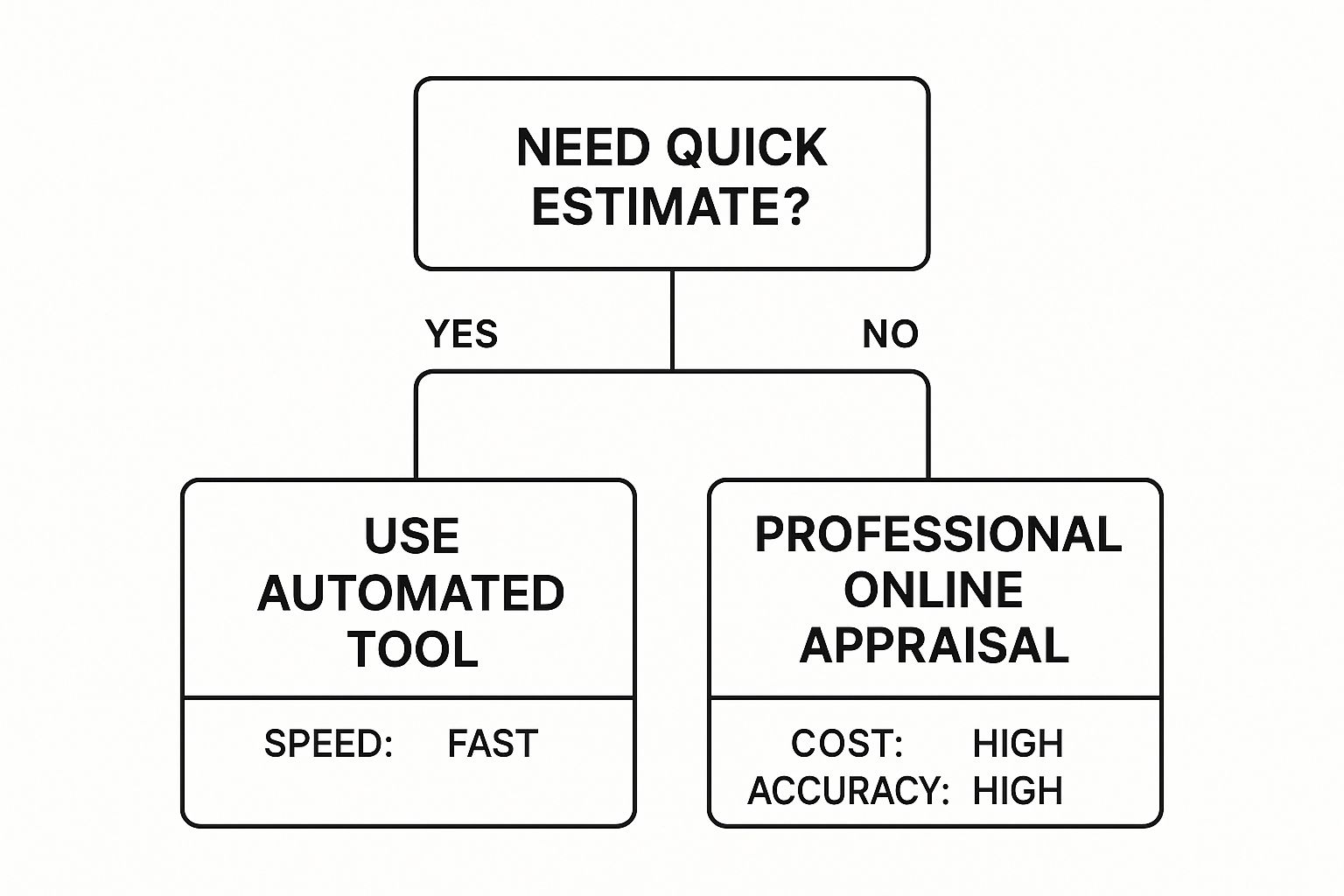
This visual guide helps simplify the decision. For a quick, informal check, online tools are fine. But when the stakes are higher and accuracy is non-negotiable, a professional’s input is essential.
Professional Australian valuers also offer a boots-on-the-ground view of where the market is heading. A recent report found that 74% of valuers expect house values to continue growing over the next year. Different parts of the market are moving at different speeds; for instance, properties between $2 million and $3.5 million are seeing intense competition, while the sub-$1 million market is staying strong thanks to first-home buyers and investors. You can dive into the full research about these Australian residential valuer insights on cbre.com.au.
How to Prepare Your Home for a Valuation
It’s a common misconception that when you get your house valued, you're just a passive observer. The truth is, you can absolutely influence the outcome by making sure your property is presented in its best possible light. A bit of focused preparation can make a real difference to that final number.
I’m not talking about launching into major renovations. Instead, the smart money is on high-impact, low-effort jobs that show off your home’s potential and highlight how well it’s been maintained. A valuer starts forming their impression the second they pull up to your property.
Boost Your Kerb Appeal
The journey to a better valuation starts at your letterbox. A tidy, well-presented exterior immediately signals that the property is cared for, setting a positive tone before the valuer even steps through the door. This is an easy win that costs you more in time than it does in money.
A few simple tasks can completely change the first impression:
- Tidy the garden: Give the lawn a fresh mow, trim back any unruly hedges, and pull out any obvious weeds.
- Clear the entrance: Make sure the porch and path to the front door are clean, clear of clutter, and welcoming.
- Wash the exterior: A quick go-over with a pressure washer can strip years of grime from walls, driveways, and footpaths.
These little details really do add up, painting a picture of a home that’s been looked after. A valuer is much more likely to see a property in a positive light if the outside is as neat as the inside.
Tackle Minor Repairs and Declutter Inside
Once they’re inside, a valuer has a trained eye for spotting defects. All those little DIY jobs you’ve been meaning to get to can collectively chip away at your home’s perceived value. Taking the time to fix them shows you’re serious about maintenance.
A home that looks clean, functional, and spacious lets a valuer concentrate on its best features instead of getting distracted by clutter or small flaws. A tidy home just feels more valuable.
Focus on the quick fixes that pack a big visual punch. This means patching small cracks in the walls, replacing any blown lightbulbs, and making sure all doors and windows open and close without a struggle. In the same way, decluttering creates an incredible sense of space, making every room feel larger and more appealing.
Assemble Your Documentation
Beyond the physical prep work, having your paperwork in order can add serious weight to your valuation. Don't leave the valuer guessing about the value of your recent upgrades—show them the receipts.
Get a folder together and include:
- Council approvals: For any extensions, granny flats, or significant structural work.
- Receipts for recent upgrades: Invoices for that new kitchen, bathroom renovation, or air conditioning system are perfect.
- A list of inclusions: Note down any high-value items that will be staying with the property, like specific appliances or integrated smart home tech.
Presenting this information proves you’ve invested in the property and substantiates its value. This is especially important in a market where property values are on the rise. To give you some perspective, the total value of Australian residential dwellings recently jumped by $213.8 billion in a single quarter, hitting a massive $11.564 trillion. You can read more on these national total value of dwellings statistics on abs.gov.au. Providing clear evidence of your home's improvements helps ensure you claim your fair slice of that value.
Common Questions About Getting a House Valued
https://www.youtube.com/embed/K2fuApF4kRA
Even after you've done your homework on property valuations, a few questions always seem to pop up. Getting clear on the answers will help you make smarter decisions about your biggest asset, whether you're getting ready to sell, hoping to refinance, or just keeping an eye on your investment.
One of the first things people ask is about timing. How often should you get a professional valuation? Honestly, there’s no single right answer—it really comes back to what you're trying to achieve.
If you're just tracking your net worth, a yearly check-in using a mix of online tools and your own research on recent sales is probably enough. But if you’re looking to refinance and pull out some equity for renovations, you'll need a formal valuation as a non-negotiable part of the loan application.
What If the Valuation Seems Too Low?
It can be a real gut punch to get a valuation that comes in well below what you were expecting, especially when a loan depends on it. If you’re convinced the figure is off the mark, you don't have to just accept it. You can contest it, but you’ll need to build a rock-solid case.
First, ask for a copy of the valuer's report to see exactly how they landed on that number. Then, it's time to gather your own evidence to counter their findings. Make sure you include:
- Better Comparable Sales: Find recent, relevant sales in your immediate area that the valuer might have missed. Proximity and timing are key here.
- Proof of Upgrades: Did you renovate the kitchen or add a deck? Provide receipts and council approvals for any significant improvements that add real, tangible value.
- Highlight Unique Features: Point out anything that makes your property stand out, like incredible views, a more functional floor plan, or high-end finishes that the comps don’t have.
Present this information clearly and calmly to the lender or valuer. While there's no guarantee they'll change their mind, a well-reasoned argument backed by strong evidence gives you the best possible shot at getting the figure reconsidered.
A low valuation isn't automatically wrong, but it’s always worth investigating. Arm yourself with objective data—not just emotion—to challenge the result effectively and make sure you understand exactly how your house is being valued.
Common Factors That Reduce a Home's Value
We all love to focus on what adds value, but it's just as critical to know what can drag it down. Valuers have a sharp eye for red flags that can seriously impact their final assessment. Knowing what they are allows you to get ahead of any issues.
The most common value-killers often come down to a few key things:
- Deferred Maintenance: Obvious problems like peeling paint, a leaky roof, or cracked tiles scream neglect and signal future costs for a potential buyer.
- Dated Finishes: A kitchen or bathroom that’s a time capsule from another decade can make the whole property feel old and will almost certainly pull the value down.
- Poor Kerb Appeal: An overgrown garden, a tired-looking front door, or a cluttered entryway creates a bad first impression that’s tough to overcome.
- Neighbourhood Issues: Sometimes it’s things outside your control, like a noisy neighbour, nearby industrial zoning, or a poorly maintained street, that can negatively influence your property’s value.
Are you ready to discover your home's true market potential in Mandurah? At David Beshay Real Estate, we provide expert, no-obligation property appraisals to help you make informed decisions. Get your free, accurate appraisal today!


Pingback: Your Essential Steps for Selling House in Australia - David Beshay Real Estate - The Agency