


Before your home even hits the market, the real work begins. Those crucial first steps—a thorough preparation of your property—are what set the stage for a successful sale. This isn't just about a quick tidy-up; it involves a deep clean, serious decluttering, handling strategic repairs, and getting all your legal documents in order to ensure everything goes smoothly.
Laying the Groundwork for a Successful Sale
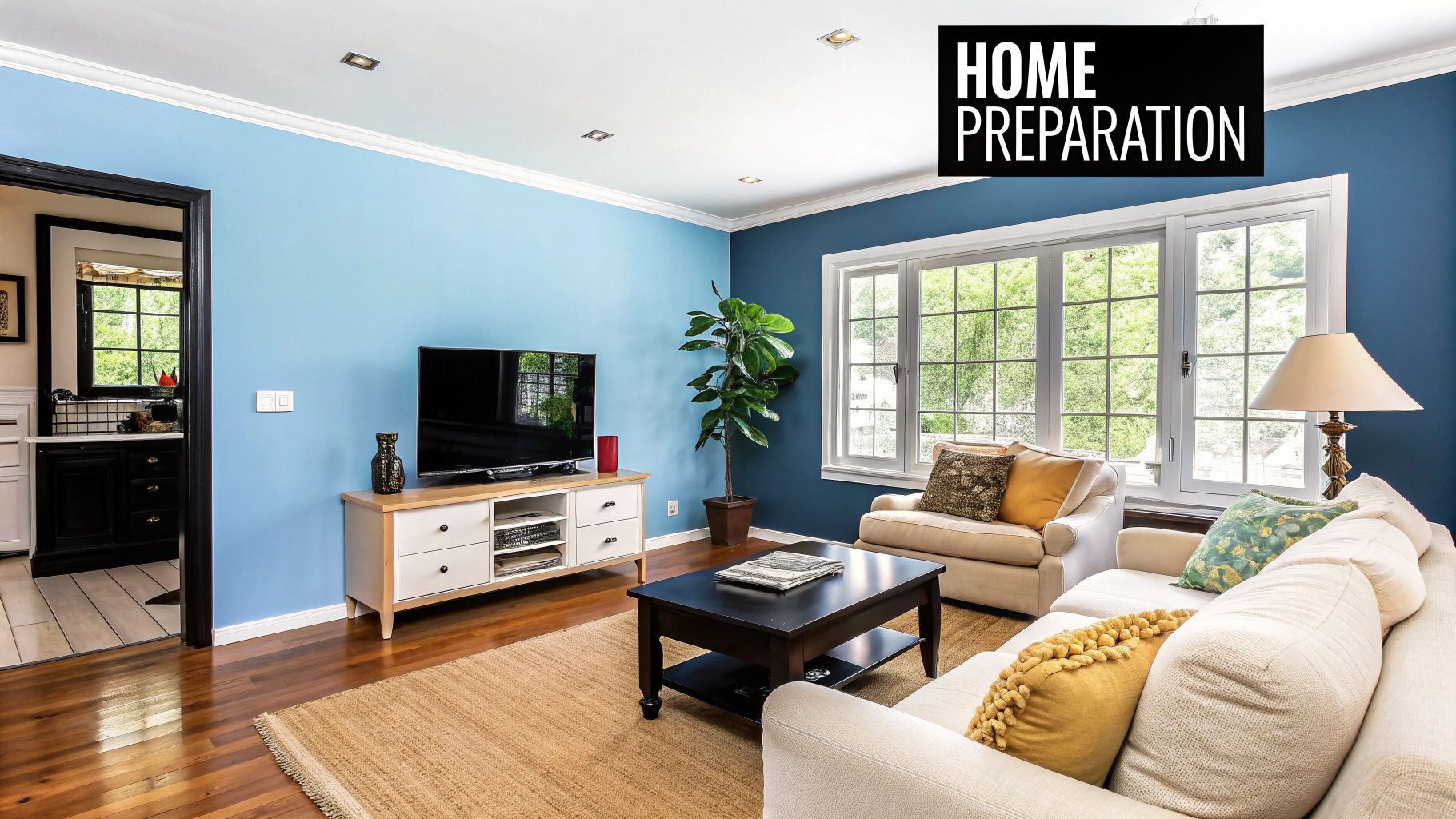
The journey to selling your home starts well before the first buyer walks through the door. This critical prep phase really does set the tone for your entire sales campaign and has a direct impact on your final sale price. Think of it as creating the best possible first impression, both in the online photos and when people visit in person.
Declutter, Clean, and Repair
Your first job is to make your home feel spacious, spotless, and well-maintained. Start by decluttering every single room. The aim is to help buyers imagine their own lives in the space, which is incredibly difficult when it's full of your personal things. It’s time to pack away family photos, any excess furniture, and anything that makes a room feel crowded.
Next up is a deep, thorough clean. This part is absolutely non-negotiable. Don't forget the often-overlooked spots like skirting boards, windows, grout, and light fittings. A home that sparkles sends a powerful message to buyers: this property has been loved and cared for.
Tackling minor repairs is one of the most cost-effective ways to boost buyer confidence. A dripping tap or a cracked tile might seem small to you, but buyers often overestimate the cost and effort of such fixes, which can lead to lower offers.
Focus on repairs that give you the most bang for your buck. A fresh coat of neutral-coloured paint, for example, can instantly brighten a space for a minimal cost. Make sure you fix any of those nagging issues like sticky doors or faulty light switches. For more comprehensive guidance, our detailed guide on preparing your house for sale offers a practical checklist to follow.
Get Your Paperwork in Order
Being proactive extends beyond just making the house look good. Having all your essential documents organised from the get-go prevents last-minute scrambles and builds trust with potential buyers. You'll want to gather:
- Council Approvals: Find any documentation for renovations, extensions, or major works you've had done.
- Compliance Certificates: This might include certificates for your pool, spa, or smoke alarms.
- Building and Pest Inspection Reports: Getting a pre-sale inspection done can uncover potential deal-breakers early, giving you the chance to fix them. Presenting a clean report to buyers can streamline negotiations in a big way.
By methodically working through these initial steps, you're creating a compelling product that will stand out in the Mandurah market. This groundwork doesn't just enhance your home’s appeal; it simplifies the entire sales process, leading to a faster, more profitable result.
Pricing Your Home to Compete in the Market
Setting the right asking price is, without a doubt, one of the most critical decisions you'll make when selling your home. Aim too high, and your property could sit on the market for months, becoming stale and deterring serious buyers. Price it too low, and you risk leaving a significant amount of money on the table. It's a delicate balance.
The key is to detach from emotion and take a hard look at the data. Forget what you think your home is worth or how much you need from the sale. The only number that truly matters is what a buyer in the current Mandurah market is willing to pay. And that's where the real work begins.
Analysing Comparable Sales
Your first port of call is to research comparable sales, or 'comps' as we call them in the industry. These are properties in your immediate area that are genuinely similar to yours—think size, age, condition, and features—and have sold recently. For the most accurate snapshot of current market value, you'll want to focus on sales from the last three to six months.
When you're digging into comps, ask yourself these questions:
- Location: Is the property on a comparable street, or is it tucked away in a more desirable pocket of the suburb?
- Size: How does your land size, bedroom/bathroom count, and total floor space stack up?
- Age and Condition: Is your home freshly renovated while the comp was dated? Or is it the other way around?
- Unique Features: Does your property boast a pool, a powered workshop, or that highly sought-after side access that others lack?
Running this analysis helps you build a realistic price bracket. Of course, for a definitive figure to anchor your strategy, it's always worth exploring how to get your house valued professionally.
Understanding Current Market Dynamics
Looking at comps is only half the picture. You also need to zoom out and consider the wider market conditions. Are we in a buyer's market, where high inventory gives buyers the upper hand? Or is it a seller's market, with low stock levels fuelling fierce competition for every new listing? This dynamic has a massive impact on your pricing power.
A property priced just 5% above its true market value can deter over 50% of potential buyers. The initial listing price sets the tone for your entire campaign, making accuracy essential from day one.
Keeping a finger on the pulse of these broader trends is vital. For instance, the Australian property market has seen incredible growth recently.
Australian Dwelling Value Growth Snapshot
This table summarises the total value of residential dwellings in Australia, illustrating the strong market sellers are currently navigating.
| Time Period | Total Value of Residential Dwellings |
|---|---|
| Dec Qtr 2021 | $9.6 trillion |
| Dec Qtr 2022 | $9.8 trillion |
| Dec Qtr 2023 | $10.3 trillion |
As the data shows, the market has expanded significantly, pushing the average Australian dwelling price past the $1 million mark for the first time. The total value of residential dwellings has now hit an incredible $11.4 trillion, and Western Australia is one of the key states fuelling this surge. Aligning your expectations with these market realities is non-negotiable for a successful sale.
The right price influences everything that follows.
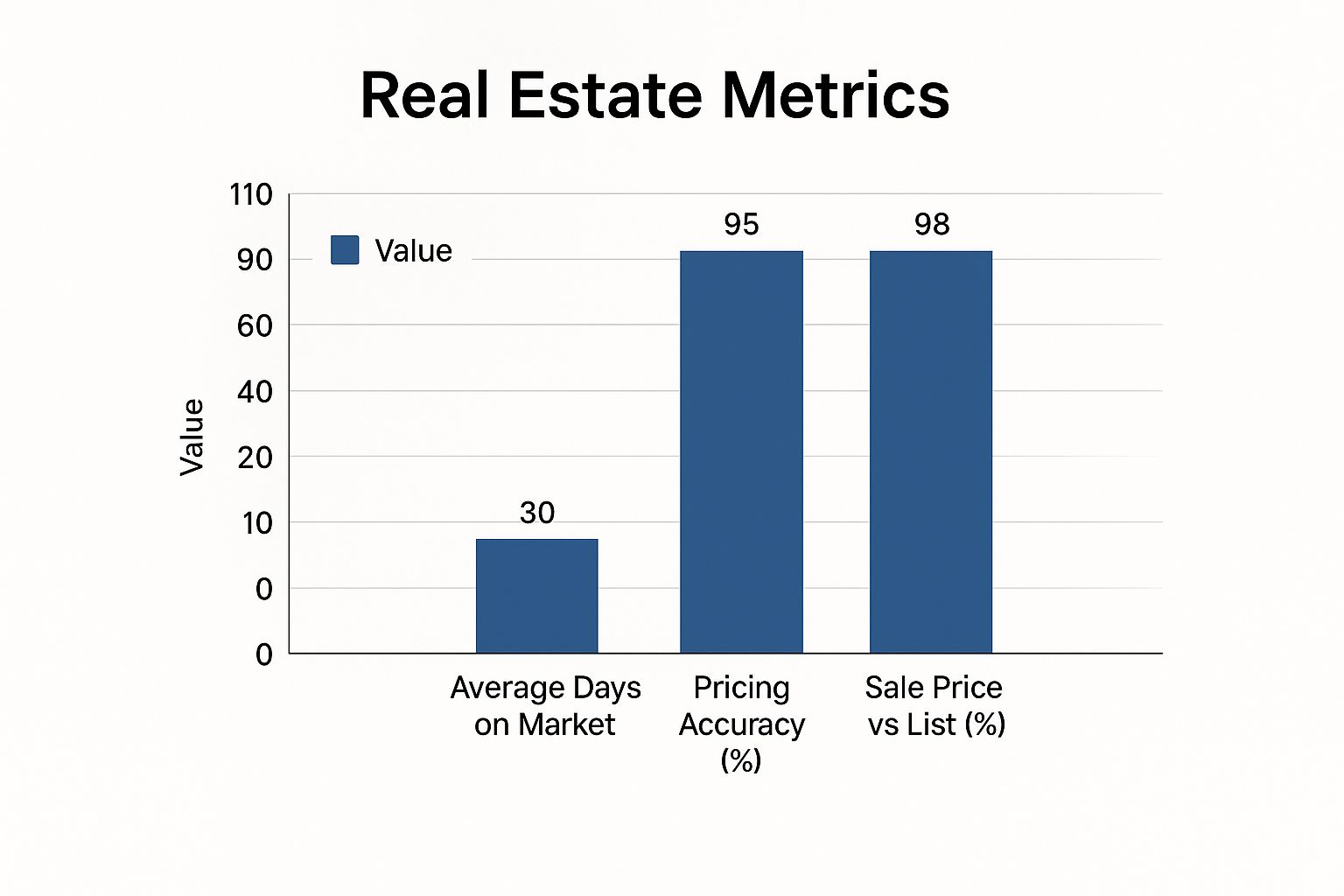
As you can see, sharp pricing doesn't just get your home sold faster. It attracts serious, ready-to-act buyers from the get-go. This creates a sense of urgency and competition, building momentum that ultimately leads to a much stronger final sale price.
Choosing Your Sales Method and Real Estate Agent
Once you’ve got a realistic price in mind, you’re at a critical fork in the road. You now need to decide how you’re going to sell and who is going to help you do it. These two decisions are completely intertwined and will set the stage for everything that follows, from your marketing strategy to the final handshake.
Honestly, choosing the right sales method and the right agent is just as important as the house itself. Get it wrong, and you could leave money on the table. Get it right, and you'll have a smooth, profitable sale.
In Australia, we generally lean on a few trusted methods. Each has its pros and cons, and what works for a waterfront canal home in Mandurah might not be the best fit for a small unit.
- Private Treaty: This is the most common path. You set an asking price, and your agent gets to work negotiating with buyers. It’s a flexible approach that gives you control over the timeline.
- Auction: This is all about creating urgency and competition. Buyers bid openly against each other, driving the price up until the hammer falls. It’s brilliant for unique properties or in a hot market where you know demand is strong.
- Expressions of Interest (EOI): Think of this as a 'blind auction'. It’s often used for high-end or unusual homes where setting a firm price is tricky. Buyers submit their best offer by a deadline without knowing what others are bidding.
The right choice really depends on the current market pulse in Mandurah, your property type, and how quickly you need to sell. A good local agent will give you the unvarnished truth on which strategy will drum up the most interest and deliver the best result for you.
Selecting the Right Real Estate Agent
Finding a real estate agent isn’t just about getting your house on realestate.com.au. You’re looking for a strategic partner—someone who lives and breathes the local market, has a killer marketing plan, and is a sharp negotiator when it matters most.
When you start interviewing agents, don't hold back. This is your chance to really grill them. You're paying them a significant commission, so you have every right to understand exactly what you're getting in return. The stats don't lie: homes sold with a professional agent almost always fetch a higher price.
A classic mistake I see sellers make is choosing an agent purely because they offer the lowest commission or promise the highest sale price. The best agent isn't the cheapest or the most optimistic; they're the one with a clear, evidence-based strategy to get you the best outcome.
To find that person, you need to ask some tough questions. Ask about their recent sales in your suburb, how they plan to spend your marketing budget, and how often you'll hear from them. A confident, transparent agent will have no problem answering. If you need more pointers, our guide on how to choose a real estate agent has a full checklist of questions to ask.
At the end of the day, you're handing over the keys to one of your biggest assets. The right agent doesn't just maximise your sale price; they manage the stress and complexity of the entire process, giving you the peace of mind to focus on what's next. Take your time, do the research, and go with the professional you trust.
Crafting a Powerful Property Marketing Campaign
Right, your pricing is sorted and you know your sales strategy. Now for the exciting part: putting together a marketing campaign that actually gets buyers to stop scrolling.
In a competitive market like Mandurah, you can't just throw your home online and hope for the best. You need to tell a compelling story, one that connects with buyers and makes them feel like they have to book an inspection.
This is where professional presentation makes all the difference. That first impression a buyer gets will almost certainly be online, and you've got just a few seconds to grab their attention. It’s why investing in professional real estate photography and videography isn't just a nice-to-have; it's non-negotiable.
Making a Strong First Impression Online
Forget blurry photos snapped on your phone. A professional photographer knows how to use light, angles, and composition to make every room look its absolute best—spacious, bright, and genuinely inviting. It's a proven fact that high-quality images generate far more online views, which leads directly to more people walking through your front door.
Want to take it a step further? A well-made video tour or a 3D virtual walkthrough is a game-changer. It lets potential buyers, even those from interstate, get a real sense of the home's flow and feel before they even think about scheduling a viewing. This kind of engagement can easily turn a casual browser into a serious, motivated buyer.
Listings with professional photos can sell up to 32% faster than those without. In a market like this, that time saved can often mean a better final price, as your property doesn't have time to go stale.
Writing Descriptions That Sell a Lifestyle
Beyond the visuals, the property description is your chance to sell the dream, not just the details. So many listings fall into the trap of just listing features: "three bedrooms, two bathrooms, double garage." That doesn't exactly get the heart racing, does it? The best descriptions paint a picture and sell a lifestyle.
Think about the difference between these two approaches for a home with a great backyard here in Mandurah:
- The Standard Approach: "Features a large, fully-fenced backyard with a covered patio."
- The Compelling Approach: "Imagine spending your weekends hosting family barbecues on the expansive covered patio, watching the kids play safely in the fully-fenced backyard. It’s the perfect space for creating those lasting memories."
See the difference? The second one helps buyers envision themselves living in and loving the space. It creates an emotional pull, which is an incredibly powerful sales tool. Work with your agent to pinpoint what makes your home's lifestyle unique. Is it the short walk to the estuary? The fantastic local school? The quiet, friendly street? These are the details that build a connection and drive real interest. Getting this right is one of the most effective steps you can take to sell your house successfully.
Navigating Offers and Finalizing Your Sale
That moment an offer lands is a huge milestone. It’s the culmination of all your hard work preparing and marketing your home. But this is exactly where a cool head and a clear strategy become your most valuable assets.
Whether you're selling by private treaty or going under the hammer at auction, knowing how to handle offers is one of the final, crucial steps to a successful sale.

It's tempting to fixate on the dollar amount, but the best offer isn't always the highest one. You need to look at the entire package, paying close attention to the conditions attached. A seemingly great offer might be loaded with "subject to" clauses that can cause the deal to fall apart weeks down the track.
Evaluating and Negotiating Offers
When an offer comes in, your agent will present it to you along with their professional read on the situation. Here’s what you need to scrutinise beyond just the price:
- Finance Clause: How long does the buyer need to get their home loan sorted? A shorter timeframe (like 14 days) is much stronger than a lengthy 28-day clause.
- Building and Pest Inspection: Are their inspection clauses reasonable? An offer with no inspection clause is incredibly strong, though definitely less common.
- Settlement Date: Does their proposed settlement date line up with your own plans? A buyer offering a flexible settlement can be a massive advantage.
Negotiation is a delicate dance. Your agent’s job is to leverage any interest to create competition and push for the best possible price and terms. Remember, a counter-offer is technically a rejection of the original offer, so it has to be handled strategically to keep the buyer engaged and moving forward.
Understanding the broader market is key here. As an example, the national housing market recently saw a modest 1.0% quarterly price growth, but Perth was a standout, leading growth at an annual rate of 5–6%. These dynamics directly influence buyer urgency and your negotiating power. You can find more insights on the Australian property market on eldersrealestate.com.au.
To better contextualise how Mandurah's market fits into the national picture, here’s a quick comparison of major cities:
Property Market Growth Comparison by Major City
This table provides a snapshot of property market performance across key Australian cities, helping sellers understand the local dynamics that influence their sale.
| City | Market Condition | Key Influencing Factors |
|---|---|---|
| Perth | Strong Growth | High population growth, low supply, strong economy |
| Sydney | Stabilising | Affordability constraints, recent price moderation |
| Melbourne | Moderate Growth | Steady demand, but slower growth than previous years |
| Brisbane | Steady Growth | Interstate migration, infrastructure projects |
| Adelaide | Consistent Growth | Affordability, stable demand |
This comparison highlights why Perth, and by extension Mandurah, is currently a strong seller's market, giving you more leverage in negotiations.
From Contract to Settlement
Once you’ve agreed on a price and terms with a buyer, you'll both sign the official contract of sale. In Western Australia, this is a legally binding moment. The buyer then pays a deposit, which is held securely in a trust account until settlement.
A common point of confusion for sellers is the 'cooling-off period'. It's critical to know that in Western Australia, there is no mandatory cooling-off period for real estate contracts unless a specific condition for one has been added to the contract.
This means that once the contract is signed and any conditions (like finance approval) are met, the sale is secure.
From here, your conveyancer or solicitor takes the reins, managing the legal transfer of ownership. They'll coordinate with the buyer's representative and the banks to ensure all legal and financial boxes are ticked.
On settlement day, the legal professionals finalise everything behind the scenes. The balance of the purchase price is transferred to you, and they will notify your agent. Once that call comes through, the keys can officially be handed over to the new owners. You’ve done it—your house is sold.
Common Questions About Selling a House in Australia
Even with the best game plan, selling your home can throw a few curveballs. It's completely normal to have questions pop up along the way. Getting clear, straightforward answers makes the whole process feel much less daunting. Here are some of the most common queries we hear from homeowners, answered to help you move forward with confidence.
What Is the Best Time of Year to Sell a House in Australia?
Traditionally, everyone points to spring (September to November) and autumn (March to May) as the prime seasons to sell. And for good reason. Buyer activity is usually buzzing, gardens are looking their best, and the mild weather is perfect for people to get out and about for open homes. This flurry of activity can create a competitive atmosphere, often leading to faster sales.
But here’s a bit of insider perspective: the "best" time really hinges on your local market and your specific property. Listing in the dead of winter, for instance, might sound counterintuitive. Sure, there are fewer buyers pounding the pavement, but there’s also a lot less competition from other sellers. If you’ve got a unique home that stands out, you could capture the attention of serious buyers and snag a fantastic result when supply is low.
The real secret to timing the market is leaning on a local agent's expertise. They have their finger on the pulse of buyer demand and stock levels in your specific suburb, helping you pinpoint the most strategic moment to launch your campaign.
How Much Does It Really Cost to Sell a House?
Getting your head around the costs involved is a massive part of planning your sale. As a rough rule of thumb, you can budget for the total costs to land somewhere around 2-3% of your home's final sale price. This figure is made up of a few key expenses.
The biggest chunk is almost always the real estate agent's commission, which is calculated as a percentage of the sale price. Beyond that, other significant costs include:
- Marketing and Advertising: This is what gets your property in front of buyers. Think professional photography, listings on major portals like realestate.com.au and Domain, signboards, and brochures.
- Legal and Conveyancing Fees: You'll need a solicitor or conveyancer to handle the legal heavy lifting of transferring the property.
- Optional Extras: You might also choose to invest in things like home staging, pre-sale building and pest inspections, or a few minor repairs to make sure your home presents flawlessly.
Before you sign anything, always ask your agent and solicitor for a detailed, itemised breakdown of every single cost. This transparency is crucial and ensures there are no nasty surprises when settlement day rolls around.
How Long Does It Take to Sell a Property?
This is the classic "how long is a piece of string?" question. The timeline for selling a house can vary wildly depending on your location, price point, and what the market's doing at that moment.
We can generally break the process into two phases. First is the "on-market" period—the time from listing your home to accepting an offer. This usually takes anywhere from 30 to 90 days.
Once you have a solid, unconditional contract, the settlement period kicks in. This is when the legal and financial cogs turn to finalise the sale, and it typically takes another 30 to 90 days. In a red-hot market, you might see both of these timelines shrink significantly. On the flip side, if things are a bit slower, patience is key. Your agent can give you a realistic estimate based on the current "average days on market" for similar homes in your area.
Do I Actually Need a Solicitor or Conveyancer?
Absolutely. In Australia, this is a non-negotiable legal requirement. You must have a licensed conveyancer or solicitor on your team to manage the legal side of the sale. Their job is to protect your interests and make sure the whole transaction is watertight and above board.
They’re the ones who prepare the contract of sale, carry out all the necessary property searches, and communicate with the buyer's legal team. They manage the secure transfer of funds and all the official documents, ensuring everything is completed correctly and on time for settlement. Honestly, their expertise is essential for a smooth, lawful, and stress-free sale.
Ready to take the next step on your selling journey? At David Beshay Real Estate, we offer expert guidance shaped by years of experience in the Mandurah market, all to help you achieve the best possible outcome. Get started with a free, no-obligation property appraisal today.

