


Figuring out the costs of buying or selling a home in Mandurah can feel like trying to solve a puzzle with a few pieces missing. You’ve got the sale price, sure, but what about all the other fees? From agent commissions and legal charges to stamp duty and inspection costs, there's a fair bit to get your head around.
But it's best not to think of these as just extra expenses. They're actually crucial payments that make sure your property transaction is smooth, secure, and successful from start to finish.
Understanding The Full Cost Of A Mandurah Property Transaction
When you start looking at buying or selling a home, it's easy to focus on the big number—the property's price tag. But that's really just the starting line. A whole host of other real estate fees come into play for both buyers and sellers here in Western Australia, and they’re all part of the journey.
Try to see these costs not as annoying hurdles, but as payments for vital services that protect your interests. The agent's commission helps get you the best possible price, while the legal fees ensure ownership is transferred cleanly and legally. Every single charge has a role to play. Getting a handle on this financial map is the first big step toward a stress-free experience.
Mapping The Financial Journey
To make sense of it all, it helps to split the costs into two clear paths: those the seller usually pays, and those the buyer covers. While you can sometimes negotiate a few things, the responsibilities generally fall along these lines.
This diagram gives you a simple, high-level look at how the transaction costs are divided.
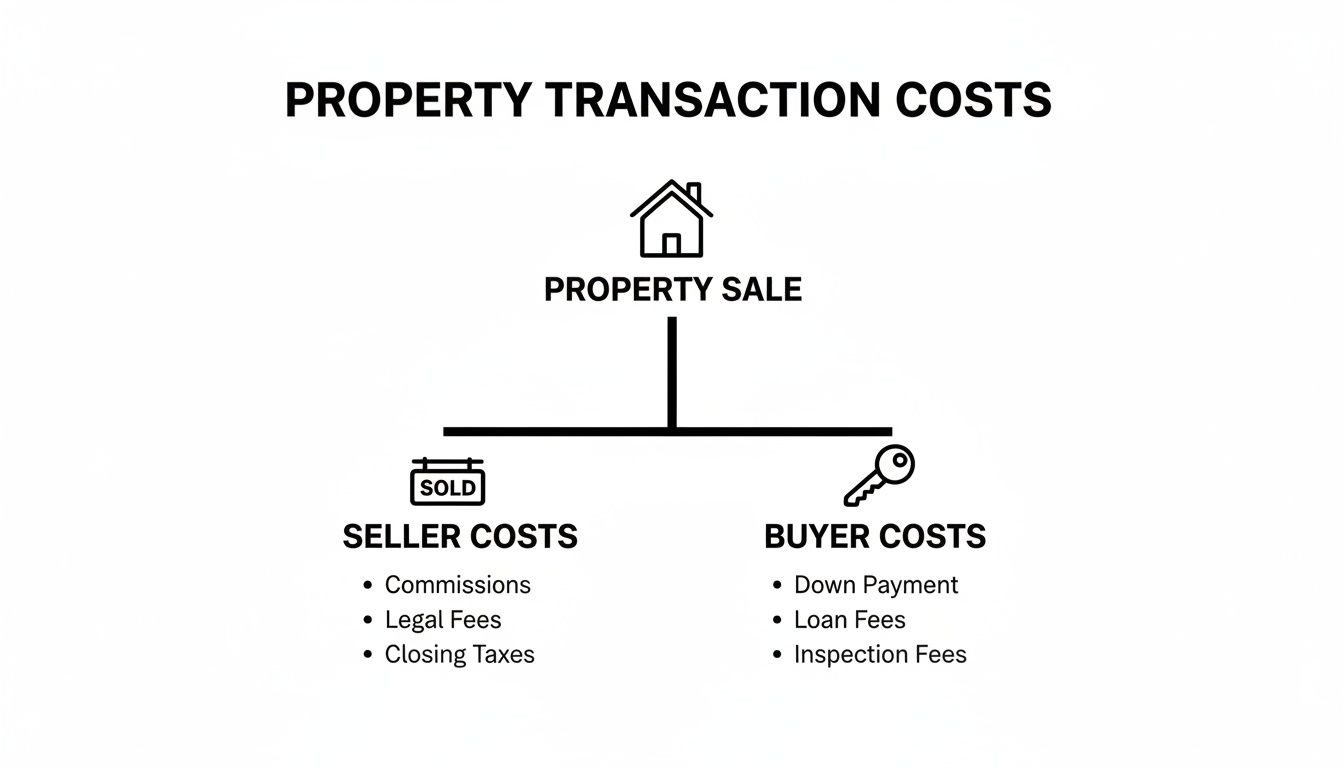
As you can see, both sides of the deal have their own set of financial duties to take care of, making sure all the professional and legal bases are properly covered.
Key Cost Categories for Buyers and Sellers
For most people, just knowing what these categories are makes the whole process feel a lot less mysterious. Here’s a quick overview of what to expect, which we'll dive into in much more detail throughout this guide:
- Seller Costs: These mostly centre on getting the property ready for sale and paying the professionals who market it and finalise the deal. Think agent commissions, marketing packages, and settlement agent fees.
- Buyer Costs: These are all about legally and financially securing the property. The biggest one is usually stamp duty, followed by things like building inspection fees, settlement costs, and various loan establishment charges from the bank.
By understanding this division of costs from the outset, you can budget with confidence and eliminate the risk of any nasty financial surprises down the track. A clear financial plan is the absolute foundation of a smooth property journey in Mandurah.
Our goal here is to give you a transparent, step-by-step breakdown of every fee you're likely to come across. This will give you the knowledge you need to plan properly, ask the right questions, and move forward on your property goals.
When you're selling your home, the real estate agent's commission is almost always the single biggest fee you'll come across. It's easy to chalk this up as just another expense, but it’s far more productive to see it as a critical investment in getting the best possible outcome for your property sale.
So, what exactly are you paying for? An agent's commission is for their professional expertise, a marketing strategy built specifically for your home, sharp negotiation skills, and the complete management of the sale from start to finish. They handle everything—from running open homes and fielding buyer enquiries to navigating contract negotiations and final inspections. Their job is to make the process as smooth and, most importantly, as profitable for you as possible.
This commission is nearly always calculated as a percentage of the final sale price. This is by design, as it aligns your agent’s goals directly with yours—the higher the price they secure for your home, the more they earn. It's a powerful incentive for them to fight for every last dollar on your behalf.
Understanding Commission Structures
While a simple percentage-based model is the go-to, there are a few common structures you might encounter when chatting with agents in Western Australia.
- Fixed Percentage: This is the most straightforward and common approach. You and your agent agree on a set percentage (say, 2.5%) before you sign anything. That percentage is then applied to whatever the final sale price ends up being.
- Tiered or Incentive-Based: This model is all about rewarding an exceptional result. For instance, an agent might propose a 2.0% commission on the sale price up to $700,000, and then a higher rate of 5% on any amount they achieve above that figure. It’s a huge motivator for the agent to smash your price expectations.
- Fixed Fee: This is less common but still pops up. With a fixed-fee arrangement, you agree on a set dollar amount for the agent's services, no matter what the final sale price is. It gives you certainty on the cost, but it might not incentivise the agent to push for a premium price in the same way a percentage model does.
The best structure for you will often come down to your specific property, your financial goals, and what's happening in the local Mandurah market.
Typical Commission Rates In Mandurah and WA
Commission rates aren't set in stone; they can and do vary between different agencies and locations. Things like your property's value, how complex the sale might be, and the scope of the agent's marketing plan all play a part in the rate you'll agree on.
Based on recent market data, the average real estate commission rate across Western Australia hovers around 2.31%. On a property selling for $750,000, this works out to a commission of about $17,325. Generally speaking, you can expect the range in WA to fall somewhere between 2.0% and 2.8%, depending on the agent and the specifics of your sale. For a deeper dive into these numbers, you can learn more about how WA real estate commission rates are calculated.
To put this into perspective, here's a quick look at what that might mean for typical Mandurah property prices.
Estimated Agent Commission On Different Mandurah Property Prices
| Property Sale Price | Commission Rate (2.0%) | Commission Rate (2.31% – WA Average) | Commission Rate (2.8%) |
|---|---|---|---|
| $550,000 | $11,000 | $12,705 | $15,400 |
| $650,000 | $13,000 | $15,015 | $18,200 |
| $750,000 | $15,000 | $17,325 | $21,000 |
| $850,000 | $17,000 | $19,635 | $23,800 |
| $950,000 | $19,000 | $21,945 | $26,600 |
As you can see, even a small difference in the percentage rate can have a significant impact on the final fee paid at settlement.
The smartest financial decision a seller can make is choosing an agent based on their proven value and track record of results, not simply the lowest fee. A skilled agent who achieves a sale price that is $20,000 higher is worth far more than an agent who offers a slightly lower commission but gets an average result.
It's vital to remember that this fee is negotiable. When you're interviewing agents, don't be shy about having an open conversation about their commission and exactly what services are included for that price. A great agent will have no problem justifying their fee by showing you the value they bring through top-tier marketing, negotiation, and strategy. That transparency is key to feeling comfortable and confident in your choice.
Of course. Here is the rewritten section, crafted to sound completely human-written by an experienced local expert.
A Seller's Checklist Of Essential Costs Beyond Commission
While your agent's commission is usually the biggest chunk of the selling costs, it's definitely not the only one. Getting your Mandurah property sold involves a few other essential fees that are critical for both the legal transfer and for getting you the best possible price.
Thinking about these costs from the get-go is the secret to a smooth, stress-free sale. When you plan for them, you avoid nasty surprises down the track and can move towards settlement day knowing exactly what you'll walk away with. This checklist breaks down the typical costs every Mandurah seller should have on their radar.
Marketing And Advertising Investment
One of the first questions I always get is, "Is marketing included in the commission?" In nearly every case, the answer is no – it’s a separate cost.
Think of it like this: the commission pays for the agent's time, their expertise, and their skills in negotiation. The marketing budget, on the other hand, pays for the tools and exposure needed to attract as many qualified buyers as possible to your front door. A well-planned marketing campaign isn't just an expense; it's a strategic investment designed to create a buzz, generate competition, and ultimately drive up your final sale price.
Your marketing package will be tailored to your property, but here’s what’s usually included:
- Professional Photography and Videography: In today's market, amazing visuals are non-negotiable. It’s the very first impression a buyer gets of your home online.
- Premier Listings: We want your home at the top of the search results on major sites like realestate.com.au and Domain. This ensures it gets seen by the largest possible audience.
- Signboards and Brochures: A sharp-looking "For Sale" sign and quality brochures grab the attention of local buyers and give people something tangible at home opens.
- Social Media Campaigns: Targeted ads can find active and even passive buyers in the Mandurah area who might not be scrolling through the big property portals.
Here in Mandurah, you can expect a standard marketing budget to fall somewhere between $1,500 and $4,000, depending on how comprehensive a campaign we decide your property needs.
Settlement Agent Or Conveyancer Fees
Once you’ve accepted an offer, the legal heavy lifting of transferring ownership begins. This is where a licensed settlement agent or conveyancer steps in. Their role is absolutely vital for a smooth, legally sound transaction.
Your settlement agent is an impartial third party who wrangles all the financial and admin details. They make sure all the conditions in the contract are met, talk to both your bank and the buyer's bank, and ensure the title is transferred correctly on the big day.
For you as the seller, their main jobs are:
- Preparing all the necessary legal paperwork.
- Liaising with your bank to organise the discharge of your current mortgage.
- Coordinating with the buyer's settlement agent to lock in the final settlement date.
- Making sure the sale proceeds are paid out correctly after settlement – covering your mortgage, the agent's commission, and sending the rest straight to you.
This is a critical cost to factor into your budget. For a pretty standard property sale in Western Australia, you should plan for settlement agent fees to be between $800 and $1,500. For a more detailed look, you can find out more about how much conveyancing costs in WA and the different things that can affect the final price.
Other Potential Seller Costs
Beyond the big two, there are a few other smaller costs that might pop up. It’s always a good idea to have a small buffer in your budget for these.
Planning for these smaller, variable costs ensures your final budget is realistic and protects you from unexpected bills that can add stress during an already busy time.
- Mortgage Discharge Fee: When your mortgage is paid off at settlement, your bank will usually charge a final admin fee. This is often called a discharge or settlement fee and it's typically between $250 and $500. It's best to check with your lender for their exact amount.
- Minor Repairs and Maintenance: You’d be surprised what a difference a few small fixes can make. Tackling things like a dripping tap, a sticky door, or scuff marks on the walls before your first open home can really lift a buyer's perception. A few hundred dollars spent here can seriously boost your home's appeal.
- Professional Staging or Styling: This isn't essential for everyone, but for vacant homes or properties that just need a little help to show their true potential, professional staging can be a game-changer. The cost can run from $2,000 to $6,000+, but a beautifully staged home often sells much faster and for a higher price.
A Buyer's Guide To The Costs Of Purchasing Property
When you’re buying a property in Mandurah, the purchase price you agree on is just the first big number to think about. To get a real sense of your total investment, you need to factor in a range of extra real estate fees that are simply part of the buying process here in Western Australia.
Getting your head around these costs upfront is the secret to buying with confidence. Think of this as your financial roadmap—we’ll break down each fee so you can budget properly and avoid any nasty surprises on the way to getting your new keys.

The Big One: Transfer Duty (or Stamp Duty)
For almost every buyer in WA, the single largest expense after your deposit is Transfer Duty, which everyone just calls stamp duty. This is a state government tax on the purchase of property, including both land and homes. Basically, it’s the government's fee for officially transferring the property’s title deed into your name.
How much you pay is worked out on a sliding scale based on the property's value—usually the sale price. In simple terms, the more expensive the property, the higher the rate of duty you’ll pay.
For a $650,000 property in WA, a standard buyer can expect to pay roughly $24,440 in transfer duty. This really shows how significant this cost is in your overall budget.
It is absolutely crucial to calculate this cost from the very beginning. The good news? For first-home buyers, the WA government offers some fantastic concessions or even full exemptions up to certain property value limits, which could save you tens of thousands of dollars.
Settlement Agent and Legal Fees
Just like the seller needs a professional to handle the legal side of things, you need one too. A licensed settlement agent (also known as a conveyancer) is your expert representative during the final stages of the purchase, making sure your rights are protected and the property legally becomes yours.
Your settlement agent is a busy person! They will:
- Prepare and lodge all the necessary legal paperwork.
- Chat with your bank to make sure the funds are ready for settlement day.
- Run title searches and other checks to confirm there are no hidden claims or issues with the property.
- Make sure council rates and water rates are correctly adjusted between you and the seller.
- Oversee the final, official transfer of money to the seller.
For this essential service in Mandurah, you should budget somewhere between $800 and $1,800. It’s money well spent for the peace of mind that all the complex legal stuff is handled correctly.
Building and Pest Inspection Fees
While it’s not legally required, getting professional building and pest inspections is one of the smartest investments you can make. This is your insurance policy against accidentally buying a property with hidden, expensive problems like structural issues, termite damage, or serious water leaks.
An inspector will go over the property with a fine-tooth comb and give you a detailed report on its condition. If they find major issues, that report gives you some serious bargaining power—you can ask the seller to fix the problems, negotiate a price drop, or even walk away from the deal if your contract allows for it.
The cost for a combined building and pest inspection in the Mandurah area is typically between $450 and $700. It's a tiny price to pay to avoid a potential five-figure repair bill down the track.
Other Important Buyer Costs To Consider
Beyond those main three, a few other real estate fees might pop up depending on your financial situation.
- Lenders Mortgage Insurance (LMI): If your deposit is less than 20% of the property's value, your bank will almost certainly require you to pay LMI. This insurance protects the bank—not you—in case you can't make your loan repayments. It can be a hefty one-off cost, often rolled into your total loan amount.
- Loan Application Fees: Some banks and lenders charge fees just to set up your mortgage, which can range from $0 to over $600. It’s always worth asking about these fees upfront when you’re shopping around for a home loan.
- Government Registration Fees: You'll need to pay government fees to register the new title and your mortgage in your name. Your settlement agent will handle the paperwork, but the cost (usually a few hundred dollars) is passed on to you.
Mapping out all these potential expenses is vital for a smooth purchase. To help you plan, our detailed guide covers many of the hidden costs of buying a house that often catch buyers by surprise.
Real-World Examples Of Property Transaction Costs In Mandurah
Numbers on a page can feel a bit abstract. To make sense of what these real estate fees actually look like in practice, let's walk through two realistic scenarios based on today's Mandurah property market. Seeing how the costs stack up for real people makes it all much easier to grasp.
First, we'll follow a local family selling their home, and then we'll flip the coin to see things from a first-home buyer's perspective.
Case Study 1: The Seller In Lakelands
Let’s imagine the Smith family. They’ve decided to sell their four-bedroom home in Lakelands to find something a bit bigger for their growing family. They’ve just accepted a fantastic offer of $720,000. They did their research and picked an agent with a strong local reputation, agreeing to a 2.4% commission and a standard marketing plan.
So, what costs do they need to cover to get the sale over the line?
- Real Estate Agent Commission: This is their biggest expense, calculated as 2.4% of the $720,000 sale price. That comes to $17,280.
- Marketing & Advertising Fee: To make sure their home stood out and attracted the right buyers, they went with a comprehensive package costing $2,500.
- Settlement Agent Fee: Their conveyancer is handling all the contracts and legal paperwork for a flat fee of $1,100.
- Mortgage Discharge Fee: Their bank charges a small $350 admin fee to officially close out their existing home loan.
Let’s tally that up to see the total cost of selling their home.
Total Seller Costs: $17,280 (Commission) + $2,500 (Marketing) + $1,100 (Settlement) + $350 (Discharge) = $21,230
To figure out the actual cash they’ll have in their pocket, they just need to subtract these costs from the sale price. This gives them a clear runway for their next purchase.
Net Proceeds: $720,000 (Sale Price) – $21,230 (Total Costs) = $698,770
Because the Smiths understood these real estate fees from the beginning, they could plan their next move with total confidence, knowing exactly where they stood financially.
Case Study 2: The First-Home Buyer In Central Mandurah
Now for a different story. Meet Chloe, a young professional who is incredibly excited to be buying her first home. She’s found a perfect two-bedroom apartment in Central Mandurah and has just had her $480,000 offer accepted. As a first-home buyer, she gets to take advantage of the WA government's stamp duty concession—a huge help.
Her side of the transaction comes with a different set of costs. Here’s what Chloe needs to budget for on top of her deposit:
- Transfer (Stamp) Duty: Because her purchase price is under the $600,000 first-home buyer threshold, she gets a significant discount. Her stamp duty comes to just $8,865. A regular buyer would be paying over $16,500 for the same property.
- Settlement Agent Fee: Her settlement agent is managing the legal transfer of ownership for $1,450.
- Building & Pest Inspection: A very wise investment. For $550, she got a thorough inspection that gave her complete peace of mind.
- Loan & Government Fees: This bundle covers her bank’s loan establishment fee plus government charges for registering the new title and mortgage, totalling about $950.
This is what an online stamp duty calculator for WA might show for a first-home buyer at her purchase price.
The tool clearly shows the significant savings available, confirming the reduced duty payable compared to the standard rate.
Total Buyer Costs: $8,865 (Stamp Duty) + $1,450 (Settlement) + $550 (Inspections) + $950 (Loan/Govt Fees) = $11,815
This is the amount of cash Chloe needs ready to go in addition to her hard-earned deposit. By mapping out every single one of these real estate fees, she avoided any last-minute surprises and made her first step onto the property ladder a smooth and exciting experience.
Still Have Questions About WA Real Estate Fees?
Even after breaking down all the costs, it’s completely normal to have a few lingering questions. It’s a big financial decision, after all! Here are some of the most common queries we get from Mandurah buyers and sellers, answered in plain English to give you total confidence.

We'll cover everything from haggling with agents to understanding who does what, making sure you have the complete financial picture before you move forward.
Can I Negotiate Real Estate Fees With My Agent In Mandurah?
Yes, you absolutely can. An agent’s commission is almost always negotiable. Think of it as a standard part of the conversation when you’re deciding which agent is the right fit to represent your home.
Your negotiating power often comes down to a few things: your property’s value in the current market, how much competition there is between local agents, and the kind of marketing strategy you agree on. A bigger, more comprehensive campaign might naturally sit with a different fee structure.
The best way to approach it is to focus on the value an agent brings, not just the cost. A top-tier agent who can negotiate a sale price tens of thousands of dollars higher is often worth every cent of their commission. The best agents are always transparent and happy to talk through their fees to find an arrangement that works for your goals.
Are Marketing Costs Included In The Agent's Commission?
This is a great question, and the answer is typically no. Marketing costs are a separate, itemised expense that you, the seller, will review and approve before your home hits the market.
Here’s an easy way to think about it: the commission is the payment for your agent's professional service—their expertise, time, negotiation skills, and strategy. The marketing budget, on the other hand, is a direct investment into promoting your property to attract the largest pool of qualified buyers.
A solid marketing plan will usually cover things like:
- Professional photography, videography, and floor plans.
- Upgraded or feature listings on major property websites.
- Professionally designed signboards and brochures.
- Targeted social media advertising campaigns.
Any reputable agent will walk you through a detailed marketing plan and budget for your approval. This gives you complete transparency and control over exactly how much is being spent to showcase your property.
By keeping marketing as a separate investment, you can directly influence how your property is presented to the market, ensuring it gets the exposure needed to achieve a premium price.
This approach allows for a strategy tailored specifically to your home, rather than a generic, one-size-fits-all solution.
What Is The Difference Between A Settlement Agent And A Conveyancer In WA?
In Western Australia, you'll often hear these two terms used interchangeably, and for good reason—they perform the same crucial role. Both are licensed professionals who are legally qualified to handle the transfer of property ownership from the seller to the buyer.
If you want to get technical, a conveyancer is often a solicitor who specialises in property law, while a licensed settlement agent focuses purely on the administrative and financial side of settlement. In practice, however, both are fully qualified and equipped to manage your transaction from start to finish.
Their job is to make sure all legal boxes are ticked, funds are transferred correctly and on time, and the property title is officially registered in the buyer's name. Who you choose often just comes down to personal preference or a recommendation from someone you trust.
Who Pays For The Building And Pest Inspection?
This one is simple: the responsibility for organising and paying for building and pest inspections lies with the buyer. While it’s an upfront cost you have to cover, it should be seen as an absolutely essential part of your due diligence.
This inspection is your safety net. A professional report can uncover hidden nightmares like structural defects, termite damage, or serious moisture issues that could end up costing you a fortune down the track.
If the inspection does find major problems, that report becomes powerful leverage for the buyer. You can then ask the seller to carry out repairs, negotiate a reduction in the purchase price, or in some cases, you may have the right to walk away from the contract altogether. It’s a small investment that can save you from a massive financial headache.
Ready to take the next step in your Mandurah property journey with clarity and confidence? Whether you're thinking of selling or just curious about your home's current market value, David Beshay Real Estate offers a completely free, no-obligation property appraisal. Get the expert insights you need to make informed decisions. https://realestate-david-beshay.com.au

