


When it comes to selling your home, the biggest line item you'll likely see is the real estate agent's commission. Think of it as their 'success fee'—a percentage of the final sale price that you pay the agent for getting your property sold. Getting your head around this cost is the very first step toward a smart, financially sound sale.
Demystifying Agent Commissions
A real estate commission is, at its heart, a powerful motivator. Because an agent’s pay is directly tied to your home's final price, your goals and their goals are perfectly aligned. This performance-based model means they are driven to get you the best possible result.
This structure is a huge plus for sellers. You generally don't pay anything upfront for the agent's time, expertise, or the initial work they put in. The commission only becomes due once the sale of your property successfully settles. This protects you from being out of pocket if, for whatever reason, your home doesn't sell.
How Are Rates Determined?
One of the most important things to realise is that real estate commission rates are not fixed. There's no law at the state or federal level in Australia that dictates what an agent can charge, which puts the power to negotiate firmly in your hands. The rate you ultimately agree on will come down to a few key factors:
- Your Property's Location: Rates in a hot city market can look quite different from those in a quiet country town.
- Property Value: It might seem counterintuitive, but higher-value homes often attract a lower commission percentage.
- Agent Experience: A top-tier agent with a proven track record and strong sales history might command a higher rate for their expertise.
- Included Services: The breadth of the marketing and advertising strategy an agent proposes will also influence the final fee.
Across Australia, the national average commission rate hovers around 2.23%, but this number can swing quite a bit from state to state. For instance, Tasmania has one of the highest averages at about 2.87%, while South Australia is among the lowest at around 2%. This variation is exactly why it's so critical to understand your local market before you start interviewing agents. You can find out more about how these fees are structured at Local Agent Finder.
Important Note: Always, always clarify if the commission rate you're quoted includes GST. By law, a 10% Goods and Services Tax (GST) must be paid on the agent's fee. That can be a significant chunk of change if you haven't budgeted for it.
How Real Estate Commissions Are Calculated
Getting to grips with how an agent’s commission is calculated is the key to moving from uncertainty to a place of clarity. It means you know exactly what to expect on settlement day, with no nasty surprises. While the maths is pretty simple, the way the commission is structured can differ. In Australia, you'll most commonly come across two models: the flat percentage and the tiered, performance-based structure.
The flat percentage is the most straightforward and widely used method. You and your agent agree on a single percentage, and that rate is applied to the final sale price of your home. It’s predictable, simple, and easy to understand from day one.
For example, if you agree on a 2.5% commission and your home sells for $700,000, the calculation is as clear as day. Your agent’s fee would be $17,500 before GST. The real benefit here is its simplicity—what you see is what you get.
Understanding Tiered Commissions
A tiered commission structure is a different beast altogether. It's designed to give your agent a powerful incentive to achieve a sale price that goes above and beyond your expectations. This model sets a base percentage up to an agreed-upon price, with a much higher 'kicker' percentage applied to any amount achieved over that target. It’s all about aligning the agent's financial reward directly with your goal of getting the absolute best price for your property.
Let's break it down. Imagine your agent agrees to 2% on the first $1,200,000 of your property’s sale price and a bonus of 10% on anything above that. If the final sale price lands at $1,250,000, the commission is worked out in two parts:
- Base Commission: 2% of $1,200,000 = $24,000
- Bonus Commission: 10% of the extra $50,000 = $5,000
- Total Commission (before GST): $24,000 + $5,000 = $29,000
You can see how this structure can be a massive motivator for an agent to fight for that extra $10,000 or $20,000 during negotiations.
The Role of GST in Commission Calculations
One common point of confusion for sellers is how the Goods and Services Tax (GST) fits into the final calculation. It's absolutely crucial to remember that GST is calculated on the agent's commission fee, not on the entire sale price of your home. The agent is providing a professional service, and just like any other service, it's subject to GST.
The Core Formula: (Final Sale Price x Commission Rate %) + 10% GST = Total Commission Payable
Let’s go back to our first example: a $700,000 sale with a 2.5% commission ($17,500). The GST would be 10% of that $17,500, which comes to $1,750. So, the total fee you would pay is $19,250. Always, always clarify with your agent whether their quoted real estate commission rates are inclusive or exclusive of GST to avoid any shocks at settlement.
Comparing Commission Rates Across Australian States
Just as property values fluctuate from Sydney to Perth, so do the commission rates agents charge. The fee you might pay in one state can look quite different from what a seller pays elsewhere. This is largely driven by local market dynamics, property prices, and how much competition there is between agencies in the area.
Getting a handle on these regional differences is one of the best things you can do before you start interviewing agents. It helps you set realistic expectations from the get-go.
A State-by-State Look at Commissions
The differences across the country can be pretty significant. In Australia, commission rates aren't set in stone; they vary widely thanks to local market conditions and historical deregulation. Recent data shows Tasmania has the highest average commission rate at 3%, which is well above the national metropolitan average of 2.07%.
On the other end of the scale, South Australia has the lowest average at just 2%. To put that in perspective, on a $500,000 property, a seller in Tasmania might pay around $5,000 more in fees than someone in South Australia.
Other states fall somewhere in between. New South Wales and Victoria average around 2.05%, Western Australia sits at 2.31%, and Queensland is at 2.61% since its market was deregulated. You can discover more insights about these commission trends on Soho.com.au.
The data below gives you a quick visual breakdown of the key components that make up an agent's fee structure.
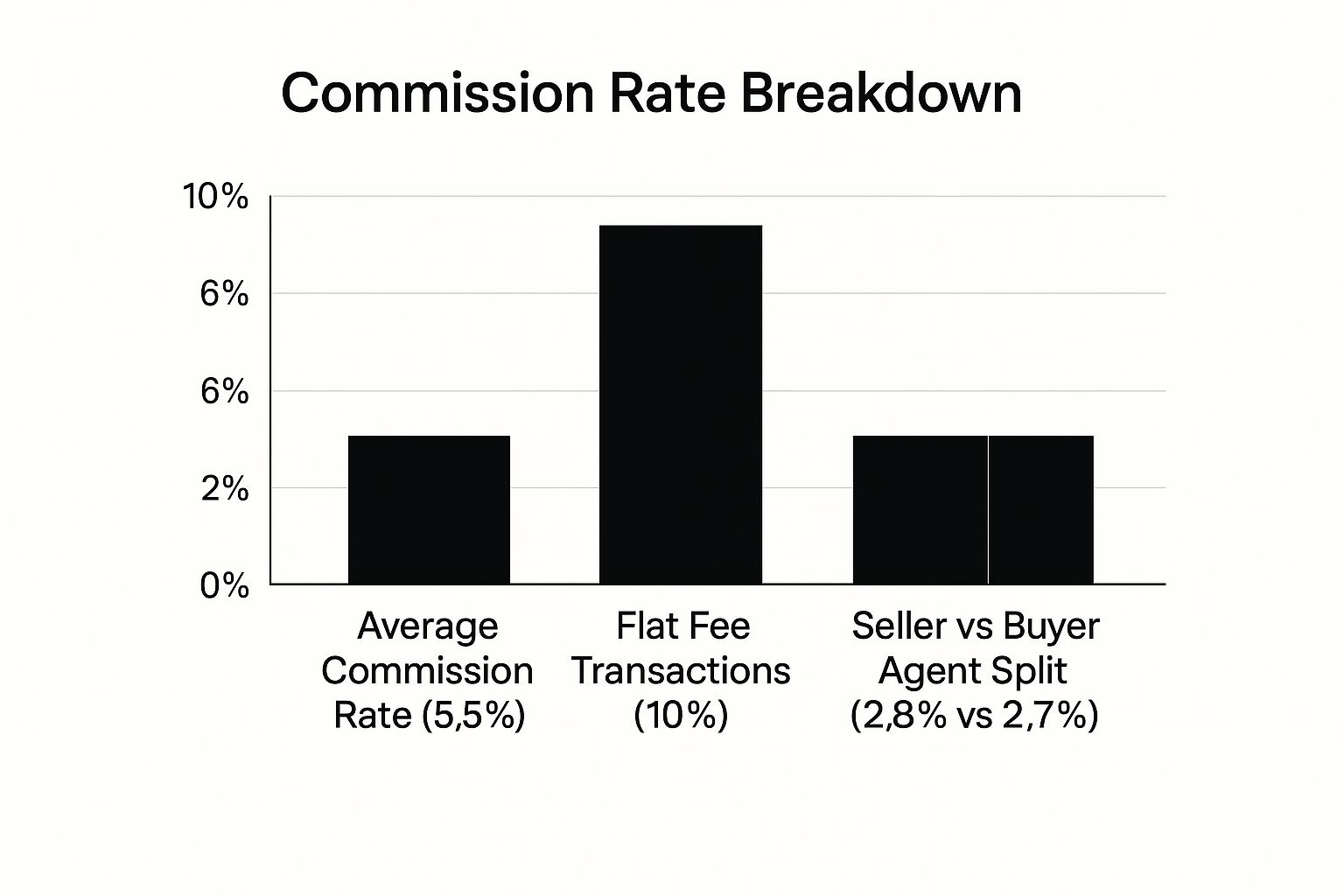
This chart helps to show how fees can be structured and split, which ultimately influences the final amount you pay as a seller.
To see how this plays out in real dollars, let's look at a comparison across the country.
Average Real Estate Commission Rates by Australian State
Here's a quick look at the average commission rates across various Australian states, highlighting what you might expect to pay depending on where you live.
| State/Territory | Average Commission Rate (%) | Commission on a $750,000 Sale (Approx.) |
|---|---|---|
| South Australia | 2.00% | $15,000 |
| New South Wales | 2.05% | $15,375 |
| Victoria | 2.05% | $15,375 |
| Western Australia | 2.31% | $17,325 |
| Queensland | 2.61% | $19,575 |
| Tasmania | 3.00% | $22,500 |
As you can see, selling a $750,000 home could mean a difference of over $7,000 in commission fees, purely based on your postcode.
Why Do Rates Differ So Much?
So, what's really behind these numbers? The variance in commission rates isn't random. It actually boils down to a few core economic principles at play in each market.
- Property Prices: Think about it—in hot markets like Sydney and Melbourne where property values are sky-high, an agent can earn a substantial fee even with a lower percentage. But in areas with lower median prices, agents often need to charge a higher rate to make sure they can cover their business and marketing costs for your property.
- Competition: In bustling city centres, you'll find a lot of agencies all competing for listings. This healthy competition naturally drives commission rates down. Head out to more regional or rural areas with fewer agents, and you'll find less competitive pressure, which can lead to higher standard rates.
- Market Health: The overall health of the market plays a big role. In a booming market where homes are selling in a flash, agents might be more willing to negotiate a lower rate. In a slower market that demands more work, a bigger marketing budget, and more time to find a buyer, a higher commission is often justified.
Local Knowledge is Power: When you know the average commission rate in your state, you have a powerful baseline. It means you can walk into negotiations with an agent feeling informed and confident, ensuring the rate you agree on is fair and competitive for your specific area.
Key Factors That Influence Commission Rates
Real estate commission rates aren’t just a one-size-fits-all number pulled from a hat. The rate an agent proposes is a carefully considered figure, and it’s based on a unique blend of factors specific to your property and the current market. Getting your head around these variables is crucial, as it helps you understand whether a quote represents fair value for the service you’ll receive.
It helps to think about two different sellers. One has a pretty standard two-bedroom apartment in a buzzing suburb, while the other owns a sprawling, unique rural estate an hour out of town. The effort, strategy, and resources needed to sell these two properties are worlds apart—and their commission rates will likely be, too.
Property Value And Location
The value of your property is one of the biggest pieces of the puzzle. It might seem a bit backwards, but higher-priced homes often attract a lower commission percentage. Why? Because an agent can still earn a substantial fee on a multi-million dollar sale even with a smaller rate. On the other hand, they might need a higher percentage on a less expensive property to make sure their marketing and operational costs are covered.
Location plays just as big a role. An agent selling an apartment in a high-demand area like Mandurah is up against fierce competition from other agencies. That competition naturally helps keep commission rates competitive. In contrast, selling that unique rural property with a smaller pool of potential buyers and fewer local agents might require a much more specialised marketing plan. This justifies a higher commission to compensate for the extra effort involved. Broader economic conditions, like the trends influenced by rising interest rates in Australia, also have a ripple effect on buyer demand and can shape an agent's rate structure.
An agent's commission is a direct reflection of the work, risk, and expertise required to achieve a premium price for your specific property in its specific market.
Agent Experience And Marketing Investment
The calibre of your agent and the marketing muscle they bring to the table are also key. An agent with decades of experience and a proven track record of smashing price records will likely charge a higher rate than someone new to the game. What you’re paying for is their expertise, sharp negotiation skills, and a database packed with qualified buyers.
Likewise, the commission covers the entire marketing strategy. A really comprehensive campaign is much more than a simple online listing. It can include a whole suite of services:
- Professional Services: High-end photography, videography, eye-catching drone footage, and detailed floor plans.
- Digital Advertising: Premium, top-spot listings on major real estate portals like realestate.com.au and Domain.
- Social Media Campaigns: Targeted ads designed to reach very specific buyer demographics.
- Print Media: Advertisements in local newspapers or glossy property magazines.
A bare-bones marketing plan will naturally cost less and might come with a lower commission. But a powerful, multi-channel strategy designed to maximise exposure and create a buzz will be reflected in the agent’s fee. Ultimately, the right real estate commission rate is one that balances all these factors to create a fair and productive partnership between you and your agent.
Of all the ways to save a few thousand dollars when selling your home, negotiating your agent’s commission is the most direct. I know it can feel a bit intimidating, but it’s important to remember that commission rates aren’t set in stone—they are absolutely meant to be discussed. With a bit of prep work, you can walk into that conversation feeling confident and ready to secure a great outcome.
Your most powerful tool here is simple: competition. Never, ever just go with the first agent you meet. By interviewing at least three different agents, you naturally create leverage. This process alone gives you a clear picture of the standard commission rates and service levels in your area, which is the perfect foundation for any negotiation.
Arm Yourself with Research
Before you even start talking to agents, do your homework on the average commission rates in Mandurah. When you know the local standard, your negotiation shifts from a hopeful guess to an evidence-based discussion. You can confidently put forward a rate that’s fair to the agent but also works for you.
When an agent tables their proposed fee, don't be shy about asking for a reduction, especially if it’s coming in higher than the local average. You can frame it constructively by saying something like, “Thanks for that. I’ve spoken with a few agents and done some research on the typical rates in the area, which seem to be sitting around X%. Is there any flexibility in your fee to bring it a little closer to that?”
Pro Tip: While a lower commission is tempting, the cheapest agent isn't always the best choice. An inexperienced agent might quickly agree to a low rate but lack the skill to get you the top sale price, which could cost you far more in the long run. The goal is to find the best value, not just the lowest fee.
Propose a Performance-Based Commission
A fantastic way to find a happy middle ground is to propose a tiered or performance-based commission structure. It’s an approach that shows you value the agent’s hard work while also giving them a real incentive to get the highest possible price for your home.
This kind of structure perfectly aligns your goals with your agent's. For a deeper dive into making your property as attractive as possible to buyers, check out our ultimate guide to selling your home for expert tips.
Here’s a simple script you could adapt:
- Propose a base rate: "Would you consider a 2.1% commission on the sale price up to our agreed target of $750,000?"
- Add an incentive: "And to reward an exceptional result, I’d be happy to offer a higher rate, say 5%, on any amount you manage to achieve above that figure."
This strategy genuinely motivates your agent to push for every last dollar. It creates a win-win situation where everyone gets rewarded for a fantastic result.
Common Questions About Real Estate Commissions
As you get closer to listing your property, a few final questions about commission rates will likely pop up. Getting straight answers is key to feeling confident and knowing you understand exactly how your agent gets paid.
Let's clear up some of the most common queries we hear from sellers just like you.
Do I Have to Pay Commission if My House Doesn’t Sell?
In nearly all cases, no. The vast majority of real estate agents work on a “no sale, no fee” basis. It's best to think of the commission as a success fee—it’s only paid when your property successfully sells and settles.
However, it's absolutely crucial to read your agency agreement carefully. While the agent's service fee is tied to a successful sale, you might still be responsible for any marketing or advertising costs you agreed to upfront, regardless of the final outcome.
Is the Agent's Commission Inclusive of GST?
This is a big one, and you need to be crystal clear on it. An agent might quote their commission rate either including or excluding GST, so you must ask. By law, 10% GST has to be added to the final commission fee.
So, a 2% commission rate actually becomes 2.2% after GST is applied. Asking about this early on prevents any nasty surprises when you see the final bill.
The commission is a fee for professional services, and just like other services in Australia, it's subject to GST. One of the most important questions you can ask is, "Is your quoted rate inclusive of GST?"
Can I Negotiate the Commission Rate With My Agent?
Yes, you certainly can. Real estate commission rates in Australia are not set in stone and are fully negotiable. In fact, negotiating the rate is a normal part of the conversation when you're choosing an agent.
Come to the table prepared. Use your research on local rates, your property’s value, and the level of service being offered to have a productive discussion.
For property investors, understanding every potential cost and saving is crucial. You can find related insights in our guide that asks what is negative gearing in Australia.
What Does the Commission Fee Actually Cover?
At its core, the commission pays for the agent's professional expertise, their time, and the resources they pour into selling your home.
This includes things like:
- Strategic pricing and marketing advice
- Managing all buyer enquiries
- Running open homes and private inspections
- Skilled negotiation with potential buyers
- Handling the complex paperwork and process all the way to settlement
It's important to note that the commission is usually separate from the money spent on direct advertising, like online listings or print ads.
Ready to get a clear, no-obligation understanding of your property's value and the commission structure that will work best for you? Contact David Beshay Real Estate for a free, expert property appraisal in Mandurah today. https://realestate-david-beshay.com.au


Pingback: Find Top Local Real Estate Agencies in Mandurah - David Beshay Real Estate - The Agency
Pingback: A Guide to Real Estate Agent Fees When Selling - David Beshay Real Estate - The Agency