


Figuring out stamp duty is pretty straightforward once you get the hang of it. At its core, you just multiply your property's value by the right tax rate, which slides up or down depending on the price. Think of it as the government's fee for putting the property title in your name—a critical cost you absolutely need to build into your home-buying budget.
What Is Stamp Duty and How Is It Calculated
Stamp duty, which is officially called 'transfer duty' here in Western Australia, is a state tax you have to pay when you buy property. It's not just a flat fee; it’s a progressive tax. That means the rate climbs as the property's value increases, which is why the final bill can be wildly different from one home to the next.
The whole calculation starts with one number: the dutiable value. This is either the price you agreed to pay for the property or its current market value, whichever is higher. The state revenue office always uses the higher of the two to make sure the right amount of tax is paid and to prevent people from undervaluing a property just to save on duty.
Understanding the Core Components
Before you jump into the numbers, it helps to understand what actually shapes your final bill. It’s not just about the sale price. A few key things come into play:
- Your Buyer Profile: Are you a first-home buyer, a seasoned investor, or maybe a foreign resident? Each profile can attract different rates or qualify for certain concessions.
- Property Type: The rules can change depending on if you're buying an established home, a block of vacant land, or an off-the-plan apartment.
- Concessions and Exemptions: These are the gold nuggets—discounts or complete waivers from the government. First-home buyers are the most common recipients of these.
A classic mistake I see people make is budgeting only for the base duty and completely overlooking potential savings. Digging into the available concessions can save you thousands, turning a scary expense into something much more manageable.
The Progressive Tax System in Action
Because stamp duty works on a progressive scale, different chunks of the property's value are taxed at different marginal rates. For example, the first portion of the value is taxed at one rate, the next slice at a higher one, and so it goes on up the ladder.
This tiered system is exactly why a simple percentage calculation doesn't work. To give you an idea, in New South Wales, the average stamp duty rate during the 2023 fiscal year landed around 3.66%. That figure is a blend of all the different tiers applied across countless property values and buyer types.
Getting these fundamentals down is the first real step to an accurate calculation. It's also crucial for understanding the ongoing discussions around revitalizing Western Australia’s real estate landscape through stamp duty reforms.
Getting Your Key Information for an Accurate Quote
To get a stamp duty figure you can actually rely on, you'll need to pull together a few key details first. It’s a common mistake to think the sale price is the only number that matters. In reality, several factors can shift your final quote quite dramatically.
Getting these specifics right from the start is the difference between a rough guess and a solid number for your budget.

The first and most important piece of the puzzle is the dutiable value of the property. This is either the purchase price or the property’s current market value—whichever is higher. The government uses this rule to make sure the correct amount of tax is paid.
This means you can’t just use the price you agreed on if the market value is actually higher. Your conveyancer will be the one to confirm the official dutiable value that must be used for the calculation with the state revenue office.
Define Your Buyer Profile
Who you are as a buyer has a direct impact on the final stamp duty bill. Different buyer types qualify for different rates, concessions, or sometimes even extra charges.
You'll need to work out which of these categories you fit into:
- First-Home Buyer: This is where the biggest savings are found. In WA, eligible first-timers can get a full exemption or a concessional rate, depending on the property's value.
- Repeat Home Buyer: If you’ve owned a property before, you’ll almost certainly be paying the standard residential rate.
- Investor: Property investors typically pay the full rate of duty, as most concessions are designed for people who will live in the home.
- Foreign Resident: Non-Australian citizens buying property are often up for a Foreign Owner Rate Surcharge on top of the standard duty.
Your status is a critical detail. Forgetting to apply a first-home buyer concession, for example, could see you budgeting for thousands of dollars in unnecessary costs.
Identify the Property and Transaction Type
Finally, the nature of the property itself helps determine which tax brackets and rules apply. A block of land is treated differently from an established apartment, and your calculation needs to reflect that.
Have these details handy:
- Established Home: A property that has been owned and lived in before.
- Vacant Land: An empty block you plan to build on.
- Off-the-Plan Purchase: Buying a property, like a new apartment, before construction is finished.
Taking a few minutes to gather these three key pieces of information—dutiable value, buyer profile, and property type—is essential. It lets you move beyond generic estimates and use our online stamp duty calculator for a precise, reliable figure you can confidently take to the bank.
Applying the Stamp Duty Rates and Thresholds
Right, let's get to the heart of it—turning those rates and thresholds into an actual dollar figure. The key thing to understand is that WA uses a tiered system to calculate stamp duty. It's not just a single flat percentage slapped onto the purchase price, which is a common mistake I see people make.
This marginal rate system means different parts of your property's value get taxed at progressively higher rates. It might sound a bit complicated at first, but it’s actually a fairer way to do things. I'll break it down with a clear example to show you it’s more straightforward than you might think.
Here's a quick look at the core steps involved in figuring out your stamp duty.
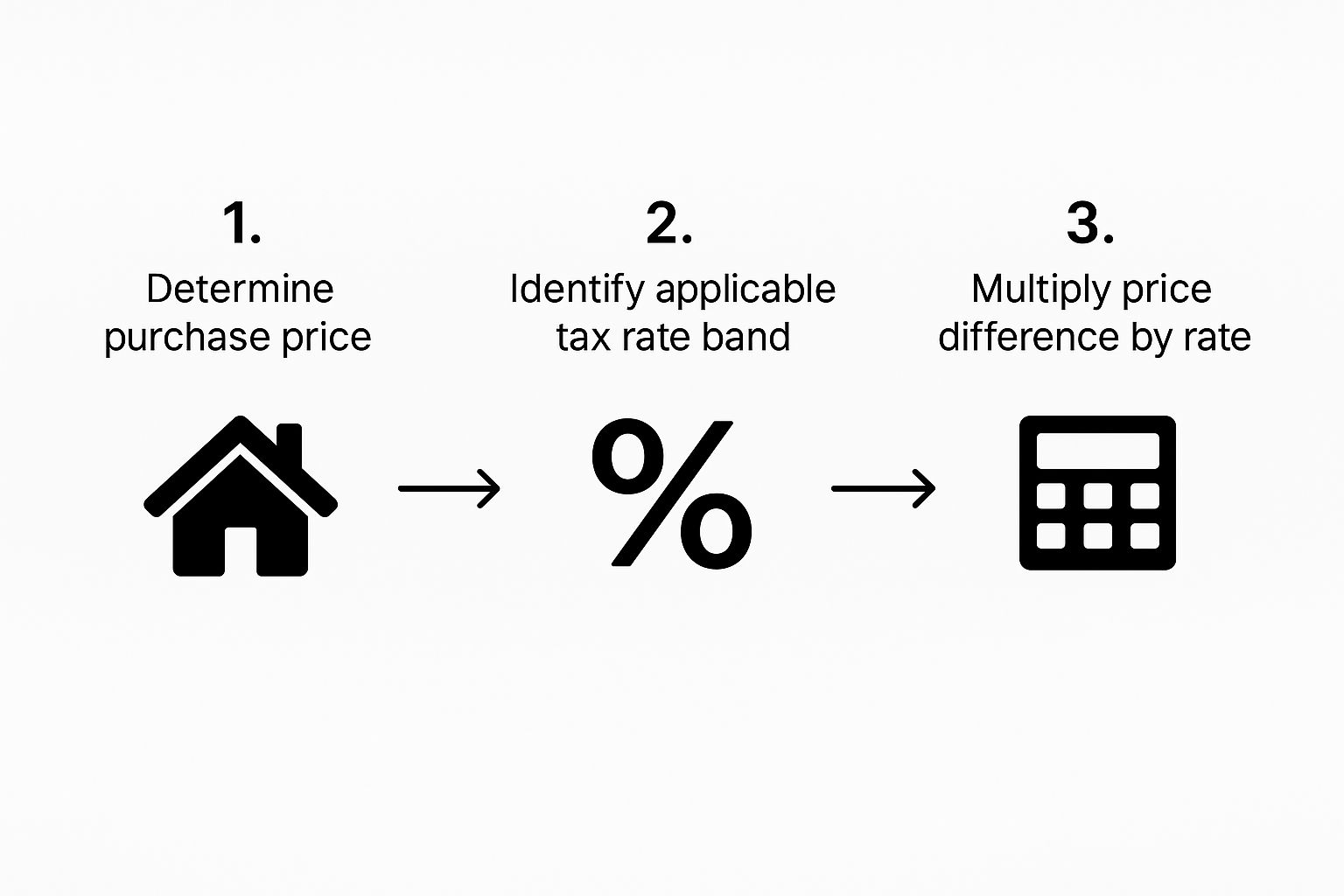
As you can see, the process is all about matching your property's value to the correct tax bracket and then applying the right rate to the relevant slice of that value.
A Worked Example for a $550,000 Property
Let's walk through a real-world scenario. Say you’re buying an established home in Mandurah for $550,000. We'll assume you're not a first-home buyer, so the standard residential rates are the ones we need to use.
To get started, here are the official progressive duty rates for residential property in WA.
WA Stamp Duty Rates for Residential Property
| Dutiable Value Range | Rate of Duty |
|---|---|
| $0 – $80,000 | 1.90% of the dutiable value |
| $80,001 – $100,000 | $1,520 + 2.85% on the excess over $80,000 |
| $100,001 – $250,000 | $2,090 + 3.80% on the excess over $100,000 |
| $250,001 – $500,000 | $7,790 + 4.75% on the excess over $250,000 |
| Over $500,000 | $19,665 + 5.15% on the excess over $500,000 |
This table shows exactly how much you'll pay at each value tier.
Since our property is valued at $550,000, it falls squarely into that top bracket. The calculation is $19,665 plus 5.15% on whatever amount is over the $500,000 mark.
Here’s how the maths plays out:
- First, find the amount that's over the threshold: $550,000 – $500,000 = $50,000
- Next, calculate the duty just on that portion: $50,000 x 5.15% (which is 0.0515) = $2,575
- Finally, add this to the base amount for that bracket: $19,665 + $2,575 = $22,240
And there you have it. The total stamp duty payable for this $550,000 property is $22,240.
Understanding the National Context
This way of using value brackets isn't unique to WA; it's pretty consistent across Australia. The big difference is that the specific rates and thresholds vary a lot from state to state. The Commonwealth Grants Commission (CGC) even uses a standardised method to assess stamp duty across all states, breaking property values into ranges from $100,000 to over $5 million for fair comparisons. If you're interested in the nitty-gritty, you can read more about how the CGC assesses stamp duty on conveyances.
It's easy to get lost in the numbers, but remember what you're doing: you're calculating tax on different slices of the property's value and adding them together. Our online calculator automates this entire process, but seeing the manual breakdown helps you understand exactly where the final figure comes from.
Once you get the hang of this structure, you can confidently work out a solid estimate for any property price. The next step is to figure out if you can bring that final number down.
Finding Savings with Concessions and Exemptions
Working out the base rate for stamp duty is the first hurdle, but it's definitely not the end of the story. The real chance to bring down your final bill is by getting familiar with the various concessions and exemptions available here in Western Australia. These discounts can slash thousands off your upfront costs—and in some cases, wipe out the duty completely.
The biggest and most well-known of these is the First Home Owner Rate of Duty. It's designed specifically to give people a leg up into their first property. If you and your partner (if you're buying with one) have never owned a home anywhere in Australia before, you could be looking at some serious savings.
The First Home Owner Rate of Duty
For eligible buyers, this concession is an absolute game-changer. It offers a complete exemption from stamp duty for properties up to a certain price, and a discounted rate for homes valued a bit higher than that.
To qualify, you need to meet a very specific set of criteria. The rules are strict, so it’s vital to make sure you tick every single box before you start banking on those savings.
- Purchase Price Caps: The dutiable value of the property has to fall within the government's set limits. For an established home, you'll pay zero stamp duty if the property is valued at $430,000 or less.
- Residency Rules: At least one of the buyers must move into the property and make it their main home within 12 months of settlement. You'll also need to live there continuously for at least six months.
- Previous Ownership: You can't have owned a home in Australia before, or have already received the First Home Owner Grant or any duty concessions in another state or territory.
For homes valued between $430,001 and $530,000, you won't get the full exemption, but you'll still get a break with a reduced, or concessional, rate of duty. You can dive deeper into the specifics by checking out our complete guide to first home buyer stamp duty in WA.
A Scenario for First Home Buyers
Let's put this into a real-world context. Imagine a young couple buying their first apartment in Rockingham for $420,000. Because the value is under the $430,000 threshold and they meet all the eligibility rules, their stamp duty bill is $0. Nothing.
Now, compare that to a regular buyer purchasing the exact same property. Based on the general rates, their stamp duty would be $13,815. That’s a massive saving that can instead go directly towards their deposit, moving costs, or furnishing their new place.
Other Concessions and Exemptions to Know
While the first home owner rate is the most common one, there are other situations that can also lead to reduced or waived stamp duty. It's always worth investigating if any of these apply to your circumstances, as they can make a huge difference to your final calculation.
It's a common oversight to assume that only first-time buyers get assistance. Always check for other potential discounts, as the savings can be substantial even for seasoned property owners in specific situations.
Other notable exemptions include:
- Family farm transfers: Special provisions are in place to help transfer farming properties between eligible family members without triggering a hefty duty bill.
- Spousal or de facto transfers: When a property is transferred between partners as part of a relationship breakdown, it is often exempt from duty.
Understanding these different pathways is a crucial part of learning how to calculate stamp duty accurately, and it ensures you don't pay a cent more than you legally have to.
How Stamp Duty Works for Commercial Properties
Stamp duty isn’t just a hurdle for home buyers—it's a significant upfront cost that commercial investors and businesses need to factor in. When you’re looking at buying an office, a warehouse, or a retail space, the way you calculate stamp duty feels familiar, but the numbers are often worlds apart from their residential cousins.

The starting point is the same: the calculation is based on the dutiable value, which is the higher of the purchase price or the property's current market value. Where it gets tricky is that the rates and thresholds applied to this value are completely different, a critical distinction that can easily catch out inexperienced commercial buyers.
Key Differences from Residential Duty
The most obvious difference is that commercial properties don’t get any of the concessions available to residential buyers. There’s no First Home Owner Rate or other discounts designed to help people into their homes.
This means you are almost always dealing with the full, general rate of transfer duty. While this rate is also progressive—climbing higher as the property value increases—the brackets are structured differently. For any business owner, this makes getting an accurate valuation and calculation absolutely non-negotiable for your financial modelling and budgeting.
A common mistake I see is people applying residential stamp duty logic to a commercial purchase. The rates are distinct, and overlooking this can lead to a budget shortfall of tens of thousands of dollars, putting the entire transaction at risk.
The Importance of Precise Valuation
Getting a precise valuation is even more critical for commercial transactions. Unlike a family home, a commercial property's value can be heavily influenced by things like rental income, existing lease agreements, and future zoning potential.
On top of that, a commercial purchase often has extra layers of complexity, like Goods and Services Tax (GST). Depending on how the sale is structured—for example, if it's sold as a 'going concern'—GST may or may not apply, which in turn can affect the dutiable value used for the stamp duty calculation. This is exactly why it’s so important to have an expert team, including a sharp conveyancer and an accountant, to navigate these details. They can clarify how GST impacts your specific purchase and make sure you're using the correct dutiable value.
Getting this right is fundamental, especially when you consider how these costs fit into the broader picture of acquiring a new asset. For a closer look at how these duties apply across different purchasing strategies, you might find our guide on investment property stamp duty useful.
Common Questions About Paying Stamp Duty
So, you've crunched the numbers and have a final figure for your stamp duty. What now? It’s completely normal for a few practical questions to pop up at this stage. Knowing the next steps is just as crucial as the calculation itself. Let's walk through what happens after you know how much you owe.
Getting these final details right is key to making sure your property settlement goes off without a hitch. A smooth transaction is a stress-free transaction.
When Do I Actually Pay the Stamp Duty?
The timing for paying stamp duty is one of those critical, non-negotiable deadlines in the property buying process. In Western Australia, it's generally due at or before the settlement of your purchase. The absolute latest is usually within 30 days of the contract date or by the settlement date itself.
Don't stress about managing this yourself. Your conveyancer or settlement agent will handle it. They ensure the funds are correctly transferred to the state revenue office on time, which is a vital step for the property title to be legally and officially registered in your name.
Can I Add Stamp Duty to My Home Loan?
Yes, this is a pretty common strategy. It's often possible to roll the stamp duty cost into your total home loan amount, a practice known as loan capitalisation. It’s a handy way to reduce the mountain of upfront cash you need to find.
But there's always a trade-off. By adding it to your loan, you'll be paying interest on that stamp duty amount for the entire life of the mortgage. This will increase the total interest you pay over the long haul.
It’s really important to have this conversation with your mortgage broker or lender early in the piece. Adding the duty to your loan increases your total borrowing amount and, therefore, your Loan to Value Ratio (LVR). If this little bump pushes your LVR above 80%, you might get hit with Lenders Mortgage Insurance (LMI) – another hefty cost you’ll want to avoid if you can.
What Happens If I Calculate the Stamp Duty Wrong?
Getting the stamp duty calculation wrong can cause some serious delays and financial headaches, and always at the worst possible time—right before you're due to get the keys. Accuracy here is everything.
If you accidentally underpay, the property transfer simply cannot be completed. The title won't be registered in your name, and you could be slapped with late payment penalties from the revenue office. It can put the entire settlement at risk.
On the flip side, if you happen to overpay, you can apply for a refund. But be warned, it’s often a slow and frustratingly bureaucratic process. This is exactly why it’s best practice to use an official online calculator and then have the final amount confirmed by your conveyancer. They are legally responsible for paying the correct duty on your behalf.
Think of your conveyancer as your ultimate safety net. They make sure the right amount is paid so your property journey has a successful, happy ending.
Navigating the complexities of the property market requires trusted advice and powerful tools. David Beshay Real Estate provides comprehensive resources, including precise calculators and expert local insights, to guide you every step of the way. Start your property journey with confidence at https://realestate-david-beshay.com.au.

