

A licensed residential valuation in Australia typically costs $300–$600, while a real estate agent appraisal is usually free. For Mandurah and Lakelands sellers, the right choice depends less on the fee and more on whether you need a marketing opinion or a formal figure for finance, legal, tax or family matters.
A common conversation starts with a homeowner in Lakelands who has owned a four-bedroom property for years and is finally considering a move. An agent has mentioned a likely selling range, but the owner is wondering whether that verbal estimate is solid enough to set the listing price. The same question comes up in Halls Head, Madora Bay, Meadow Springs, Falcon, Wannanup and Dudley Park, especially when a home has coastal features, extensive renovations or an unusual layout.
The important distinction is purpose. A free appraisal can help you decide how to position a home for sale. A paid valuation creates formal evidence that may be recognised by a lender, court, accountant or other institution. Understanding that difference is the most reliable way to judge property appraisal cost in Mandurah.
Table of Contents
- What a Mandurah Homeowner Really Pays for an Appraisal
- Agent Appraisal vs Licensed Valuation in WA
- Typical Property Appraisal Cost Ranges in Australia
- What Drives the Cost Up or Down in Mandurah
- When Paying for a Formal Valuation Is Worth It
- Getting the Most Accurate Number for Your Home
- Choosing the Right Appraisal Path for Your Sale
What a Mandurah Homeowner Really Pays for an Appraisal
A Lakelands seller deciding whether to list has a practical question: is a free agent appraisal enough, or will a paid valuation prevent an expensive mistake? The answer depends on who needs to rely on the figure and what decision it must support.
For a typical sale, a local agent appraisal usually carries no direct fee. The agent reviews comparable sales, studies the home's presentation and position, and applies current buyer behaviour in the suburb. The result is a pricing conversation, often based on the likely campaign range rather than a formal report.
That suits a straightforward decision in Lakelands, Halls Head or nearby Mandurah suburbs. If you are testing the market, choosing an asking price or comparing agents, obtain appraisals from people who regularly sell similar homes locally. Their value comes from interpreting competition, buyer demand and how the property should be presented.
A licensed valuation serves a different purpose. It provides an independent figure and supporting reasoning for a lender, court, estate process, tax discussion or family settlement. A standard residential valuation generally costs $300–$600 in Australia, according to ANZ's guide to property valuations and their costs. More complex or higher-value assignments can cost $1,000–$5,000 or more, depending on the property and work required.
The local context matters
The work is rarely identical from one Mandurah property to another. A standard brick-and-tile home in Lakelands may have clear comparable sales, while a canal property in Madora Bay, renovated coastal home in Halls Head or lifestyle property in Falcon may require closer examination. Access, age, design, improvements and the availability of similar sales all affect the assessment.
The practical test: if the figure is for your listing strategy, start with local agent appraisals. If another party must accept or scrutinise it, consider a formal valuation.
Paying for the right evidence can protect your position. An inflated estimate may leave the home sitting on the market, while an understated figure can limit negotiations from the start. Choose the service that matches the consequence of getting the price wrong.
Agent Appraisal vs Licensed Valuation in WA
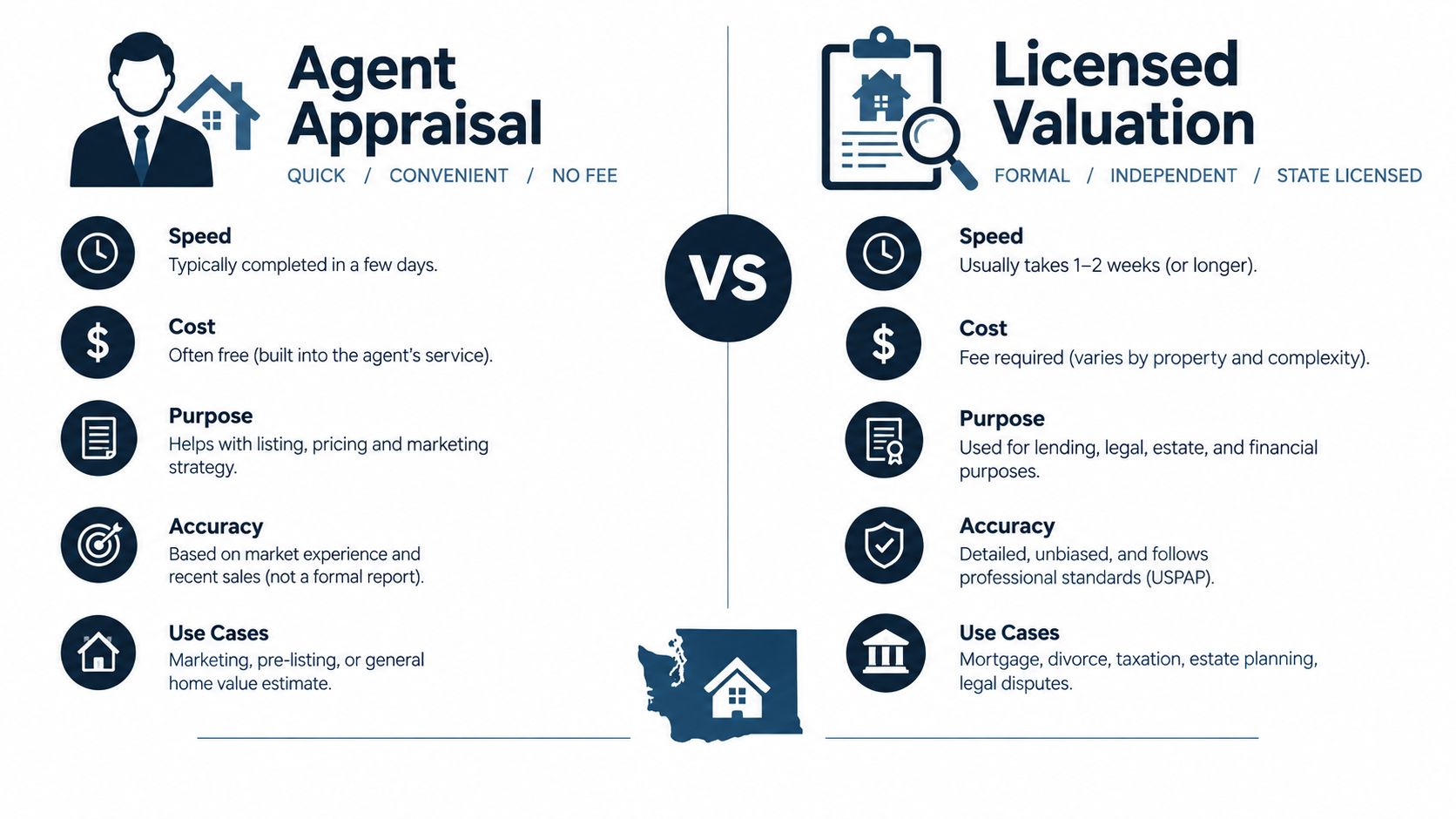
An agent appraisal and a licensed valuation are not cheaper and more expensive versions of the same service. They're different documents prepared for different purposes.
Think of an agent appraisal as a market conversation. The agent looks at recent local sales, competing listings, property condition and buyer demand, then forms an opinion about a sensible campaign price. The advice is shaped by the practical question, “What price is likely to attract the right buyers while protecting the owner's position?”
A licensed valuation is closer to a formal assessment record. A qualified valuer inspects the property, researches relevant evidence and prepares a report explaining the reasoning behind the figure. The report can be commissioned for lending, legal, tax, estate or dispute purposes.
Who prepares each service
The agent prepares an appraisal as part of their real estate service. Their strength is local market interpretation, including how buyers respond to presentation, street appeal, outdoor living, water access and competition from nearby homes in suburbs such as Meadow Springs, Halls Head and Madora Bay.
A formal report comes from a suitably qualified valuation professional. The work is independent of the agent's objective to win a listing and is designed to satisfy the requirements of the party requesting it. A bank, family-law process or estate settlement may reject an agent's opinion because it needs a recognised valuation report rather than marketing advice.
The practical differences are summarised below:
| Service | Prepared by | Main purpose | Inspection and evidence |
|---|---|---|---|
| Agent appraisal | Local real estate agent | Campaign pricing and selling strategy | Market comparisons, property review and local buyer insight |
| Licensed valuation | Qualified valuation professional | Finance, legal, tax, estate or dispute matters | Formal inspection, research and written reasoning |
For a more detailed explanation of how lender assessments differ from agent opinions, see this guide to bank evaluations and real estate agent appraisals.
Why the distinction affects your decision
A seller in Wannanup may want an agent's view of how buyers will respond to a coastal lifestyle property. An owner in Dudley Park dealing with a family property matter may need a formal report that can be shared with solicitors. Both owners need a number, but they don't need the same type of number.
A free appraisal isn't inferior just because it isn't a valuation. It becomes unsuitable only when the intended recipient requires a formal, independent report.
Typical Property Appraisal Cost Ranges in Australia
The most useful starting point is simple. Agent appraisals are generally free, while full residential valuations commonly sit between $300 and $600. Mozo's Australian valuation cost guide places desktop and automated valuation-style assessments at free to A$200, compared with approximately $300–$600 for a full residential valuation.
The method affects both price and usefulness. A desktop assessment relies heavily on available property and comparable-sales data. A kerbside assessment adds an external review. A full valuation involves an internal inspection and a more detailed report.
Residential valuation cost ranges in Australia
| Valuation Type | Typical Cost | Best For |
|---|---|---|
| Agent appraisal | Free | Initial sale pricing and campaign strategy |
| Desktop or AVM-style assessment | Free to A$200 | Early screening, lending situations with lower data uncertainty |
| Kerbside valuation | A$200–$350 | External review where an internal inspection isn't required |
| Full residential valuation | A$300–A$600 | Finance, formal advice and properties needing detailed assessment |
| Complex or high-value assignment | A$1,000–A$5,000 or more | Commercial, unusual or highly involved valuation work |
The table shows why comparing only the headline fee can mislead. A desktop figure might be adequate for early screening of a conventional property in Meadow Springs, where comparable homes are readily understood. It may be less useful for a distinctive home with limited direct comparisons.
Where Mandurah homes tend to sit
A conventional home in Lakelands or Meadow Springs may fit comfortably within the standard residential range when a full inspection is needed. Coastal and premium properties in Halls Head, Falcon or Madora Bay can require more investigation where they include water views, unusual improvements, larger land components or higher-value finishes.
That doesn't mean every home in those suburbs attracts a higher fee. It means the scope of the assignment, not the suburb name alone, should guide the quote. Ask whether the fee includes the inspection, comparable-sales research, written report and any required turnaround.
What Drives the Cost Up or Down in Mandurah
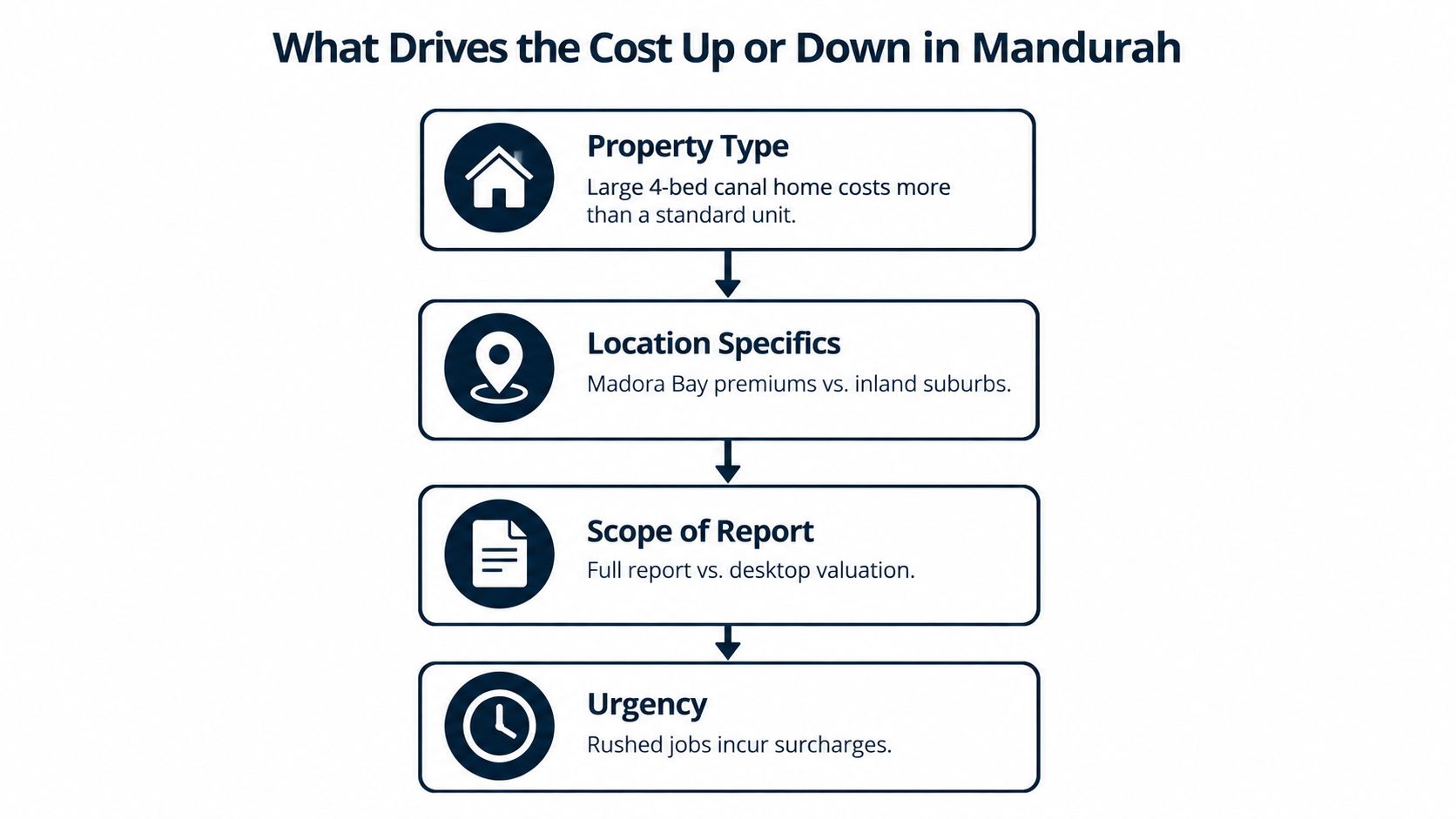
The largest fee differences usually come from the amount of work required, not from a simple postcode surcharge. A valuer assessing a standard home with clear comparable sales can work more efficiently than one analysing a distinctive property with limited evidence.
Property type comes first
A large four-bedroom canal home in Madora Bay or a renovated beachfront property in Halls Head may need more research than a standard three-bedroom brick-and-tile home in Lakelands. The valuer may need to examine differences in water access, orientation, outdoor areas, building quality, renovations and site characteristics.
A unit, standard suburban home and multi-dwelling property also present different assessment questions. Granny flats, dual-occupancy arrangements and separate living areas can require careful treatment, particularly where approvals or income-producing use are relevant.
Location and evidence
Location within the Peel region matters because comparable sales aren't always interchangeable. A home in Falcon shouldn't automatically be compared with an inland property just because the bedroom count is similar. Dudley Park, Wannanup, Madora Bay and Halls Head each present different buyer expectations and property characteristics.
The factors affecting property value also influence the amount of analysis needed. A valuer must consider the physical home alongside its setting, access, land component and recent market evidence.
Scope and urgency
Desktop assessments usually cost less because they don't require an internal inspection. Full reports cost more when the valuer must inspect, measure, investigate improvements and explain the conclusion in detail.
Urgency can also affect the quote. A seller working to a tight finance or legal deadline may pay more for a rushed turnaround, so it's sensible to ask about standard and urgent delivery options before commissioning the work.
Age and complexity deserve particular attention. Older homes, heritage-related work, incomplete approvals, unusual construction and rural or semi-rural characteristics can make the report more involved. A valuer with experience across the Mandurah and Peel corridor may also interpret coastal and lifestyle evidence more accurately than someone unfamiliar with local stock.
When Paying for a Formal Valuation Is Worth It
A paid valuation earns its place when the cost of uncertainty is greater than the fee. That often happens when several people need to agree on a figure, or when an organisation needs evidence prepared by an independent professional.
A family-law matter, deceased estate, property dispute or court process is the clearest example. Legal Aid WA explains that real estate appraisals are free in Western Australia and recommends obtaining at least two or three appraisals, while a sworn valuation carries a separate fee. In those circumstances, an agent's opinion can help with context, but it may not replace the formal document required by the process.
Situations where the fee has a clear purpose
| Situation | Typical Fee | Why It Pays |
|---|---|---|
| Straightforward private sale | Free agent appraisal | Provides practical campaign pricing advice |
| Family-law or estate matter | Fee set by the valuer | Creates independent evidence for the parties involved |
| Lending or refinancing | Often ordered within the lending process | Supports the lender's assessment of security |
| Complex renovation or extension | A$300–A$600 for a standard residential valuation | Tests whether the work is reflected in market value |
| Tax or formal dispute | Fee depends on scope | Produces a defensible report rather than a marketing opinion |
The same logic applies when an owner is considering significant work in Madora Bay or Falcon. A valuation won't guarantee that renovation costs will be recovered, but it can provide a more disciplined reference point before committing to a substantial project.
A buyer's lender may also arrange a valuation during finance approval. If the lender's figure is lower than the contract price, a seller-funded report won't automatically override it, but well-organised evidence can help a buyer and their adviser understand the difference. The report has greatest value when the property is unusual, the evidence is contested or the financial consequences of a wrong assumption are significant.
Before ordering one, confirm who will accept the report and what format they require. This explanation of property valuation can help clarify whether your situation calls for a formal report or a market appraisal.
Getting the Most Accurate Number for Your Home
A Lakelands or Halls Head owner deciding whether to accept a free agent appraisal or pay A$400–A$600 for a licensed valuation should start with the purpose of the number. Preparation improves either process. It gives the agent or valuer a clear view of the home's condition, improvements and supporting evidence.
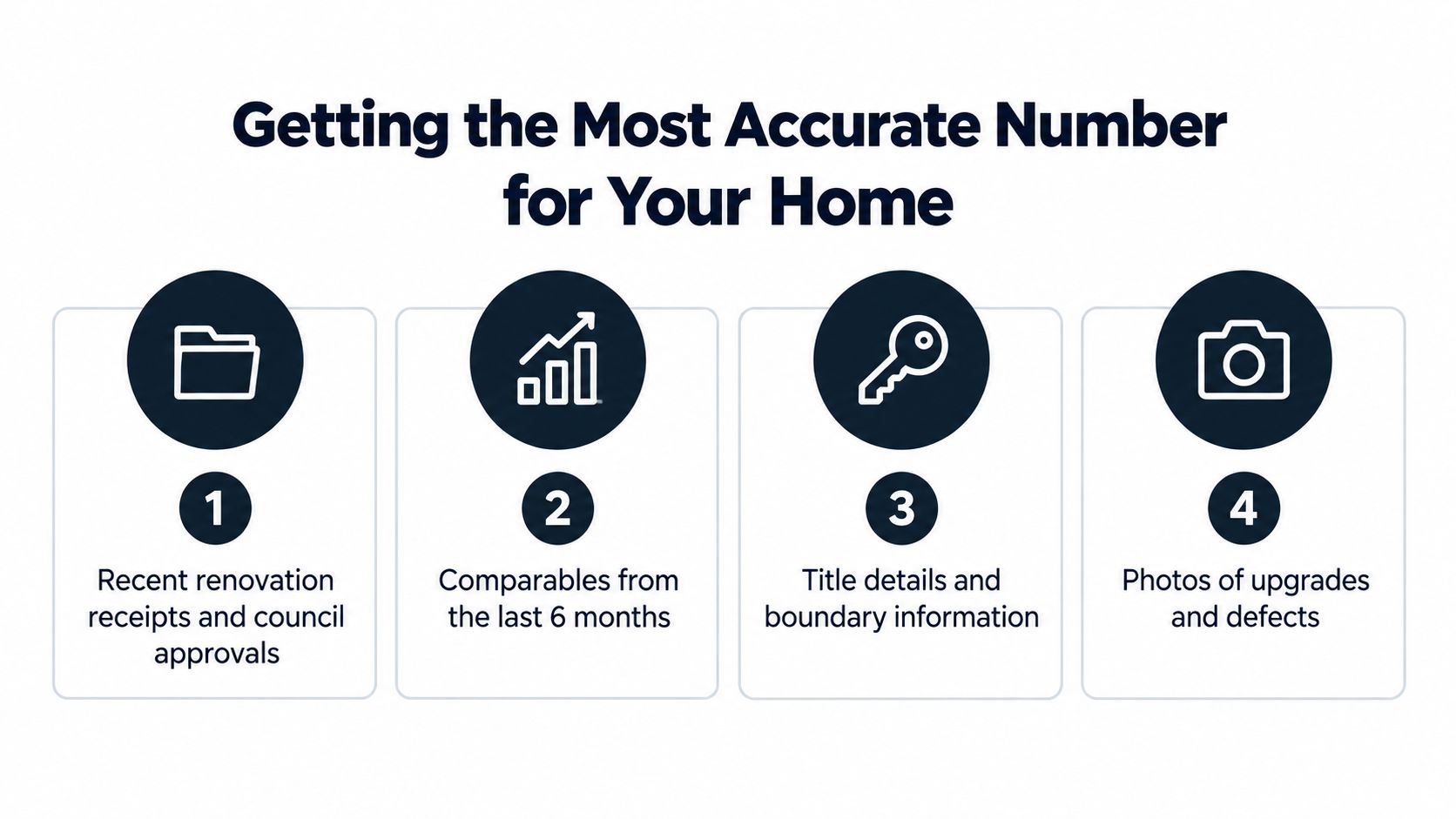
Prepare an information pack before the inspection. Include suitable comparable sales from the past 90 days within a 1-kilometre radius, along with the council rates notice, building approval history and a renovation schedule showing dates and receipts. Valuation guidance places weight on property-specific factors such as location, accessibility, age, style and complexity.
For a checklist suited to local homes, review these home appraisal tips for Mandurah sellers before the appointment.
Prepare the property and paperwork
- Document improvements: List kitchen, bathroom, roof, outdoor-area and extension work. Add approvals and receipts where available.
- Resolve visible maintenance: Fix leaking taps, replace blown bulbs and address minor defects that could distract from the property's overall condition.
- Clear unnecessary clutter: Open rooms, wardrobes and storage areas so the assessor can judge the home's usable capacity.
- Tidy the exterior: Mow the lawn, refresh garden beds with mulch and keep access clear, particularly for a kerbside or drive-by assessment.
- Provide property documents: Gather floor plans, title details and strata or community-title material that may affect the assessment.
This preparation has practical value in Lakelands, Meadow Springs and Madora Bay, where buyers often compare similar homes. Differences in upkeep, layout and presentation can influence an agent's pricing advice, even when the properties appear broadly comparable.
Ask how the number was reached
Ask which sales support the figure and why they are relevant. The agent or valuer should explain adjustments for land size, accommodation, condition, renovation quality and location. If the explanation does not match the evidence, request a clearer comparison before relying on the number.
Use the conversation to raise features that public records may not show, including approved improvements, protected views, upgraded services or a well-designed outdoor entertaining area. The right preparation will not guarantee a particular result, but it helps ensure the appraisal reflects the property being assessed.
Choosing the Right Appraisal Path for Your Sale
The right appraisal path is the one that supports the decision you need to make. For a straightforward sale in Lakelands, Halls Head or Madora Bay, the practical objective is usually a competitive launch price, strong buyer engagement and enough negotiation room to protect the owner's position.
Start with two or three local agent appraisals, ideally in the same week. Compare more than the suggested figures. Look at the sales evidence, the proposed campaign strategy, the explanation of buyer demand and the agent's understanding of the specific suburb.
Choose a formal valuation when the property is part of a mortgage, deceased estate, tax matter, family-law process or dispute, or when the home is sufficiently unusual that a marketing opinion won't meet the requirement. In Western Australia, Aussie's comparison of property appraisals and valuations also distinguishes free agent appraisals from paid valuations and describes desktop, kerbside and full-inspection approaches.
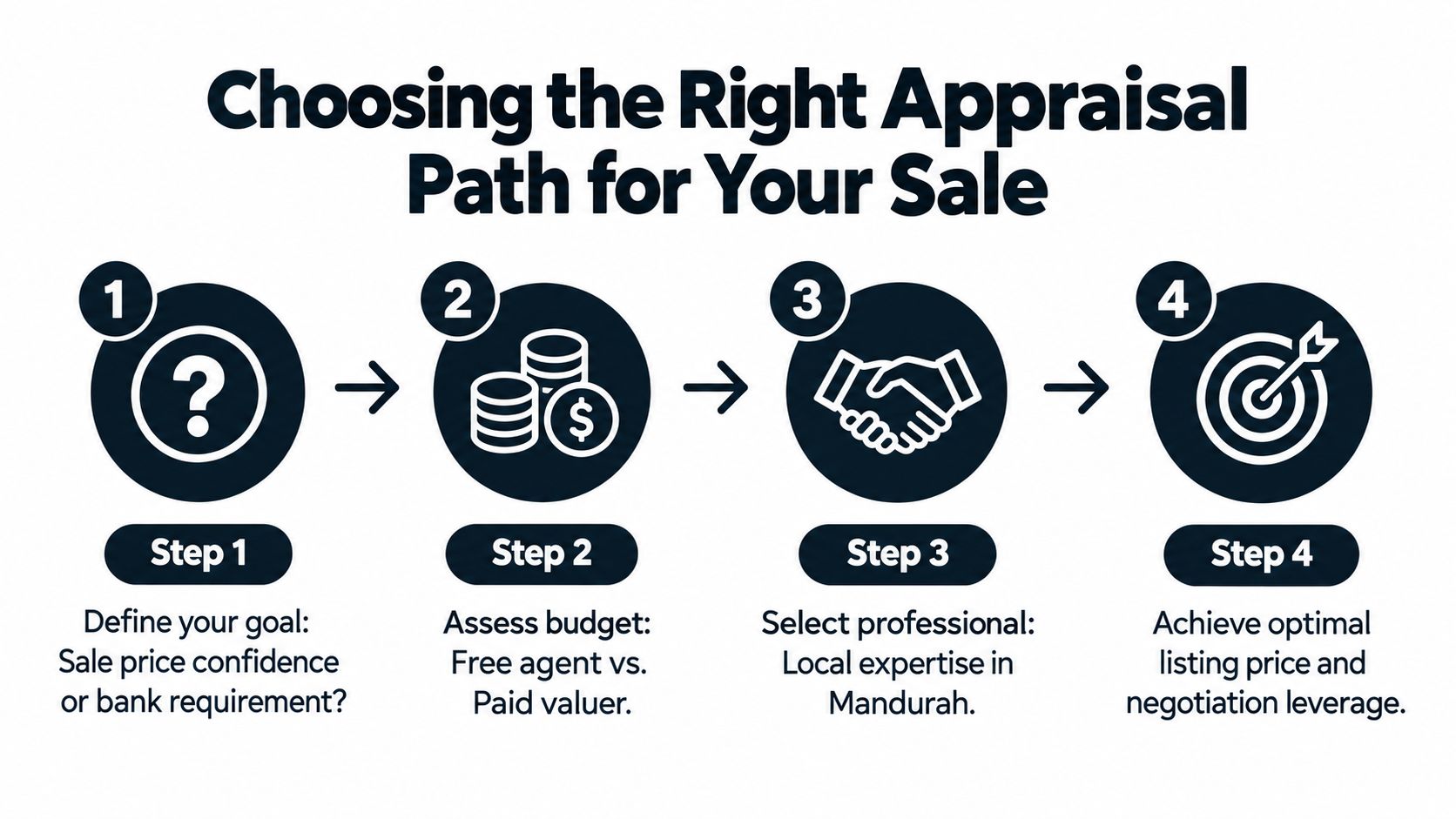
The decision flow is straightforward:
- Define the purpose: Do you need sale-price confidence, or a document for a bank or legal process?
- Compare the cost: Weigh a free market appraisal against a paid valuation suited to the required use.
- Choose local expertise: Select a professional familiar with Mandurah's coastal and inland property differences.
- Use the evidence: Set a realistic listing price and enter negotiations with a clear understanding of the home's position.
The listing price affects more than the first online advertisement. It influences the quality of buyer enquiries, the campaign's momentum and your position when offers arrive. A free appraisal is often enough to begin that process, while a formal report makes sense when the stakes or requirements extend beyond marketing.
David Beshay Real Estate provides complimentary, no-obligation appraisals for owners seeking a data-informed view of their property's market position across Mandurah and surrounding suburbs.
If you're comparing local agents, this guide on how to choose a real estate agent offers a useful framework for assessing communication, evidence and campaign fit.
If you're considering selling in Lakelands, Madora Bay, Halls Head, Falcon, Wannanup, Dudley Park or nearby Mandurah suburbs, arrange a complimentary, no-obligation appraisal with David Beshay Real Estate. You'll receive a practical discussion about comparable sales, positioning and whether a formal valuation is necessary for your circumstances.

