


Western Australia's rental market gives investors a reason to look beyond national averages. The state's vacancy rate is 0.63%, while median gross rental yields sit at 4.86% for houses and 6.28% for units. WA houses also have a median listing price of $695,000, after rising 20.86% over the prior year, with median rents of $650 per week for houses and $580 per week for units. WA property market data puts the investment question in sharper terms: the opportunity is not just buying property, it's buying the right asset in the right coastal corridor and protecting the net return after every cost.
Mandurah deserves that more disciplined approach. Lakelands, Madora Bay, Meadow Springs, Halls Head, Falcon, Wannanup and Dudley Park don't perform as one uniform market. Houses and units attract different tenants, carry different entry prices and respond differently to coastal demand, maintenance, insurance and land tax. The reason to buy investment property here is strongest when the acquisition is assessed suburb by suburb, dwelling type by dwelling type, and on net performance rather than a headline yield.
Table of Contents
- The Structural Case for Western Australian Property
- Mandurah Rental Market Dynamics and Tenant Demand
- Capital Growth Trends Across Key Coastal Suburbs
- Navigating Western Australian Tax and Holding Costs
- Comparing Houses and Units for Investment Returns
- Evaluating Risk and Building a Resilient Portfolio
- How Beshay Realty Identifies Premium Investment Opportunities
The Structural Case for Western Australian Property
A 0.63% vacancy rate, a 4.86% median gross house yield and a 6.28% median gross unit yield give Western Australia a strong starting point for property investors. Those figures describe the state-level opportunity, not the return an individual owner will keep after management fees, insurance, repairs, land tax and finance. The state market figures establish the broad case for WA, while the investment decision depends on selecting the right asset within the right local market.
Price and rent movements reinforce that case. WA's median house listing price reached $695,000 after a 20.86% annual increase. Median rents reached $650 per week for houses and $580 per week for units. These figures do not guarantee future performance, but they explain why investors continue to assess WA for a combination of rental income and potential equity growth.
For a fuller view of state-wide conditions, read our Western Australia property market analysis.
Why Mandurah fits the state-wide thesis
Mandurah combines coastal lifestyle, established services and access to employment centres. That mix creates a broader tenant proposition than a property selected only for a low purchase price. Meadow Springs and Lakelands can suit renters seeking schools, shopping and commuting convenience. Halls Head, Falcon, Wannanup and Madora Bay offer stronger coastal and recreational appeal.
The corridor still requires suburb-level analysis. Houses and units attract different tenants, have different maintenance profiles and produce different outcomes after ownership costs. Insurance, strata expenses, repairs and land tax can reduce a headline yield quickly, particularly when the property sits near a relevant land tax threshold.
Investment principle: State-wide conditions create the setting. Suburb-level selection determines whether the property performs.
Tax treatment should be assessed against the actual Mandurah asset. Treasury material explains negative gearing as a situation where deductible rental expenses exceed rental income, and notes that new buildings can attract a 2.5% depreciation allowance. A new-build unit in Lakelands may therefore produce a different after-tax position from an established Halls Head house, even when the advertised rent appears similar. Treasury's housing and tax material supports including deductions and depreciation in the assessment, without treating them as a substitute for sound cash flow.
The recommendation is direct: use WA's favourable conditions as a filter, then test each Mandurah property on net income, localized holding costs, tax exposure and realistic growth potential. Houses and units should not be compared through yield alone. Their divergent demand, maintenance and growth profiles determine whether the investment case survives beyond the brochure figures.
Mandurah Rental Market Dynamics and Tenant Demand
Mandurah's rental market is tight by any practical local measure. Reported vacancy rates across different providers range from 0.3% to about 2.4% in 2026, well below the 3% level commonly treated as a balanced WA market. Mandurah vacancy data shows why a well-located property can lease faster, face stronger tenant competition and experience less income downtime than an equivalent asset in a looser market.
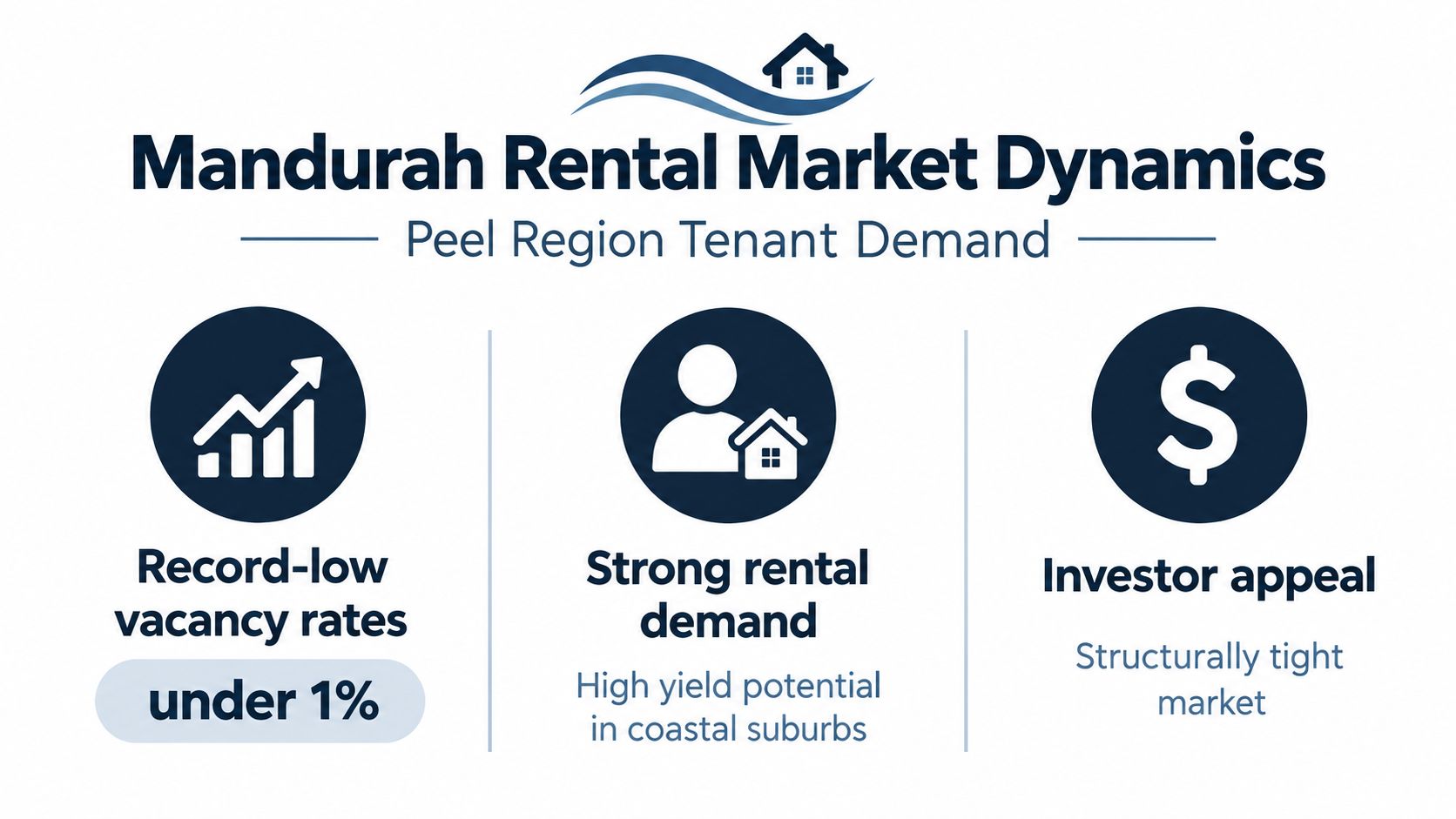
The practical effect of sub-3% vacancy is more important than the label “high demand”. A tenant who has fewer suitable homes available is more likely to act quickly when a well-presented property appears. That can reduce the time between tenancies, improve the landlord's position during renewal discussions and support more reliable net operating income.
Matching the property to the tenant
Demand isn't identical across the corridor. Lakelands and Meadow Springs can suit renters who value contemporary family housing and everyday convenience. Madora Bay and Halls Head attract tenants drawn to coastal living, while Falcon and Wannanup appeal to renters who prioritise beach access, boating, recreation and a more relaxed setting. Dudley Park offers another profile, with proximity to the estuary, town amenities and established housing stock.
Investors should therefore define the tenant before choosing the property. A low-maintenance unit may suit a professional or downsizer, while a detached home with practical outdoor space may attract families seeking a longer lease. The strongest rental result comes from matching floor plan, condition, parking, outdoor areas and location to an identifiable local tenant group.
Local leasing rule: A property doesn't benefit from Mandurah demand if it fails to meet the expectations of the tenants most likely to inspect it.
Coastal demand also creates a maintenance distinction. Salt air, outdoor areas, fencing, drainage and building finishes deserve closer attention than they might in an inland market. A property that leases quickly can still disappoint if repairs, insurance and presentation costs repeatedly interrupt the return.
Investors who don't want to manage these details alone can assess the local service model alongside the asset. Mandurah property management services can help owners consider leasing, tenant communication and ongoing property oversight as part of the acquisition decision, not as an afterthought.
Capital Growth Trends Across Key Coastal Suburbs
Mandurah's coastal corridor is not one market. Suburb-level data shows why a single city-wide median can mislead investors, with meaningful differences between houses, units, entry prices and recent growth.
The corridor at a glance
| Suburb and dwelling | Median price | Annual growth |
|---|---|---|
| Madora Bay houses | $920,000 | 21% |
| Halls Head units | $665,000 | 21% |
| Falcon houses | $790,000 | 16% |
| Dudley Park units | $590,000 | 34% |
The 2026 coastal market snapshot highlights the spread. Madora Bay houses sit at the highest price point in this comparison and have recorded strong growth. Halls Head units offer a lower coastal entry point, while Falcon houses combine a different price position with solid movement. Dudley Park units recorded the fastest growth in the snapshot.
The figures are not interchangeable. Providers use different datasets and methodologies, and suburb results can diverge sharply from the wider Mandurah median. Treat the table as a screening tool, not a valuation.
Turning suburb data into a buying strategy
Investors targeting long-term family demand should examine houses in Madora Bay, Falcon and Halls Head, then test the purchase price against achievable rent, insurance, maintenance and WA land tax exposure. Strong capital growth does not automatically produce the best net return.
Buyers seeking a lower entry point and stronger recent unit momentum can assess Dudley Park or Halls Head apartments and units. The trade-off is different resale competition, body corporate obligations and a narrower buyer pool for some buildings. Those costs can reduce the advantage suggested by headline growth.
Lakelands and Meadow Springs need their own appraisal. They should not be treated as substitutes for established coastal suburbs without checking tenant profile, competing supply, transport access and likely resale demand.
Wannanup also requires property-level scrutiny. Lifestyle appeal can support demand, but water proximity, construction quality, access and maintenance exposure can materially change ownership costs. Two properties in the same suburb may carry very different insurance, upkeep and resale characteristics.
Acquisition discipline: Use suburb growth to shortlist locations, then judge each property against rent, condition, ownership costs and future buyer appeal.
A serious appraisal should identify the likely tenant, comparable sales, achievable rent, competing listings and the asset's position within its street. Mandurah's property market reporting provides a useful market reference, but an inspection-led assessment remains necessary before making an offer.
Navigating Western Australian Tax and Holding Costs
Gross yield is only the opening calculation. A Mandurah investment needs to be assessed after interest, insurance, maintenance, management, vacancy, repairs and state taxes. The most commonly overlooked item for growing portfolios is WA land tax, because the assessment is based on aggregated taxable land value rather than just the building's purchase price.
Western Australia's general land-tax threshold is $300,000 of aggregated taxable land value. The state then applies $300 to land valued from $300,001 to $420,000, followed by 0.25% on the amount above $420,000 up to $1,000,000, with higher tiers above that. The WA land-tax assessment guidance sets out the applicable structure.
Model the holding cost before making an offer
Start with the land component, not the headline property price. Two homes with similar rents can produce different outcomes if their taxable land values, ownership structures or portfolio positions differ. A purchase in Lakelands, Madora Bay, Meadow Springs, Halls Head, Falcon, Wannanup or Dudley Park may appear manageable in isolation, yet the combined land value of several holdings can move an investor into a new annual liability.
WA's tax year runs to 30 June, and the $300,000 threshold applies to aggregated taxable land value. This state-by-state land-tax explanation reinforces why timing, ownership structure and portfolio planning deserve professional advice before contracts are signed.
Use a written acquisition model with separate lines for:
- Rental income: Use a defensible rent based on comparable local properties, not an optimistic asking figure.
- Finance costs: Test the deal against the actual loan structure and repayment obligations.
- Insurance and maintenance: Coastal exposure can make these costs more material than a standard suburb comparison suggests.
- Land tax: Check current taxable land holdings and the ownership structure that will apply.
- Tax deductions: Separate ordinary deductible costs from capital works and depreciation claims.
Tax benefits don't rescue a weak purchase
Negative gearing can improve after-tax outcomes where deductible costs exceed rental income. New buildings may attract a 2.5% depreciation allowance, subject to the relevant rules and the property's eligibility. That benefit should support a sound purchase, not justify paying too much for an asset with weak rent, poor condition or limited tenant appeal.
Stamp duty and acquisition costs also need to be included before comparing one property with another. WA investment property stamp duty guidance can help buyers identify the transaction costs that sit outside the advertised price.
The recommendation is simple. Have your accountant and finance adviser review the ownership and tax assumptions before you commit, then ask whether the property still produces a resilient result without relying on the most favourable deduction outcome.
Comparing Houses and Units for Investment Returns
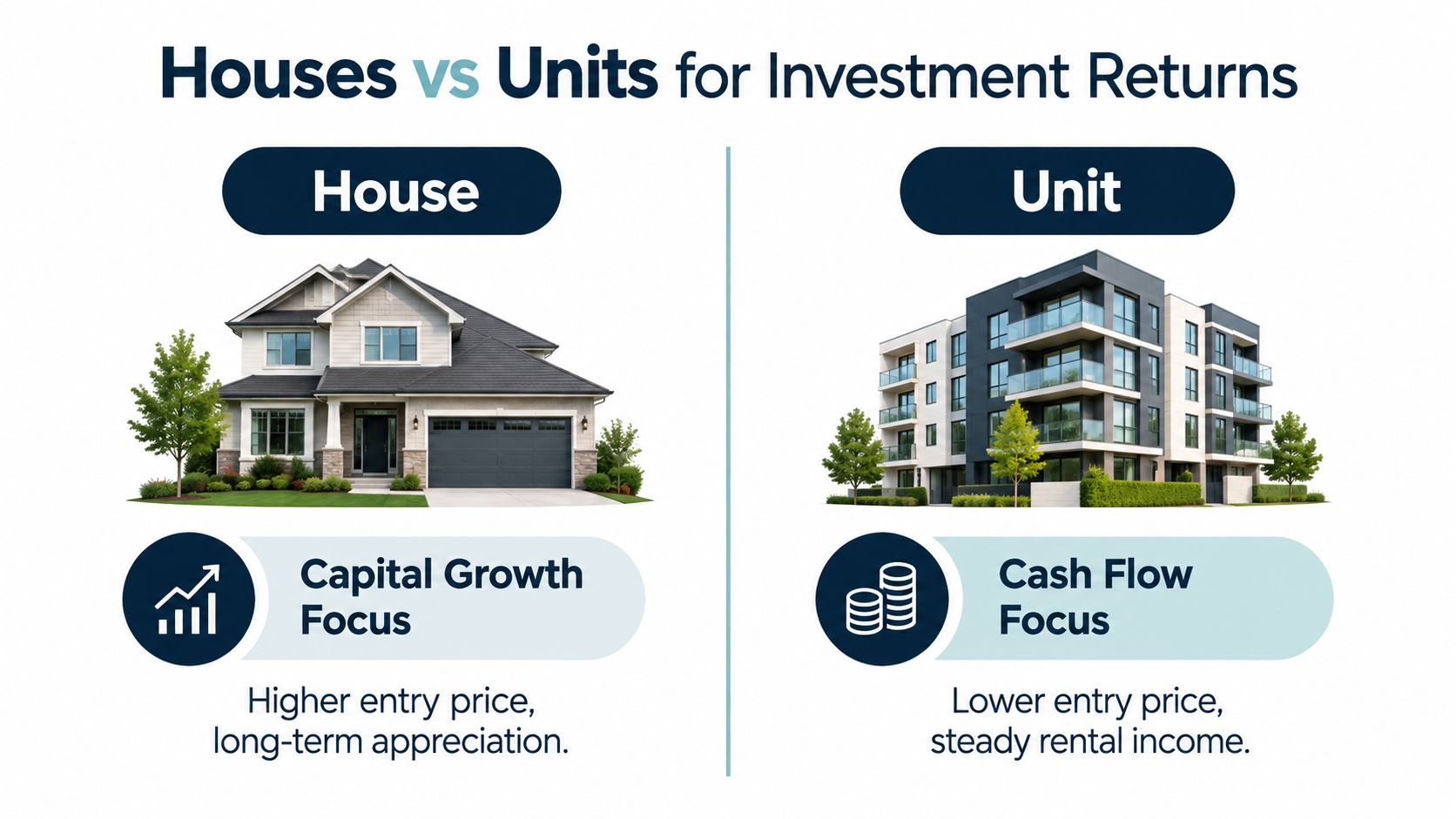
The better asset is the one that produces the stronger net return after Mandurah-specific costs. Houses offer land content, family appeal and a broad resale audience. Units can require less capital, produce efficient rent relative to price and provide exposure to a different buyer and tenant pool.
A useful comparison starts with rent, not the purchase category. A $625,000 unit returning $580 per week grosses roughly 4.8% before strata costs. A $703,000 house at $650 per week also grosses about 4.8%, before land tax, insurance and upkeep. The apparent parity ends once ownership costs are deducted. Strata levies and special works can reduce the unit result, while land tax, coastal maintenance and insurance can reduce the house result.
Choose the asset by objective
Choose a house when land, family tenants and long-term growth are the priority. Falcon, Madora Bay, Lakelands and Meadow Springs can suit this approach, provided the rent supports the larger capital commitment and the ownership costs remain controlled.
Choose a unit when a lower entry requirement, portfolio diversification or low-maintenance tenant appeal matters more. Halls Head and Dudley Park illustrate how unit ownership can provide a different growth and income profile from detached homes, particularly where location supports consistent tenant demand.
| Investor priority | Asset to investigate | Main question |
|---|---|---|
| Land and family appeal | House | Does the rent justify the higher capital tied up? |
| Lower entry cost | Unit | Are strata costs and building quality acceptable? |
| Coastal lifestyle demand | Either | Does the property meet the local tenant profile? |
| Capital growth diversification | Unit or house | Is the asset exposed to one buyer segment? |
Calculate gross yield on the same basis for both assets, then assess the result after recurring costs. This rental-yield calculation guide sets out the basic method. For a Mandurah purchase, extend it to strata, management, insurance, repairs, vacancy allowance and the applicable WA land tax position.
A unit becomes less attractive when levies are high, the complex is poorly maintained or major capital works are likely. A house loses its apparent advantage when insurance, upkeep and land tax consume the benefit of owning more land. Compare the expected net return, tenant demand and resale depth, then select the asset that fits your borrowing capacity, risk tolerance and portfolio purpose.
Evaluating Risk and Building a Resilient Portfolio
The question isn't whether the rent covers the mortgage. The question is whether the property remains investable after the full ownership cost is paid. National vacancy has remained tight at about 1.3% to 1.9% in recent 2026 reporting, while national gross yields have improved to around 3.79%, but those figures can obscure the effect of insurance, repairs and finance costs on the individual asset. The broader market analysis makes the more useful point for Mandurah buyers: headline yield isn't the same as durable net return.
Mandurah's third-party suburb data places house yields around 4.09%, unit yields around 4.31%, and vacancy around 1.38% in August 2026. The figures suggest that local demand can support leasing, but they don't remove the need to underwrite every expense.
Build the property-level stress test
A sound appraisal should separate income from costs rather than treating gross yield as profit. Start with achievable rent, then deduct recurring expenses, management, repairs, insurance, strata where relevant, land tax and finance costs. Test the result against a period of vacancy and an unexpected maintenance bill.
Coastal ownership deserves particular scrutiny. Salt exposure, weather, external finishes, fencing, drainage and outdoor areas can increase the frequency or cost of upkeep. Wannanup, Halls Head, Falcon and Madora Bay may offer strong lifestyle appeal, but a buyer should inspect construction quality and insurance conditions rather than assume the coast is a free benefit.
Underwriting test: If the deal only works before insurance, maintenance and land tax, it doesn't work.
WA's regional gross rental yield environment is supportive. Cotality reported regional WA yields around 5.4% in early 2026, with coastal and peri-urban markets such as Mandurah and Rockingham returning roughly 5% to 6%. Cotality's WA rental-market guide shows why yield can act as a cash-flow buffer, but the precise result still depends on the property and its expenses.
Diversify with purpose
A resilient portfolio doesn't just collect multiple properties in the same suburb. It balances asset types, tenant profiles and levels of maintenance exposure. An investor might compare a low-maintenance unit in Dudley Park with a family house in Lakelands or Meadow Springs, then decide whether the additional land and upkeep of the house justify the expected return.
Keep a cash buffer, avoid relying on perpetual rent increases and review insurance annually. Growth is valuable, but liquidity protects the portfolio when a property needs work or leasing conditions change.
How Beshay Realty Identifies Premium Investment Opportunities
Investment property selection in Mandurah should begin with local evidence, not a national rule of thumb. A suburb can show strong growth while an individual property remains overpriced, difficult to lease or expensive to maintain. The role of a local adviser is to filter the opportunity through comparable sales, tenant demand, property condition, likely rent and the costs that affect the owner after settlement.
Beshay Realty works across Mandurah, Lakelands, Madora Bay, Meadow Springs, Halls Head, Falcon, Wannanup and Dudley Park, with a focus on residential sales, coastal homes, lifestyle properties, investment property and appraisals. That local coverage matters because the investment decision changes between a family house near everyday amenities, a coastal dwelling exposed to more maintenance, and a unit where strata obligations shape the net result.

The local filter matters
A reliable appraisal should answer practical questions before an investor becomes emotionally attached to a property:
- What will it rent for? Compare current competing homes, presentation, floor plan and tenant profile.
- Who will lease it? Identify whether the asset suits families, professionals, downsizers or lifestyle renters.
- What will it cost to hold? Include insurance, maintenance, strata, land tax and finance assumptions.
- How will it resell? Consider the future owner-occupier audience, not only the investor market.
- What needs checking? Review building condition, approvals, inclusions, access, drainage and any strata documentation.
Accurate appraisal guidance becomes more than a price estimate. It gives the investor a reference point for negotiation and a clearer view of whether the property's rent and growth prospects justify the capital required.
The recommendation for buyers is to shortlist assets by numbers first, then inspect with a local professional who understands the difference between suburbs and dwelling types. Mandurah has enough variation that a single city-wide assumption will leave opportunities on the table and expose buyers to avoidable costs.
David Beshay Real Estate offers local sales advice, property appraisals and investment guidance across Mandurah and the surrounding coastal suburbs. If you're assessing a house or unit in Lakelands, Madora Bay, Meadow Springs, Halls Head, Falcon, Wannanup or Dudley Park, visit David Beshay Real Estate to discuss the property's rental, resale and net-return potential before you buy.


Pingback: Property Investment for Beginners: Mandurah Guide 2026 - David Beshay Real Estate - Beshay Realty