


So, what exactly is a property valuation? In simple terms, it's a professional and legally recognised assessment of what your home is worth on the open market at a specific moment in time. Think of it as an official, evidence-based conclusion rather than just an educated guess.
Understanding a Property Valuation

Imagine getting a rare painting appraised. The expert doesn't just glance at it and name a price. They conduct a thorough analysis of market data, the painting's condition, and recent sales of similar pieces. A property valuation works in much the same way, blending data-driven science with an expert's eye to determine a property’s precise market value.
This isn’t just an interesting number to know; it’s a critical figure for major financial decisions. Whether you're looking to buy, sell, refinance your mortgage, or divide assets during a settlement, this single number provides the solid, factual foundation needed for a fair and transparent transaction.
A formal valuation delivers an unbiased, legally defensible figure that banks, courts, and serious buyers rely on for accuracy. It cuts through the speculation and replaces it with a well-researched, professional opinion of value.
It's crucial to understand that a formal valuation is quite different from the market appraisal an agent provides. While both are useful, they serve very different purposes.
An appraisal gives you a fantastic idea of what your home might sell for in the current market, helping you set a realistic listing price. A formal valuation, however, is a legally binding document often required for official purposes like mortgage applications or legal settlements.
Here’s a quick breakdown of the main differences:
Valuation vs Market Appraisal Key Differences
| Aspect | Formal Property Valuation | Real Estate Market Appraisal |
|---|---|---|
| Purpose | Legally binding assessment for financial, legal, or tax purposes. | An estimate of market value to guide a selling price. |
| Conducted By | A Certified Practising Valuer (CPV) with formal qualifications. | A licensed real estate agent with local market expertise. |
| Cost | A fee is charged for the detailed report (typically $300-$600). | Usually offered as a complimentary service by agents. |
| Legal Standing | Legally recognised document used by banks, courts, and government. | An informal opinion of value, not legally binding. |
| Report Detail | Extensive, multi-page report with in-depth data and analysis. | A brief report (1-4 pages) with comparable sales and market commentary. |
Understanding this distinction helps you know exactly what you need and when. For setting a sale price, an agent's appraisal is your go-to. For anything requiring legal or financial proof, you'll need a formal valuation.
Why Valuations Matter in Australia
The sheer scale of Australia's housing market highlights just how important accurate valuations are. The total value of all residential properties skyrocketed to an unprecedented AUD 11,366.4 billion in the March quarter of 2025, with the national average home price crossing the AUD 1 million mark for the first time.
This incredible data from the Australian Bureau of Statistics shows how valuations act as a vital gauge of our collective wealth and market health, even influencing government policy and taxation.
Ultimately, a property valuation offers something invaluable: certainty. It demystifies your property's worth and empowers you with the concrete knowledge needed to make confident financial moves.
Why an Accurate Valuation Is So Important

A property valuation isn't just some abstract number; it becomes a real-world necessity during some of life's biggest moments. An accurate valuation is far more than a figure on a page—it's a critical tool that gives you clarity, security, and fairness when the stakes are high. Think of it as the bedrock for sound financial and legal decisions.
Imagine a couple excited to buy their first home. A precise valuation is what helps them secure the right home loan without a hitch, giving the bank the confidence it needs in the asset it's financing. Without one, they could face delays or even have their loan application rejected, causing a mountain of stress and potentially costing them their dream home.
On the flip side, consider a seller getting ready to list their property. A true understanding of its value is absolutely essential for setting a competitive price. If you price it too high, your home can sit on the market for months, becoming stale in the eyes of potential buyers. Price it too low, and you're simply leaving a significant amount of money on the table.
A professional valuation provides an objective, defensible figure that anchors your financial strategy. It’s the difference between guessing what your property is worth and knowing its true market value with confidence.
Navigating Major Life Events
In several key situations, a formal, accurate valuation becomes completely non-negotiable. It provides an impartial assessment that all parties can rely on, which is vital for reaching fair and equitable outcomes.
These scenarios often include:
- Securing Finance: Banks and lenders require a formal valuation to approve a mortgage or refinance an existing loan. They need to verify that the property’s value provides enough security for the loan amount.
- Property Settlements: During a divorce or the separation of co-owners, an unbiased valuation is crucial to ensure assets are divided fairly.
- Deceased Estates: When managing an estate, a valuation is needed to determine the value of property assets for probate and to make sure beneficiaries receive their rightful inheritance.
- Taxation Purposes: Calculating Capital Gains Tax (CGT) or other property-related taxes often requires a historical or current valuation to establish a cost base.
The True Cost of Inaccuracy
Getting the valuation wrong can have some pretty serious financial consequences. For instance, an overvalued property in a divorce settlement could force one person to buy out the other at an inflated price, creating long-term financial hardship. Likewise, an undervalued property in a deceased estate could mean the beneficiaries are short-changed.
It's also important to understand the difference between the figures provided by various parties. While a bank's assessment is a key part of the lending process, it's primarily designed to protect the lender's interests. Knowing the difference between bank valuations and real estate agent appraisals is essential for getting a complete picture of your property's financial position.
Ultimately, a reliable property valuation is your financial safeguard. It empowers you to negotiate effectively, plan for the future with certainty, and ensure fairness in transactions that will shape your life for years to come.
The Three Core Methods Valuers Use
So, how does a professional valuer land on that final, decisive figure? It's not guesswork or a quick glance at the market. A formal property valuation is a methodical process built on established, recognised approaches.
Valuers typically rely on three distinct methods to calculate a property's true worth. Often, one method takes the lead, while the others act as a backup to confirm the result. Getting your head around these approaches helps demystify the valuation process, turning what seems like a complex assessment into a logical conclusion.
The image below breaks down these three core pathways.
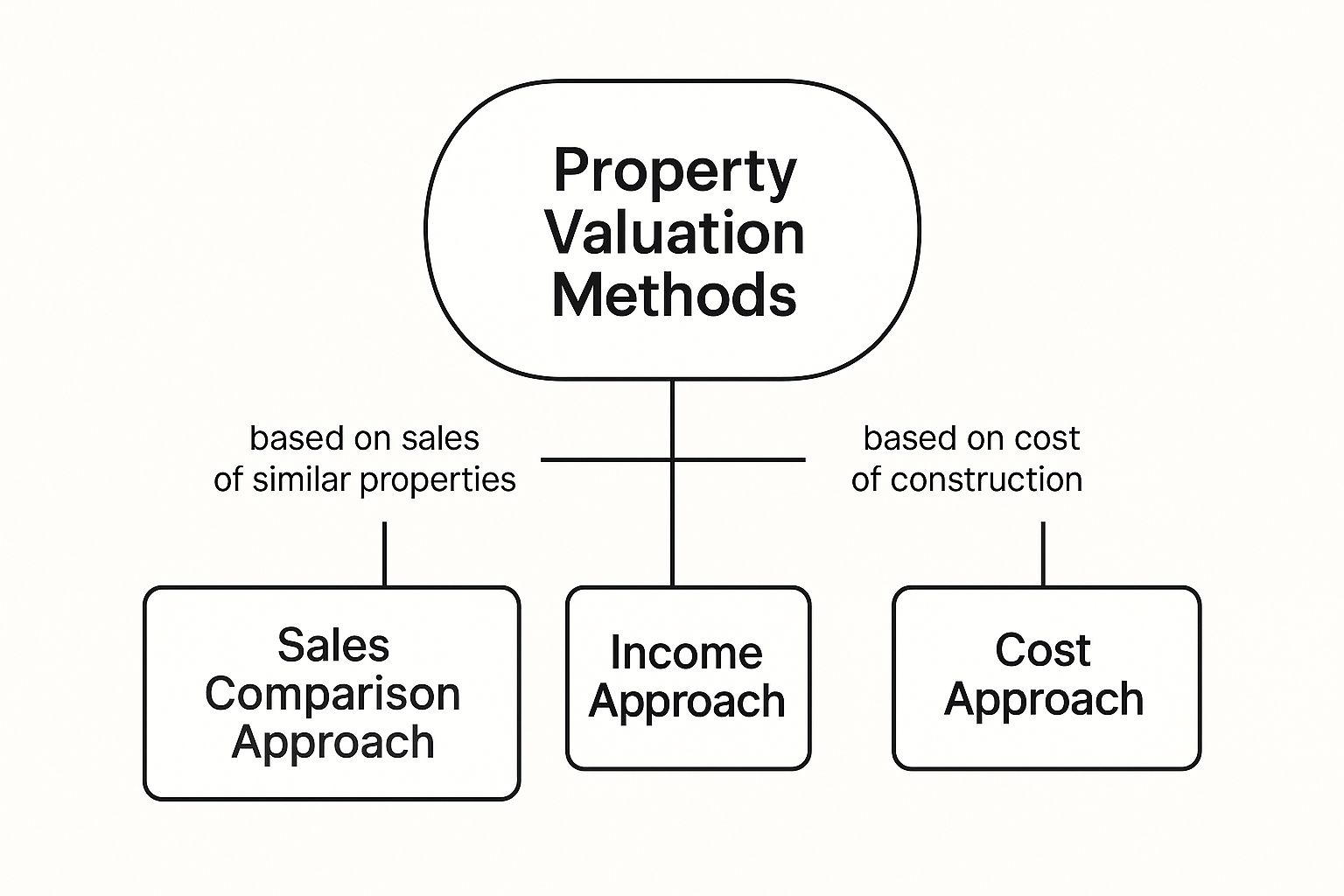
As you can see, a valuer can take one of three paths—Sales Comparison, Cost, or Income—to reach a conclusion about a property's value. Let's dig into each one.
Sales Comparison Approach
This is by far the most common and trusted method for residential homes. Think of it like checking the recent sale prices of nearly identical houses on your street, but with a much finer-toothed comb. A valuer will analyse recent, comparable sales (known as “comps”) in the immediate area to set a baseline.
They're looking for properties that are as similar as possible in:
- Location and neighbourhood
- Size, age, and condition
- Number of bedrooms and bathrooms
- Land size and extra features (like a pool or a new kitchen)
From there, the valuer makes adjustments. If a comp sold for a great price but had a brand-new kitchen and yours is original, they'll adjust its sale price downward to create a true apples-to-apples comparison. This method is powerful because it reflects what real buyers are actually willing to pay in the current market.
While it sounds a bit like what a real estate agent does for an appraisal, a valuer's analysis is far more rigorous and formal. If you're curious about the agent's take, you can learn more about what is a property appraisal and how it helps guide sellers.
Cost Approach
The Cost Approach tackles value from a completely different angle. It asks a simple question: what would it cost to build this exact home again from scratch, using today's material and labour prices? That total figure, minus any depreciation for age or wear and tear, is then added to the land's value.
This method is less about what someone would buy it for and more about what it would cost to replace it. It’s particularly useful for unique or special-purpose properties where there are no comparable sales available.
Think of one-off custom-built homes, a local church, or a public school. Since you can't just find a bunch of similar properties that have recently sold nearby, the Cost Approach provides the most logical way to pin down a value.
Income Approach
Finally, we have the Income Approach, which is all about the numbers. This method is reserved for investment properties and determines a property's value based purely on the income it can generate.
Valuers look at key figures like rental income, operating expenses (rates, insurance, maintenance), and vacancy rates to calculate the property’s net operating income. This final number is then used to determine a value, reflecting what an investor would logically pay to receive that ongoing income stream. It’s the go-to method for commercial properties like office buildings, retail shops, and apartment blocks.
Key Factors That Influence Your Property's Value

A property's final value is a complex puzzle, pieced together from dozens of individual factors. A professional valuer doesn’t just look at the house; they’re analysing a whole range of elements, some you can control and others you simply can’t. Getting your head around these key drivers gives you a much clearer picture of what a valuation truly involves.
These factors generally fall into two main camps. First, you have the property-specific elements—all the unique characteristics of your home and land. Then there are the broader market forces that shape what buyers are willing to pay across an entire region.
Property Specific Factors
These are the tangible, physical attributes of your property. While some things are set in stone, like the size of your block, others, like the condition of your home, give you a real chance to directly influence its value. A valuer will meticulously go through every detail.
Here’s what they’re looking at:
- Location: This is the golden rule of real estate, and for good reason. Being close to amenities like schools, shops, parks, and public transport is absolutely paramount. Here in Mandurah, for instance, a home within walking distance of the estuary or a popular beach will always command a premium.
- Land Size and Usability: It’s not just about the total square metres of your block. The shape, slope, and potential for future development (like adding a granny flat) all play a big part.
- Building Size and Layout: This covers the total floor area, the number of bedrooms and bathrooms, and the overall flow of the home. A practical, modern floor plan is always going to be more desirable than a dated, awkward one.
- Age and Condition: A well-maintained older home can easily hold its own against a newer build. The valuer is assessing the structural integrity, the state of the roof, and any signs of wear and tear.
- Unique Features and Upgrades: That sparkling new kitchen, renovated bathroom, or inviting outdoor entertaining area can add serious value. Special features like a swimming pool, a large workshop, or side access for a boat or caravan are major drawcards in lifestyle areas like Mandurah.
A property valuation is not a simple checklist. It’s an expert assessment of how all these individual features combine to create a single, cohesive asset that buyers will desire in the current market.
Market Factors and Economic Conditions
Your property doesn't exist in a vacuum. Its value is heavily influenced by the wider economic environment and the state of the local property market. These are the forces largely outside of your control, but they have a massive impact on the final figure.
This includes the simple economics of supply and demand—how many properties are for sale versus how many buyers are actively looking. It also includes interest rates, which directly affect how much people can borrow and how confident they feel. The health of the local economy, job growth, and major infrastructure projects also play a huge role in shaping what a property valuation looks like.
Recent data shows just how much these regional differences matter. By early 2025, Australia's national median dwelling price hit AUD 815,912, but the performance varied dramatically between cities. Perth saw a massive 17.6% annual increase, while Melbourne actually experienced a slight decline. This just goes to show how local economic health and housing supply create unique market dynamics that are critical for an accurate valuation. You can explore more about these property price trends across Australia.
Ultimately, a valuer's job is to weigh the specific attributes of your home against the backdrop of these powerful market forces to arrive at a precise, evidence-based conclusion of its worth.
The Importance of Local Expertise in Mandurah
While online calculators can give you an instant estimate, they’re missing the one ingredient that truly defines a property's worth: local, on-the-ground insight. A generic algorithm just can't grasp the subtle details that make the Mandurah and Peel region property market so unique.
This is where the real value in answering "what is property valuation" lies—not in data alone, but in expert interpretation. An automated tool sees postcodes; a local expert sees distinct micro-markets. They know the premium buyers will pay for canal-front homes in Halls Head versus the family-friendly appeal of properties near top school zones in Meadow Springs. This is deep-seated knowledge, built from years of experience, not just code.
The Algorithm Blind Spot
An online valuation tool won’t tell you about the whisper-quiet sale that just happened down the street, setting a new price benchmark for the area before it ever hits public records. It has no idea about the new infrastructure project about to make a neighbourhood more connected, or the subtle shifts in buyer demand from one pocket of Mandurah to another.
Local expertise transforms a property valuation from a simple calculation into a strategic analysis. It’s the critical difference between a generic estimate and a true market appraisal that reflects real-world conditions.
An experienced agent like David Beshay brings insights that algorithms completely miss. They understand the local culture and what buyers in this specific region truly want—whether that’s side access for a boat or a home with a sought-after north-facing outdoor area. This granular knowledge is essential for an accurate appraisal and is a core part of the growth of the Mandurah real estate market.
Looking Beyond Today's Market
A truly comprehensive property valuation also looks ahead to future trends. Economic forecasts and interest rate outlooks play a huge role in shaping value. For example, recent national projections showed that while house prices were forecast to rise moderately by 3.3% in 2025, unit prices were expected to climb by 4.6% due to affordability pressures. Perth was tipped to lead house price growth at 4%, proving just how crucial regional context is.
These predictions, influenced by expected policy changes like interest rate cuts, have a direct impact on buyer behaviour and market prices. This forward-looking perspective, combined with an intimate understanding of Mandurah's specific market dynamics, is something only a dedicated local professional can offer. It ensures your valuation isn’t just accurate for today, but is also intelligently positioned for tomorrow.
Of course. Here is the rewritten section, crafted to sound like it was written by an experienced human expert, following the specific style and tone from the provided examples.
Your Top Property Valuation Questions Answered
Even after getting your head around the basics of property valuations, it's completely normal to have a few more practical questions pop up. When it's your own home and financial future on the line, you want to be sure about every detail. Let’s walk through some of the most common queries to clear things up and give you the confidence you need.
Think of this as the final piece of the puzzle, answering those lingering "what if" and "how does" questions about the valuation process.
Can I Do Anything to Increase My Property's Value Before a Valuation?
Yes, you absolutely can, but the trick is to be smart about it. You want to focus on improvements that give you the best bang for your buck without overcapitalising—that’s the industry term for spending more on a renovation than it actually adds to your home's value.
It's often the simple, cost-effective updates that make the biggest difference. Here are a few high-impact ideas:
- A Fresh Coat of Paint: You’d be amazed what a difference this makes. Sticking to neutral colours both inside and out gives a home an instant lift, making it feel newer, brighter, and well-cared-for.
- Tidy Landscaping: First impressions count, and that starts at the kerb. A freshly mowed lawn, weed-free garden beds, and a few simple, healthy plants can create a much more welcoming feel.
- Minor Kitchen and Bathroom Fixes: You don't need to rip everything out. Sometimes, just replacing dated tapware, swapping out old cabinet handles, or putting in a modern vanity is enough to transform a space.
While major renovations like adding an entire room can be tempting, they're also risky. It's usually better to stick with cosmetic touch-ups that have broad appeal.
Online Estimate vs Professional Valuation: What’s the Real Difference?
This is a really important one to understand. Online estimate tools are handy for a quick, ballpark figure, but they are no substitute for the accuracy and authority of a professional valuation.
An online tool is just an algorithm. It crunches public data, like recent sale prices in your postcode, but it has huge blind spots. It has never stepped foot inside your home. It has no idea about that beautiful kitchen you just renovated, the condition of the roof, or the incredible view from your back deck.
A professional valuer brings something irreplaceable to the table: an expert eye and a physical inspection. They blend the hard data with their real-world observations of your property’s unique features, its overall condition, and its specific position on the street. The result is a credible figure that banks, courts, and other official bodies will actually accept.
How Long Does a Valuation Take and What Does It Cost?
The good news is that the process is generally quite quick and efficient. The physical inspection of a standard house usually only takes about 30 to 60 minutes.
Once the valuer has seen the property, they'll head back to the office to do their research and compile a detailed report. You can typically expect to receive this within two to five business days. For a standard residential property valuation here in Australia, the cost generally falls between $300 and $600, though this can vary depending on your property's size and complexity.
Ready to discover the true value of your Mandurah property? With in-depth local knowledge and a commitment to achieving outstanding results, David Beshay Real Estate provides accurate, obligation-free property appraisals to empower your next move. Get your free property appraisal today and make your next move with confidence.


Pingback: Property Valuation Guidelines in Mandurah: A 2026 Guide - David Beshay Real Estate - Beshay Realty
Pingback: Property Value Growth Calculator Guide for Mandurah - David Beshay Real Estate - Beshay Realty