


Embarking on a property investment journey in Australia presents a landscape of immense opportunity, but one that demands a well-considered approach. The right strategy can be the difference between building substantial long-term wealth and facing unforeseen financial hurdles. With fluctuating market dynamics, evolving tax laws, and diverse regional trends, understanding the various property investment strategies Australia has to offer is more critical than ever. This guide moves beyond generic advice to provide a comprehensive roundup of nine distinct, proven strategies tailored for the Australian market.
We will delve into the mechanics of each approach, from the classic 'Buy and Hold' to the more sophisticated 'Subdivision and Development.' For each strategy, we'll break down the pros, cons, risk levels, and provide real-world examples to help you identify the path that best aligns with your financial goals, risk tolerance, and time commitment. Whether you're a first-time investor in Mandurah or a seasoned portfolio holder looking to diversify, this blueprint will equip you with the knowledge to make informed, strategic decisions. Let's explore how you can turn property into a powerful vehicle for your financial future.
1. Strategy 1: The Classic Buy and Hold Approach
The buy and hold approach is the cornerstone of many successful Australian property portfolios. This traditional strategy involves purchasing a property and holding it for an extended period, typically 10 years or more, to capitalise on long-term capital growth and consistent rental income. It's a proven method for wealth creation, leveraging the power of compound growth over decades.
This strategy is one of the most popular property investment strategies in Australia because it allows market cycles to smooth out, reducing the impact of short-term volatility. Investors who bought in areas like Sydney's lower north shore in the 1990s have seen values soar from around $300,000 to over $2 million, demonstrating the immense potential of patient, long-term investing.
Key Implementation Steps
To execute this strategy effectively, focus on high-growth locations.
- Research Growth Drivers: Target areas with strong, sustained population growth and significant government or private investment in infrastructure like transport, hospitals, and schools.
- Analyse Rental Demand: Before purchasing, thoroughly investigate local rental demand and vacancy rates. A low vacancy rate (under 3%) indicates a healthy rental market.
- Secure Cash Buffers: Maintain adequate cash reserves to cover unexpected maintenance costs, potential vacancies, and other holding expenses without financial stress.
- Conduct Regular Reviews: Annually review your property’s performance against the market to ensure it's meeting your financial goals and decide if any strategic adjustments are needed.
The following quick-reference summary box highlights the key metrics associated with the classic buy and hold strategy.
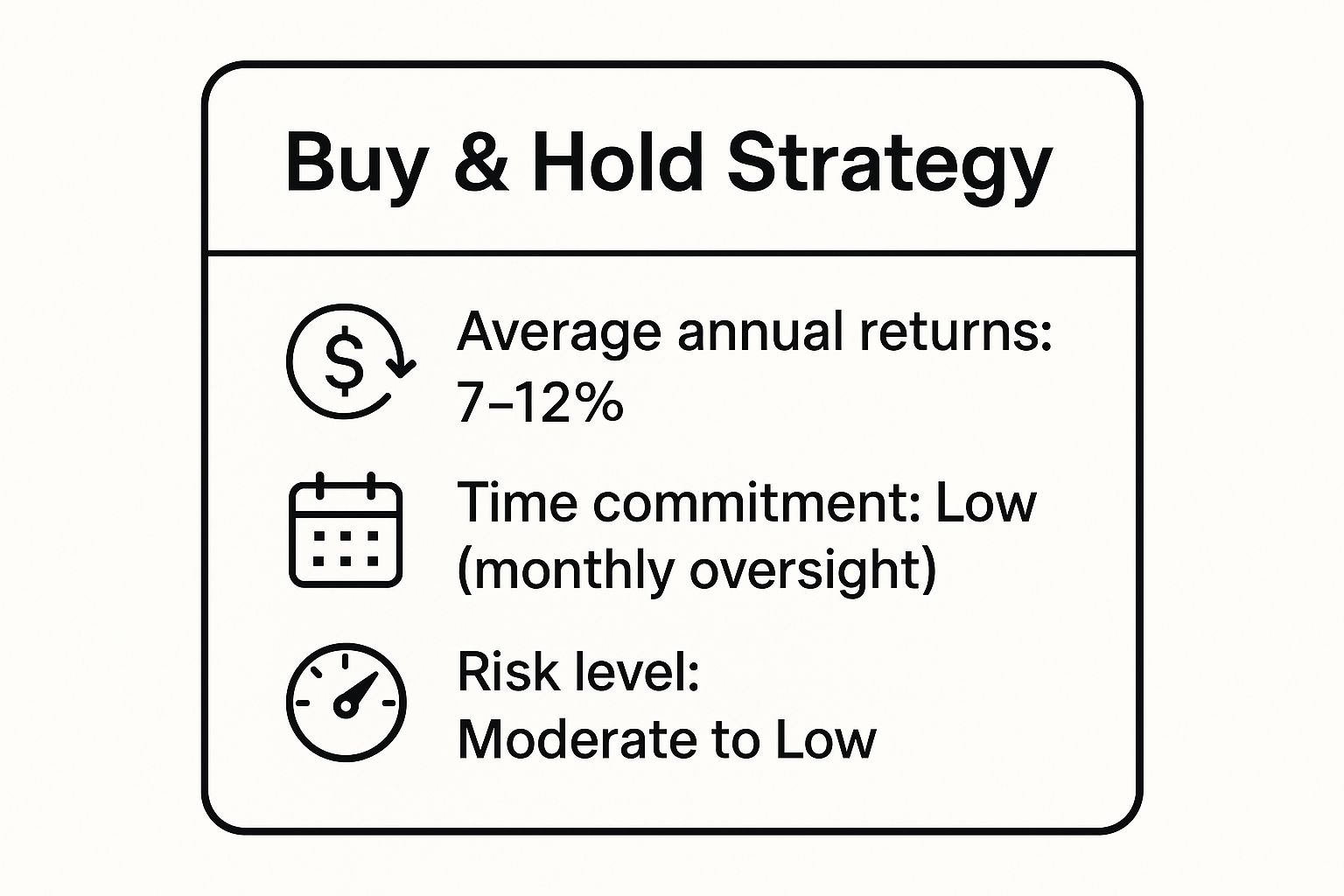
As the data shows, this approach offers a balanced risk-to-reward profile with a relatively low hands-on time commitment once the property is tenanted.
2. Renovation and Value-Add Strategy
The renovation and value-add strategy involves purchasing properties below market value that require cosmetic or structural improvements. By renovating, you can significantly increase the property's value and rental appeal, creating instant equity. It's a hands-on approach popularised by experts like Cherie Barber and TV shows like 'The Block', where investors manufacture capital growth rather than waiting for the market to deliver it. This is one of the most proactive property investment strategies in Australia for building a portfolio quickly.

This method thrives in Australia's established suburbs, where older housing stock offers immense potential. For example, renovating an inner-city terrace in Sydney can add hundreds of thousands to its value, while classic Queenslander homes in Brisbane often see value increases of 30% or more post-renovation. The key is to identify tired properties in great locations and transform them for a significant profit or enhanced rental yield. For a deeper look at specific improvements, you can learn more about how to increase your home's value.
Key Implementation Steps
To successfully execute a renovation strategy, careful planning and budgeting are critical.
- Budget for Contingencies: Always factor in a contingency fund of at least 15-20% of your total renovation budget to cover unexpected costs that inevitably arise.
- Focus on High-Impact Renovations: Prioritise renovations that offer the best return on investment. Kitchens, bathrooms, and creating functional outdoor living spaces consistently add the most value.
- Understand Council Regulations: Before committing, investigate local council requirements, building codes, and potential heritage overlays that could impact your renovation plans and timeline.
- Don't Overcapitalise: Research the ceiling price for renovated properties in the neighbourhood. Ensure your total spending (purchase price plus renovation costs) remains below this figure to guarantee a profit margin.
The following video provides further insights into identifying value-add opportunities.
Executing this strategy effectively requires a good eye for a property's potential and diligent project management skills.
3. Negative Gearing Strategy
Negative gearing is a uniquely popular Australian tax-minimisation strategy where an investor purchases a property that costs more to maintain than it generates in rental income. This deliberate shortfall creates a net loss, which can then be offset against the investor's other taxable income, reducing their overall tax liability while they wait for long-term capital growth.
This strategy is one of the most debated yet widely used property investment strategies in Australia, largely due to its favourable treatment under the nation’s tax laws. For example, a high-income earner like a medical professional might purchase a new apartment in Melbourne. Even with a weekly cash flow shortfall of $150-$300, the tax benefits combined with eventual capital appreciation can make it a highly profitable long-term venture.
Key Implementation Steps
Success with negative gearing hinges on strong capital growth and careful financial management.
- Confirm Income Stability: You must have a stable, high disposable income to comfortably cover the ongoing out-of-pocket expenses and property shortfalls without financial distress.
- Target High-Growth Assets: Prioritise properties in areas with proven or projected strong capital growth potential. The ultimate goal is for capital gains to significantly outweigh the accumulated holding costs.
- Maintain Meticulous Records: Keep detailed records of every single property-related expense, from interest payments and council rates to minor repairs. This is crucial for accurately calculating your tax deductions.
- Assess After-Tax Viability: Don't just look at the pre-tax loss. Analyse the investment based on its after-tax cost to understand the true financial impact and ensure the numbers work for your situation. You can learn more about what negative gearing is to better understand these calculations.
4. Strategy 4: The Positive Gearing Strategy
The positive gearing strategy focuses on purchasing investment properties that generate more rental income than they cost to maintain, creating positive cash flow from day one. This approach prioritises immediate income generation over long-term capital growth or tax benefits, making it an attractive option among property investment strategies in Australia for investors seeking to supplement their lifestyle or build a portfolio that pays for itself.
This strategy is particularly popularised by cash-flow-focused educators like Steve McKnight. It gains traction in markets where rental yields are exceptionally high, often found in regional centres or resource-dependent towns. For example, some residential properties in areas like Mount Isa or Broken Hill have historically offered rental yields well above 8%, providing instant positive returns for savvy investors who understand the local economic drivers.
Key Implementation Steps
To succeed with positive gearing, diligent research into niche markets is essential.
- Target High-Yield Locations: Focus on areas with strong rental demand relative to property prices. This often includes regional centres like Ballarat or Toowoomba, or towns with significant local industries.
- Analyse Economic Stability: Before investing, thoroughly investigate the local economy's stability and employment drivers. Avoid over-reliance on a single industry and look for signs of economic diversification.
- Factor in Higher Costs: Regional properties can have higher vacancy rates and property management costs. Ensure you factor these potential expenses into your cash flow calculations to maintain profitability.
- Plan for Volatility: Resource-dependent towns can experience boom-and-bust cycles. A solid cash buffer is crucial to navigate potential downturns and extended vacancy periods without financial distress.
5. Strategy 5: The Property Flipping Strategy
The property flipping strategy involves purchasing a property, adding value through renovation or cosmetic upgrades, and selling it relatively quickly for a profit. Popularised by television shows, this high-stakes approach focuses on generating rapid, lump-sum returns rather than long-term rental income and is a distinct method among property investment strategies in Australia. It requires a keen eye for undervalued assets and a precise understanding of market dynamics.
This strategy thrives in specific market conditions, such as periods of rapid price appreciation. For instance, during the Sydney property boom from 2013 to 2017, savvy investors were able to generate profits of $100,000 to $300,000 on flips. However, it carries significant risks, primarily due to high transaction costs like stamp duty, agent fees, and Capital Gains Tax (CGT), which can quickly erode profits.

Key Implementation Steps
To succeed with property flipping, meticulous planning and execution are non-negotiable.
- Master Your Numbers: Before making an offer, calculate all potential costs including stamp duty, legal fees, renovation expenses, holding costs (interest, rates), and selling fees. This ensures your target sale price is realistic.
- Focus on Cosmetic Upgrades: Concentrate on improvements with the highest return on investment, such as modernising kitchens and bathrooms, painting, and improving street appeal. Avoid major structural changes that are costly and time-consuming.
- Build a Strong Team: Develop relationships with reliable real estate agents to source off-market deals and skilled, affordable tradespeople to complete renovations on time and within budget.
- Plan Your Exit: Have multiple exit strategies. If the market turns, could you hold the property and rent it out? Consider holding for over 12 months to potentially access the 50% CGT discount if profit margins are tight.
6. Subdivision and Development Strategy
The subdivision and development strategy involves acquiring larger blocks of land or properties with the intent of creating additional value through division or construction. This high-stakes, high-reward approach can unlock significant equity by transforming a single title into multiple saleable lots or constructing multiple dwellings, such as townhouses or units, on one site. It is a powerful method for manufacturing growth rather than waiting for market forces to deliver it.
This is one of the more advanced property investment strategies in Australia, gaining traction in areas undergoing urban densification. For instance, developers in Brisbane's growth corridors have successfully turned single-house lots into profitable dual-occupancy projects. Similarly, subdividing rear lots in established Perth suburbs has demonstrated the potential for impressive returns, often exceeding 40% by creating a new, marketable asset from underutilised land.
Key Implementation Steps
Success in development hinges on meticulous planning and professional execution.
- Research Council Guidelines: Begin by exhaustively investigating the local council’s development control plans (DCPs) and local environmental plans (LEPs) to understand zoning, minimum lot sizes, and permissible development types.
- Engage a Professional Team: Assemble a team of qualified experts, including a town planner, architect, surveyor, and reliable builder. Their expertise is crucial for navigating regulations and ensuring project viability.
- Create a Detailed Feasibility Study: Factor in all potential costs, including purchase price, stamp duty, council contributions, professional fees, construction, and holding costs, to accurately project your profit margin.
- Secure Contingency Funds: Development projects are notorious for unexpected delays and cost overruns. Allocate a contingency fund of at least 10-15% of the total project cost to mitigate financial risk.
7. REIT and Property Trust Investment
REIT and property trust investment offers a way to tap into Australia's property market without the significant capital outlay and management responsibilities of direct ownership. These vehicles pool funds from numerous investors to acquire and manage a portfolio of properties, offering units or shares that trade on an exchange like the ASX or through managed funds. This provides instant diversification across various assets, from large shopping centres to industrial warehouses.
This strategy is one of the most accessible property investment strategies in Australia, allowing investors to buy into high-value commercial, retail, or industrial assets with a relatively small investment. For instance, instead of needing millions to buy a shopping centre, you can buy shares in a REIT like Scentre Group (ASX:SCG), which owns and operates Westfield centres across Australia and New Zealand, or Goodman Group (ASX:GMG), a global leader in industrial property.
Key Implementation Steps
To effectively invest in REITs, a thorough due diligence process is crucial.
- Analyse the Portfolio: Investigate the quality and location of the properties held by the trust. Look for a strong tenant mix, long lease terms (known as WALE – Weighted Average Lease Expiry), and high occupancy rates.
- Evaluate the Management Team: The performance of a REIT is heavily dependent on its management. Research the track record and experience of the team responsible for asset acquisition, development, and management.
- Assess Sector Exposure: Consider diversifying across different property sectors. A REIT focused on logistics and industrial properties will perform differently from one concentrated on retail or office spaces, especially in changing economic climates.
- Compare Fees and Yields: Examine the management expense ratio (MER) and compare the distribution yield against other similar REITs and investment options. A lower MER means more of the returns stay in your pocket.
8. Strategy 8: Regional Growth Area Investment
Investing in regional growth areas involves targeting towns and cities outside major metropolitan centres that are primed for economic expansion and population growth. This strategy capitalises on affordability and higher rental yields, while still offering significant potential for capital growth as regional development accelerates. It is one of the more forward-thinking property investment strategies in Australia for those looking to diversify away from capital city markets.
The success of this approach hinges on identifying regions on the cusp of transformation. For instance, areas like Geelong in Victoria have boomed due to major infrastructure projects and their proximity to Melbourne. Similarly, lifestyle hubs like Orange in NSW have seen property demand surge, driven by population growth and a shift towards regional living, proving that smart regional plays can yield metropolitan-level returns.
Key Implementation Steps
To successfully invest in regional growth areas, a data-driven approach is essential.
- Analyse Growth Indicators: Research government and private sector data on population trends, employment growth, and economic diversity. Look for areas with a multifaceted economy, not just reliance on a single industry like mining.
- Investigate Infrastructure Pipelines: Identify regions with confirmed, funded infrastructure projects such as new hospitals, university expansions, or major transport links. The Bendigo Hospital redevelopment is a prime example of a project that bolstered local property values.
- Assess Proximity and Connectivity: Consider a region's transport links to the nearest capital city. Strong road and rail connections can make a regional centre more attractive for commuters and businesses, fuelling sustained demand.
- Understand Local Market Dynamics: Dive deep into the local rental market. Check vacancy rates, average rental yields, and the types of properties in demand to ensure your investment aligns with local needs.
9. Off-the-Plan Investment Strategy
The off-the-plan investment strategy involves purchasing a property before its construction is complete, often securing it with just a deposit. Investors sign a contract based on architectural plans and specifications, with the full settlement occurring once the building is finished. This approach allows investors to potentially buy at today's price and benefit from any capital growth that occurs during the construction period, which can last several years.
This method is one of the more speculative property investment strategies in Australia, offering high rewards but also carrying significant risks. For instance, some investors who bought off-the-plan apartments in Melbourne during the 2014-2017 boom saw values increase significantly by the time of settlement. Conversely, those who purchased in Brisbane around 2018 faced challenges when the market softened, with valuations at settlement coming in lower than the contract price.
Key Implementation Steps
Success with this strategy hinges on meticulous research and risk management.
- Scrutinise the Developer: Thoroughly investigate the developer's track record, past projects, and financial stability. A reputable developer like Mirvac or Lendlease is more likely to deliver a quality product on time.
- Understand the Contract: Pay close attention to the sunset clause, which allows either party to rescind the contract if the project isn't completed by a certain date. Get independent legal advice on all contract terms. If you want to dive deeper, you can learn more about what is off-the-plan.
- Analyse Future Supply: Research the local area for other planned developments. An oversupply of similar properties at completion can suppress both rental returns and capital growth.
- Secure Finance Early: Obtain finance pre-approval before signing, but ensure you have a plan to secure formal approval closer to settlement, as market conditions and your own financial situation may change.
9 Australian Property Investment Strategies Compared
| Strategy | Implementation Complexity 🔄 | Resource Requirements ⚡ | Expected Outcomes 📊 | Ideal Use Cases 💡 | Key Advantages ⭐ |
|---|---|---|---|---|---|
| Buy and Hold Strategy | Low | Moderate (capital, management) | Moderate returns (7-12% p.a.) | Long-term wealth building, stable rental income | Lower transaction costs, tax benefits, compound growth |
| Renovation and Value-Add | High | High (time, skills, capital) | High returns per project (15-30%) | Properties below market value with renovation potential | Instant equity creation, higher rental yields, creative control |
| Negative Gearing Strategy | Moderate | Moderate (capital, ongoing funds) | Variable (dependent on growth) | High-income earners seeking tax minimization | Immediate tax benefits, enables investment in high-growth areas |
| Positive Gearing Strategy | Moderate | Moderate | Moderate returns with high rental yield (8-15%) | Investors needing positive cash flow, regional markets | Immediate income, reduced financial stress, reinvestment potential |
| Property Flipping Strategy | Very High | Very High (capital, time) | Variable, potentially very high (up to 50%+) | Short-term profit seekers in appreciating markets | Quick profits, rapid capital accumulation, market knowledge |
| Subdivision and Development | Very High | Very High (capital, expertise) | Very high returns per project (20-50%) | Large sites, growing suburbs with development potential | Multiple income streams, significantly increased property value |
| REIT and Property Trust | Low | Low (small capital needed) | Stable returns (6-10% p.a.) | Investors seeking indirect, diversified property exposure | Professional management, high liquidity, low time commitment |
| Regional Growth Area Investment | Moderate | Moderate | Moderate returns (8-15% in growth phases) | Regional centres with growth drivers | Lower entry costs, higher rental yields, less competition |
| Off-the-Plan Investment | Low to Moderate | Moderate (deposit and financing) | Variable returns, risk of loss or 20%+ gains | Investors seeking new builds with tax benefits | Potential discounted purchase, new properties, depreciation benefits |
Choosing Your Path and Taking Action
You've now explored a comprehensive suite of property investment strategies Australia's dynamic market offers, each presenting a unique pathway to building wealth. From the long-term, patient approach of a Buy and Hold strategy to the fast-paced, high-reward world of Property Flipping, the right choice is never one-size-fits-all. The path you select will be deeply personal, shaped by your individual financial capacity, risk tolerance, and ultimate life goals.
The most critical takeaway is this: there is no single "best" strategy, only the one that is best for you. Your task is to transition from accumulating knowledge to taking decisive, informed action. This begins with a candid assessment of your personal circumstances.
Charting Your Course: Next Steps for Aspiring Investors
To move forward with confidence, a structured approach is essential. Break down the process into manageable steps to bridge the gap between theory and execution.
- Define Your Financial Reality: Start with a forensic analysis of your finances. Calculate your borrowing power with a mortgage broker, tally your available cash reserves for a deposit and associated costs, and understand your ongoing serviceability. This foundation determines which strategies are realistically within your reach.
- Articulate Your "Why": What is the primary driver for your investment? Are you chasing long-term capital growth to fund retirement, as favoured by the Buy and Hold or Negative Gearing strategies? Or do you need supplementary income now, making Positive Gearing or a REIT a more suitable option? Clearly defining your objective will immediately narrow down your choices.
- Align Strategy with Goals: Match your financial capacity and investment goals to the strategies detailed in this article. For instance, a hands-on investor with trade skills might thrive with a Renovation and Value-Add project, while a time-poor professional may prefer the passive nature of a property trust. Someone with a high-risk appetite and development expertise might explore Subdivision, a path others would wisely avoid.
Key Insight: The true power of any investment strategy lies not in its standalone brilliance, but in its perfect alignment with the investor's unique profile. A mismatched strategy is often a recipe for financial stress and subpar returns.
Ultimately, mastering these concepts is about more than just financial gain; it's about taking control of your financial future. The Australian property market, with all its complexities and opportunities, has consistently proven to be a powerful vehicle for wealth creation for those who approach it with diligence, research, and a clear plan. Your journey from reader to successful investor starts with the first step you take today.
Ready to put these strategies into action in one of Western Australia's most promising growth corridors? The team at David Beshay Real Estate offers unparalleled local expertise in the Mandurah region, helping investors identify and secure properties that align perfectly with their financial goals. Connect with us to get a professional appraisal and discover investment opportunities tailored to you.


Pingback: Using a Property Investment Calculator Australia - David Beshay Real Estate - The Agency
Pingback: What Is Property Investment in Mandurah: A Local Guide - David Beshay Real Estate - Beshay Realty