


When you think "property manager," you probably think of someone who just collects the rent. But that's only a tiny piece of the puzzle. A truly great property manager acts as the CEO of your investment property. They are the critical link between your financial goals and the day-to-day reality of owning a rental, making sure your asset is not just protected, but profitable.
What a Property Manager Really Does
Many first-time investors see property management as just another expense eating into their profits. The reality is, a skilled manager is an asset—someone who actively drives value through their expertise in three core areas: looking after the money, managing the people, and staying on the right side of the law. Their job is a constant mix of high-level strategy and practical, hands-on problem-solving, all designed to boost your returns while taking the stress off your plate.
Think about it this way: your rental property is a business. You wouldn't try to run a cafe or a shop without a manager handling the daily operations, would you? A property manager does just that for your investment, freeing you up to focus on the bigger picture of your portfolio.
The CEO of Your Investment
A proactive manager doesn't just sit back and wait for things to go wrong; they get ahead of problems before they even start. Their role is all about protecting and growing your investment through a few key functions:
- Financial Guardianship: This is more than just rent collection. They're on top of chasing arrears, paying the bills like council rates, and giving you clean, easy-to-understand financial statements every month.
- Tenant Curation: They are experts at marketing your property to attract the best applicants, rigorously screening them to find quality tenants, and managing all communication to build positive, long-term relationships.
- Asset Protection: From coordinating routine maintenance and urgent repairs to conducting regular inspections, they keep your property in top shape. Critically, they also ensure it complies with every single WA regulation, from smoke alarms to RCDs.
The real value of a professional property manager isn't just in the tasks they tick off a list, but in the costly problems they prevent. Their deep knowledge of local tenancy laws is your first line of defence against nightmare vacancies and legal dramas.
This hands-on oversight is absolutely vital in a market like Mandurah, where local knowledge can be the difference between a thriving investment and a financial headache. Across Australia, the real estate sector leans on about 39,200 property managers. Here in Western Australia, we account for 10.0% of those professionals, a number that reflects the huge demand in hotspots like Mandurah during Perth's property boom. You can dive deeper into these figures with property management employment trends from Jobs and Skills Australia.
Breaking Down Core Property Management Responsibilities
The day-to-day life of a property manager is a constant balancing act. They're juggling a handful of critical tasks that all work together to protect and grow your investment. It’s a common misconception that their job is just about collecting rent; in reality, a professional’s duties are built on three core pillars that keep your property running smoothly, profitably, and legally.
Think of a good property manager as the CEO of your investment. They're in charge of balancing the high-level financial goals with the hands-on, daily reality of owning a rental property.
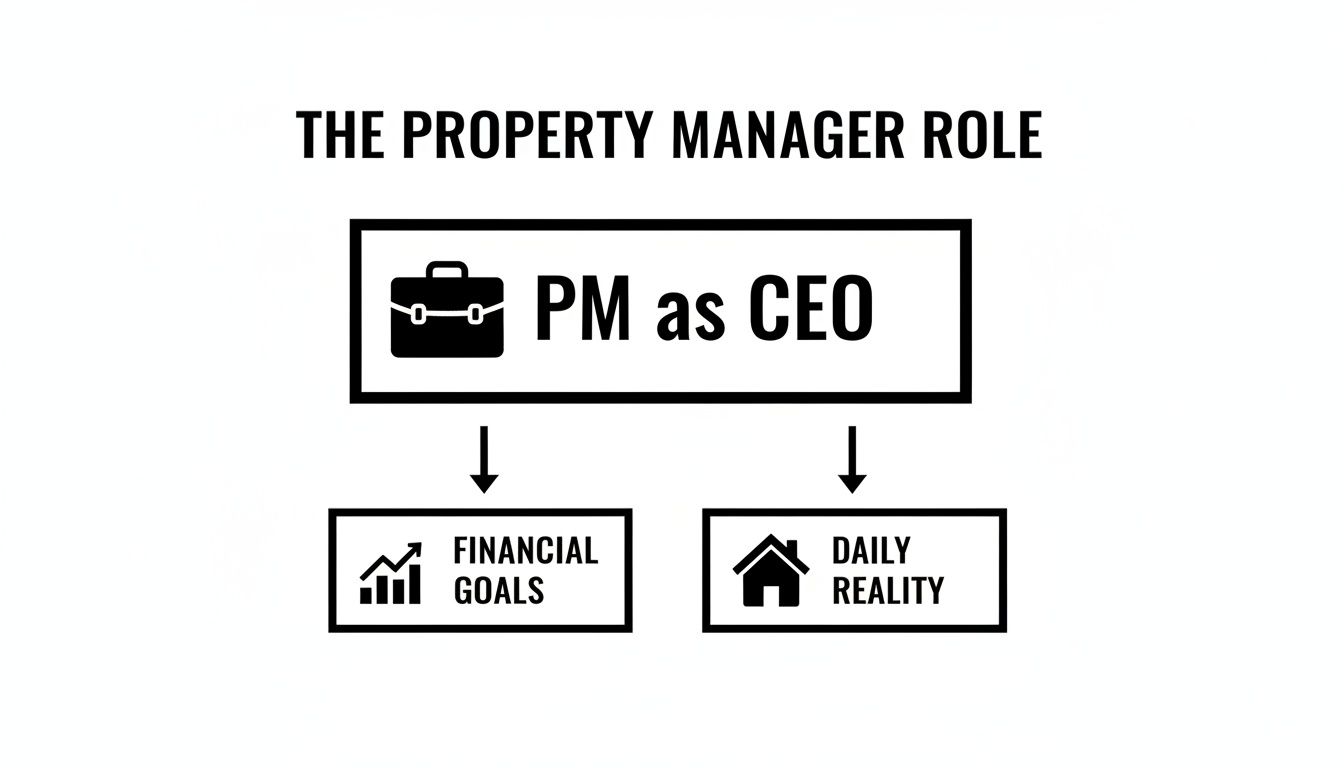
This flowchart really drives home that their role isn't just a checklist of to-dos. It's a strategic position responsible for both the asset's financial performance and its physical condition.
Pillar 1: Tenant Management and Relations
The most visible part of their job is managing the people living in your property. This goes way beyond just finding someone to fill a vacancy—it's about creating a stable and positive tenancy from day one. A great manager knows how to build relationships that encourage long-term tenants who respect your asset.
This involves:
- Marketing and Leasing: Crafting compelling listings that stand out, running viewings, and attracting a deep pool of qualified applicants.
- Rigorous Screening: This is crucial. They perform thorough background checks, verify employment and income, and check rental histories to pick the most reliable tenants.
- Communication Hub: They act as the single point of contact for every tenant enquiry, complaint, and request, making sure issues are sorted out quickly and professionally.
- Lease Administration: From the initial agreement to renewals and terminations, they handle all the paperwork, ensuring every step is compliant with WA’s tenancy laws.
Pillar 2: Financial and Administrative Oversight
The second pillar is all about sharp financial management. Your property manager is your financial administrator, ensuring consistent cash flow while keeping transparent, easy-to-understand records. This oversight is what turns a simple rental property into a high-performing business.
In fact, the residential property operators industry in Australia, which leans heavily on professional managers, hit a market size of $81.1 billion with steady growth. That boom shows just how vital their financial and operational know-how is for investors today.
Their financial duties cover:
- Rent Collection: Setting up efficient systems for on-time rent payments and proactively chasing any arrears to minimise any disruption to your income.
- Expense Management: Paying all property-related bills on your behalf, like council rates, water bills, and strata levies.
- Detailed Reporting: Supplying you with clear, itemised monthly and end-of-financial-year statements that track every dollar in and out.
Pillar 3: Property Maintenance and Legal Compliance
Finally, the third pillar covers the physical upkeep and legal integrity of your property. This is where a proactive manager becomes truly invaluable, stopping small issues from spiralling into expensive emergencies and shielding you from legal headaches. If you want a more detailed look at these duties, check out our guide on what a property manager does.
A manager's primary goal is to maintain the property’s condition to preserve its long-term value. This includes coordinating everything from a leaking tap to ensuring smoke alarms and RCDs are fully compliant with Western Australian law, which protects both the tenant and you, the owner. Regular inspections are the key here—they spot maintenance needs early, saving you money and stress down the track.
Property Manager vs Self-Management: A Task Comparison
To truly appreciate the scope of a property manager's role, it helps to see their responsibilities side-by-side with what a self-managing landlord has to handle. The difference in workload and expertise required is stark.
| Task Area | Handled By Property Manager | Handled By Self-Managing Landlord |
|---|---|---|
| Marketing & Advertising | Creates professional listings, photos, schedules viewings | Writes ads, takes photos, answers all enquiries |
| Tenant Screening | Conducts background checks, verifies income & references | Must source own screening tools and verify all info |
| Lease Agreements | Drafts legally compliant WA lease agreements | Needs to find and understand current legal templates |
| Rent Collection | Manages payments, follows up on arrears, issues notices | Must track payments and personally chase late rent |
| Maintenance Coordination | Has a network of trusted tradies, manages all repairs | Finds, vets, and coordinates tradespeople for every job |
| Routine Inspections | Conducts regular inspections with detailed reports | Must schedule and conduct inspections themselves |
| Legal Compliance | Stays updated on WA tenancy laws (RTA, RCDs, etc.) | Responsible for knowing and following all legislation |
| Financial Reporting | Provides monthly statements and EOFY summaries | Tracks all income/expenses manually or with software |
| Dispute Resolution | Mediates tenant issues, represents owner at court/tribunal | Must handle all conflicts and legal proceedings alone |
As you can see, a property manager takes a massive amount of work—and risk—off your plate, allowing you to focus on the investment strategy rather than the day-to-day grind.
Property Manager vs. Sales Agent: Clarifying the Roles
For anyone new to property investing, it’s easy to get the roles of a real estate sales agent and a property manager mixed up. While they’re both licensed professionals and vital to your success, their jobs are worlds apart.
Confusing the two is a bit like mistaking a wedding planner for a marriage counsellor. One organises a single, massive event, while the other is there to nurture a long-term relationship.
A sales agent is a transaction specialist. Their entire world revolves around getting a property sold. Think of them as a matchmaker, bringing a buyer and seller together to seal the deal. Their work is intense, focused, and short-term, ending the moment the keys change hands.
Once settlement is complete, their job is done.
A property manager, on the other hand, is a long-term guardian. They step in after the sale, taking over the day-to-day care, profitability, and legal compliance of your investment. Their relationship with you and your property is ongoing, focused on making sure it performs at its best, year after year.
Different Goals, Different Timelines
The real difference comes down to their core objectives and the timeframe they work in. This shapes everything—their daily tasks, the skills they need, and the value they bring to your portfolio.
- Sales Agent Goal: To secure the highest possible sale price in the shortest time. Success is measured by that one successful transaction.
- Property Manager Goal: To maximise your rental yield and protect your capital growth over the long haul. Success is measured by consistent income, happy tenants, low vacancies, and a well-maintained asset.
A sales agent helps you buy the asset. A property manager makes sure that asset works hard for you for the next five, ten, or twenty years. They aren't interchangeable—they're sequential partners in your investment journey.
Key Functional Distinctions
Let’s get practical and break down exactly how their responsibilities differ. This shows why you absolutely need the right expert for the right stage of your investment.
| Aspect | Real Estate Sales Agent | Property Manager |
|---|---|---|
| Primary Focus | The sale transaction | Ongoing asset management |
| Timeline | Short-term (weeks/months) | Long-term (years) |
| Key Skillset | Negotiation, marketing, closing deals | Tenant relations, maintenance, legal compliance |
| Client Relationship | Transactional | Continuous partnership |
| Income Source | Commission on the sale price | Percentage of monthly rental income |
Getting this difference right is critical. Asking a sales agent to manage your rental is a total mismatch of skills, just like asking a property manager to sell your home means you’ll miss out on the specialised expertise needed for a top-dollar sales campaign. Each professional has a vital and distinct role to play in building a successful property portfolio here in Mandurah.
Understanding Property Management Fee Structures in WA

Engaging a property manager is an investment in your asset's performance and, just as importantly, your own peace of mind. To understand this investment, it’s essential to get clear on how the fees are structured, especially here in Western Australia. These costs aren’t arbitrary; they directly reflect the comprehensive service, legal protection, and expertise that a good property manager brings to the table.
The great thing is that these fees are generally predictable and transparent, allowing you to budget effectively. They fall into two main categories, with a few smaller charges popping up for specific tasks.
Core Fee Components
The two most significant costs you'll encounter are the ongoing management fee and the one-time letting fee. These compensate the manager for their day-to-day work and the intensive effort of securing a new, high-quality tenant.
- Ongoing Management Fee: This is the primary charge for the continuous oversight of your property. It's calculated as a percentage of the gross weekly rent collected, typically ranging from 8% to 12% in WA. This fee covers all the regular stuff: collecting rent, communicating with tenants, providing financial reports, and coordinating routine maintenance.
- Letting Fee: This is a one-off fee charged when your manager successfully places a new tenant in your vacant property. It's usually equivalent to two weeks' rent and covers the cost of advertising, showing people through the property, and processing all the tenancy applications.
Additional Service Charges
Beyond those two main fees, your management agreement may include other charges for specific, non-routine services. This ensures you only pay for the work that is actually done. You can explore a detailed breakdown of these in our guide to property management costs.
Common additional fees include:
- Administration Fee: A small monthly fee (think $5-$10) for things like postage and stationery.
- Inspection Fee: A charge for each detailed routine inspection report, complete with photos and notes.
- Lease Renewal Fee: A fee for negotiating and preparing a new lease with an existing tenant, which is often around one week's rent.
Think of these fees not just as an expense, but as a retainer for a dedicated professional whose job is to protect your investment. Their work ensures consistent rental income and prevents costly vacancies or legal dramas, providing a clear return on that investment.
This professional dedication is reflected in the workforce. In Australia, 72% of property managers work full-time, averaging 42 hours per week to provide the meticulous attention required. With WA home to 10.0% of the nation's 39,200 property managers, you're tapping into a robust local industry of experts. You can see more details in this Australian property landscape analysis.
How To Hire The Right Property Manager In Mandurah

Choosing who manages your Mandurah property is easily one of the biggest decisions you'll make as an investor. This isn't just about handing over the keys to someone who can collect rent; it's about forming a partnership with a professional you trust with a very valuable asset.
A sharp, proactive manager can seriously boost your returns and make ownership a breeze. The wrong one? They can become a source of endless headaches and eat into your profits.
The hiring process is your chance to find a manager who’s on the same page as you. Think of it less like filling a role and more like interviewing a crucial business partner. You need someone with proven experience, fantastic communication, and most importantly, deep-seated local knowledge of the Mandurah market, from Falcon to Lakelands.
Where To Start Your Search
Kick things off by shortlisting a few reputable local agencies. A great first step is to look at online rental listings for properties similar to yours in the Mandurah area and see which agencies are consistently active and professional.
From there, do a little digging into their online presence:
- Check Reviews: Look for a pattern of positive feedback on platforms like Google. Pay close attention to what other property owners are saying, not just tenants.
- Review Their Website: A polished, easy-to-navigate website is a good sign. It shows they take their business seriously and care about clear communication.
- Assess Their Current Listings: Are their rental ads well-written? Are the photos high-quality? This is a direct reflection of the care and attention they’ll give your property.
Key Qualities To Look For
Once you’ve got a shortlist, it's time to zero in on their specific skills and the systems they use. The best property managers all share a few non-negotiable traits.
They must be organised, tech-savvy, and excellent communicators. You want someone who keeps you in the loop on what matters without bogging you down with trivial updates.
A truly great property manager doesn't just react to problems—they anticipate them. Their value is measured in the crises they help you avoid, from costly vacancies to navigating complex tenancy laws. This proactive approach is essential for maximising your investment's potential.
On top of that, their ability to thoroughly screen tenants is absolutely critical. A watertight vetting process is your single best defence against future problems, making it a vital area to quiz them on during an interview. To get a better sense of what top-tier service involves, learn more about professional Mandurah property management and the high standards you should be looking for.
Essential Interview Questions For Your Next Mandurah Property Manager
When you sit down with potential managers, having a structured list of questions is your best tool. It helps you compare their answers apples-to-apples and pinpoint the perfect fit for your investment property. Your questions should dig into their local experience, day-to-day processes, and communication style.
This isn't just a formality; it’s a crucial step in vetting your future business partner. Use this table as a starting point to guide your conversation.
| Question Category | Sample Question | What To Listen For In The Answer |
|---|---|---|
| Local Market Knowledge | "What's the current rental market like in this specific Mandurah suburb, and how would you price my property to be competitive yet profitable?" | A detailed, data-driven response that shows they know the local nuances, not just city-wide trends. They should mention recent comps. |
| Tenant Screening | "Can you walk me through your tenant screening process step-by-step? What specific checks do you run?" | A multi-layered process including rental history, employment verification, reference checks, and tenancy database searches. Vague answers are a red flag. |
| Maintenance & Repairs | "How do you handle maintenance requests? Do you have a network of trusted local tradespeople you rely on?" | Look for a clear system for logging requests, getting owner approval, and using qualified, insured local trades. A good network is invaluable. |
| Communication Style | "How and when will you communicate with me about my property? What's your policy for responding to owner and tenant enquiries?" | A clear, defined communication plan (e.g., monthly statements, immediate calls for emergencies). They should have set response timeframes. |
| Vacancy Management | "What’s your strategy for marketing a vacant property and minimising the time it's empty?" | They should mention professional photography, broad online advertising, and a proactive approach to viewings to get it tenanted quickly. |
| Conflict Resolution | "Tell me about a difficult situation you handled with a tenant. What was the outcome?" | An answer that shows professionalism, knowledge of tenancy law, and a focus on de-escalation and fair resolution for all parties. |
The answers you get will speak volumes about their professionalism, systems, and expertise. Taking the time to ask these questions will give you the confidence you need to choose the right partner to protect and grow your investment.
When it comes down to it, a property manager is far more than just a rent collector—they’re a genuine partner in your investment's success. A great manager isn’t just one thing; they’re a blend of financial strategist, legal expert, and skilled negotiator, all working to protect and grow your asset. They’re the person on the ground, overseeing not just the day-to-day but the long-term health of your property.
In a competitive market like Mandurah, their value is impossible to ignore. They are the key to unlocking higher rental returns, keeping those costly vacancies to a minimum, and steering you clear of the complexities of WA's property laws. A skilled professional is an absolutely essential part of your investment team.
The right property manager brings more than just a service; they bring strategic value to your portfolio. They can turn a hands-on headache into a high-performing, hands-off investment, working tirelessly behind the scenes for your financial success and peace of mind.
As this guide has shown, bringing in professional management is one of the smartest moves a property owner can make. By picking the right partner, you’re not just hiring help—you’re setting your property up for sustained growth and profitability. This allows you to step back and enjoy the rewards of your investment, without getting bogged down in the daily grind.
Still Have Questions? Let's Clear a Few Things Up
Got a few lingering questions about how property management works here in Western Australia? You're not alone. Let's tackle some of the most common queries investors have before they hand over the keys.
Getting these details straight from the start is crucial. It helps you understand your rights, what to expect from the partnership, and the legal standards that are in place to protect your investment.
What Qualifications Should a WA Property Manager Have?
This is non-negotiable. For a property manager to operate legally in WA, they must be registered with the Department of Mines, Industry Regulation and Safety (DMIRS). This isn't just a nice-to-have; it's a mandatory requirement that protects you and your asset.
To get this registration, they need to complete specific training, like a Certificate IV in Real Estate Practice. This ensures they have a solid grasp of the state's complex property laws. Always ask for proof of their registration and don't be shy about verifying it—you need to know you're dealing with a qualified and legally compliant professional.
Can I Change Property Managers If I’m Unhappy?
Absolutely. You're never locked into a bad situation indefinitely if the service just isn't up to scratch. Your management agreement will spell out the notice period required to end the contract, which is typically between 30 to 90 days.
Making the switch is straightforward. You just need to give written notice to your current manager. From there, your new manager steps in and handles the entire handover. They’ll coordinate collecting all the keys, tenant files, and important documents, making the transition as seamless as possible for both you and your tenant.
How Involved Do I Need to Be as the Owner?
This is completely up to you. One of the biggest perks of hiring a property manager is that they take all the day-to-day operational headaches off your plate, freeing up your time and mental energy.
A great manager is more than just a rent collector; they're your strategic partner. They keep you in the loop on the big picture while sweating the small stuff so you don't have to. You'll only be contacted for your approval on major decisions, like choosing a new tenant or authorising a significant repair over an agreed-upon limit. This lets you focus on your investment strategy, not on leaking taps or routine inspections.
Ready to partner with a dedicated real estate professional who can maximise your property's value in Mandurah? Contact David Beshay Real Estate for expert market analysis and a personalised strategy. Get your free property appraisal at https://realestate-david-beshay.com.au.

