


When you’re thinking about selling your home, the real estate agent commission rate is one of the first numbers that comes to mind. In Western Australia, this figure generally falls somewhere between 2.0% to 2.8% of the final sale price. This percentage isn't just a fee; it's the primary motivation for your agent to secure the best possible outcome for you.
Demystifying Agent Commissions in the Mandurah Market
It’s helpful to think of an agent’s commission not as a simple cost, but as a success fee. This structure is designed to perfectly align their goals with yours. The logic is simple: the higher the price they get for your home, the more they earn.
This performance-based model is what separates a great agent from the rest. Unlike someone on a fixed salary, a commission-driven agent is completely invested in your success. Every open home, every phone call, and every negotiation is another step toward our shared goal: maximising your sale price.
Typical Commission Rates in Western Australia
To really get a feel for the Mandurah market, it helps to zoom out and look at the bigger picture across the state. In Western Australia, commission rates usually sit between 2.0% and 2.8% of the sale price. The state-wide average is around 2.45%, which gives sellers in places like Mandurah a solid benchmark.
This range exists because of the state's diverse market. For instance, agents in the highly competitive Perth metro area often charge around 2.0%, while those in more regional spots might need to charge a bit more to cover the costs of reaching a wider audience. This WA average gives you a good starting point for what to expect, but local factors always play a huge role.
Zooming in on Mandurah and Perth
The Mandurah real estate scene gets a real boost from its closeness to Perth, which fuels a very competitive environment among local agents. This is fantastic news for you as a seller because it naturally helps keep commission rates on the lower end of that state-wide scale.
While the WA average might be 2.45%, it’s not uncommon to see rates closer to the 2.0% to 2.2% mark here in Mandurah and the broader Peel region. This comes down to a few key local dynamics:
- High Agent Competition: With plenty of skilled agents in the area, we all have to offer competitive rates and top-tier service to earn your business.
- Property Values: Mandurah has a strong median house price, which means agents can still earn a fair fee on a slightly lower percentage, giving us more room to move during negotiations.
- Market Velocity: Homes in sought-after pockets of Mandurah often sell quite quickly, which can make an agent more willing to negotiate a sharper rate.
The table below gives you a quick snapshot of what these percentages look like in real dollar terms for typical Mandurah property values.
Mandurah Commission Rate Quick Reference
Here’s a simple breakdown showing how different commission rates can impact your net proceeds on a sale. Notice how even a small difference in the rate can add up to significant savings.
| Property Sale Price | Average WA Commission Rate (2.45%) | Competitive Perth/Mandurah Rate (2.0%) | Potential Savings |
|---|---|---|---|
| $500,000 | $12,250 | $10,000 | $2,250 |
| $650,000 | $15,925 | $13,000 | $2,925 |
| $800,000 | $19,600 | $16,000 | $3,600 |
| $1,000,000 | $24,500 | $20,000 | $4,500 |
Disclaimer: These figures are illustrative examples. Actual commission rates are negotiable and subject to GST.
Knowing these numbers upfront empowers you to have a much more confident and productive chat with potential agents. As you can see, the difference between a 2.0% and a 2.5% commission could mean thousands of extra dollars in your pocket at settlement. For a deeper dive, check out our guide on the different types of agent fees when selling a house.
When you see commission as an investment in expertise and motivation, you stop thinking about "cost" and start focusing on "value." The right agent doesn’t just put a sign in your yard; they build a strategy to get a premium price that more than covers their fee.
What Actually Influences a Real Estate Agent's Commission Rate?
Ever wondered why there isn’t a single, fixed commission rate for selling a house? It’s simple, really: not all properties are the same, and neither is the work required to sell them. The commission is a direct reflection of the expertise, effort, and resources an agent needs to pour into getting you an outstanding result.
Think of it this way. Selling a waterfront canal home in a high-demand Mandurah suburb is a completely different ball game to selling a sprawling rural property further inland. Each one demands a unique strategy, a different marketing budget, and a distinct level of negotiation. That’s why the rate is flexible—it’s shaped by a few key factors.
Once you understand these variables, you’ll see the commission not as a simple cost, but as a strategic investment in your final sale price. Let's break down exactly what goes into that percentage you and your agent agree on.
Property Value and Price Point
One of the biggest factors is the property's estimated value. It might seem a bit backwards, but higher-priced homes often attract a lower commission percentage. For instance, an agent might happily agree to a 2.0% rate on a $1.5 million property because the final payout is still substantial.
On the other hand, a lower-priced property, say around $450,000, might need a slightly higher rate, maybe 2.5%. This ensures the agent is fairly compensated for the extensive work involved. The truth is, the amount of effort needed to market, show, and negotiate the sale of both properties is often very similar, even if their price tags are worlds apart.
The core idea is that a smaller slice of a big pie can be more rewarding than a bigger slice of a small one. This naturally gives sellers of high-value homes a bit more room to negotiate.
Location and Property Desirability
Where your property is located plays a massive role. A home in a sought-after Mandurah spot with great schools and amenities is likely to sell faster and with less marketing spend. That desirability gives you, the seller, some leverage.
Agents are often more flexible on their rates for properties they know will generate a flood of buyer interest and sell quickly. In contrast, a property in a slower market or a more remote area might require a much bigger and more expensive marketing campaign to attract the right buyer. In that case, a standard or even slightly higher commission is justified.
The unique features of your home matter, too:
- High-Demand Features: A modern, move-in-ready home with a new kitchen or a sparkling pool is just easier to market.
- Niche Properties: Unique homes, like those needing specialised buyer knowledge (think equestrian properties), demand more targeted, and often more costly, marketing.
- Property Condition: A beautifully maintained home that presents well from day one simply requires less heavy lifting from the agent, who may be more willing to negotiate their fee.
Scope of Services and Marketing Strategy
Finally, the commission rate is directly tied to the level of service and the marketing plan you agree on. It's not just about whacking your home online and hoping for the best. A comprehensive sales strategy involves a significant investment of time and money from the agency.
A basic service package might just cover standard online listings and a "For Sale" sign. But a premium marketing campaign—the kind designed to squeeze every last dollar out of the sale—will involve a much broader scope of activities.
This could include things like:
- Professional Photography and Videography: High-quality visuals are completely non-negotiable if you want to attract serious buyers.
- Home Staging Consultation: Getting expert advice on how to present your home to appeal to the widest audience can make a huge difference.
- Premier Online Advertising: Paying to put your property at the very top of search results on major real estate websites.
- Social Media Campaigns: Running targeted ads to reach both active and passive buyers right here in the local area.
- Print Advertising: Securing features in local property magazines and newspapers.
When an agent offers a lower commission, it’s crucial to ask what’s included. A cut-rate fee might mean a scaled-back marketing plan, which could ultimately lead to a lower final sale price. The best approach is always to partner with an agent who invests in a powerful strategy, ensuring your property gets the exposure it deserves to command a premium price.
Decoding Commission Models: Percentage vs Fixed Fee
When you decide to sell your home, understanding how your real estate agent gets paid is one of the most important parts of the process. It's not just about the final number; the payment structure itself can shape your agent's entire strategy and motivation. In Mandurah, and across Australia, you'll generally come across two main options: the classic percentage-based commission and the straightforward fixed-fee model.
Let's break down how each one works so you can figure out which is the best fit for your property and financial goals.
The most common structure you’ll see is the percentage-based commission. It's simple: your agent's fee is a percentage of the home's final sale price. This model is popular for a reason—it creates a powerful, shared goal. The more your home sells for, the more the agent earns. It’s a true partnership.
On the other hand, you have the fixed-fee model. With this approach, you and your agent agree on a specific dollar amount right at the start. That fee won't change, no matter what the final sale price is. For sellers who value certainty and predictability, this can be a very appealing option, as you know exactly what your costs will be from day one.
The Power of Percentage-Based Commission
Let’s put this into a real-world Mandurah context. Say you're selling your home and agree to a 2.2% commission. If your property sells for your target price of $650,000, the commission comes to $14,300.
But a top agent doesn't just settle for the target. They push for more. If their marketing campaign and negotiation skills drive the final sale price up to $675,000, their commission becomes $14,850. That’s an extra $25,000 in your pocket, and it only cost you an additional $550 in commission. That's what you call a great return on investment.
This model directly rewards the agent for getting you a premium price, aligning their success with yours.
The Certainty of a Fixed-Fee Model
Now, what if you chose a fixed fee instead? You might agree on a flat fee of $14,000 to sell that same $650,000 home. This number is locked in, giving you complete clarity. Whether the home sells for $640,000 or $660,000, the agent's professional fee stays the same.
The main advantage here is that predictability. Some sellers prefer knowing the exact cost upfront, as it removes any guesswork from their budget. The key question to ask yourself, though, is whether this structure offers the same fire-in-the-belly motivation for an agent to fight for every last dollar during those crucial negotiations.
This diagram shows some of the core elements that influence commission discussions, regardless of the model you lean towards.
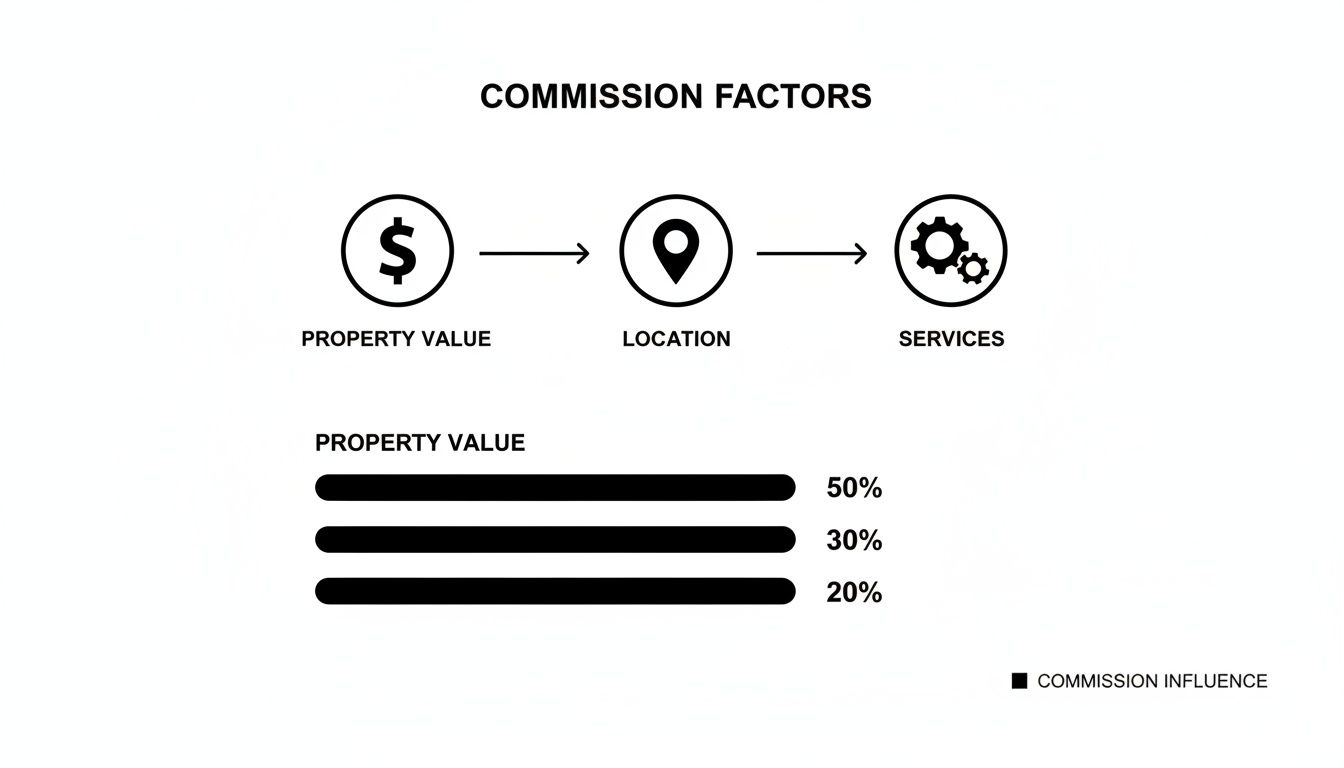
As you can see, things like your property's value, its location, and the level of service you need from your agent are the foundational pieces that help determine a fair fee.
Exploring Tiered Commission Structures
There's also a third, more creative option that's worth knowing about: the tiered or bonus commission model. Think of it as a hybrid that blends the security of a standard rate with the high-performance drive of a bonus. It’s designed to create a real sense of alliance between you and your agent.
Here's a breakdown of how it works:
- Set a Baseline: You agree on a standard commission rate up to a certain sale price (for example, 2.0% on a sale up to $700,000).
- Establish a Kicker: Then, you agree on a much higher percentage—a "kicker"—for any amount achieved above that baseline. For instance, you could offer 10% on every dollar over $700,000.
If the home sells for $720,000, the commission is calculated in two parts:
- $14,000 (2.0% of the first $700,000)
- $2,000 (10% of the additional $20,000)
- Total Commission: $16,000
In this scenario, you walk away with an extra $18,000, and your agent is rewarded handsomely for their exceptional result. This model is particularly effective in a hot market because it gives agents a massive incentive to smash price expectations. For a complete rundown, you can explore the different types of real estate commission rates available.
A tiered commission transforms the agent-seller relationship from a service agreement into a strategic alliance. Both parties are financially invested in pushing past the expected market value to achieve an extraordinary result.
To help you visualise these different models, here's a quick comparison based on selling a $700,000 home in Mandurah.
Commission Model Comparison
| Commission Model | How It Works | Pros for Seller | Cons for Seller |
|---|---|---|---|
| Percentage | A set percentage (e.g., 2.2%) of the final sale price. | Directly motivates the agent to achieve the highest possible price. | The final fee isn't known until the property sells. |
| Fixed-Fee | A pre-agreed flat dollar amount (e.g., $15,000) regardless of sale price. | Provides cost certainty and makes budgeting easy from the start. | May reduce an agent's incentive to negotiate for a price above the expected value. |
| Tiered | A base rate up to a target price (e.g., 2.0% on $700k) plus a bonus rate (e.g., 10%) on any amount above it. | Creates a powerful incentive for the agent to exceed expectations and secure a premium result. | Can be more complex to calculate and may result in a higher fee if the agent achieves a standout price. |
Ultimately, the right commission structure depends on your priorities—whether that's maximum motivation, cost certainty, or a blend of both.
Let's be honest, talking about money can be awkward. But when it comes to your agent's commission, it really doesn't have to be. The trick is to stop thinking of it as "asking for a discount" and start seeing it as "building a partnership." You're having a conversation about getting the best possible result for your home, and agreeing on a fee that fairly reflects that value and expertise.
Think of it less like a confrontation and more like a strategy session. You and your agent are on the same team, aiming for the highest sale price. This conversation is just about fine-tuning the game plan to make sure it’s a win for everyone.
The goal isn't to chase the absolute lowest rate. A rock-bottom fee often means you get a bare-bones marketing plan or a less experienced agent, which could cost you tens of thousands in a lower sale price. What you really want is a fair real estate agent commission rate that gets you top-tier service and an agent who is fired up to get you the best outcome.
Prepare for a Productive Conversation
Before you pick up the phone, do a little homework. Get a feel for the Mandurah market so you can have a conversation grounded in reality. Knowing the typical commission rates in the area gives you a solid starting point.
Be ready to talk up your property's best features. Is it beautifully maintained? In a killer location? A home that’s easy to sell requires less marketing muscle, and that's a powerful point to bring to the table.
Finally, know what you want. Are you after a full-blown marketing campaign with professional staging and all the digital bells and whistles? Or is your home likely to be snapped up quickly with a more standard approach? Being clear on your expectations helps you justify the fee you're happy to pay.
Strategic Negotiation Points
When you sit down with an agent, steer the conversation towards value, not just cost. Instead of kicking off with, "Can you do it for less?", try asking about their strategy and how it’s going to get you a premium price.
Here are a few talking points to guide the chat:
- Drill Down on the Marketing Plan: Ask for a full breakdown of their proposed marketing budget. If you think some elements, like extensive print ads, aren't right for your property, you can suggest reallocating that spend or using it as a reason for a slightly sharper fee.
- Play Up Your Property's Strengths: If your home is in a hot Mandurah suburb and looks a million bucks, say so! You could try something like, "Given the home is move-in ready and in such a sought-after spot, we're expecting a lot of interest. How does that factor into your commission?"
- Offer a Double Deal: If you're also looking to buy in the area, using the same agent for both deals is a massive carrot to dangle. The promise of two commissions gives them a very good reason to be more flexible on your sale.
- Show You've Done Your Research: It’s smart to interview at least two or three agents. Casually mentioning you’re speaking with other professionals creates a bit of healthy competition and encourages them to put their best foot forward.
The best negotiations happen when a seller can clearly explain why a different rate makes sense. It's about showing you understand your home's value and the local market, not just pulling a number out of thin air.
When you walk into the conversation with confidence and a collaborative spirit, you set the stage for a great partnership. It ensures you feel good about the value you're getting, and your agent feels motivated to smash it out of the park for you. When you're ready to start talking, finding a top real estate agent in Mandurah is the perfect first step.
Understanding Your Sales Agency Agreement

Before your property really hits the market, there’s one document that makes the partnership between you and your agent official: the sales agency agreement. It’s easy to see it as just more paperwork, but it’s much more than that. Think of it as the foundational blueprint for your entire sale.
This legally binding contract spells out every detail of your professional relationship with your agent. Getting this right from the start is absolutely crucial, as it protects you by setting clear expectations and financial obligations upfront. No nasty surprises down the track.
What to Look for in Your Agreement
Your sales agency agreement is the single source of truth for the campaign ahead. It’s meant to be comprehensive, but there are a few key sections that you really need to zero in on before signing. Any transparent agent will be more than happy to walk you through each point.
Here are the non-negotiables to check:
- The Commission Clause: This is the big one. It’s where the agreed-upon real estate agent commission rate is clearly documented. Double-check that the percentage or fixed-fee amount is exactly what you negotiated. Crucially, it should also specify if the figure includes GST—it’s almost always quoted as "plus GST".
- The Payment Trigger: The agreement will state precisely when the commission is actually due. For most residential sales here in Western Australia, this is upon the successful settlement of the property, not just when an offer is accepted.
- The Agency Period: This clause sets the length of time the agent has the exclusive right to sell your property. This is negotiable but typically sits around 90 days.
- Marketing Costs: The agreement must draw a clear line between the agent's professional service fee (the commission) and the marketing and advertising budget. These are two completely separate costs.
How Marketing and Commission Are Separated
This is a common point of confusion for sellers, so let’s clear it up: your marketing budget is not part of the agent's commission. The commission is the fee you pay for the agent's time, expertise, strategy, and skill in negotiation. It’s their success fee, plain and simple.
The marketing budget, on the other hand, is a separate investment used to pay third-party suppliers for the promotional tools that get your property seen. This covers things like professional photography, premier listings on realestate.com.au, the signboard out front, and property brochures. A solid agreement will always include a detailed marketing schedule and budget for your approval, giving you total control over this spending.
Your sales agreement should provide total transparency. The commission is your investment in professional skill, while the marketing budget is your investment in visibility. The two should never be bundled together without a clear itemised breakdown.
Understanding this distinction is vital. It keeps your agent accountable for a specific marketing plan and gives you the peace of mind that their professional fee is tied directly to achieving the best possible sale price for you. This clarity turns a complex document into a simple, powerful tool for a successful property sale.
So, What's Your Next Move in Mandurah?
You've made it through the nuts and bolts of real estate commission in Mandurah. We’ve covered the typical rates across Western Australia, peeked into the factors that can shift that number—like your property’s location or the marketing plan—and hopefully, you’re feeling a lot more confident about the road ahead.
The biggest takeaway? The "right" commission isn't just about finding the cheapest agent. It’s about finding that sweet spot—a fair fee for a professional who's going to pull out all the stops to get you an incredible result. You now know the difference between a percentage fee and a fixed one, and you’ve got some solid strategies for negotiating genuine value, not just a cheap rate. That knowledge alone puts you ahead of the game.
Get a Real-World Number for Your Property
Okay, theory is one thing, but your home is another. The most logical next step is to get some real, hard numbers that apply specifically to your property. The best way to do that? A professional, no-obligation property appraisal. Think of it as the bridge between understanding the general market and knowing exactly what your home is worth today.
An appraisal delivers two crucial things:
- An Accurate Market Value: You’ll get a clear, data-driven estimate of what your home could sell for in the current Mandurah market. No guesswork involved.
- A Foundation for Discussion: This valuation is the perfect launchpad for a proper chat about a commission structure that makes sense for your home and your goals.
An appraisal isn't a sales pitch; it's a strategic planning tool. It arms you with the data you need to have a meaningful conversation about commission, marketing, and what you’ll actually walk away with after the sale.
Take Action Today
Once you have an accurate appraisal in hand, you can have a completely transparent chat with an agent about a fee that reflects your property’s unique strengths and what you want to achieve. It takes all the hypotheticals out of the equation and puts you firmly in control. When you do decide to sell, you’ll be doing it with total clarity.
Ready to take that first, simple step? We offer a completely free, no-pressure property appraisal to help you discover your home's true potential. It's the best way to kick off your selling journey with confidence.
Got Questions? We've Got Answers
When it comes to selling your Mandurah home, the topic of agent commissions often brings up a lot of questions. Let's clear the air and give you the straightforward answers you need to move forward with total confidence.
Is GST Included in the Real Estate Agent Commission Rate?
This is a big one, and it’s crucial to get it right. In Western Australia, it’s standard practice for agents to quote their commission rate exclusive of GST. You absolutely must confirm this before signing anything to avoid any nasty surprises down the track.
Let’s break it down. Say you agree to a 2.0% commission on a $700,000 sale. The commission itself works out to be $14,000. But on the final invoice, 10% GST will be added on top, bringing the total fee you pay to $15,400. Always double-check your sales agency agreement to see the words 'plus GST' so you can budget with pinpoint accuracy.
Are Marketing Costs Included in the Commission Fee?
In short, no. Your marketing and advertising costs are almost always a separate investment. Think of the real estate agent commission rate as the 'success fee'—it pays for the agent's expertise, their time on the phone, their negotiation skills, and the strategy they use to get your home sold.
The marketing budget, on the other hand, pays for the tangible tools used to get your property in front of buyers. This includes things like:
- Professional photography and videography that make your home shine online.
- Upgraded 'Premier' or 'Feature' listings on the major property websites.
- The 'For Sale' sign that goes on your front lawn.
- High-quality brochures handed out at home opens.
A good, transparent agent will always walk you through a distinct marketing plan and budget for your approval. This puts you in the driver's seat, giving you full control over how your property is presented to the market.
What Happens to the Commission If My Property Does Not Sell?
Here’s some peace of mind for you. The vast majority of agents in Mandurah work on a 'no sale, no fee' basis for their commission. This is one of the biggest motivators for an agent—it means they only get paid when they deliver a successful result for you.
If, for whatever reason, your property doesn’t sell, you don't pay the agent's commission. Simple as that. It's important to know, however, that you'll likely still need to cover any marketing costs you pre-approved. Those funds have already been spent with third-party suppliers like photographers and online portals.
The 'no sale, no fee' model is a fundamental sign of an agent's confidence in their ability to sell your home. It ensures their financial goals are perfectly aligned with yours from the very beginning.
Can I Renegotiate Commission After Signing the Agreement?
Once you’ve signed the sales agency agreement, that commission rate is legally locked in. This is why it’s so important that any and all negotiations happen before you put pen to paper. That initial conversation is your opportunity to discuss the rate, understand the value being offered, and land on a figure you’re both happy with.
Trying to change the terms halfway through the campaign isn't how it's done and can really sour the relationship with your agent. You want a smooth, collaborative partnership, so it’s essential to agree on a rate that feels fair from the get-go.
Ready to find out what your Mandurah property is truly worth and chat about a commission structure that fits your goals? Reach out to David Beshay Real Estate for a free, no-obligation property appraisal. Let's start your selling journey on the right foot.

