


When you're thinking about the costs of selling your house, it's easy to focus just on the agent's commission. But the truth is, that's only part of the story. To get a real handle on your budget in Western Australia, you need to factor in the agent's commission, the money set aside for marketing, and any admin or settlement fees. These three things together will determine how much you walk away with.
What Are the Real Costs of Selling a House in WA?
Selling your home is a huge financial move, and knowing every single cost involved is the key to planning properly. Too many sellers get fixated on the commission percentage, but that’s like looking at just one ingredient instead of the whole recipe. It’s more helpful to think of the total expense as a project management fee for pulling off a complex sale from start to finish.
Think of your agent as the project manager for your home sale. Their job is to juggle all the moving parts to make sure the project—selling your place for the best possible price—is a success. The total cost is a reflection of the expertise, strategy, and resources needed to get that result. Let's break down what you'll typically see when selling in the Mandurah and Peel region.
The Three Core Components of Selling Costs
To get a clear financial picture, it helps to break down the costs into three main buckets. Each one plays a specific role in getting your home from "For Sale" to "Sold."
- Agent Commission: This is what you pay the agency for their professional know-how, negotiation skills, and for managing the whole process. It's almost always calculated as a percentage of the final sale price.
- Marketing and Advertising: This is a separate, dedicated budget to get your property in front of the largest possible pool of qualified buyers. It covers things like professional photos, online ads on sites like realestate.com.au, the "For Sale" sign, and brochures.
- Administrative and Settlement Costs: These are the necessary third-party fees to legally finalise the sale. While you don't pay them to the agent, they're a mandatory part of selling. This includes your settlement agent or conveyancer who handles the legal transfer of ownership.
By understanding these three distinct categories, you can see beyond a simple commission rate and appreciate the full scope of what you're paying for. This clarity is the first step toward a predictable, successful sale without any nasty financial surprises at the end.
Our goal here is to make these numbers less intimidating. By breaking down each part, you can confidently compare agent proposals, create an accurate budget, and make decisions you feel good about. It's all about knowing exactly where your money is going and the value you're getting for it, setting you up for a smooth and profitable sale.
How Real Estate Commission Structures Actually Work
When you're selling your home, the agent's commission is almost always the biggest single line item on your list of costs. But how is it actually worked out? It’s not a one-size-fits-all charge. Think of it like hiring a project manager—you might agree to pay them a flat rate, a percentage of the final result, or even a bonus for hitting it out of the park.
Getting your head around these models is the key to picking an agent and a fee structure that lines up perfectly with your own financial goals for your Mandurah property. Let's break down the three main ways agents put their fees together.
The Standard Percentage-Based Commission
This is the classic approach and the one you'll come across most often in Australia. The agent's commission is simply a set percentage of whatever your property sells for. If your home goes for a higher price, the agent earns more; if it sells for less, they earn less. Simple as that.
What's great about this model is that it directly links the agent's success to yours. You both have the exact same goal: get the highest possible price. For a bit of perspective, on a $600,000 sale with a 2.5% commission, the fee would come to $15,000 (plus GST).
While it's straightforward, it’s worth knowing that these percentages can shift quite a bit from place to place. For example, down in Melbourne’s very competitive market, commissions might hover between 1.6% and 2.9%. That's often lower than what we see here in WA, mainly because their property values are higher on average. You can dive deeper into these regional differences in our guide to commission rates.
The Fixed-Fee Model
A less common but definitely growing alternative is the fixed-fee structure. Here, you and the agent agree on a specific dollar amount for their services right from the get-go, and it doesn't change no matter what the final sale price is.
The big plus here is absolute certainty. If you're someone who needs to budget down to the last dollar, this can be really appealing. You know exactly what you’re up for, whether your home sells for your asking price, a bit under, or way over.
The flip side, though, is that the agent’s financial motivation isn't directly tied to pushing for that top price. Whether they sell your place for $580,000 or $620,000, their paycheque is the same. This model is often the go-to for online or "no-frills" agencies that might offer a more streamlined service package.
Key Takeaway: The choice between a percentage and a fixed fee really comes down to shared risk versus cost predictability. A percentage commission motivates an agent to squeeze out every last dollar for you, while a fixed fee gives you a guaranteed cost from day one.
This little graphic helps show where commission fits into the bigger picture of selling costs.
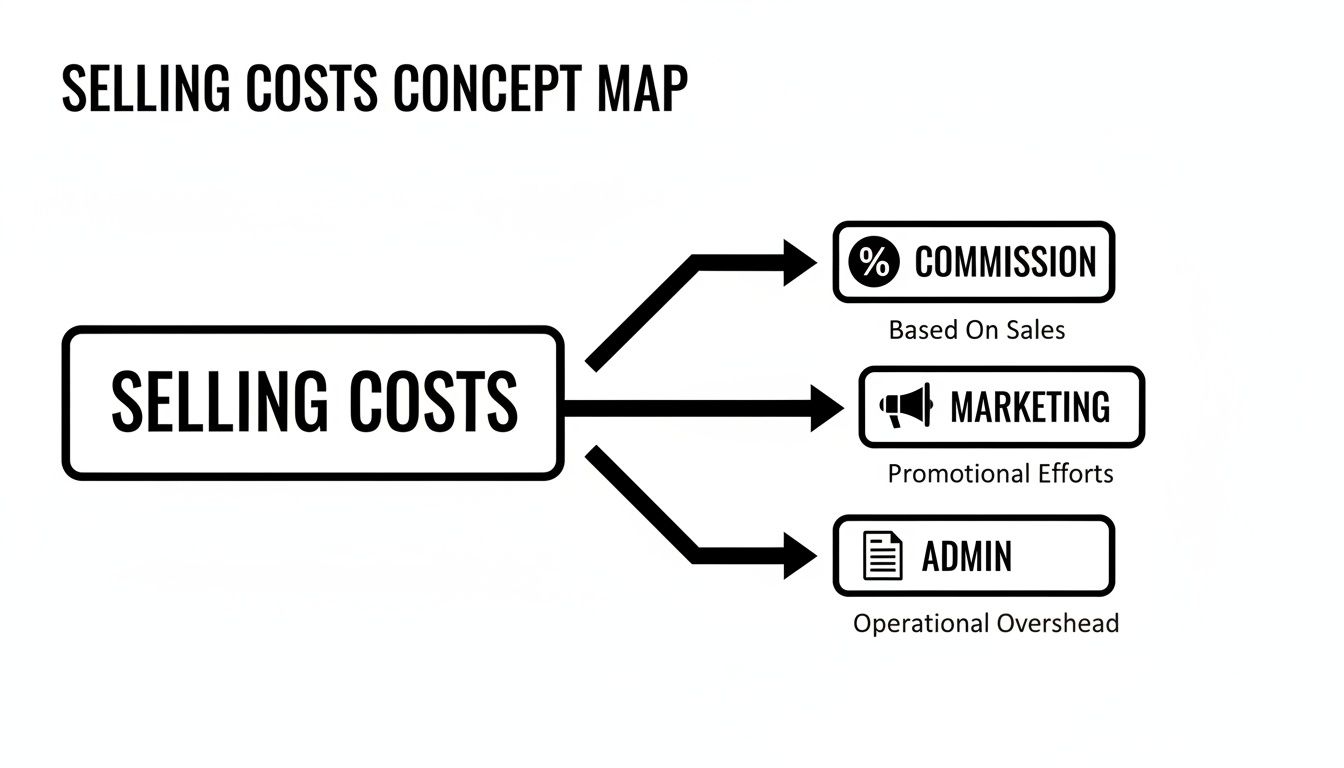
As you can see, the commission is just one of three main costs, sitting alongside marketing and admin fees, that all add up to your total selling expenses.
Tiered or Incentive-Based Commission
Now, the tiered commission structure is a clever hybrid designed to really light a fire under an agent to smash your price expectations. It works by setting a target sale price and then offering a much juicier commission rate on any amount they achieve above that target.
It’s a bit like a base salary plus a performance bonus. The agent gets their standard commission on the agreed-upon price, but they earn a much higher percentage on the "bonus" cash they bring in on top.
Let's run through a practical example for a home right here in Mandurah:
- Agreed Benchmark Price: $700,000
- Base Commission: 2.5% on the first $700,000
- Bonus Commission: 10% on any amount achieved over $700,000
If your agent sells the property for $730,000, their commission is calculated in two parts: $17,500 (2.5% of $700k) plus an extra $3,000 (10% of that bonus $30k), for a total of $20,500. This structure powerfully aligns your interests, because you can bet that agent will be fighting hard to get you that extra $30,000. It’s a fantastic way to make sure your agent is gunning for the absolute best result possible.
Calculating What You Will Actually Take Home
Understanding the different fees is one thing, but let's get down to the real question on every seller's mind: "After everything is paid, how much money will I actually have left?" This final figure that lands in your bank account is your net proceeds.
To make this crystal clear, we'll walk through two realistic scenarios for properties right here in the Mandurah and Peel region. These examples will strip away the jargon and show you exactly how the numbers work, from the sale price down to your final payout.
Scenario One: A Typical Mandurah Home
Let's say you've just sold your family home for $550,000. Brilliant. You agreed to a commission of 2.5% (+GST) with your agent, and your marketing package came to $3,000. We also need to account for a standard settlement agent fee, which we'll estimate at $1,500.
Here’s how it all breaks down:
- Step 1: Work out the commission. First, we calculate the agent's commission before GST.
- $550,000 x 0.025 = $13,750
- Step 2: Add GST to the commission. Remember, GST applies to the agent's service, not the total house price.
- $13,750 x 0.10 (GST) = $1,375
- Total Commission Payable = $13,750 + $1,375 = $15,125
- Step 3: Deduct all costs from the sale price. Now we subtract all the expenses from that top-line number.
- $550,000 (Sale Price)
-
- $15,125 (Total Commission incl. GST)
-
- $3,000 (Marketing Costs)
-
- $1,500 (Settlement Fee)
Your Estimated Net Proceeds: $530,375
So, from a headline sale of $550,000, your final take-home amount is just over $530,000. This is the real figure you can use to plan your next purchase or life adventure.
Scenario Two: A Higher-Value Peel Region Property
Now, let's look at a property with a higher price tag, maybe a lovely waterfront spot that sells for $750,000. We'll stick with the same 2.5% commission but assume a more extensive marketing campaign costing $4,500. The settlement fee is still estimated at $1,500.
If you're curious about the full range of potential expenses, you can check out our complete guide on how much selling a house costs.
Let's run the numbers again:
- Step 1: Calculate the base commission.
- $750,000 x 0.025 = $18,750
- Step 2: Add the GST.
- $18,750 x 0.10 = $1,875
- Total Commission Payable = $18,750 + $1,875 = $20,625
- Step 3: Subtract all the costs.
- $750,000 (Sale Price)
-
- $20,625 (Total Commission incl. GST)
-
- $4,500 (Marketing Costs)
-
- $1,500 (Settlement Fee)
Your Estimated Net Proceeds: $723,375
As you can see, figuring out your take-home amount is really just a simple process of subtraction. By running these numbers before you even list your property, you arm yourself with financial clarity. It means you can plan your next steps with total confidence, free from any guesswork or nasty surprises when settlement day arrives.
Uncovering the Hidden Costs of Selling Your Home
It’s easy to get laser-focused on the agent's commission. It’s usually the biggest number on the page, after all. But one of the most common oversights sellers make is forgetting about the other costs involved in a successful sale.
Think of it like planning a wedding. You budget for the big venue hire but completely forget about the flowers, the catering, and the music. Ignoring these additional expenses can lead to a nasty shock and financial stress right when you least need it.
These costs aren't really "hidden." They are standard, essential parts of the selling process and, more importantly, they are investments in achieving the best possible sale price for your home. Let's break them down so you can plan with total clarity.
A Checklist of Essential Selling Expenses
Beyond the agent's service fee, your budget needs to account for a few other key items. Each one plays a critical role in either presenting your property in its best light or getting the sale legally across the line.
Here’s a simple checklist of what to expect:
- Professional Photography and Floor Plans: In today's market, this is non-negotiable. High-quality images are the very first thing buyers see online, and they can make or break their decision to even book a viewing. Here in WA, expect to pay anywhere from $300 – $800 for a professional package.
- Online Listing Portal Fees: To get in front of the widest possible audience, your property has to be on the major platforms like realestate.com.au. Agents will almost always bundle these fees into their marketing packages, which can range from a few hundred to several thousand dollars depending on the ad prominence you choose.
- Signboards and Brochures: A classic "For Sale" sign is still a surprisingly powerful tool, creating buzz in your immediate neighbourhood. Professional brochures also give buyers something tangible to take away from a home open. These costs are typically rolled into the overall marketing budget.
It's crucial to see these not as expenses, but as investments. Spending an extra $500 on brilliant photography can easily add thousands to the final sale price by attracting more emotional, competitive buyers.
Legal and Financial Loose Ends
As you approach the finish line, a few mandatory legal and financial steps come into play, each with its own fee. These are vital for ensuring a smooth, legally sound transfer of ownership.
Settlement Agent or Conveyancer Fees
Your settlement agent is the legal gun who handles the transfer of the title from your name to the buyer's. They manage the mountain of paperwork, liaise with the banks, and make sure every legal box is ticked.
In Western Australia, you can expect their services to cost between $1,200 and $2,000. You're paying for their expertise to navigate the complex legalities, protect your interests, and ensure settlement day goes off without a hitch.
Potential Mortgage Discharge Costs
If you still have a mortgage on the property, your bank will likely charge a fee to close the loan account. This mortgage discharge fee covers their administrative work in removing their legal claim over your property's title.
The cost is usually between $150 and $400, though it does vary from one lender to another. It’s a small but necessary cost to finalise your financial obligations on the home.
It's always interesting to see how things differ across the country. Over in Queensland, for example, agent commissions average 2.72% but can swing from 1.5% all the way up to 3.8% depending on the location. They also use sliding scales more frequently to incentivise higher sale prices. You can find more insights on QLD commissions over at OpenAgent.com.au.
How to Negotiate Agent Fees Without Sacrificing Value
Talking about money can feel a bit awkward, but when it comes to selling your home, it's a conversation you absolutely need to have. Smart negotiation isn't about hunting down the cheapest agent you can find; it's about securing the best possible value. Think of it like hiring a top-tier project manager for one of your biggest financial assets—you want proven expertise, not just a low price tag.
The goal is to land on a fair agreement with a high-performing agent who is genuinely fired up to get you an outstanding result. When you walk into that conversation well-informed, you can confidently discuss terms and structure a deal that works for everyone. This way, you're not just shaving a few dollars off a fee; you're actively working to maximise the final figure that lands in your bank account.

Come to the Table Prepared
Confidence in any negotiation comes from solid preparation. Your most powerful tool? Information. Before you even think about picking up the phone, do your homework on the local Mandurah market and get a feel for the typical fee structures in our area.
Your first move should be to interview at least three different agents. This isn't just about comparing their commission rates; it's a chance to weigh up their entire sales strategy and what they bring to the table. Ask each one for a detailed written proposal that breaks down:
- Their proposed commission structure: Is it a flat percentage, a tiered incentive, or a fixed fee?
- A comprehensive marketing plan: Where will your property be advertised, and what's their game plan to attract the best buyers?
- A line-item breakdown of advertising costs: You need to see exactly where every dollar is going.
- A comparative market analysis (CMA): This is their estimated sale price for your home, and it must be backed by recent, comparable sales data.
With these proposals laid out in front of you, you can compare apples with apples. You're no longer guessing; you're entering the discussion from a position of strength. This knowledge is crucial right across Australia. For instance, if you were selling a house in New South Wales, the average agent commission is around 2.31%. But that can drop to 1.2% in competitive city suburbs or climb to 3.5% in regional spots, showing just how much negotiation matters. To get a broader view of these differences, you can explore the latest data on Australian real estate commissions.
Smart Negotiation Strategies
Once you've got a few proposals, it’s time to talk turkey. The key is to frame the discussion around a win-win scenario that rewards excellent performance.
Instead of just asking, "Can you do it cheaper?" try a different angle. Ask, "How can we structure your fee so we're both motivated to achieve the absolute highest sale price?" This shifts the conversation from simply cutting costs to creating value together.
A great tactic is to propose a tiered or incentive-based commission. As we've touched on, this model sets a standard commission up to an agreed-upon sale price, with a higher percentage kicking in on any amount achieved above that benchmark. It’s a powerful way to align your financial goals with your agent's, showing you're more than happy to reward them for a truly exceptional result.
And don't shy away from negotiating the marketing budget. Ask the agent to walk you through each expense and justify its inclusion. Is that top-tier online advertising package really necessary for your type of property? Will a letterbox drop genuinely reach your target buyer in this area? A good agent will welcome this chat and be able to tailor a campaign that’s both effective and cost-efficient.
Critical Questions to Ask Every Agent
To truly understand an agent’s value and see if their fee is justified, you need to dig a little deeper. These questions go beyond the numbers and get to the heart of their skill, strategy, and track record.
Here are a few essential questions to have ready:
- Can you show me your last three sales in this area? Look for solid proof that they can sell properties like yours for a great price.
- What's your specific strategy for selling my home? A top agent won't give you a cookie-cutter plan; they'll have a customised approach designed for your unique property.
- How do you justify your commission rate compared to other agents? This prompts them to articulate their value—whether it’s their superior negotiation skills, a bigger database of active buyers, or a more robust marketing strategy.
- What is your average 'days on market' for homes like mine? This tells you how efficiently they operate.
- What's your list-price-to-sale-price ratio? This reveals how accurately they price homes and how effectively they negotiate to hit—or exceed—that price.
By arming yourself with knowledge and asking these targeted questions, you completely change the dynamic of the fee discussion. It stops being about haggling over a percentage and becomes a strategic partnership aimed at getting the absolute best outcome for your most valuable asset.
Take the Next Step with a Professional Property Appraisal
Getting your head around agent fees when selling a house is the first major hurdle. Now that you're armed with the right knowledge about commissions and negotiation, you have the confidence to protect your biggest asset. But knowledge is one thing; the next step is putting it into action.
The single most important move you can make right now is getting an accurate, current market value for your property. This isn't just about picking a number out of thin air; it's a data-driven valuation that will be the foundation of your entire sales strategy. Without it, you're flying blind.
Your Local Mandurah Property Experts
At David Beshay Real Estate, we live and breathe the Mandurah and Peel property market. Our deep local knowledge means we see beyond the spreadsheets. We understand the unique vibe of our neighbourhoods and what today’s buyers are really looking for in a home. We take all that complex market data and translate it into a clear, honest appraisal of what your property is worth.
Our commitment is to give you a transparent, no-obligation service that puts you in the driver's seat. A professional appraisal is so much more than a price estimate. If you want to dive deeper, you can explore our guide on what is a property appraisal to see how it truly sets the stage for a successful sale.
An accurate appraisal is the first, most critical step in maximising your final sale price. It ensures you list competitively, negotiate from a position of strength, and ultimately achieve your property goals.
We pair this detailed valuation with a proven track record of getting exceptional results for homeowners just like you, right across the Peel region. Our approach is simple: clear communication and a strategy built specifically around your property.
Ready to find out what your home is truly worth in today's market? Let's have a chat. Book your free, no-obligation property appraisal with our team today and take the first real step towards a successful and profitable sale.
A Few Common Questions About Agent Fees
Selling a home naturally brings up a lot of questions, especially around the costs involved. To help you feel completely confident, let's clear up some of the most common queries sellers have about real estate agent fees.
When Do I Actually Pay the Agent's Commission?
This is a great question, and the answer is simpler than you might think. You don’t pay a cent upfront for the agent's time or service. The commission, along with any marketing costs you've agreed on, is only paid at settlement.
It’s all handled seamlessly by your settlement agent (or conveyancer). They simply deduct the agency’s fees from the final payment made by the buyer, pay the real estate agency directly, and then transfer the rest—your net sale proceeds—straight into your bank account.
Is a Cheaper Agent Always a Better Deal?
Not always, and it’s so important to get your head around this. A low commission rate can look appealing on paper, but you have to look at the bigger picture. The only number that truly matters is the final amount of money in your pocket after everything is said and done.
A cut-price fee often comes with compromises, like:
- Limited Marketing Reach: A smaller budget might mean fewer eyeballs on your property, missing out on potential buyers.
- Weaker Negotiation Skills: A top-tier negotiator can often secure a final price that’s thousands of dollars higher, making their fee a smart investment.
- Lack of Local Experience: You can't put a price on an agent's proven track record and deep connections within the Mandurah market.
An exceptional agent who secures a higher sale price, even with a slightly higher commission, will very often leave you with a larger net profit. The key is to focus on overall value and the agent’s strategy, not just the lowest percentage.
Are Marketing Costs Negotiable?
Yes, absolutely. Your marketing budget should always be a conversation, not a command. It needs to be tailored to your specific property and what you're comfortable with. A professional agent will never hand you a rigid, one-size-fits-all plan.
Before agreeing to anything, ask for a detailed breakdown of exactly where every dollar is going. This allows you to have a proper chat about what's essential for your home and what might be optional. A great agent will justify the entire campaign and work with you to build a strategy that targets the right buyers for your property.
Ready to get a clear, data-driven picture of your property's value? At David Beshay Real Estate, we provide expert guidance and transparent advice to help you make the best financial decisions for your sale. Contact us for a free, no-obligation property appraisal and take the first step towards a successful sale today. Find out more at https://realestate-david-beshay.com.au.

