


Thinking about selling your house privately?Thinking about selling your house privately? It’s a route many homeowners consider, and for good reason. Known as a ‘For Sale By Owner’ or FSBO sale, it means you take the reins and manage the entire process yourself, from the first photo to the final signature, without a traditional real estate agent.
Going it alone puts you in the driver's seat for everything: setting the asking price, marketing your home, running viewings, negotiating with potential buyers, and handling the paperwork. It's a hands-on approach, no doubt, but the major drawcard is the potential to save a significant amount on agent commissions.
Is Selling Privately Right for You in Mandurah?
This is the big question. For most Mandurah homeowners weighing this up, it really comes down to a simple trade-off: is the money you save worth the time and effort you’ll need to put in? When you choose to sell privately, you're not just selling a house; you're becoming the project manager for one of the most significant financial deals of your life.
This path is about far more than just sticking a sign out the front. It requires a solid understanding of the responsibilities an agent would normally handle. Let's break down what's really involved.
Private Sale vs Agent Sale: A Quick Comparison
Before diving deeper, it helps to see a side-by-side comparison of the two approaches. Each has its distinct advantages and challenges, especially in the context of the local Mandurah market.
| Aspect | Selling Privately (FSBO) | Using a Real Estate Agent |
|---|---|---|
| Costs | No agent commission. You pay for marketing, photography, and legal fees. | Agent commission (1.5% – 3% + GST). Marketing costs may be extra or included. |
| Control | You have 100% control over pricing, scheduling, and negotiation. | Agent advises on strategy, but you make the final decisions. |
| Time & Effort | Requires a significant time commitment for all tasks. | Agent handles most of the legwork, saving you time. |
| Expertise | You rely on your own research of the Mandurah market and legal process. | Access to professional market knowledge, negotiation skills, and buyer network. |
| Negotiation | You negotiate directly with buyers, which can be emotional. | Agent acts as a professional buffer and negotiator on your behalf. |
This table gives you a snapshot, but the right choice really depends on your personal circumstances, confidence, and how much time you can realistically commit.
The Financial Incentive
Let's be honest, the number one reason people sell their own home is to save money. By cutting out the middleman, you sidestep commission fees, and that can be a hefty sum.
In Australia, agent commissions generally fall between 1.5% to 3% plus GST of the final sale price. On a typical Mandurah home, that could mean saving anywhere from $14,000 to $29,000. That’s a figure that makes you stop and think. You can explore median house prices around Australia to get a clearer idea of what you could save.
But hold on—those savings aren't pure profit. You'll need to open your wallet for things like professional photography, online listings, and getting a settlement agent to handle the legal side of things. These costs can add up, so it's vital to budget for them from the start.
Assessing Your Skills and Commitment
This is where you need to be really honest with yourself. Selling your own home isn't for everyone. It demands a particular set of skills and, more importantly, a serious time commitment. Ask yourself if you’re genuinely prepared to take on:
- Marketing: Can you create an online listing that grabs attention? This means writing compelling copy and, crucially, getting high-quality photos that make your home shine.
- Time Management: Are you ready to field calls and emails from potential buyers at all hours? You'll also need to be flexible enough to arrange viewings that suit their schedules, not just yours.
- Negotiation: This is often the hardest part. Can you stay objective and emotionally detached when negotiating with buyers to get the best possible price? It can get tense.
- Legal Processes: You’ll need a handle on the essential legal paperwork here in Western Australia, especially the Offer and Acceptance contract.
A private sale puts you in the captain's chair. You set the schedule, you craft the marketing, and you lead the negotiation. For homeowners who are organised, confident communicators, and have a good feel for the local Mandurah property market, this level of control can be incredibly empowering.
At the end of the day, selling your home privately can be a hugely rewarding experience, both financially and personally. It’s a great fit for people who are detail-oriented, have strong people skills, and are ready to dedicate the time needed to see the sale through from start to finish.
Getting Your Mandurah Home Ready for a Winning Sale
First impressions are everything when you're selling a house privately. Before a single potential buyer walks through your door, the groundwork you lay can mean the difference between a quick sale at a premium price and a property that just sits there. This isn't about a quick tidy-up; it's about presenting a lifestyle that really connects with Mandurah buyers.

Think of this preparation phase as your chance to sort out any minor issues before they become major bargaining chips for a buyer. A home that looks well-cared-for instantly builds trust and helps justify your asking price right from the get-go.
First, Focus on High-Impact Fixes
You don’t need to rip out the kitchen to make a big impression. Instead, zero in on the small, affordable repairs that buyers notice straight away. Put yourself in their shoes, walk through your home, and make a list of every little scuff, squeak, and drip.
These are the fixes that give you the best bang for your buck:
- Patch and Paint: Deal with any scuffs, cracks, or nail holes in the walls. A fresh coat of neutral paint in the main living area or master bedroom can make a space feel bright, clean, and new almost instantly.
- Update Fixtures: Old, dated light fittings, cabinet handles, and taps can really drag down a room's appeal. Swapping them for modern ones is a cheap and easy way to lift the whole feel of a kitchen or bathroom.
- Check the Essentials: In the Mandurah climate, working air conditioning is a must. Get it serviced to ensure it's running perfectly. While you're at it, test all the light switches, fix any dripping taps, and make sure every door and window opens and closes smoothly.
Taking care of these small jobs shows you've paid attention to detail and stops buyers from mentally knocking money off their offer for repairs.
Declutter and Depersonalise Your Space
Your mission is to help buyers imagine their own lives in your home, and that’s tough to do when your family photos and personal keepsakes are everywhere. Depersonalising doesn't mean making your home feel cold or sterile, it just means creating a clean canvas.
Start by packing away family photos, souvenirs, and any bold decor that’s very specific to your taste. This simple step helps buyers project their own style onto the space. Then, it's time to tackle the clutter. A home that feels spacious and organised is always going to be more attractive.
Buyers need to see the house, not your stuff. When you clear out excess furniture and personal items, you're not just cleaning—you're strategically selling space and potential.
Once you’ve decluttered, a proper deep clean is non-negotiable. This is more than your usual weekend tidy. We're talking windows, skirting boards, grout, and ovens. For a complete checklist, you’ll find some great tips on how to prepare a house for sale to make sure you don't miss a thing.
Staging for the Mandurah Lifestyle
Staging is really just about telling a story with your home. Here in Mandurah, that story is all about relaxed coastal living and entertaining outdoors. You need to highlight the features that local buyers are looking for.
If you have a patio or alfresco area, set it up with some inviting outdoor furniture to show it off as a true extension of the living space. Got a view? Make sure nothing is blocking it. Inside, arrange your furniture to create an easy sense of flow and let in as much natural light as possible.
Get Your WA Paperwork Together Early
Being organised is one of the best ways to make a private sale feel smooth and professional. Before you even think about listing your property, start gathering all the required documents. This not only gets you ready for buyer questions but also shows them you’re a serious and capable seller.
Here’s your essential document checklist:
- Certificate of Title: This is the legal proof that you own the property.
- Council and Water Rates: Have the most recent notices handy for buyers to see.
- Building Approvals: If you’ve done any major work like adding a patio, pool, or extension, you'll need the council approval paperwork.
- Compliance Certificates: In WA, it's essential to have up-to-date compliance certificates for your RCDs (safety switches) and hard-wired smoke alarms.
Having these documents ready from the start prevents frustrating delays later on and builds the kind of confidence in buyers that leads to a successful sale.
How to Price Your Property Accurately
Of all the steps in selling your house privately, getting the price right is without a doubt the most crucial. Nail it, and you’ll have serious buyers lining up. Get it wrong, and you risk everything.
Go too high, and your property becomes that stale listing everyone scrolls past. Go too low, and you're literally giving away your hard-earned equity. This isn’t about plucking a number from thin air or deciding what you feel your home is worth. It's a calculated decision based on hard, local data.
Your mission is to land on a figure that perfectly reflects the current market, drawing in buyers while making sure you walk away with the best possible return.
Start with What’s Actually Selling
The only way to find your property's true value is to see what similar homes have recently sold for right in your neighbourhood. These are your "comparables"—or "comps"—and they're the bedrock of an accurate price.
You’re looking for properties that have sold within the last three to six months and are as close a match to yours as you can find. Focus on:
- Location: Be hyperlocal. If you’re in Halls Head, don’t look at sales in Falcon. A property sold down the street is a far better indicator than one in a neighbouring suburb.
- Size and Features: An apples-to-apples comparison is key. Compare homes with the same number of bedrooms, bathrooms, and a similar land size. A four-bedder on 600sqm is a completely different beast to a three-bedder on 450sqm.
- Age and Condition: A tired 1980s original won't fetch the same price as one that’s been beautifully renovated. Be brutally honest about how your home stacks up against the competition.
Jump onto the major real estate portals and filter by sold properties in your postcode. Your goal is to build a solid list of at least three to five strong comps. This will give you a realistic price range to work with.
Use Online Estimators as a Starting Point Only
You’ve seen them everywhere—the free online valuation tools promising an instant price. They’re tempting, but you have to take their estimates with a huge grain of salt. These tools run on algorithms that crunch generic data and have no way of knowing about your stunning new kitchen or that incredible alfresco area you’ve built.
Think of an online estimate as a conversation starter, not the final word. It gives you a rough ballpark figure, but it completely misses the unique details that make your house a home.
They're a decent piece of the puzzle, but they are absolutely not the whole picture. For a much clearer understanding of how the pros do it, it's worth digging into how to get your house valued accurately.
Keep an Eye on the Broader Market
Your property isn’t an island. What’s happening in the wider economy absolutely impacts buyer confidence and what people are willing to pay. For example, the rate of new home sales across Australia gives us clues about market dynamics.
Recent data has shown a dip in new home sales, with forecasts suggesting a further slowdown. As a private seller, what does this mean for you? It points to more competition from brand-new builds, which often means sellers of established homes need to be sharper on their pricing to stand out. You can follow these trends by checking out the latest new home sales data in Australia on Trading Economics.
Knowing this helps you position your property strategically. If the market is flooded with new builds, you need to price your home in a way that highlights its established charm and superior value.
When to Bring in a Professional Valuer
If you’re stuck between two figures or if your home has unique features that are hard to put a price on, investing in a professional valuation is one of the smartest things you can do.
A licensed valuer gives you an independent, legally recognised assessment of your home’s value. This is not the same as an agent’s appraisal, which is more of a marketing estimate. A formal valuation is a detailed, rigorous report that gives you a rock-solid, defensible price.
Imagine being in a negotiation and having the confidence to hold your ground, backed by an expert report. For a few hundred dollars, it can save you from making a pricing mistake that could cost you tens of thousands and gives you complete peace of mind.
Your DIY Real Estate Marketing Playbook
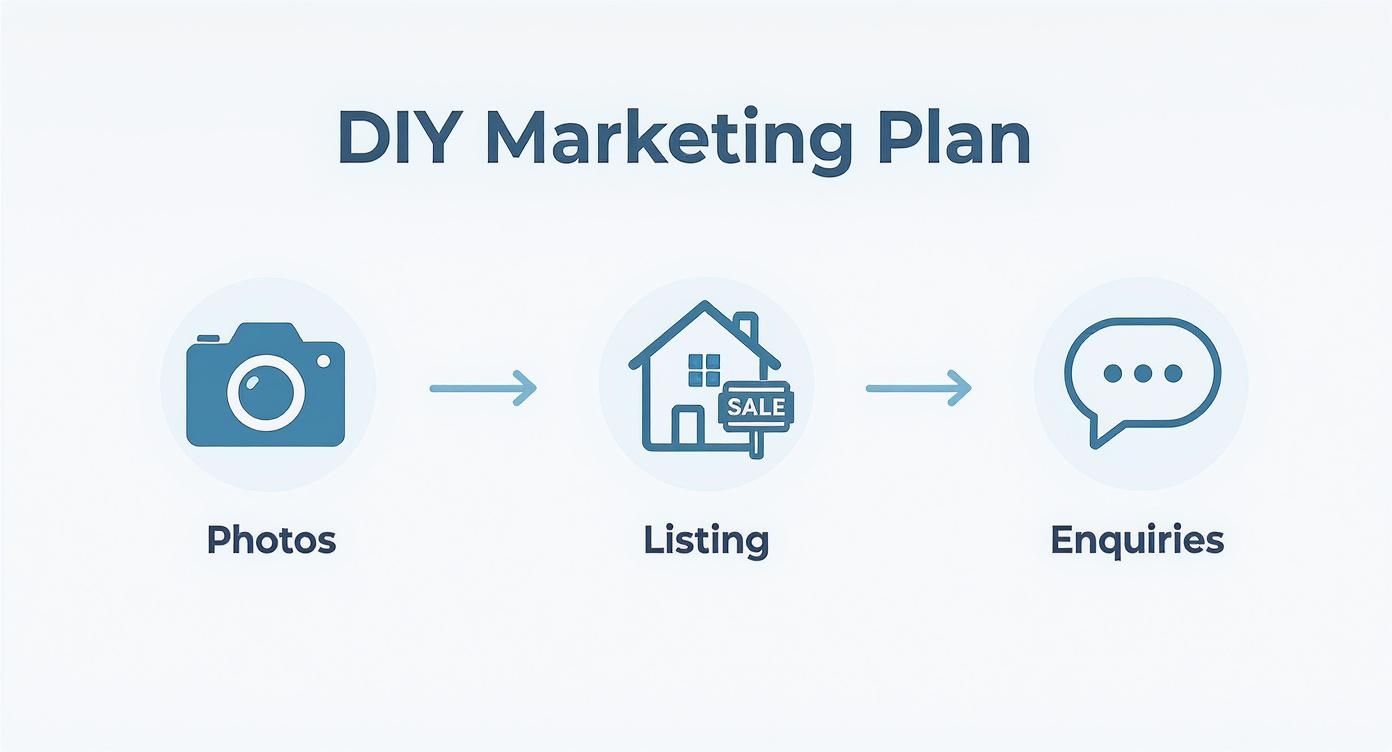
When you decide to sell your house privately, you’re not just the owner anymore—you’re the Chief Marketing Officer. Without an agent's hefty database and marketing machine, getting your home in front of the right buyers is entirely up to you. A solid marketing plan isn't just a good idea; it's your roadmap to attracting serious offers and getting the deal done.
This all starts long before you hit ‘publish’ on an online listing. It begins with creating the kind of marketing materials that grab a buyer’s attention and make them feel a connection to your home before they’ve even walked through the door.
Crafting Your Core Marketing Assets
In today’s market, your property's online presence is everything. Buyers make snap judgments based on what they see on screen, and that first impression is often the one that sticks. Cutting corners here is a false economy; this is where you need to invest your time and money to compete effectively.
Here are the absolute non-negotiables for a listing that looks the part:
- Professional Photography is a Must: I can't stress this enough. Your phone, no matter how new, simply can't compete with a professional real estate photographer. They know the lighting, the angles, and the tricks of the trade to make every room look spacious and inviting. It's the single best marketing money you will spend.
- Write a Compelling Property Description: Don't just list facts; sell the dream. Instead of saying "large backyard," paint a picture: "a huge backyard perfect for family barbecues and watching the kids play." Talk about the lifestyle. Mention the short stroll to the estuary for a morning kayak or the convenience of being just minutes from your favourite local cafe.
- Get a Detailed Floor Plan: Buyers absolutely love floor plans. They’re a practical tool that helps them visualise the space, understand the home’s flow, and start mentally arranging their own furniture. It’s a small touch that adds a massive amount of professionalism and value.
Choosing Where to Advertise
Once your photos and description are ready, it's time to get the word out. The aim is to maximise your exposure across a few different channels to make sure you’re reaching a broad, yet relevant, audience.
While you can’t list directly on major portals like Realestate.com.au as a private individual, there are excellent workarounds. Several third-party For Sale By Owner (FSBO) websites offer packages that get your property listed on these essential sites for a flat fee. This is a crucial move, considering over 90% of buyers begin their property search online.
But don’t stop there. Thinking locally can pay huge dividends:
- Leverage Social Media: Local Mandurah community groups on Facebook can be incredibly powerful. Share your listing with your best photos and a direct link to the main ad. You’d be surprised how much local interest and word-of-mouth buzz this can generate.
- A Quality "For Sale" Sign: Don’t underestimate the old-school approach. A professional-looking sign out front with your phone number is still amazingly effective. It catches the eyes of neighbours who might have friends or family desperate to move into the area, not to mention all the passive buyers just driving by.
Your best bet is a multi-channel strategy. By combining a major online listing with targeted social media posts and a physical sign, you're casting a wide net to catch as many potential buyers as possible.
Managing Enquiries and Viewings Like a Pro
If your marketing hits the mark, the phone will start ringing and emails will land in your inbox. How you manage this stage sets the professional tone for the entire sale. You need to be organised, prompt, and, above all, safe.
A smart first step is setting up a dedicated email address for the sale. You might even consider a cheap pay-as-you-go mobile number to keep all property enquiries separate from your personal life. When someone gets in touch, get back to them quickly and politely.
It’s also a great idea to create a simple, professional-looking features sheet to email interested parties or hand out at viewings. This should include:
- A few of your best photos.
- The full property description.
- The floor plan.
- Key details like land size, council rates, and water rates.
- Your contact information.
When it comes to scheduling viewings, your personal safety is paramount. Never, ever conduct a viewing alone—always make sure another adult is home with you. It’s also perfectly reasonable to ask for the person's full name and contact number before they arrive.
The Australian property market is incredibly active, with established houses making up 63% of all dwelling transfers, so there are plenty of genuine buyers out there. By being prepared and professional, you can tap into this market effectively and safely. You can discover more about Australian housing market trends on Your Mortgage.
Navigating Offers and WA Legal Requirements
The first offer landing in your inbox is a massive thrill. It’s the moment all your hard work preparing and marketing your Mandurah home starts to feel real. But this is also where things get serious, and getting your head around the legal side of things in Western Australia isn't just a good idea—it's essential for a smooth, secure sale.
The legal paperwork can feel a bit intimidating at first, but it’s a very structured process. It’s designed to protect everyone involved. Once you know the key documents and compliance checks, you can handle this stage with the confidence of someone who's done it all before.
The Cornerstone Document: The Offer and Acceptance Contract
In Western Australia, the entire sale hangs on one critical document: the Contract for Sale of Land or Strata Title by Offer and Acceptance. Don't think of this as a simple agreement; once signed by you and the buyer, it's a rock-solid, legally binding contract. It meticulously details every term of the sale, from the price and settlement date to any special conditions.
You absolutely cannot just write one of these up yourself. You must use the official, current version provided by the Real Estate Institute of Western Australia (REIWA) and the Law Society of WA. Trying to get by with an old form or a generic online template is asking for legal trouble.
Because this document is so legally crucial, the smartest thing you can do is engage a settlement agent or conveyancer before you even list your property. They'll supply the correct forms and give you the right advice on how to fill them out when an offer comes through. For a more detailed breakdown, check out our guide on navigating the Offer and Acceptance process in WA.
Understanding and Responding to Offers
An offer is never just about the number. It almost always comes with conditions, often called "subject to" clauses. These are hurdles that need to be cleared for the sale to go ahead, and as a private seller, you need to know how to read between the lines and negotiate them.
You’ll see a few common conditions pop up again and again:
- Subject to Finance: This is the big one. It gives the buyer a specific timeframe, usually 14 to 28 days, to get their home loan formally approved. If their bank says no, they can legally walk away from the contract.
- Subject to Building and Pest Inspection: The buyer will want to bring in a professional to check for any hidden issues. The contract needs to be clear about what happens if they find major structural defects or active pests.
- Subject to the Sale of Another Property: This one can be tricky. It means your buyer can't buy your place until they've sold their own. For you, the seller, this introduces a level of uncertainty and potential delays.
When you receive an offer, you've got three choices: accept it, reject it, or make a counter-offer. A counter-offer is your move in the negotiation dance—you might propose a higher price or tweak the conditions and send it back to the buyer. This is where your negotiation hat goes on.
A strong offer isn't just the highest price. It's the one with the cleanest, most favourable conditions that give you the greatest certainty of making it to settlement day. A slightly lower, unconditional cash offer can often be far more attractive than a higher offer that’s tangled up in the sale of another property.
Essential WA Compliance Checks
Before your property can officially change hands, WA law requires you to prove that key safety measures are in place. My advice? Get these sorted out early to avoid any last-minute panic.
You’ll need to get a licensed electrician to come in and certify that:
- At least two RCDs (Residual Current Devices) are installed and protecting the power and lighting circuits.
- Hard-wired smoke alarms are fitted in the correct spots and are no more than 10 years old.
These certificates aren’t optional. Your settlement agent will need them to finalise the sale. If you don't have them ready, you risk delaying settlement and could even face financial penalties.
Your Most Important Ally: The Settlement Agent
While you’re busy running the marketing and negotiations, the actual legal transfer of the property title has to be handled by a licensed professional. In WA, we call them a settlement agent or conveyancer.
Honestly, hiring one early is the best decision you'll make when selling privately. Think of them as your independent legal expert, making sure every box is ticked. They'll handle the title searches, adjust council and water rates, talk to the buyer's bank, and manage the secure transfer of funds on settlement day. Their fee is a small price for the peace of mind that comes from knowing your sale is legally sound and your money is protected.
Getting to the Finish Line: Negotiating and Closing Your Private Sale
You’ve done the hard yards. The house looks fantastic, your marketing has hit the mark, and now, the moment you’ve been working towards is here: an offer has landed in your inbox. This is where you switch gears from marketer to negotiator. It can feel like the most intense part of the process, but with a clear head and a solid strategy, you can navigate it with confidence and lock in a great result.
Remember, the first offer is almost never the final one. Think of it as the opening line in a conversation, not the final word. It's so important not to have a knee-jerk reaction, whether the offer is surprisingly high or disappointingly low. Your job is to stay cool, look at the offer on its merits, and plan a calm, strategic response.
Handling Offers and Counter-Offers
Before you even think about offers, you need to decide on your 'walk-away' price. This is your line in the sand—the absolute minimum you'll accept. Knowing this number from the get-go gives you a firm anchor and stops you from making a rash decision when the pressure is on.
When an offer comes through, don't just fixate on the price. Scrutinise every part of it. Pay close attention to the proposed settlement date and any special conditions, like being "subject to finance" or a building inspection. Honestly, a clean, unconditional offer might be worth more to you than a slightly higher one tangled up in complicated conditions.
You really only have three ways to respond:
- Accept: If the offer ticks all your boxes—price, conditions, settlement date—you can accept it as is.
- Reject: If the offer is a lowball or has terms you just can't work with, you have every right to reject it outright.
- Counter-offer: This is where most of the action happens. You tweak the price, settlement date, or conditions and send it back to the buyer. This keeps the conversation going and helps you both find that sweet spot in the middle.
A good negotiation isn't about one person 'winning'. It's about finding that mutual agreement where both you and the buyer feel like you've landed a fair deal. Keep the communication professional and respectful, always.
Reading the Buyer’s Play
Getting a bit of an insight into the buyer’s situation can give you a real advantage. Are they first-home buyers desperate to get on the ladder? Are they investors after a quick deal, or a family that has completely fallen in love with the neighbourhood and the local schools?
You can pick up a lot just by listening carefully during viewings and asking a few gentle, open-ended questions. A buyer who comes in with a pre-approved loan and a flexible settlement date is in a much stronger position than one whose offer relies on selling their own home first. Knowing this helps you figure out just how firm you can be on your price and terms.
From Acceptance to Settlement Day
Once you and the buyer have agreed on everything and signed the Offer and Acceptance contract, you officially enter the settlement period. This is typically a 30 to 90-day window where all the final legal and financial bits and pieces happen in the background.
This is where your chosen settlement agent really steps up and earns their keep. They'll be the one liaising with the buyer’s conveyancer, the banks, and all the relevant government bodies to make sure the transfer of ownership is seamless. They handle the mountain of paperwork, adjust for council rates and water taxes, and make sure the money is transferred correctly and securely on the final day.
During this time, you just need to make sure any conditions in the contract are met. For example, if the sale was subject to a pest inspection, you’ll need to grant access for the inspector to come through.
The private sale route is definitely becoming a more common sight in the property market. Data from the Australian Bureau of Statistics shows a noticeable year-on-year increase in dwelling transfers, pointing to a rise in private sales, especially in certain market segments. You can discover more insights into Australian dwelling values on the ABS website.
Finally, settlement day arrives. Your settlement agent will give you the call to confirm the buyer's funds have cleared. And that's it—the sale is complete. The only thing left to do is hand over the keys, marking the successful end of your journey in selling your own home.
Common Questions About Selling a House Privately
Jumping into the world of selling your own home always brings up a few questions. Even with a solid plan, there are a handful of specific concerns that pop up time and again for Mandurah homeowners. Let's get you some clear, direct answers to the most common ones we hear.
Do I Need a Real Estate Lawyer in WA?
While you're not legally required to have a lawyer oversee the entire sale, it is mandatory to use a licensed settlement agent or conveyancer in Western Australia. These are the professionals who handle the legal transfer of the property title from you to the buyer.
Think of them as the crucial final piece of the puzzle. They manage the official paperwork, hold all funds securely in a trust account, and make sure every single legal and financial box is ticked according to WA law. Honestly, getting one on board before you even list your property is one of the smartest things you can do.
What Are the Biggest Risks of a Private Sale?
When you boil it down, the main risks fall into three buckets. First, there's the danger of underpricing your property. Without deep market knowledge, it's easy to leave a significant amount of money on the table without even realising it.
Second is a failure to market your home effectively. If you can't reach a wide enough pool of genuine, qualified buyers, your home could sit on the market for a lot longer than necessary. And finally, making a mistake on the critical legal documents, like the Offer and Acceptance contract, can lead to serious headaches and even legal disputes down the track.
The good news? All these risks are completely manageable. With thorough market research, a small investment in professional help for things like photography and legal work, and a structured plan, you can minimise them almost entirely.
How Long Does It Usually Take?
This is the classic "how long is a piece of string?" question, because the timeline can vary so much. It's true that a private sale can sometimes take longer than one handled by an agent, mostly because you don't have access to their extensive network and marketing machine.
Your success really hinges on three things: nailing the price from day one, presenting your property flawlessly, and the current state of the Mandurah market. A beautifully presented, well-priced home in a hot market might get snapped up in just a few weeks. But in a slower market, or if your price is a bit ambitious, you should be prepared for it to take several months.
Feeling more confident but still want a professional opinion on your home's value? David Beshay Real Estate offers a completely free, no-obligation property appraisal. We'll give you a clear, data-backed understanding of what your home is worth in today's Mandurah market. Get the expert insights you need to make the best decision for your sale at https://realestate-david-beshay.com.au.

