


Thinking of selling your home privately? It’s a move that gives you complete control over everything—pricing, marketing, negotiations, the lot. The biggest carrot, of course, is saving thousands in agent commissions. But it's not a path for everyone. This route demands a serious investment of your time, a solid understanding of the Mandurah property market, and the confidence to handle some tricky legal stuff on your own.
It's a classic trade-off: potential savings versus hands-on responsibility.
Is a Private Sale in Mandurah Right for You?
This is the first, and most important, question you need to ask yourself. The thought of keeping an extra $15,000 or $20,000 in your pocket is incredibly tempting, and for some Mandurah homeowners, it’s a perfectly achievable goal. If you've got a knack for marketing and a schedule that allows for flexibility, you could be well on your way.
But let's be realistic—you're essentially taking on the full-time job of a real estate agent. This is far more than just sticking a sign out the front and hoping for the best. A successful private sale requires a specific set of skills and an emotional toughness that many people don't anticipate.
The Profile of a Successful Private Seller
From my experience, certain people and situations are naturally a better fit for a 'For Sale By Owner' (FSBO) sale. You’re more likely to pull it off if you:
- Have plenty of time to spare. Buyer enquiries will come in at all hours. You'll need to be ready to drop everything for viewings on evenings and weekends and handle all the admin that follows.
- Are a confident negotiator. Can you stay cool and objective when a buyer comes in with a lowball offer or tries to attach difficult conditions? You have to separate your emotional attachment to your home from a major financial deal.
- Know your way around basic marketing. You'll be responsible for writing compelling ad copy, taking high-quality photos, and figuring out the best places to list your home to attract genuine buyers. These aren't optional skills.
- Are exceptionally organised. You are the sole project manager. From tracking legal paperwork to scheduling building and pest inspections, there's no one else to remind you about a critical deadline.
A private sale gives you ultimate control, but it also means you carry the ultimate responsibility. Every single task, from answering that first phone call to handing over the keys on settlement day, rests entirely on your shoulders.
This decision tree can help you visualise whether you're prepared for the journey.
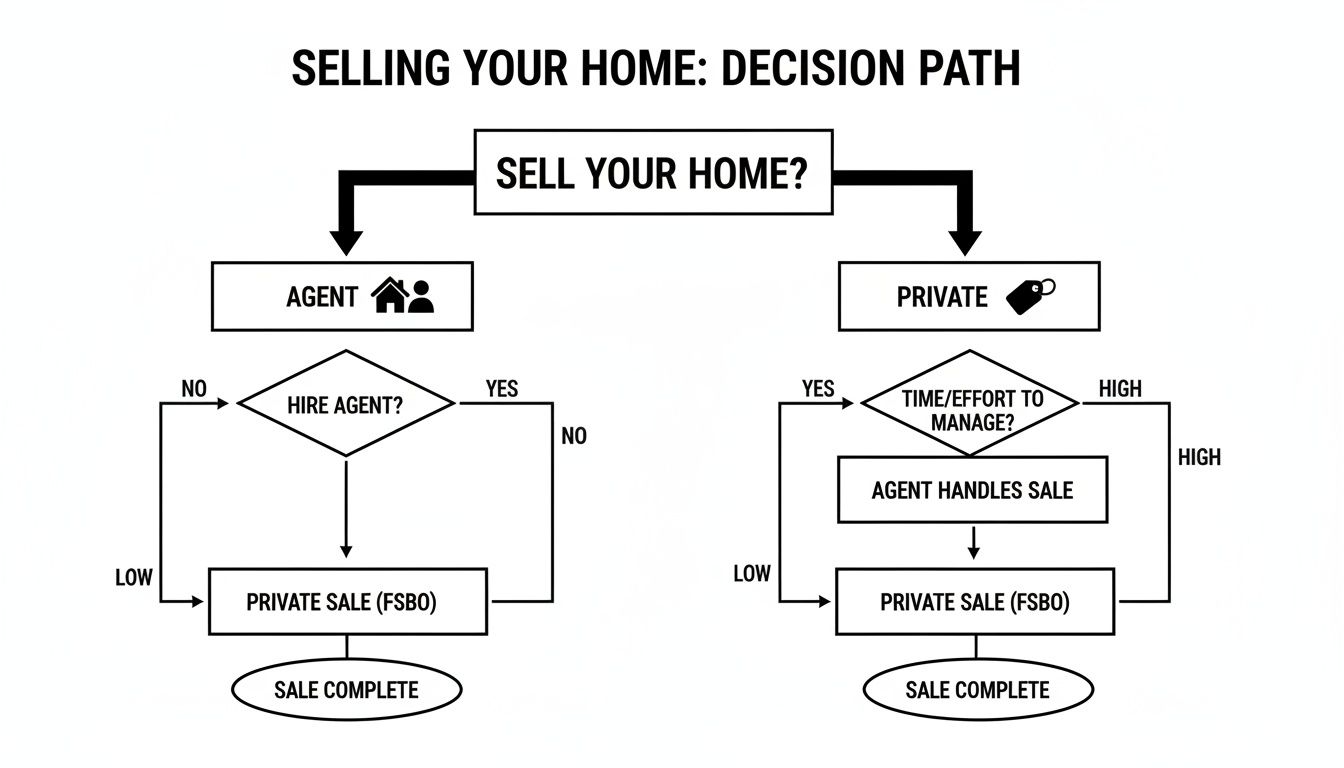
As the flowchart shows, things like your available time, knowledge of the local market, and comfort level with legal processes are the real deciders between going it alone or calling in a pro.
To make it even clearer, let's break down the core differences in a side-by-side comparison.
Private Sale vs Agent-Led Sale A Quick Comparison
This table offers a snapshot of what to expect from each path, helping you weigh up the realities of managing the sale yourself versus hiring a professional.
| Aspect | Selling Privately (FSBO) | Using a Real Estate Agent |
|---|---|---|
| Costs & Savings | No agent commission (typically 2-3% of sale price). You pay for marketing, legal fees, etc. | Agent commission is the main cost. Marketing costs may be separate or included. |
| Time & Effort | High personal time commitment. You manage all enquiries, viewings, and admin. | Minimal time investment from you. The agent handles the day-to-day workload. |
| Market Reach | Limited to online portals and your own network. Can be harder to attract a large pool of buyers. | Access to the agent's extensive database of qualified buyers and broader marketing channels. |
| Negotiation | You negotiate directly with buyers. Can be emotionally challenging and requires skill. | A professional, objective negotiator works on your behalf to secure the best price and terms. |
| Legal & Admin | You are solely responsible for ensuring all legal paperwork is correct and compliant. | The agent manages contracts and ensures all legal requirements are met, reducing your risk. |
| Final Price | Potential to net more if you achieve a top price, but risk of underselling due to inexperience. | An experienced agent can often create competition to achieve a higher sale price, offsetting their fee. |
While a DIY sale can work, it's clear that an agent brings a level of expertise and resources that are difficult for an individual to replicate.
When an Agent Adds Unmatched Value
On the flip side, there are definite times when bringing in a professional is the smartest financial move you can make. If you have a unique property—say, a luxury canal home in Halls Head or a sprawling rural block—an agent’s database of qualified, high-intent buyers is something you simply can't buy.
You also have to consider the market itself. Right now, in a hot Mandurah market, a skilled agent is a master at creating a competitive frenzy. They can generate multiple offers that push the final sale price well beyond what you'd hoped for. That premium alone can often cover the commission and still leave you with more in your bank account. If you want to explore different sale strategies, it’s worth understanding the difference between an auction vs private sale.
At the end of the day, this isn't just about saving a commission. It's about being brutally honest with yourself about your skills, your time, and the unique aspects of your property. A frank self-assessment now will save you a world of stress and potentially costly mistakes down the line.
Pricing and Preparing Your Mandurah Property
Right, you've decided to sell your home yourself. Good on you. Now comes the hard part, and honestly, the two things that will make or break your sale: getting the price right and making the place look a million bucks.
Nailing the asking price is a delicate dance. Go too high, and you'll hear crickets – buyers won't even bother booking a viewing. Price it too low, and you're literally giving away your hard-earned equity. At the same time, how your property actually looks and feels will directly shape the offers you get, if any.
Getting these two things sorted from the get-go is how you build momentum for a quick, profitable sale. Think of it as setting the stage perfectly before the curtains go up.
How to Price Your Home Like a Pro
First things first: forget relying solely on those instant online valuation tools. They're a decent starting point for a ballpark figure, but they have no idea about your new kitchen, the feel of your street, or the specific vibe of your part of Mandurah. To set a price that's both competitive and realistic, you need to roll up your sleeves and do your own comparative market analysis (CMA).
Basically, you're about to become a local property detective. Your mission is to find out exactly what homes just like yours have actually sold for recently.
- Hunt for Your Comps: Start looking for properties in your immediate area that have sold in the last three to six months. I'm not talking about the whole suburb – think your street and the ones directly around it.
- Compare Apples with Apples: The properties you find (your "comps") need to be as close to yours as possible. That means similar land size, number of bedrooms and bathrooms, age, and general condition. A four-bedroom canal home in Wannanup is useless for comparing to a three-bed unit in central Mandurah.
- Dig Into the Data: Look at their final sale price, not what they were first listed for. Also, pay attention to how long they were on the market. A place that sold in a week was probably priced spot-on. One that sat there for months? Almost certainly overpriced.
You can find all this sold data on the major real estate portals by using their filters. This research is genuinely the most important thing you'll do in the pricing stage.
Pro Tip: You have to be brutally honest with yourself here. Buyers will absolutely compare your home's tired kitchen or dated bathroom to the slick, renovated one down the road. You must adjust your price expectations to reflect your home's real condition.
Making Essential Pre-Sale Preparations
With a solid pricing strategy forming, it's time to switch gears to presentation. The goal is simple: make potential buyers fall in love with the idea of living in your home the second they see the photos or walk through the door.
This doesn't mean you need to sink thousands into a massive renovation. Not at all. The key is to focus on high-impact, low-cost jobs that give you the best bang for your buck. Buyers make up their minds in seconds, so that first impression is everything.
Your Pre-Listing Preparation Checklist
Before you even think about taking photos, run through this list. A weekend or two of focused effort here can genuinely add thousands to your final sale price.
- Declutter Ruthlessly: Pack away family photos, ornaments, and any extra furniture. Clear every single benchtop and surface. You're selling space, so show off as much of it as you can.
- Deep Clean Everything: This isn't your regular Saturday morning once-over. I'm talking sparkling windows, scrubbed grout, clean skirting boards, and a fresh, clean smell. If the budget allows, professional cleaners are worth every single cent.
- Fix the Small Stuff: That dripping tap, the squeaky door, the patch of chipped paint you've been ignoring for ages? Buyers will spot them immediately, and it makes them wonder what bigger problems are lurking. Get them all sorted.
- Boost That Kerb Appeal: The front of your house is the first thing people see. Mow the lawns, pull the weeds, give the driveway a good pressure wash. A new doormat and some colourful potted plants by the door can make a massive difference.
- Let There Be Light: Open every curtain and blind for photos and viewings. Make sure all light fittings are clean and replace any dim or blown bulbs with bright, warm ones. It makes every room feel bigger and more inviting.
- Do Some Basic Staging: You don't need to hire a professional. Simple things like fresh, fluffy towels in the bathrooms, a nice throw on the sofa, and a bowl of lemons on the kitchen bench help buyers connect emotionally with the home. For a deeper dive, check out our guide on how to prepare a house for sale.
By putting in the time on meticulous pricing and thoughtful preparation, you're not just listing a house—you're presenting a premium product to the market. This groundwork is the foundation for attracting serious buyers and getting a great result when you sell privately.
Crafting a Strategic Marketing Plan

When you decide to sell your home privately, you're stepping into the shoes of a real estate agent. You won't have their list of active buyers or their big-budget marketing machine. That means your own marketing approach needs to be smart, targeted, and really well put together to grab the attention of serious buyers in the Mandurah market.
A great marketing plan is about more than just posting a listing online. It's about telling a story that makes people feel they need to see your home. To do that, your plan needs three core things: incredible visuals, compelling words, and getting it all in front of the right people.
Professional Photography is a Non-Negotiable
If you're going to spend money on just one thing, make it professional photography. It's that important. Buyers are swiping through hundreds of listings on their phones, and your photos are your one shot at a first impression. Grainy, dark pictures taken on your smartphone will get your property scrolled past in a heartbeat.
A professional real estate photographer knows all the tricks—they understand lighting, the best angles, and how to compose a shot that makes rooms feel bright and spacious. They highlight your home's best features and help a buyer form an emotional connection before they've even set foot inside. This isn't a "nice-to-have"; it's an absolute must for a successful private sale.
- Twilight Photography: Got a canal home in Dudley Park or a fantastic outdoor area? A twilight shoot can create that high-end, dramatic feel that literally stops people from scrolling.
- Floor Plans: Buyers absolutely love floor plans. It helps them piece the home together in their minds, figure out if their furniture will fit, and understand the flow of the space. It adds a layer of professionalism that many private listings lack.
- Drone Shots: If you're on a bigger block in a suburb like Lakelands or your property has a unique position backing onto a park or the water, aerial shots are invaluable. They show the context and scale in a way ground-level photos just can't.
Writing a Listing Description That Actually Connects
Once your amazing photos have grabbed their attention, your words need to seal the deal. Your listing description is your chance to sell the lifestyle, not just the bricks and mortar. Stay away from a boring, bullet-pointed list of features and instead, paint a picture of what it’s actually like to live there.
First, think about who your ideal buyer is. Is it a young family who needs a big backyard and good schools nearby? Or maybe a retiree looking for a low-maintenance place close to the Mandurah foreshore? Write your description as if you're speaking directly to them.
Focus on the feeling, not just the features. Instead of saying "large outdoor patio," try something like, "Imagine weekend barbecues with friends on the expansive north-facing patio, perfectly protected from the afternoon sea breeze." This helps buyers emotionally place themselves right there in your home.
Don't forget to highlight what makes your specific spot in Mandurah special. Mention the short walk to the local coffee shop, the quiet cul-de-sac where the kids can play safely, or the easy access to the freeway for those commuting to Perth. These are the little details that truly resonate with local buyers.
Choosing Your Online Platforms
As a private seller, you can't just log into realestate.com.au or Domain and create a listing yourself. But you can still get on them. You'll need to use a third-party 'For Sale By Owner' (FSBO) website. These services are your gateway to reaching the 90% of buyers who start their property search online.
For a fee, these companies will upload your property to the major portals, giving you the exact same online visibility as an agent-listed home. Make sure you research their packages, as the costs and what's included can vary quite a bit.
Beyond the big players, don't ignore the power of social media:
- Facebook Marketplace: You might be surprised at how effective this free platform is for local listings.
- Local Community Groups: Share your listing in Mandurah-specific Facebook groups (just check the group rules first!). This is a brilliant way to reach a super-targeted local audience.
- Your Own Network: Post your professional photos and a well-written description on your own social media. You never know who in your network—or their network—is looking to buy.
A smart mix of professional photos, evocative copy, and strategic online placement is the backbone of any successful private sale marketing plan.
Managing Viewings, Negotiations, and Legal Duties

This is where the rubber really hits the road in a private sale. You've done the hard yards—pricing your property, getting it looking immaculate, and your marketing is finally bringing in the calls. Now, you have to shift gears into managing inspections, navigating the tricky art of negotiation, and making sure you're ticking all the legal boxes required in Western Australia.
Getting this stage right is what separates a smooth, profitable sale from a stressful and potentially costly mistake. It's a real blend of organisation, people skills, and a solid grasp of the local rules.
Conducting Safe and Effective Viewings
When the phone starts ringing, your main goal is to show off your home's best features while keeping yourself and your property secure. It doesn’t matter if you decide on private inspections or set open home times; having a structured approach is what makes the experience feel professional for everyone.
Before you even let someone through the door, it’s a smart move to pre-qualify them. You can learn a lot by asking a simple question like, "Are you in a position to make an offer, or are you just starting your search?" This little bit of intel helps you focus your energy on serious buyers, not just the curious neighbours.
To keep your viewings safe and productive, here are a few things I always recommend:
- Create a Welcoming Atmosphere: Open all the curtains to let the natural light flood in, switch on all the lights, and maybe put on some quiet, neutral music. A subtle, fresh scent from a diffuser (think citrus or vanilla) can make a space feel incredibly inviting.
- Remove Valuables: This one’s a no-brainer. Lock away any jewellery, important documents, and even prescription medications. It's a simple precaution that gives you total peace of mind.
- Prepare an Information Pack: Have a simple one-page flyer ready with the key details—land size, council rates, a list of key features—and your contact information. It looks professional and, more importantly, it helps buyers remember your property after they've seen a few others.
- Guide, Don't Hover: Let people wander through the rooms at their own pace. Make yourself available to answer questions, but try to avoid following them from room to room. It can make people feel pressured and uncomfortable.
Your role during a viewing is to be a helpful host, not a high-pressure salesperson. Let the home speak for itself. Your preparation has already done the heavy lifting; now, your job is to answer questions honestly and build rapport.
This approach builds a sense of trust and gives buyers the space they need to emotionally connect with your home—a crucial step towards them putting in an offer.
The Art of Negotiation
Getting that first offer is a genuinely exciting moment, but it’s so important to stay calm and think strategically. Negotiation is a skill, and when you’re selling privately, you’re the chief negotiator. It’s not about winning or losing; it’s about finding a middle ground where everyone feels good about the outcome.
Offers will come in all shapes and sizes. Some will be clean, straightforward offers on the price, while others will come with conditions attached. The most common ones you'll see are "subject to finance" or "subject to a building and pest inspection."
When an offer lands in your inbox, don't feel like you have to respond immediately. Thank the buyer, tell them you'll consider it, and promise to get back to them. This buys you valuable time to think clearly without the pressure of the moment.
Here are a few tactics to keep in your back pocket:
- Understand the Whole Offer: The price is just one piece of the puzzle. A slightly lower offer with no conditions or a settlement date that suits you perfectly might actually be more valuable than a higher offer tied up with complicated terms.
- Make a Strategic Counter-Offer: If an offer is disappointingly low, don't take it personally. Respond with a counter-offer that's reasonable and brings them closer to your asking price. It shows you're serious about selling and willing to meet them partway.
- Use a Deadline: When you present a counter-offer, it's perfectly fair to state that it's valid for a specific period, like 24 or 48 hours. This creates a bit of urgency and discourages the buyer from using your price to shop around with other sellers.
Remember, the best negotiations end with both parties feeling like they've walked away with a fair deal.
Understanding Your Legal Duties in WA
Pay close attention here, because this is the most critical part of selling your home privately in Western Australia. Mistakes at this stage can have serious legal and financial consequences. You don't need to be a lawyer, but you absolutely must understand your core legal responsibilities as a seller.
The central legal document in any WA property sale is the Contract for Sale of Land or Strata Title by Offer and Acceptance. Once signed by you and the buyer, this is a legally binding document.
You are required by law to disclose certain information to potential buyers. These mandatory disclosures include things like:
- The status of RCDs and hard-wired smoke alarms.
- Compliance certificates for swimming pool and spa barriers, if you have them.
- For strata properties, you must provide the strata plan, by-laws, and other relevant documents.
Failing to provide these disclosures—or providing incorrect information—can give the buyer grounds to terminate the contract and could even lead to legal action.
Given how complex this can be, engaging a settlement agent or conveyancer right from the start is non-negotiable. They will make sure your contracts are drafted correctly, that all your legal duties are met, and that the settlement process goes off without a hitch. For a more detailed breakdown, you can learn more about what is involved in a contract of sale on our blog. Honestly, their fee is a small price to pay for the assurance that your private sale is legally sound.
The Risks of Going It Alone and When to Get Help
Going down the path of a private sale can feel incredibly empowering. The idea of saving a hefty commission is a huge drawcard, no doubt about it. But that saving comes with a trade-off: you're now responsible for every single detail, from marketing to the final signature.
This isn't just about putting in the time and effort. You're stepping into a high-stakes arena where a simple mistake can have serious financial repercussions. Acknowledging the risks isn’t meant to put you off; it’s about making sure you’re prepared to spot the signs when the DIY route isn’t working and calling in a pro becomes the smartest move you can make.
Common Pitfalls for Private Sellers
One of the toughest hurdles is taking the emotion out of it. It’s your home, filled with memories, and it’s almost impossible not to let that attachment cloud your judgement. This is what usually leads to the most common mistake of all: incorrect pricing. When you overvalue your property based on sentiment, it just sits there, going stale in the eyes of genuine buyers.
The sheer volume of work involved is another thing that catches people by surprise. You quickly find yourself fielding calls at all hours, trying to weed out the time-wasters, and navigating a mountain of legal paperwork. It can easily feel like a second full-time job, leading to burnout and costly errors.
Here are a few other common stumbling blocks:
- Limited Market Reach: An agent has a database of qualified buyers and access to marketing channels you don't. Without that, you might struggle to get your property in front of enough people to create real competition.
- Negotiation Inexperience: It can be pretty intimidating to find yourself at the negotiating table with a sharp buyer's agent. A lack of experience could see you accepting a lower price or less favourable terms than you should.
- Legal and Compliance Errors: The contractual process here in Western Australia is incredibly strict. One small mistake on the Offer and Acceptance contract can put the whole sale at risk or leave you legally exposed down the track.
The truth is, selling privately in WA isn't as common as you might think. Many homeowners know that professional guidance is invaluable, especially when the market is moving as quickly as it is in Mandurah.
Recent data backs this up. A nationwide survey found only 21% of Aussies have even considered selling their home privately online. That number drops to just 9% for Baby Boomers, who make up a significant portion of homeowners across Mandurah's suburbs.
This preference for expert help makes a lot of sense in a market where Perth-area home values, including Mandurah, jumped by 4.9% in a single quarter last year. You can read more about these Australian property price trends to get a feel for the market's complexity.
Red Flags: When to Call in an Agent
Sometimes, no matter how hard you try, a private sale just doesn't get off the ground. The key is to recognise the warning signs early before you lose too much time, money, and sanity. If any of this sounds familiar, it might be time to switch gears and bring in a professional.
Think of these as urgent alerts that your strategy isn't working:
- The phone isn’t ringing. If you've been actively marketing for a few weeks and all you hear is crickets, it’s a big sign your price is off or your marketing isn't hitting the mark.
- You're only getting lowball offers. When every offer that comes in is well below what you're asking, it’s the market telling you that your price expectations are out of sync with reality.
- You're feeling completely overwhelmed. If the stress of juggling viewings, negotiations, and paperwork is getting to you, that's a sign you need help. Your mental wellbeing is just as important as the final sale price.
- The property is just sitting there. In a decent market, a well-priced home should be getting serious attention within the first month. If yours is lingering, it's losing its shine and becoming 'old news' to new buyers.
An experienced local agent can diagnose these problems in a heartbeat. They can give you an objective price appraisal, relaunch your home with a fresh marketing strategy, and tap into their network of active buyers to kickstart the momentum.
Ultimately, the goal of selling your home privately is to get the best financial result. If the process is stalling, bringing in an expert whose negotiation skills could secure you a higher price isn't admitting defeat—it's just making a smart business decision.
Frequently Asked Questions About Selling Your Home Privately in Mandurah
Taking the plunge and selling your home yourself naturally brings up a lot of questions. We get it. Here are straight-up answers to the most common queries we hear from homeowners across the Mandurah area, designed to give you the clarity you need to move forward.
What Legal Documents Do I Need to Sell My House Privately in WA?
The absolute cornerstone of your paperwork is the Contract for Sale of Land or Strata Title by Offer and Acceptance. This is the document that, once signed by you and the buyer, becomes legally binding. No turning back.
But it doesn't stop there. You'll also need to have a current title search and the property plan on hand. On top of that, Western Australian law is quite specific about what you must disclose to a potential buyer.
- Safety Switches: You're required to provide clear information on the presence of RCDs (residual current devices).
- Smoke Alarms: Details about hard-wired smoke alarms must be included.
- Pool Fencing: Got a pool or spa? You'll need a current compliance certificate for the safety barrier.
- Strata Properties: If you're selling a unit or townhouse, the buyer needs the strata plan, by-laws, and other related strata documents.
Given how much weight these documents carry, it’s not just a good idea—it's essential—to have a settlement agent or conveyancer cast a professional eye over everything. They’ll ensure you’re ticking every box and staying fully compliant.
How Can I List on Realestate.com.au Without an Agent?
This is a big one. As a private seller, you can't just create an account and list your property directly on the major portals like realestate.com.au or Domain. These platforms are built exclusively for licensed real estate agents.
There is, however, a well-trodden path around this. You can work with a third-party 'For Sale By Owner' (FSBO) service. These companies are set up to act as your middleman. For a flat fee, they will list your home on the big portals on your behalf, giving you the exact same online exposure that an agent-listed home gets.
When you're weighing up different FSBO services, look very closely at what's included in their packages. Some will bundle in extras like professional photography, floor plans, or 'For Sale' signs, which can actually be a really cost-effective way to get your marketing sorted.
Will I Really Save Money by Selling Privately?
On paper, yes. You'll avoid paying an agent's commission, which usually sits around 2-3% of the final sale price. But that doesn't automatically translate to more cash in your bank account at settlement.
Don't forget, you're now footing the bill for every single marketing expense yourself. That includes professional photography, the online listing fees, signage, and any other advertising. More importantly, the single biggest financial risk is leaving money on the table by underselling your property. A great agent often negotiates a final price that covers their commission and then some, especially in a dynamic market like Mandurah's. The potential loss from a negotiation that didn't go your way can easily wipe out any savings on commission.
What Is the Biggest Mistake Private Sellers Make?
Hands down, the most common and costly mistake is getting the price wrong. It's incredibly hard to be objective about your own home. Private sellers often let emotional attachment, or those tempting but unreliable online valuation tools, lead them to an inflated asking price. An overpriced home doesn't just sit there; it actively repels genuine buyers from day one and quickly becomes stale.
The second-biggest blunder is underestimating the sheer time, energy, and skill involved. Effective marketing, knowing how to qualify a serious buyer from a tyre-kicker, and managing a high-stakes negotiation are all distinct skills. Many sellers find the process becomes a stressful, drawn-out ordeal that ultimately leads to a less-than-ideal result. A private sale is a massive undertaking, and it demands expertise in more areas than most people realise.
Navigating the Mandurah property market takes genuine local knowledge and a strategy that's proven to work. If you're weighing up your options and want a clear, data-driven perspective on what your home is truly worth, let's talk. Contact David Beshay Real Estate for a no-obligation, free property appraisal today.

