


If you've ever looked at buying an apartment, townhouse, or unit in a complex, you've almost certainly come across the term "strata fees." But what exactly are they, and what do you get for your money?
Let’s break it down.
What Are Strata Fees Explained
Think about owning a typical standalone house for a moment. You’re on the hook for everything—mowing the lawns, fixing the roof, painting the exterior, and insuring the whole building. It's all on you.
Now, picture that apartment complex or townhouse community. Who’s looking after the shared swimming pool, the gardens, the lobby, or the building’s roof? That’s where strata fees (often called levies) come in.
In simple terms, strata fees are your contribution to a central pool of money used to manage, maintain, and insure the shared parts of the property.
These aren't just random charges; they're the lifeblood of a well-run strata complex. Everyone chips in, and that collective fund pays for all the shared expenses. It's how the property is kept in great shape, which protects your investment and lifestyle. For anyone considering a strata title property, getting your head around this concept is the first crucial step.
The Three Core Components of Strata Levies
Your total strata fee isn’t just one big, mysterious number. It’s usually broken down into a few different funds, each with a very specific job. Understanding where your money goes is key to assessing the financial health of the building.
Here’s a quick look at the three main types of levies you'll encounter.
A Quick Look at What Your Strata Fees Cover
This table shows how your total strata contributions are typically divided to cover different types of expenses, from the coffee machine in the lobby to a complete roof replacement.
| Levy Type | Purpose | Common Examples |
|---|---|---|
| Administrative Fund Levies | The day-to-day running costs. This is the operational budget for all the regular, predictable expenses needed to keep the place ticking over. | Cleaning of common areas, gardening/lawn mowing, shared electricity and water bills, building insurance premiums, strata manager fees. |
| Sinking Fund Levies | The long-term savings plan. This fund is for major, planned capital works and replacements that will eventually be needed down the track. | Replacing the roof, repainting the entire building exterior, upgrading the lift, resurfacing the driveway, major pool repairs. |
| Special Levies | The emergency fund. A one-off charge for urgent, unforeseen major expenses when there isn't enough money in the Sinking Fund. | Urgent structural repairs after a storm, unexpected major plumbing failure, legal costs from a lawsuit against the owners corp. |
A healthy Sinking Fund is a great sign when you're looking to buy—it means the owners corporation is planning properly for the future, making surprise Special Levies much less likely.
The Three Funds That Shape Your Levies
When you pay your strata fees, the money isn’t just tossed into one big bank account. It’s actually split into three different ‘pots,’ each with a very specific and important job to do. Getting your head around these three funds is the key to understanding the financial health of any strata complex.
Think of it like managing your own household budget. You’ve got your everyday account for groceries and bills, a long-term savings account for a new car or a big holiday, and maybe an emergency fund tucked away for when the unexpected happens. A well-run strata scheme works on the exact same principle.
This chart shows how your total strata contributions are broken down across these essential funds.
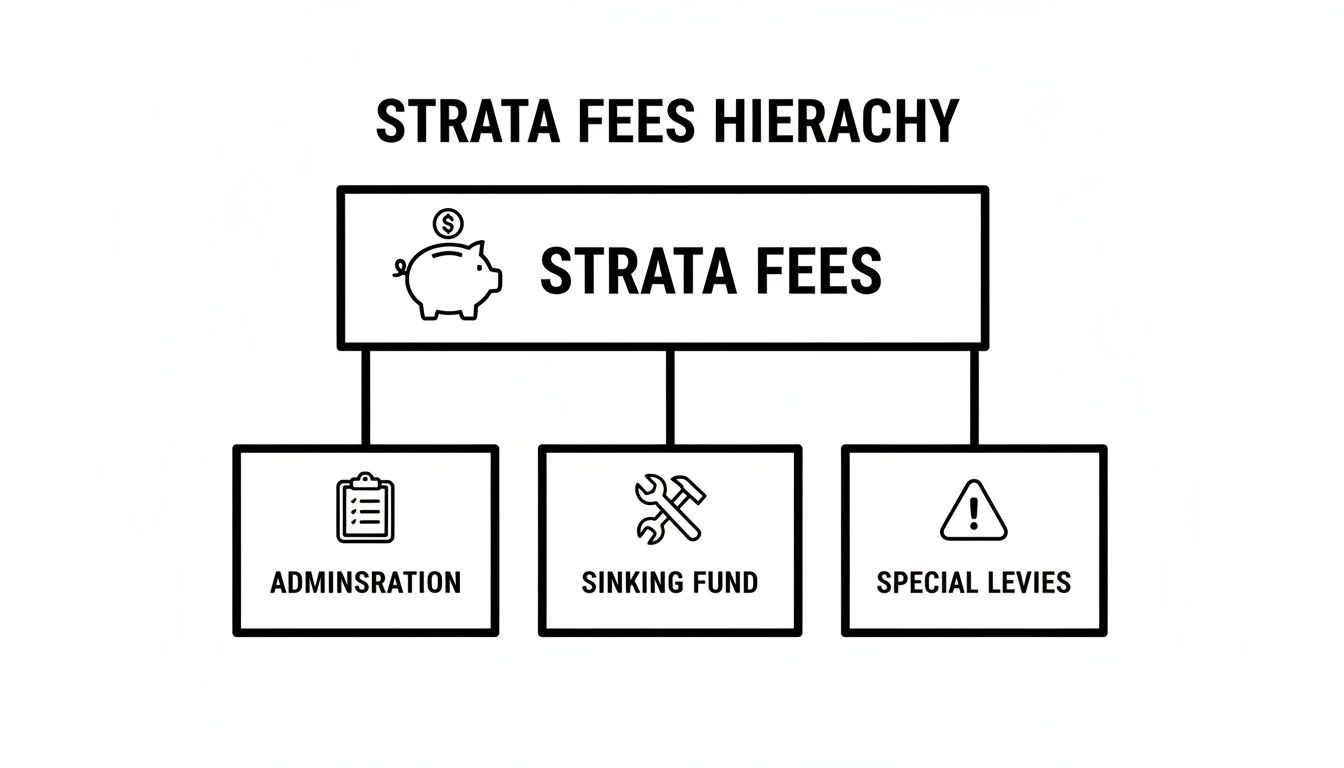
As you can see, every owner’s contribution is funnelled into three main categories—Administrative, Sinking, and Special—each serving a unique purpose, from day-to-day upkeep to major repairs.
The Administrative Fund: Your Daily Operations Budget
First up is the Administrative Fund. This is the building’s everyday transaction account, designed to cover all the predictable, recurring expenses needed to keep the property running smoothly month after month.
Without it, the common areas would quickly fall into disrepair. This fund makes sure the lights stay on in the hallways, the gardens are looked after, and the property stays clean and safe for everyone.
Some of the most common costs paid from this fund include:
- Maintenance: Regular cleaning of lobbies, gardening, and lawn mowing.
- Utilities: Electricity and water for common areas like pools, gyms, and lifts.
- Management: Fees for the professional strata manager who handles all the admin.
- Insurance: Annual premiums for the building’s compulsory insurance policy.
This fund is budgeted for every year, and your regular levy payments are what keep it topped up to handle all these ongoing costs.
The Sinking Fund: Planning for the Future
Next, we have the Sinking Fund, which you might also hear called a Capital Works Fund. This is the building's long-term savings account, and frankly, it's one of the best indicators of a well-managed strata scheme. Its whole purpose is to build up money over time for major capital works that will eventually be needed.
A healthy Sinking Fund is your best defence against a sudden, massive bill. It’s a clear sign that the owners are planning for the future, not just reacting to problems as they pop up.
This is the fund that pays for the big-ticket items that wear out over time. We’re talking about things like replacing a 20-year-old roof, repainting the entire building exterior, or upgrading an old lift. By putting a small amount aside with each levy payment, owners make sure the money is already waiting when these huge expenses finally come around.
Special Levies: The Emergency Fallback
Finally, there are Special Levies. These aren't your regular, planned payments. Instead, they are one-off charges raised for a specific, often urgent, purpose. A special levy is called for when a major, unexpected expense hits and there isn’t enough cash in the Sinking Fund to cover it.
For instance, a wild Mandurah storm might cause serious structural damage that needs immediate fixing, or a main plumbing system could fail without warning. If the Sinking Fund can’t cover the bill, all the owners have to vote to raise a special levy to make up the difference. While they’re sometimes unavoidable, a history of frequent special levies can be a major red flag, often pointing to poor long-term financial planning.
Ever wondered why your strata fees are different to your neighbour’s, even when you live in the same building? It’s a common question. The calculation isn’t as simple as splitting the total costs evenly among all the owners. Instead, it’s a detailed process that balances a shared budget against your specific stake in the property.
It all kicks off when the owners corporation—that’s the collective group of all property owners—gets together for their Annual General Meeting (AGM). This is the big one. At this meeting, they map out the building’s needs for the year ahead and lock in an annual budget. This budget has to cover everything from the day-to-day running costs paid from the Administrative Fund to the long-term savings needed for the Sinking Fund.
Once that total budget is set, the real question is: how do they slice up the pie fairly?
Understanding Unit Entitlement
The secret to understanding your strata fees lies in a concept called unit entitlement. Every apartment or townhouse in a strata plan is assigned a number, and this number basically represents your proportional share of the entire complex. You can think of it as owning a certain number of "shares" in the whole property.
This number isn't just pulled out of a hat. It's usually based on things like:
- The size of your unit (bigger apartments generally have a higher entitlement).
- The original value of your unit when the strata plan was first registered.
- Extra features like balconies, car spaces, or a killer view.
Your strata fee is worked out by multiplying the total budget approved at the AGM by your specific unit entitlement. So, a higher entitlement means you pay a larger chunk of the shared costs, while a lower one means you contribute a smaller amount.
This method ensures that owners of larger or more valuable properties, who have a greater stake in the complex, chip in proportionally more for its upkeep. It’s all about fairness.
Why Do Strata Fees Vary So Much?
Unit entitlement explains why fees differ within the same building, but why do they vary so dramatically from one building to the next? Several key drivers inflate or shrink that annual budget, which in turn dictates what you pay.
The age and condition of the building are massive factors. An older complex will naturally need more maintenance and a healthier Sinking Fund to cover upcoming repairs, which means higher fees. A brand-new building might start with lower fees, but don’t be surprised when they creep up as the property gets older.
Location matters, too. A building right on Mandurah's beautiful waterfront will likely face higher insurance premiums, and insurance is a major slice of the administrative budget.
But the biggest determinant? Amenities. A simple block of units with a shared garden will have far lower running costs than a modern high-rise tower loaded with extras like:
- Swimming pools and spas
- Fully equipped gyms
- Lifts and secure underground parking
- Concierge services
All these facilities need constant cleaning, maintenance, and power, sending the budget soaring. As a rough guide, complexes with all the bells and whistles often have fees that are much higher as a percentage of the property's value. Data from similar strata markets shows that buildings with pools and gyms typically have annual fees between 0.8% and 1.2% of the property's value, while those without are more likely to be in the 0.3% to 0.7% range. You can discover more insights about strata fee percentages and what influences them to get a better feel for what to expect. This is exactly why comparing levies between two buildings without looking at what you actually get for your money can be so misleading.
Decoding the Major Costs: Insurance and Management
When you first glance at a strata budget, two line items almost always jump out: building insurance and strata management fees. These are the heavy hitters, often taking up the biggest slice of the administrative fund. Getting your head around what these cover is key to understanding where your money is going and why they're so vital for your property's health.

Think of strata insurance as the ultimate safety net for your entire building. It’s a compulsory policy that covers the whole structure—from the roof right down to the foundations—plus all the shared spaces like lobbies, pools, and car parks. This is completely different from your personal contents insurance; it’s designed to protect the collective asset against major disasters like fire, storms, or structural failure.
The cost of this insurance premium can swing wildly depending on a few key factors. The building's age, what it's made of, and its general condition all play a big part. But location is a massive driver too, especially for coastal properties in places like Mandurah that are more exposed to storms and harsh weather.
A huge chunk of strata fees in Australia goes towards insurance premiums. We're talking anywhere from 40% to 60% of levies being tied to risks like storms, floods, and water damage. In Western Australia, this financial protection is absolutely crucial for our coastal properties.
The Role of a Professional Strata Manager
While the owners corporation (that’s you and all the other owners) makes the big decisions, a professional strata manager is usually hired to handle the day-to-day grind. This is the second major cost you’ll spot in the budget, and a good manager is worth their weight in gold. Their job is to make sure the building runs like a well-oiled machine.
A strata manager typically looks after:
- Admin Duties: Organising meetings, keeping detailed records, and managing all communications.
- Financial Management: Drawing up budgets, sending out levy notices, and handling the scheme’s bank accounts.
- Legal Compliance: Making sure the strata scheme follows the Strata Titles Act and all other relevant laws.
Their base management fee usually covers these core services. But it’s always smart to check their agreement for any extra charges for work that falls outside the standard scope, like overseeing major repairs or representing the strata at a tribunal.
A transparent, efficient manager adds immense value. You can learn more about how their role fits into the bigger picture by reading our guide on what a body corporate does. Ultimately, both insurance and management are non-negotiable costs that protect your investment and keep your property a safe, well-maintained place to call home.
Essential Due diligence for Buyers and Sellers
Whether you’re buying or selling a strata property here in WA, getting a handle on the scheme's overall health is absolutely non-negotiable. For buyers, it’s all about protecting your investment from nasty surprises down the track. For sellers, it's about confidently showcasing your property’s true value to get the best possible price.
This whole process is often called a 'strata search' or due diligence, and it really means taking a deep dive into the building's records. Honestly, it’s one of the most critical steps you can take before putting pen to paper on any contract. It tells the real story of the property’s financial and even social wellbeing. A good agent is your best friend here, helping you read between the lines and ensure a smooth transaction.
What Buyers Must Scrutinise
Before you even dream about making an offer, you need to put on your detective hat. Getting your hands on the strata records is your first mission, as they give you an unfiltered look at how the building is actually managed.
Don't just give these documents a quick skim. They are packed with clues that can save you from a world of future headaches and financial shocks. Your focus should be on a few key documents that paint the clearest picture of the strata scheme's health. You can learn more about what a comprehensive strata report includes to guide your review.
Specifically, you need to get your eyes on:
- AGM Minutes: Go back through the minutes from the last couple of Annual General Meetings. These notes are gold—they reveal everything from owner disputes and nagging maintenance issues to frank discussions about future spending.
- Financial Statements: Check the balance of both the administrative and the sinking funds. A seriously low sinking fund is a massive red flag. It suggests the scheme is flying by the seat of its pants, completely unprepared for future major works.
- The 10-Year Plan: This is the roadmap for planned capital works over the next decade. It’ll tell you if big-ticket items like a roof replacement or a lift upgrade are on the horizon, which will almost certainly impact your future levies.
Pay very close attention to any history of frequent special levies. While a one-off can happen for a genuine emergency, a recurring pattern often screams poor financial planning. This means you could be the one hit with unexpected, large bills right after you move in.
How Sellers Can Build Buyer Confidence
Now, if you're on the other side of the fence and selling, this very same information can be one of your most powerful marketing tools. A well-managed strata scheme with healthy financials isn't a liability; it's a huge selling point that adds real, tangible value to your property.
Being proactive and presenting this information builds immediate trust and confidence. Don't sit back and wait for buyers to ask. Have the key documents ready to go and be prepared to highlight the positives. A strong sinking fund balance and a clear 10-year maintenance plan show potential buyers that your property is a stable, secure investment.
This kind of transparency can make your property stand out from the competition, attract more serious buyers, and ultimately justify a higher sale price.
What Happens If You Don't Pay Your Strata Fees?
Think you can just ignore your strata levies? Think again. Those fees are a legal debt, and failing to pay them kicks off a serious process that you really want to avoid. What might start as a simple missed payment can quickly snowball into major legal and financial headaches, hammering home that these fees are a non-negotiable part of strata living.

It all starts fairly innocently. The owners corporation will send out a few reminder notices. But if the amount is still outstanding, they are legally allowed to start charging interest. In Western Australia, this can be as high as 10% per annum. This isn't just a slap on the wrist; it’s designed to strongly discourage late payments and to cover the financial gap your missed contribution has created for the entire scheme.
The Escalation Process
If the reminders and interest charges don't prompt a payment, the situation gets a lot more serious. The owners corporation has a clear pathway to recover the money, and it typically unfolds like this:
- Debt Collection: The first move is often to bring in a debt collection agency. They’ll start pursuing you for the outstanding amount, and you can be sure their collection costs will be added straight onto your bill.
- Legal Action: If that doesn't work, the next step is court. The owners corporation will seek a legal order for you to pay. The kicker? You'll likely be on the hook for their legal fees, too.
The consequences can be incredibly severe. It's not unheard of for an owners corporation to initiate bankruptcy proceedings against a lot owner to recover a substantial debt.
And this isn't just some theoretical threat. Across Australia, unpaid levies are a contributing factor in 10% of forced bankruptcies, a statistic that hits lower-income owners particularly hard. You can dive deeper into the broader impacts by reading the full government review on strata commissions.
Got Questions About Strata Fees? Here Are the Answers
When you're dealing with strata properties, a few common questions always seem to pop up. To cut through the confusion, here are some straightforward answers for both first-time buyers and long-time owners in Western Australia.
Are Strata Fees Tax Deductible in Australia?
This one comes down to a simple question: are you living in it or renting it out?
If you own the property as an investment and have tenants in, then yes, your strata fees are generally tax deductible. They're considered a standard expense of running your investment property. But if you live there yourself as an owner-occupier, the Australian Tax Office sees them as a personal living cost, which means you can't claim them.
As always with tax matters, it's smart to chat with your accountant to get advice tailored to your specific financial situation.
Can I Refuse to Pay a Special Levy?
The short answer is no. Once a special levy is properly tabled, discussed, and voted through by the required majority of owners at a general meeting, it becomes a legal debt. Every single lot owner is required to pay their share.
Think of it this way: refusing to pay a special levy is just as serious as ignoring your regular admin or sinking fund contributions. You'll face the same consequences, like interest charges piling up and even potential legal action from the strata company to recover the money. Your chance to push back or voice your opinion is during the meeting where the vote happens, not after.
How Do I Find Out the Strata Fees for a Property?
When you’re looking to buy, this information should be easy to find. The selling agent is legally required to give any serious buyer a strata disclosure statement.
This is a formal document, usually bundled with the contract of sale, that clearly lays out the current levies for the property you’re interested in.
But don't stop there. For a true picture of the building's financial health, you should also ask to see the strata records. This means looking over the minutes from recent meetings and reviewing the latest financial statements. A good local agent can not only get these documents for you but also help you understand what you're looking at.
Navigating the complexities of strata properties in Mandurah requires expert guidance. Whether you're buying your first apartment or selling a beloved townhouse, David Beshay Real Estate provides the in-depth local knowledge you need to make confident decisions. For a free, no-obligation property appraisal, visit https://realestate-david-beshay.com.au.

