


When you see a "For Sale" sign on a front lawn, chances are the home is being sold by private treaty. It’s the most common way property changes hands here in Australia, and for good reason. It simply means the property is sold through direct, private negotiation between a seller and a buyer, usually with a real estate agent acting as the go-between.
Unlike a public auction, a private treaty sale involves a set asking price where offers are made privately and confidentially.
What Selling By Private Treaty Actually Means
Think of it less like a frantic, high-pressure bidding war and more like a carefully managed business deal. An auction has a hard deadline and all the bids are out in the open. A private treaty sale, on the other hand, gives everyone a bit more breathing room. It offers more flexibility, time, and privacy for both the seller and potential buyers.
It’s a much more controlled environment where negotiations can unfold naturally, without the intense pressure of an auctioneer's hammer hanging over your head. The whole method is built on a few core ideas that make it pretty straightforward for everyone involved.
The Key Elements of a Private Treaty Sale
At its core, the private treaty process comes down to three key stages:
- Setting a Price: The seller, guided by their agent's market expertise, decides on a clear asking price or a price range. This sets the stage for all discussions and gives buyers a solid idea of the seller's expectations right from the get-go.
- Marketing the Property: The agent gets to work marketing the home to attract a wide pool of potential buyers. This involves everything from professional photography and online listings on sites like realestate.com.au to running open for inspections, all designed to showcase the property’s best features and bring in offers.
- Confidential Negotiations: Once an interested buyer comes along, they submit a formal written offer to the agent. This kicks off a private back-and-forth negotiation on not just the price, but also conditions like settlement dates or finance clauses, until both sides reach a final, happy agreement.
A private treaty sale is all about control and discretion. It allows sellers to thoughtfully consider each offer on its own merits, and it gives buyers the space to do their homework and due diligence without the stress of an auction room.
This approach creates a more predictable and less intimidating experience, which is why it’s the go-to method for most property sales across Western Australia, including right here in Mandurah. It lays the groundwork for a transparent deal where both parties can negotiate terms that genuinely work for them.
Navigating The Private Treaty Sales Process
When you sell your property via private treaty, you're not just throwing it on the market and hoping for the best. It's a clear, structured journey from the initial listing all the way to settlement, putting you firmly in the driver's seat at every turn. Knowing how the process unfolds takes the guesswork out of it, helping you make smart, confident decisions.
Think of it as a logical sequence where every action builds on the last one.
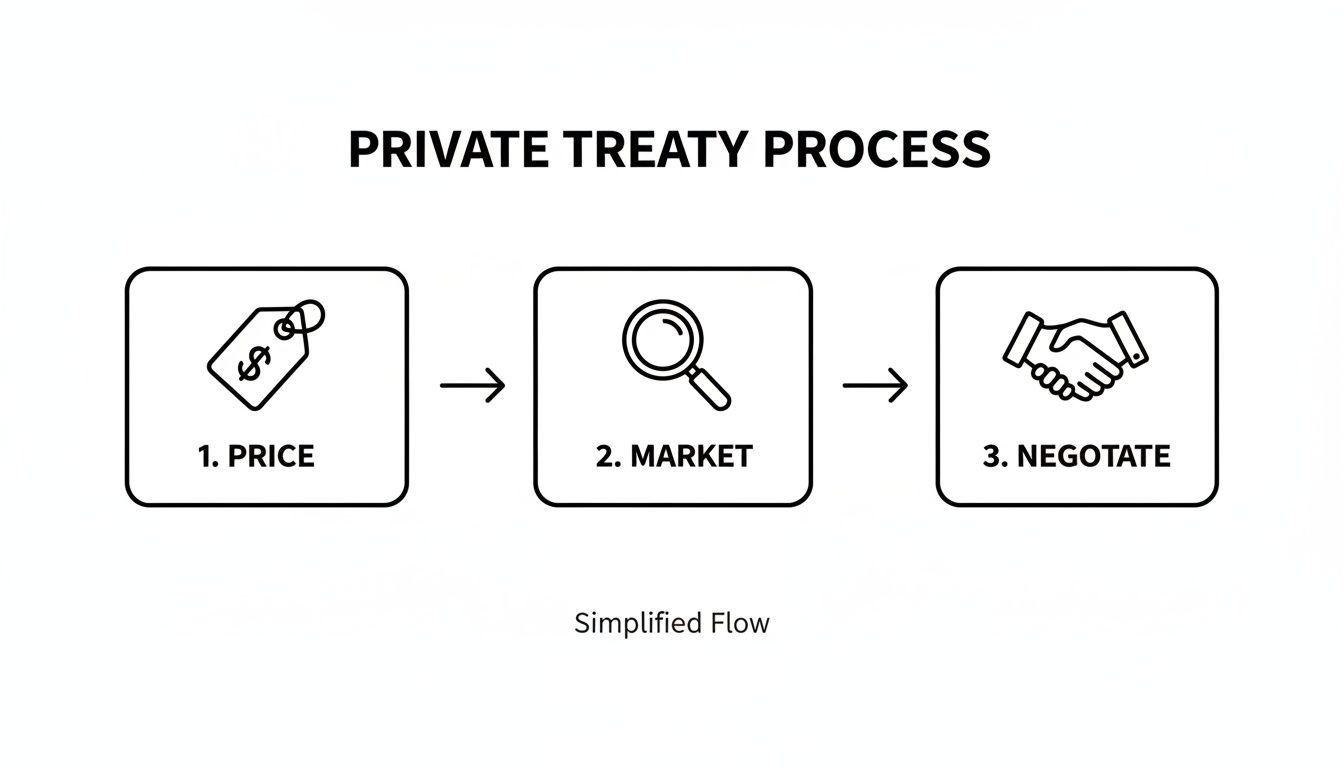
As you can see, the journey follows a straightforward path. Each step—pricing, marketing, and negotiating—is carefully managed to get you the best possible result.
Step 1: Strategic Pricing And Marketing
The first, and arguably most crucial, step is landing on the right asking price. Your agent will dive deep into a market analysis, stacking your property up against recent sales in the Mandurah area. The goal is to set a price that grabs the attention of serious, ready-to-act buyers.
With the price set, it's time to launch a marketing campaign designed to make your home shine. We want to showcase its best features to the biggest audience possible. This usually involves a mix of:
- Professional Photography and Listings: Stunning, high-quality photos are non-negotiable for online portals. It's all about making an incredible first impression.
- Open for Inspections: These scheduled viewings give potential buyers the chance to walk through and really experience what it would be like to live there.
- Targeted Advertising: We focus our efforts on reaching qualified buyers who are already actively searching for a home just like yours in your suburb.
Step 2: Receiving And Negotiating Offers
Once an interested buyer comes along, they’ll submit a formal written offer through your agent. Here in Western Australia, this is typically done on an 'Offer and Acceptance' contract. This document lays out everything clearly: the price they’re offering and any conditions they might have, like needing finance approval or a satisfactory building inspection.
This is where the real art of negotiation begins. Your agent becomes the vital link in the chain, communicating any counteroffers and working tirelessly to get you the most favourable terms. Unlike the high-pressure, public spectacle of an auction, these conversations happen entirely in private. You have the time and space to consider each proposal properly, without being rushed.
Ultimately, you hold all the cards. You can accept, reject, or counter any offer until you land on an agreement that ticks all your boxes. You can get a deeper understanding of this stage in our comprehensive guide to selling a home privately.
The negotiation phase is your biggest opportunity to maximise your return. It’s not just about the final price; it’s about securing the best possible terms on settlement dates and conditions.
Step 3: From Contract To Settlement
Once you accept an offer and both you and the buyer have signed the contract, your property is officially ‘under offer’. This kicks off the buyer's conditional period, where they'll work to get their financing locked in and complete any inspections we agreed to.
After all those conditions are met, the contract becomes unconditional. From there, it's a straight run to the final stage: settlement. This is the day ownership is legally transferred, the keys are handed over, and you receive the funds from the sale.
How Private Treaty Compares To Auction And Tender
Picking the right way to sell your property is a massive decision, and it really sets the tone for your whole sales journey. To truly grasp why a private treaty sale means having more flexibility and control, it helps to see how it stacks up against the other two main methods: auction and tender. Each one has its own distinct rhythm and rules, and they suit different kinds of properties and seller goals.
Think of it this way: a private treaty sale is a controlled, one-on-one negotiation. An auction is a high-pressure public bidding event. And a tender is a formal, sealed-bid process. While private treaty is by far the most common way to sell in Western Australia, understanding the differences will help you feel confident it's the right move for you.
Key Differences At A Glance
The main things that set these methods apart are the timing, how the price is handled, and the negotiation style. An auction creates a real sense of urgency with its fixed date, forcing buyers to act fast. On the other hand, a private treaty gives everyone more breathing room—buyers have time for their due diligence, and you get to consider offers without the public pressure of an auction floor.
Comparing Sale Methods: Private Treaty vs Auction vs Tender
When you're deciding how to sell, laying out the options side-by-side makes the choice much clearer. Each method has a different approach to pricing, timelines, and how offers are handled. The table below breaks down the core features to help you see which one aligns best with your property and personal preferences.
| Feature | Private Treaty | Auction | Tender |
|---|---|---|---|
| Pricing | Listed with a clear asking price or price range. | No price is listed; the market determines the value on the day. | Bids are submitted privately without a listed price. |
| Timeline | Flexible marketing period with no set end date. | Fixed, intensive 4-week marketing campaign ending on auction day. | A specific deadline is set for all offers to be submitted. |
| Offers | Private, confidential offers submitted anytime. | Public, competitive bidding in an open forum. | Formal, sealed written offers submitted by a closing date. |
| Conditions | Offers can include conditions (e.g., finance, inspection). | Sales are typically unconditional; "as is, where is". | Offers can be conditional, similar to a private treaty. |
| Control | High seller control over price and negotiation terms. | Less control; the outcome is decided by competitive bidding. | High control, as the seller can review all bids at once. |
As you can see, the methods are worlds apart in some areas. For many sellers, especially in the Mandurah market, the predictability and control offered by a private treaty make it the less stressful and more straightforward path.
Private treaty provides a level of discretion and adaptability that auctions simply can't match. It allows for thoughtful negotiation on terms, not just price, making it a less stressful and more predictable path for most sellers in the Mandurah market.
Ultimately, there's no single "best" strategy—it all comes down to what suits your property's unique appeal and your personal situation. For a more detailed look at the two most popular methods, you can explore our full comparison of auction vs private sale.
The Key Advantages Of Selling By Private Treaty
When you decide to sell your home, you've got a few paths you can take. So why do most Australians still choose the private treaty route? It really boils down to having more control, flexibility, and privacy throughout the entire process. For both sellers and buyers, it creates a much more predictable and less frantic environment than the high-pressure auction floor.
The numbers don't lie. Selling by private treaty is easily the most common method across Australia. In fact, research shows that approximately three times more properties change hands this way compared to auctions. This preference is particularly strong here in Western Australia, where Perth has the lowest proportion of auctions of any capital city. You can dig deeper into these market trends in the full research report.
More Control And Flexibility For Sellers
As a seller, the private treaty process really puts you in the driver's seat. You get to set the asking price and you have the final say on whether to accept, reject, or negotiate any offer that comes your way. There's no auction-day clock ticking down, forcing your hand.
This flexibility is a huge advantage, especially when it comes to the types of offers you can entertain.
- Considering Conditional Offers: You have the freedom to accept offers that come with conditions, like being 'subject to finance' or a building inspection. This opens the door to a much larger pool of potential buyers who might otherwise be shut out of an auction.
- Negotiating on Your Timeline: Unlike the fixed deadline of an auction, you can take the time you need to properly consider offers and negotiate terms that truly work for you and your family.
- Enhanced Privacy: All the back-and-forth happens confidentially between you, your agent, and the buyer. Your personal financial details stay out of the public spotlight.
Clear Benefits For Buyers
It’s not just a one-way street; buyers get some serious perks, too. For them, a private treaty sale means a more straightforward and less intimidating experience. Knowing the asking price right from the start takes out the guesswork and lets them quickly figure out if a home is within their budget.
Buyers have the crucial time and space to conduct their due diligence, such as organising building and pest inspections, without the immense pressure of an auctioneer's ticking clock. This measured approach leads to more confident and considered purchasing decisions.
Potential Downsides Every Seller Should Consider
Selling by private treaty offers a fantastic amount of control and flexibility, but it's always wise to go in with your eyes wide open to the potential challenges. Think of these less as deal-breakers and more as things to be aware of so you and your agent can build a solid strategy to navigate them.
The most common hurdle can be a longer time on the market. If the asking price isn't perfectly aligned with what buyers are willing to pay right from the start, a property can sit for weeks without generating serious interest. Unlike an auction, a private treaty sale doesn't have that hard deadline, which can sometimes reduce the urgency for buyers to put their best foot forward quickly.
Navigating Negotiations and Uncertainty
Another aspect to prepare for is the negotiation dance itself. While having control is a major plus, the process can sometimes become a drawn-out affair with offers and counter-offers flying back and forth. This requires patience and a steady hand from your agent to keep the momentum going without letting the buyer lose interest.
There's also the "cooling-off" period to consider, which is a standard part of many contracts here. This clause gives a buyer a short window to withdraw from the sale, even after they've signed on the dotted line, introducing a small degree of uncertainty into the final stages.
It’s crucial to see these points not as roadblocks, but as manageable parts of the journey. A skilled agent anticipates these challenges. They'll use sharp pricing strategies, proactive communication, and expert negotiation tactics to keep everything on track.
Understanding the complete financial picture is also key. To make sure you're fully prepared, you can learn more about the costs involved by checking out our guide on real estate selling fees. A truly great strategy accounts for every variable, turning potential downsides into well-managed components of a successful sale.
Actionable Tips For A Successful Private Treaty Sale
Knowing the theory is one thing, but turning it into a successful sale requires a practical, well-executed strategy. While the private treaty process gives you flexibility, getting an outstanding result means being proactive right from the start.
If you can master a few key areas, you'll be in a much stronger position to navigate the sale with confidence and walk away with the best possible price in your pocket.

This isn't just about putting a sign up; it's about following a clear plan designed to maximise your home's value from day one.
Price With Precision
Think of your asking price as your most powerful marketing tool. Get it right from the beginning, and you're halfway there.
- Get a Professional Appraisal: Don't just guess or rely on online calculators. A local agent will give you a data-driven appraisal based on recent, comparable sales right here in Mandurah. This ensures your price is both competitive and realistic.
- Leave Room to Move: A sharp price invites interest and gets buyers through the door. It creates a strong starting point for negotiation without scaring off the genuine contenders.
Master Your Presentation
First impressions count for everything in real estate. Buyers often make an emotional connection within seconds of entering a home, so it's critical to make your property feel inviting, spacious, and well-cared-for during inspections.
A clean, decluttered space is a blank canvas, allowing them to truly picture their own life unfolding there.
The goal is to make buyers fall in love with the lifestyle your home offers, not just the bricks and mortar. This emotional pull is often the deciding factor that leads to a strong offer.
Employ Smart Negotiation Tactics
Negotiation is a bit of a dance. Before you receive a single offer, you need to know your absolute bottom line—the price you won't go below. It's also helpful to identify where you can be flexible, whether that's on the settlement date or certain inclusions.
A skilled agent takes the lead here. They'll manage the back-and-forth, maintain momentum, and leverage any competition between buyers to strengthen your position and ultimately achieve the price you're after.
Got Questions About Private Treaty? We’ve Got Answers.
Let's wrap things up by tackling a few of the most common questions people have about selling by private treaty. Think of this as a quick debrief to clear up any lingering confusion and make sure you’re confident with how it all works in practice.
How Long Does a Private Treaty Sale Typically Take?
This is a classic "how long is a piece of string?" question, but there's a general rhythm to it. Most properties are on the market for about three to six weeks—that's the sweet spot for drumming up serious interest and getting offers on the table.
Once you accept an offer, you're looking at a settlement period, which is usually somewhere between 30 and 90 days. The exact timing really comes down to what you and the buyer agree on in the contract.
Can I Accept an Offer at Any Time?
Absolutely. In fact, this is one of the biggest perks of a private treaty sale. If a fantastic offer lands in your lap early on—one that hits your price and has the right terms—you can shake on it right then and there. No need to wait for a set date.
This is exactly the position you want to be in. Your agent will walk you through the best way to play your cards. You might decide to accept that strong first offer, or you could go back to all interested buyers and ask for their 'best and final' offer to see if you can nudge the price up a little more.
Ready to navigate your Mandurah property sale with confidence? At David Beshay Real Estate, we combine local expertise with a proven strategy to achieve outstanding results. Request your free, no-obligation property appraisal today!

