


When you buy a property in Mandurah, you're not just buying the house and the land; you're buying the title to it. This legal document is your proof of ownership. But what if that title has a hidden history? That's where title insurance comes in.
It’s a unique type of protection that shields you from financial loss caused by problems with your property's title that happened long before you became the owner. Think of it as a one-time investment that protects your ownership rights from historical baggage, like old debts tied to the property, surprise heirs, or even fraudulent signatures on past documents.
Your Guide to Understanding Title Insurance
Most insurance policies you're familiar with—like home or car insurance—cover you for things that might happen in the future, such as a fire or a fender bender. Title insurance is different; it looks backward.
Its job is to protect you from inheriting someone else's legal messes. It’s like a comprehensive background check on your property's history, making sure the person selling it to you has the clear, undisputed right to hand over the keys. This is crucial because even the most diligent searches by conveyancers can't always uncover every single potential issue lurking in the past.
The Core Concept of Protection
At its heart, title insurance is a specialised safety net for both you (the owner) and your lender. It’s designed to absorb the financial shock if a defect in your property’s title ever comes to light. If you want to dive deeper into this, you can explore detailed insights into property market education.
Specifically, if a problem arises, your policy steps in to cover significant costs, including:
- Legal defence fees: If someone makes a claim against your property and challenges your ownership, the policy covers the court costs to defend your title.
- Financial loss: Should a claim against your title be successful, it can compensate you for any drop in your property's value, or in the worst-case scenario, the entire value of your home.
- Rectification costs: It also covers the expense of fixing title issues, such as getting council approval for an unapproved structure built by a previous owner.
The infographic below really helps visualise how this protection acts as a shield for what is likely your biggest asset.
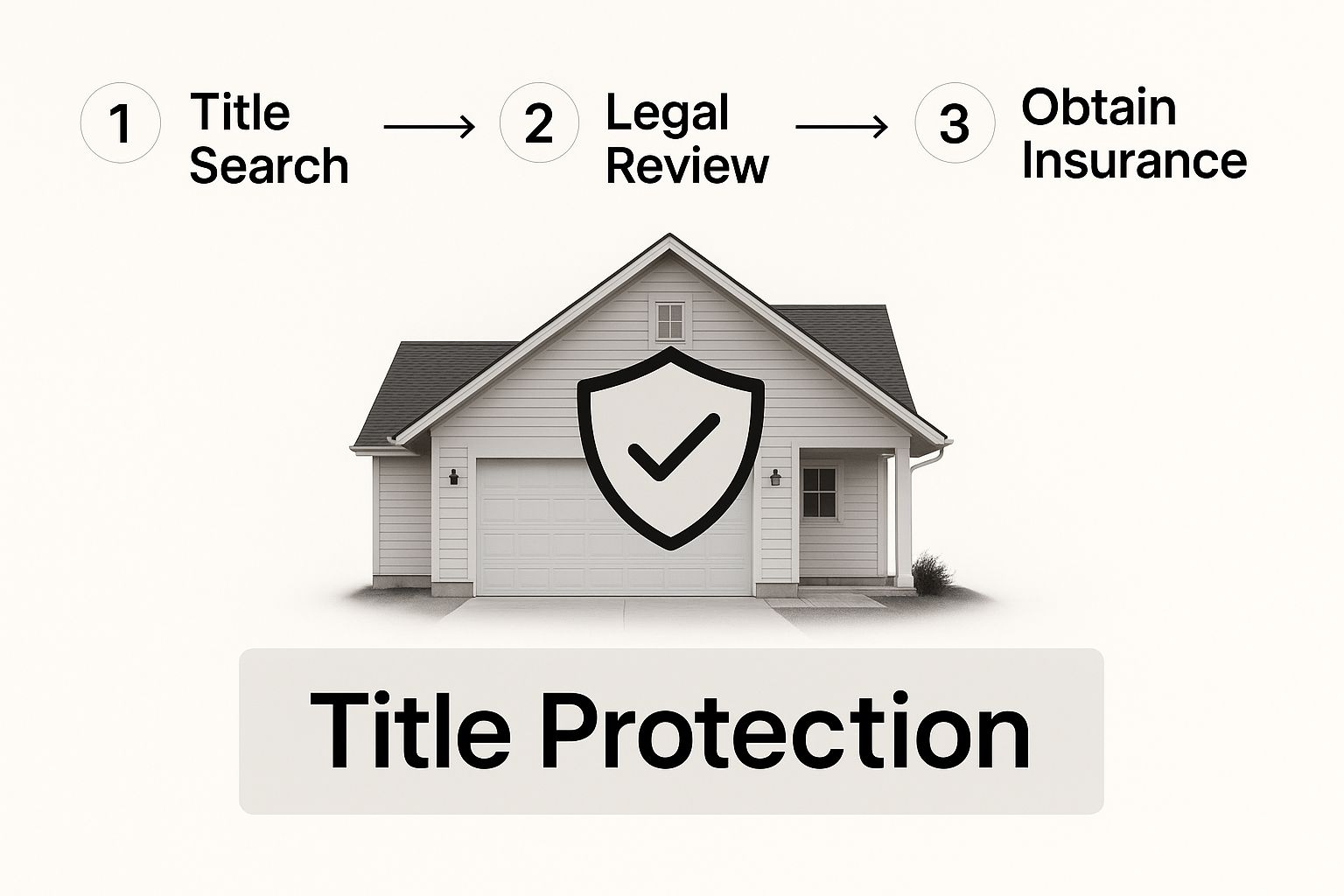
As you can see, this one-off policy secures your ownership against past events, offering you genuine, lasting peace of mind.
To break it down even further, here's a quick summary of the essentials.
Title Insurance at a Glance
This table simplifies the key aspects of title insurance, giving you a clear snapshot of what it is and what it does.
| Feature | Description |
|---|---|
| Coverage Type | Protects against historical or pre-existing issues with a property's title. |
| Payment | A one-time premium paid at the time of property purchase. No ongoing fees. |
| Who It Protects | Both the homeowner (Owner's Policy) and the mortgage lender (Lender's Policy). |
| Key Benefits | Covers legal defence costs, financial loss from a successful claim, and costs to fix title defects. |
| Policy Duration | The protection lasts for as long as you or your heirs own the property. |
| Common Issues | Defends against fraud, undisclosed heirs, illegal building works, encroachments, and outstanding rates or taxes. |
Essentially, it's a straightforward way to secure your property investment against a whole range of unknown risks that could surface down the track.
How a Title Policy Protects Your Investment
Before you get the keys to your new place, a title search is done to look into the property's history. Think of it as a background check. The goal is to spot any obvious problems or red flags tied to the land.
But here’s the thing: a title search can only find what’s on the public record. The real power of title insurance is that it protects you from the ghosts of the property’s past—the hidden risks that a search simply can't uncover.
We’re talking about things like a forged signature on a deed from 30 years ago, an illegal extension built by a previous owner, or even an unknown heir who suddenly shows up claiming the property is rightfully theirs. Without insurance, sorting out these messes could cost you a fortune in legal fees or, in the worst-case scenario, your entire home.
Owner's Policy vs. Lender's Policy
It’s really important to know there are two different kinds of policies, and they don't protect the same people.
- Lender’s Policy: If you're getting a mortgage, your bank will almost certainly require this. It only protects the lender’s financial stake in your property up to the value of your loan. It does not protect you or the equity you've worked hard to build.
- Owner’s Policy: This is the one that has your back. An owner's policy is designed to protect you, the homeowner. It safeguards your investment—your deposit and any equity you build up—for the entire time you own the property.
An owner’s policy is your personal shield. It ensures that if a historical defect emerges, you won’t be left facing a catastrophic financial loss on your own. Your one-time premium secures your most valuable asset.
A Small Price for Lasting Security
Sometimes, Aussie buyers wonder why they need title insurance when we have a solid land title registration system. It's a fair question. The key is to see them as partners; title insurance picks up where the standard protections leave off, covering those specific hidden risks that can slip through the cracks. It's an educational piece, and you can see more on the latest title premium data from the Australian market to get a sense of the landscape.
At the end of the day, that single premium you pay at settlement is a tiny price for the peace of mind that your property is truly yours, free from past claims. It works hand-in-hand with the crucial checks done by your settlement agent to give you a really solid layer of protection. If you want to dive deeper, have a look at our guide on why hiring a settlement agent is crucial for first-time buyers.
Uncovering Common Title Defects and Risks

The idea of title insurance can feel a bit abstract until you see the real-world problems it’s designed to solve. These issues, known as title defects, are nasty surprises from a property’s history that can pop up years after you’ve settled in, potentially turning your dream home into a financial nightmare.
So, what is a title defect? Think of it as any unresolved problem from the property's past that could threaten your right to own it or leave you on the hook for someone else's mistake. These aren’t just small headaches; they can be incredibly expensive and stressful to sort out on your own.
This is exactly where your title insurance policy shifts from a piece of paper into a powerful financial shield. It’s built to protect you from these unexpected, and often invisible, risks.
Real-World Scenarios and How Insurance Responds
Let's look at a few common title issues that homeowners right here in Mandurah could face. While a sharp conveyancer does a lot of digging during the sale process, some problems can stay buried deep in a property's history, only to surface when you least expect it. (You can learn more about the initial checks in our guide on what is a property title search.)
Here are a few concrete examples of what can go wrong and how title insurance steps in to help:
-
Unapproved Building Works: Picture this: you find out the beautiful back deck you fell in love with was built by a previous owner without the proper council approvals. The local council could hit you with a demolition order, leaving you to foot the bill for its removal and reconstruction. Your title insurance would cover the costs to get it approved or fix the structure.
-
Fraud or Forgery: It’s a scary thought, but it happens. A document in your property's history could have been forged. If a fraudulent signature on a past sale comes to light, your ownership could be challenged in court. Title insurance is there to cover the legal fees needed to defend your claim to the property.
-
Outstanding Rates or Levies: You move in, only to discover you're now responsible for unpaid council rates, water bills, or strata levies from a previous owner that slipped through the cracks at settlement. Instead of paying out of your own pocket, a title insurance policy would cover these outstanding debts for you.
By covering the legal fees, rectification costs, and financial losses from these hidden defects, title insurance provides a critical safety net. It ensures a past owner’s oversight doesn’t become your future financial burden, protecting your investment for as long as you own the property.
So, What Does Title Insurance Actually Cost?

This is one of the first questions most homebuyers ask, and the good news is, it’s a lot simpler than you might think. Unlike your home and contents insurance, you won't be dealing with recurring monthly or annual bills.
Title insurance is a single, one-off premium paid when you settle on your new home. That’s it. One payment covers you for the entire time you own the property, whether that’s for the next five years or the next fifty. No renewals, no ongoing fees.
The one-time fee itself is calculated based on the purchase price of your property. It makes sense, really—a more expensive home means the insurer is taking on more risk to protect a more valuable asset, so the premium will be higher.
An Investment in Your Security
It’s easy to see the premium as just another line item on a long list of expenses. But it’s much more helpful to think of it as a crucial investment in your financial security. You’re essentially paying a small, one-time fee for a lifetime of peace of mind, ensuring a mistake made by a previous owner doesn’t become your future financial nightmare.
The real value is simple: you make one payment to secure your property’s past forever. This single premium can save you from unforeseen expenses that could easily dwarf the initial cost of the policy.
The table below really drives home the difference between paying this manageable premium and facing the potentially crippling costs of a title defect without any protection. It clearly shows just how valuable this investment can be for your long-term financial wellbeing as a homeowner in Mandurah.
One-Time Premium vs Potential Ongoing Costs
| Cost Type | Title Insurance | Uninsured Title Defect (Example) |
|---|---|---|
| Initial Payment | A manageable one-time premium. | $0 (No initial cost). |
| Legal Fees | Covered by the policy to defend your title. | Potentially $10,000 – $50,000+ out of pocket. |
| Rectification Costs | Covered to fix issues like unapproved structures. | $5,000 – $30,000+ for demolition or approvals. |
| Total Financial Risk | Limited to the cost of your premium. | Potentially unlimited, up to the full value of your home. |
When you look at it side-by-side, the choice becomes pretty clear. A single, predictable payment protects you from a whole world of unpredictable and potentially devastating costs down the track.
Why Title Insurance Is a Smart Move in WA
When you're buying a property in Western Australia, it’s easy to get a false sense of security. The Torrens title system is robust, and the government guarantee on your ownership feels like a rock-solid safety net. But here’s the thing: it doesn't shield you from every possible historical defect.
This is where title insurance comes in. Think of it as an essential backstop, an extra layer of protection for things your standard conveyancing searches might never uncover.
Your conveyancer does a fantastic job scouring public records for any red flags. But what about the problems that aren't on the record? A previous owner might have built a patio without council approval, or maybe that boundary fence is actually a few centimetres onto your neighbour’s land. These sorts of issues are surprisingly common right here in Mandurah and the wider Peel region.
Protecting Your Mandurah Property Investment
Discovering a hidden issue years after you've unpacked the boxes and settled in can be an absolute nightmare, both financially and emotionally. This is exactly why understanding what is title insurance is so important.
Imagine finding out the previous owner of your new Halls Head home left behind thousands in unpaid strata levies. Or that the fantastic granny flat at your Lakelands property was never legally approved by the council. Without insurance, those problems—and their costs—are now yours to solve.
A title insurance policy is designed for these exact scenarios. It steps in to cover the costs of fixing the problem, paying legal fees, or covering any financial loss from a whole range of unknown, pre-existing issues. It's there to protect your hard-earned equity.
These risks aren't just hypotheticals. While the broader Australian insurance market and its trends are always shifting, the local-level risks of unapproved structures or boundary mistakes are a constant reality.
For a relatively small, one-off payment, you get long-term peace of mind. This protection is particularly valuable during that critical settlement phase, which has its own set of rules and timelines you'll want to get your head around—much like understanding the cooling-off period in Western Australia. Ultimately, it secures your ownership rights for as long as you hold the title to your home.
Got Questions About Title Insurance? We’ve Got Answers.
Even after you get the gist of what title insurance is, a few practical questions almost always pop up when you're in the thick of buying a house. Let’s tackle some of the most common ones so you can feel completely at ease with protecting your new property.
We'll skip the legal jargon and get straight to the point.
"My Conveyancer Is Already Doing Searches, So Why Do I Need This?"
That's a really sharp question, and it gets to the heart of the matter. Your conveyancer is absolutely essential. They do the critical work of digging through public records to find any known red flags attached to the property. But their search is limited to what’s officially on the books.
Think of title insurance as your safety net for everything that’s not on the books. It’s there to protect you from the hidden risks that even the most meticulous search could never uncover.
Here’s a simple way to look at it: your conveyancer checks for visible cracks in the foundation. Title insurance protects you if there’s a hidden sinkhole underneath the whole property. It covers nasty surprises from the past, like fraud, a forged signature on an old deed, or an illegal extension a previous owner built that could suddenly become your problem.
"How Is This Different from My Home Insurance?"
This is another great point of confusion for many buyers. The two policies protect you from completely different kinds of risk. Your home and contents insurance looks to the future—it covers your physical house and belongings from things that might happen down the track, like a fire, storm damage, or a break-in.
Title insurance, on the other hand, looks backwards. Its only job is to shield your legal right to ownership from problems that happened in the property’s past, long before you came along. One secures your future, the other secures your past.
"Is This an Annual Policy I Have to Keep Paying?"
Nope! And honestly, this is one of its best features. Unlike pretty much every other insurance policy out there, you only pay a single, one-off premium when you first buy your home.
That one payment protects you for the entire time you own the property, whether that's for five years or fifty. There are absolutely no ongoing fees or renewal costs to worry about, making it a simple, set-and-forget investment in your peace of mind.
"Can I Get Title Insurance If I Already Own My Home?"
Yes, in most cases, you certainly can. Insurers offer what’s called an "existing owner policy" for this exact situation.
It’s a fantastic option if you’re planning a big renovation and want protection against nasty surprises like unapproved structures from a previous owner. It’s also a smart move if you’ve heard about boundary disputes popping up in your neighbourhood or you simply want to add that extra layer of financial security to your biggest asset.
Ready to take the next step in your property journey with confidence? Whether you're buying or selling in Mandurah, the right guidance makes all the difference. Contact David Beshay Real Estate for a free, no-obligation property appraisal and expert advice you can trust. https://realestate-david-beshay.com.au


Pingback: New House Checklist: 10 Mandurah Move-In Steps - David Beshay Real Estate - Beshay Realty