


So, you’re thinking about selling your home and find yourself asking the big question: "what percentage does a real estate agent take?" It's one of the first things sellers want to know, and the answer isn't just one magic number—it's more of a typical range. In Western Australia, this percentage is your investment in a professional’s expertise, their marketing muscle, and sharp negotiation skills, all focused on one thing: getting you the best possible price for your property.
Your Quick Guide to Real Estate Commissions in Mandurah
Selling a house is a massive financial step, and getting a firm grip on the costs involved is absolutely essential. The agent's commission is usually the biggest single expense, but it's surprising how many sellers are a bit fuzzy on the details.
The best way to think about commission is not as a simple fee, but as a success-based partnership. Your agent is financially motivated to get the highest sale price possible because their earnings are directly tied to that final number. It’s a powerful alignment of interests.
Here in Mandurah and across WA, this structure ensures your goals are the same as your agent's. An experienced local professional like David Beshay brings a lot more to the table than just a "For Sale" sign. We’re talking in-depth market analysis, a sales strategy built specifically for your property, and the negotiation power needed to truly maximise what you walk away with. This fee covers all the complex, behind-the-scenes work: pricing your home correctly, marketing it to the right buyers, managing inspections, and navigating the legal maze from the day you list to the day you settle.
Mandurah Real Estate Commission at a Glance
For those who just need the fast facts, here’s a quick snapshot of what you can generally expect when selling a home in the Mandurah region.
| Aspect | Typical Range / Detail |
|---|---|
| Typical Commission Range | 2.8% to 3.5% of the final sale price |
| Who Pays the Commission | The property seller, deducted from the sale proceeds at settlement |
| GST Status | The quoted commission percentage is inclusive of GST |
| Negotiability | Rates are not fixed by law and are negotiable between the seller and agent |
| What It Covers | The agent's expertise, time, negotiation skills, and agency overheads |
This table gives you a solid baseline, but it's the local context that really matters. In Western Australia, real estate agent commissions typically fall between 2.8% and 3.5% of the final sale price for a standard residential property.
Let's put that into perspective. For a home sold at Mandurah's median price of around $550,000, sellers could expect to pay between $15,400 and $19,250 in agent fees. This is a significant figure, so understanding what you get for it is key.
Of course, the commission is just one piece of the puzzle. To get the full financial picture, you need to account for all potential expenses. For a detailed breakdown of every cost you might encounter, you'll want to read our complete guide on how much selling a house costs. This will help you budget properly and avoid any nasty surprises come settlement day.
How Your Agent's Commission Is Actually Calculated
Let's pull back the curtain on how an agent's commission percentage translates into a real dollar figure. It’s not complex maths, but seeing it laid out clearly shows you exactly how much of your final sale price goes toward your agent's professional fee.
At its heart, the formula is simple:
Sale Price x Commission Percentage = Total Commission Payable
This figure is the gross amount earned before it gets split between the selling agent and their agency (we'll get to that later). For most sellers, this is the single biggest cost of the sale, so it’s vital to understand how it works in the real world.
Putting the Numbers to Work in Mandurah
Theory is one thing, but let's run the numbers on a typical Mandurah home sale. Imagine you’ve sold your property for a fantastic price of $600,000. So, how does the commission affect the money that actually lands in your bank account?
Even a tiny difference in the commission rate can have a surprising impact on your final proceeds. Let's compare two common scenarios to see what that looks like.
- Scenario A (2.8% Commission): $600,000 x 0.028 = $16,800 in total commission.
- Scenario B (3.5% Commission): $600,000 x 0.035 = $21,000 in total commission.
As you can see, a difference of just 0.7% adds up to an extra $4,200 in costs. This is exactly why it’s so important to have a clear conversation about the commission percentage before you sign anything.
Exploring Performance-Based Incentives
While a flat percentage is standard, some agents use a performance-based model like a tiered commission. Think of it as a bonus structure designed to motivate your agent to smash your price expectations out of the park.
A tiered system works by setting a base commission rate up to an agreed-upon sale price, with a much higher rate kicking in for any amount achieved above that target.
Example of a Tiered Commission:
You and your agent agree on a target price of $650,000. The commission is set at 2.8% on the first $650,000 and a 10% 'kicker' on anything above that. Your agent works their magic and secures a final price of $670,000.
- Commission on the first $650,000: $650,000 x 0.028 = $18,200
- Commission on the amount above target: $20,000 x 0.10 = $2,000
- Total Commission: $18,200 + $2,000 = $20,200
This structure creates a powerful win-win. The agent is heavily incentivised to push for that premium result because their own earnings jump significantly only after they’ve delivered one for you.
When Is the Commission Actually Paid?
One of the most common questions I get from sellers is, "When do I actually pay you?". The good news is you don’t need to have thousands of dollars ready to go in your bank account. The commission is almost always paid out at settlement.
Here’s how that process unfolds behind the scenes:
- On settlement day, the buyer’s funds are transferred into the settlement agent’s trust account.
- The settlement agent first uses that money to pay off any outstanding mortgage on your property.
- Next, they deduct the agreed-upon real estate commission and any other associated costs.
- The remaining balance—your net proceeds from the sale—is then transferred directly to you.
It's a seamless and professional process that handles all the financial finalisation of the sale, so you get your final profit without having to worry about a thing.
Where Does Your Commission Money Actually Go?
When you glance at the total commission on your settlement statement, it's easy to think that entire sum lands directly in your agent's pocket. In reality, that couldn't be further from the truth. The total commission is more like a pie that gets sliced up to fund the entire machine that worked to get your home sold.
Think of it like this: your real estate agent is the star forward on a footy team. They might be the one kicking the winning goal, but they're backed by an entire club—the agency—that provides the training ground, the gear, and the game plan needed to win. The commission pays for the whole team, not just one player.
A big slice of that pie goes straight to the agent’s principal agency, the established real estate brand they work under. This split is critical because it covers the powerful, and often expensive, infrastructure that makes a great sale happen.
The Agency's Share: The Engine Room of Your Sale
So, what does the agency’s cut of the commission actually pay for? It’s the very backbone of the business, covering a heap of operational costs that directly fuel your property's sales campaign.
These costs typically include:
- Powerful Marketing Platforms: This means access to premium listings on the big real estate portals, sophisticated client management systems (CRMs), and professionally designed marketing materials.
- Essential Infrastructure: We're talking about the costs of running a physical office, paying the admin staff who handle all the crucial paperwork, and the tech that keeps everything running smoothly.
- Insurance and Compliance: Professional indemnity and public liability insurance are non-negotiable protections for everyone involved in the transaction.
- Brand Reputation and Trust: The agency pours money into building a trusted brand, which in turn helps attract more serious, qualified buyers to your doorstep.
Basically, your agent is tapping into the collective resources of their entire agency to market and sell your home. The agency's share ensures this support system is solid and professional.
This simple formula shows how we get to the total commission figure before it gets split.
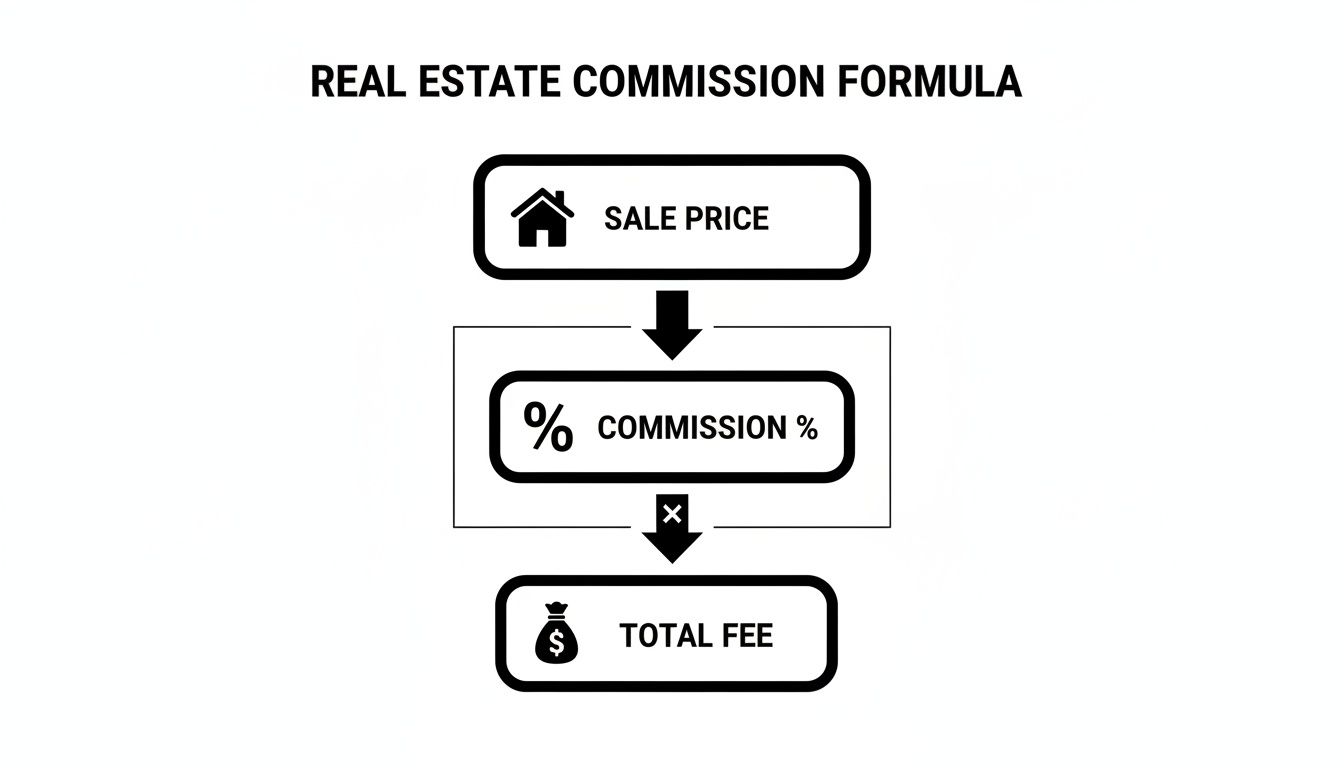
As you can see, the total commission is directly tied to the final sale price, which is exactly why an agent is so motivated to get you the best possible offer.
A Real-World Commission Breakdown
Let's make this real. Imagine a hypothetical $20,000 commission. While the exact splits change from agency to agency and depend on an agent's experience, a pretty common scenario might look like this:
Hypothetical Split of a $20,000 Commission:
- $10,000 (50%) to the Principal Agency: This covers all those operational costs we just talked about—the marketing platforms, insurance, rent, and admin support.
- $10,000 (50%) to the Selling Agent: This is the agent's gross income before they pay a single one of their own business expenses.
From their $10,000 share, the agent then has to cover their personal business costs, like fuel for their car, personal marketing, ongoing professional development, and, of course, income tax. When you start to see all these deductions, it becomes much clearer what an agent actually takes home.
For a deeper dive into these costs, our guide on agent fees when selling a house breaks it down even further.
This kind of transparency helps you see the true value you're getting—not just from your agent's hard work, but from the entire professional network standing behind them.
Key Factors That Influence Commission Rates
When you ask, "what percentage does a real estate agent take?" you’ll find the answer isn’t a simple, one-size-fits-all number. The final figure is anything but arbitrary. It's a carefully considered quote shaped by your property's unique details, the current market vibe, and the level of service you need.
Think of it less like a fixed price tag and more like a tailored plan. Understanding the variables at play helps you move the conversation from just chasing the lowest rate to appreciating the link between the fee, the sales strategy, and your final sale price. After all, the commission reflects the expertise and resources needed to get a top-dollar result for your home.
Your Property's Unique Profile
Every home has its own story, and that story directly impacts the sales process and, in turn, the commission rate. An agent will always weigh up a few key property-specific elements before proposing their fee.
Here’s what they’re looking at:
- Property Value: It might sound backward, but higher-value homes often attract a lower commission percentage. An agent might propose 2.8% on a $1.2 million waterfront home but ask for 3.4% on a $450,000 unit. The dollar amount from the luxury sale is still much higher, which justifies the lower rate.
- Property Uniqueness: Is your place a standard brick-and-tile that’s easy to sell, or is it a one-of-a-kind architectural gem with a very specific buyer in mind? A unique or challenging property—maybe one needing big repairs or in a less popular spot—might command a higher commission to cover the specialised marketing and extra legwork needed to find that perfect buyer.
Ultimately, the agent's fee is a direct reflection of the work and strategy required to sell your specific home. A straightforward sale in a hot suburb is a different ball game than a complex property with a much smaller pool of potential buyers.
The Scope of Marketing and Service
Not all sales campaigns are created equal. The commission is also tightly linked to the marketing firepower an agent brings to the table. A comprehensive, high-impact marketing plan costs more to run but is designed to pull in more buyers and drive up the final price.
A lower commission might look good on paper, but if it means a bare-bones marketing plan, it could cost you tens of thousands in a lower sale price. The right marketing investment is about maximising what you walk away with, not just minimising fees.
If an agent proposes a higher rate, they should be able to show you exactly where that money is going. We're talking professional photography and videography, premium ads on real estate websites, a targeted social media budget, and glossy brochures. A basic package will naturally cost less, and the commission might be adjusted to match.
Local Mandurah Market Conditions
Stepping back from your specific property, the bigger picture in Mandurah and the Peel region plays a huge role. Real estate is intensely local. What’s happening on the ground—right here, right now—directly shapes negotiations and pricing.
State-wide, the average real estate agent commission in Western Australia is around 2.66%, which puts us above Sydney but below Tasmania. While that's a decent benchmark, the competitive pressure in busy metro areas often creates more flexibility in rates. You can learn more about the factors influencing Australian real estate commission rates to see the full picture.
In a "hot" seller's market, where buyer demand is high and there aren't many homes for sale, properties move fast. This can sometimes lead to more negotiable rates as agents compete for listings. But in a slower buyer's market, where homes take longer to sell, agents might stand firm on their rates to ensure their extended effort and investment are properly covered.
How to Negotiate Your Agent's Commission with Confidence
Talking about an agent's commission is one of the quickest ways to affect your bottom line, but let's be honest, it can feel a bit awkward. The real goal here isn't just to find the cheapest rate. It's about securing the best overall value—a fair fee for an exceptional sales strategy that delivers a top-dollar result.
A good negotiation starts long before you sit down to talk numbers. You need to do your homework first. I always tell my clients to interview at least three different agents. This isn't about playing them off each other to see who will go lowest; it's about understanding the different service levels, marketing plans, and expertise on offer in the Mandurah market. If you want a solid framework for this, learning how to choose a real estate agent is the perfect place to start.

Look Beyond the Percentage
When an agent tells you their commission rate, your next question should be, "Great, can you show me what that includes?" Ask them to justify their fee with their complete service package.
- Marketing Investment: What specific marketing is included? Ask for a detailed plan, from professional photography and floor plans to targeted social media ads.
- Sales Strategy: How do they plan to price your home? What's their process for managing home opens and handling offers to create a competitive environment?
- Proven Track Record: Can they show you recent examples of homes they've sold in your suburb? Pay close attention to the initial asking price versus the final sale price.
This changes the conversation from being about cost to being about value. An agent who is confident in their ability to get you a premium price will have no issue explaining exactly why their fee is a smart investment.
The True Cost of a Cheaper Agent
It’s so tempting to just go with the agent offering the lowest percentage. But this can be a very expensive mistake.
Think of it like this: you wouldn't hire the cheapest builder without checking their work, right? A cheap quote might save you a little upfront, but shoddy work will cost you far more down the track. The same logic applies here. A top-tier agent with a killer strategy might charge a bit more, but their skill in attracting more buyers and negotiating a higher sale price will almost always put more money back in your pocket.
The most expensive agent isn't the one with the highest commission; it's the one who leaves your money on the table at the negotiation stage. A 0.5% saving on a commission is meaningless if the agent secures a sale price that's $30,000 lower than what another agent could have achieved.
Let's break it down with a simple comparison to see how this plays out in the real world.
Commission vs Final Sale Price: A Value Comparison
This table shows how a higher-performing agent can deliver a much better net result for you, even with a slightly higher commission rate.
| Scenario | Agent A (2.5% Commission) | Agent B (3.0% Commission) |
|---|---|---|
| Sale Price Achieved | $600,000 | $630,000 |
| Total Commission | $15,000 | $18,900 |
| Net Proceeds to Seller | $585,000 | $611,100 |
In this scenario, Agent B’s superior result delivered an extra $26,100 directly to the seller, easily covering the higher fee.
By focusing on the agent's value and their proven results, you can negotiate with confidence, knowing you’re making the smartest financial decision for your property sale.
Comparing Traditional Commissions to Other Models
While the standard percentage-based commission is what most people think of, it's definitely not the only game in town. It's smart to get your head around the alternatives so you can make a call that feels right for your situation and what you're comfortable with.
Some sellers find themselves drawn to different ways of doing things, and each model has its own set of pros and cons. Looking at these really helps to highlight why the traditional success-based fee is still so popular, especially for people who want a full-service, hands-off experience designed to squeeze every last dollar out of the sale.
Fixed-Fee or Flat-Rate Agencies
One of the alternatives you'll hear about most is the fixed-fee or flat-rate agency. Instead of a percentage, these companies charge a set dollar amount for their services, which you agree on right at the start.
The main attraction here is predictability. You know exactly what you’re paying from day one, no matter what the final sale price is. This can feel pretty comforting if you're on a tight budget and want to lock down your costs. But there's a big potential downside you need to think about.
A key question with fixed-fee models is about incentive. When the agent's pay is exactly the same whether your home sells for $550,000 or $580,000, is there the same fire in their belly to fight for that extra $30,000 when negotiations get tough?
The traditional model ties an agent's income directly to getting you the highest price possible. That creates a powerful alignment of interests that a fixed-fee structure just can’t replicate.
The Realities of DIY or Private Sales
Another route is going it alone with a do-it-yourself (DIY) or private sale. This is often done through online platforms that help you list your property for a small fee upfront. This option looks fantastic on paper because the initial cost is rock-bottom, a huge draw for anyone wanting to save on fees.
But selling your own home means you suddenly become responsible for absolutely everything.
- The Massive Workload: You’re not just the owner anymore. You're now the photographer, marketer, copywriter, receptionist, home open host, and lead negotiator.
- Marketing Hurdles: It’s incredibly tough to reach a wide pool of genuine, qualified buyers without an agent's database and access to premium advertising spots.
- Serious Legal Risks: Property deals are legally tricky. One small mistake in the contract or with disclosures can cause the sale to fall over or even land you in legal trouble later on.
While the idea of saving on commission is appealing, many private sellers find they get a lower sale price that completely cancels out any savings they made on fees. A full-service agent manages this whole complex machine, using their expertise to shield you from risk and, most importantly, secure a premium price that more than justifies their success-based fee.
Common Questions About Real Estate Commissions
Diving into the money side of selling your home always stirs up a few questions. Getting clear, simple answers is the best way to feel confident and stay in the driver's seat. Let's tackle some of the most common queries we hear from sellers right here in Mandurah about agent commissions.
Is GST Included in the Real Estate Agent's Commission?
Yes, it is. In Australia, the commission percentage an agent quotes you should always be inclusive of GST. It's a legal requirement for the final fee to include it, so you won’t get a nasty surprise with GST added on top at the end.
For instance, if you agree on a 3.0% rate, that figure already has the Goods and Services Tax baked in. The agency will calculate the total commission from the final sale price, and they're the ones responsible for sending the GST portion off to the Australian Taxation Office. Just to be safe, always double-check that this is clearly stated in your agency agreement.
Are Marketing Costs Separate from the Commission?
Almost always, yes. It's really important to see the commission and your marketing budget as two different things, because they pay for two different jobs.
- Commission: This is the professional fee for the agent's expertise, their time, negotiation skills, and all the agency support required to get your property sold. It's the "success fee."
- Marketing Costs: Think of this as a separate investment you make to get your property in front of the right buyers. It covers real, tangible items like professional photos, listings on major websites, the 'For Sale' sign, and brochures.
Some agents might offer packages that bundle in a few marketing items, but you should always be given a clear, itemised breakdown of all fees. This way, you know exactly where your money is going and how it's being used to attract the best possible offers.
A common trap is thinking a super-low commission rate also covers a high-impact marketing campaign. Always ask for a detailed breakdown of both the commission and the proposed marketing budget so you can see the complete picture.
Do I Pay Commission if My House Doesn't Sell?
In nearly all cases, no. The vast majority of real estate agencies in Western Australia, including here in Mandurah, work on a 'no sale, no fee' basis when it comes to the commission itself. It’s the foundation of the traditional real estate model.
This structure really makes it a win-win situation. You only pay the success fee if your agent successfully sells the property and it settles. It’s a powerful motivator for the agent to get you a great result. But—and this is a big but—you will likely still need to cover any upfront marketing costs you agreed to. Those expenses are paid out to third-party suppliers (like photographers and property portals) to get your home advertised.
What Other Costs Are Involved in Selling a House?
Looking beyond the agent's percentage is crucial if you want to budget properly. The commission is usually the biggest single cost, but a few other expenses will affect how much cash you walk away with.
Other key costs to plan for often include:
- Settlement Agent/Conveyancer Fees: This pays the legal professional who handles the transfer of ownership.
- Staging or Minor Repairs: Money spent getting your home looking its absolute best. This can seriously boost the final sale price.
- Compliance Certificates: Depending on your property, you might need to pay for certificates for things like smoke alarms or RCDs (electrical safety switches).
Factoring these items into your budget from the start means you'll have a much more realistic idea of the funds you’ll receive once the sale is all done and dusted.
Ready to get a clear and accurate picture of your property's value in the current Mandurah market? Contact David Beshay Real Estate for a free, no-obligation property appraisal and a transparent discussion about how we can maximise your sale price. Visit us at https://realestate-david-beshay.com.au to get started.

