

So, what's the real cost of selling a house in Mandurah? It’s the first question every seller asks, and for good reason. A good rule of thumb is to budget for somewhere between 2.5% and 4% of your property's final sale price to cover everything.
Thinking about it this way gives you a realistic starting point and helps you avoid any nasty surprises down the track.
Your Quick Guide to House Selling Costs
When you decide to put your home on the market, getting your head around the numbers is the first step towards a smooth, stress-free sale. For example, if you sell a Mandurah property for $500,000, you'll want to have between $12,500 and $20,000 set aside. This will cover all the essential costs from start to finish.
This figure isn't just a single fee. It's a combination of crucial services that all work together to get you the best possible price for your home.
Breaking Down the Main Expenses
While selling costs can vary across Australia, a few key expenses always make up the bulk of the budget. Real estate agent commissions and the marketing campaign are typically the biggest ticket items, followed by legal and conveyancing fees. In 2025, agent commissions sit somewhere between 1.81% and 2.57% nationally, and marketing can range from a modest $400 to a comprehensive $10,000+ campaign, depending on how you want to position your property. You can read more about these national averages on the cost of selling a home on OpenAgent.com.au.
To give you a clearer picture, let's look at the three biggest costs you're likely to face.
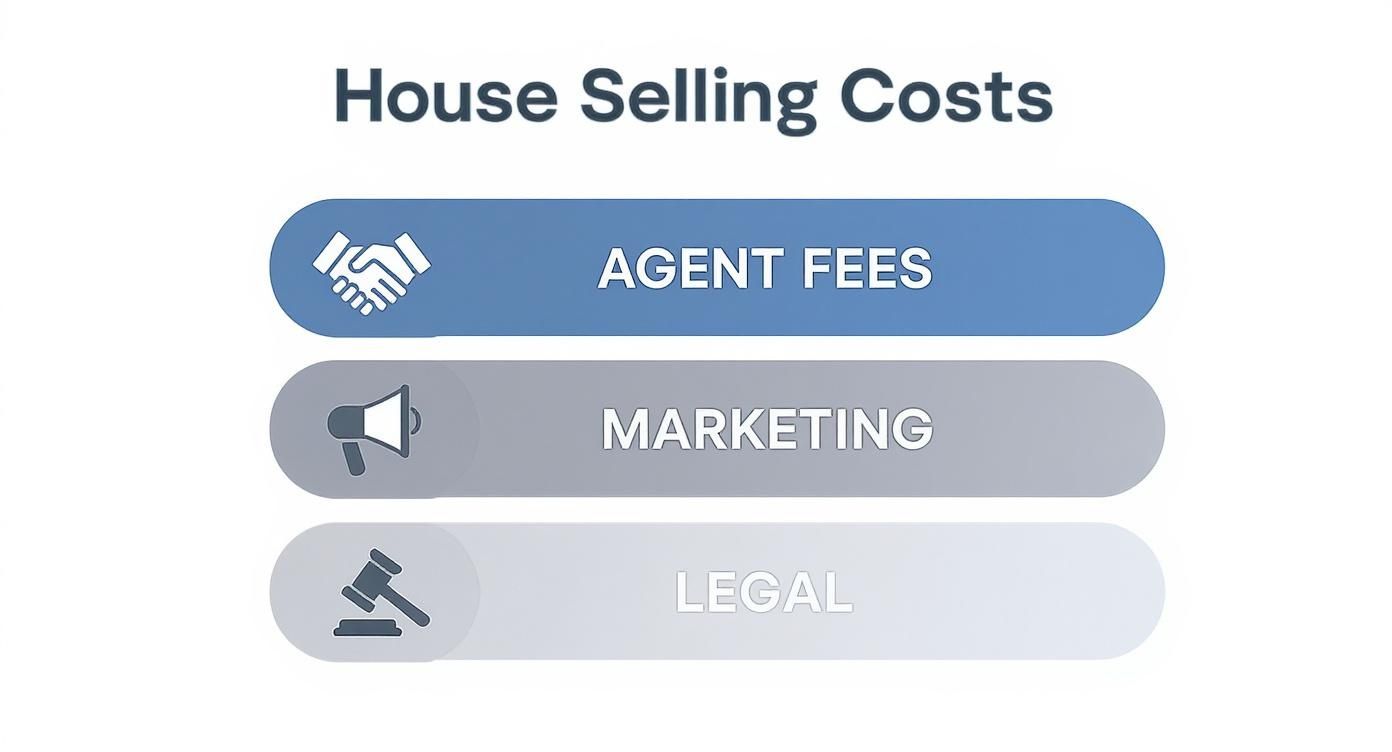
As you can see, the agent's fee makes up the lion's share of the total cost. This really drives home how important it is to understand commission structures, which we'll dive into next. Marketing and legal fees are smaller pieces of the pie, but they are absolutely essential investments for a successful and legally sound sale.
Navigating Real Estate Agent Commissions
When you start adding up the costs of selling your house, the agent's commission is almost always the biggest number on the page. It's the line item that gives most sellers pause, but it’s so important to see it not just as a fee, but as an investment in getting the best possible result for your property.
This commission is what pays for a comprehensive service designed to secure the highest sale price. Think of it as the engine driving your entire sales campaign forward.
How Agent Commissions Work in Western Australia
Here in Mandurah and across Western Australia, the most common way agents are paid is through a percentage-based fee. This simply means your agent earns a percentage of the final price your home sells for. This model is incredibly popular because it aligns our goals directly with yours—the higher the price we negotiate for your home, the more we earn. It keeps everyone focused on the same outcome.
A less common option is a flat-fee model, where you agree on a fixed amount upfront, no matter the final sale price. While the predictability can seem attractive, it doesn't always incentivise an agent to fight for every last dollar during those critical negotiations. For a deeper dive, you can learn more about how real estate commission rates are structured and what to look for.
Commission rates aren't set in stone; they're negotiable. In the Mandurah and Peel region, you can generally expect rates to fall between 2% and 3% of the sale price. This figure can shift based on things like the agent's experience, the property's value, and what the local market is doing at the time.
The True Value Behind the Commission Fee
It’s easy to get fixated on that percentage figure, but what are you actually paying for? The commission covers a whole suite of professional services that are absolutely vital to a successful sale.
Your agent is essentially the project manager for one of the biggest financial moves of your life. Their fee covers:
- Expert Pricing Strategy: We don't just guess a price. We analyse fresh market data to position your home competitively right from day one.
- Buyer Vetting: We sift through enquiries to qualify potential buyers, making sure you only deal with serious, financially capable people.
- Professional Negotiation: This is where a good agent really earns their keep—skillfully managing offers and counteroffers to maximise your final sale price.
- Time and Labour: All those open homes, private viewings, and the countless phone calls and emails from potential buyers are handled by us.
- Complex Paperwork: We manage the contracts and liaise with settlement agents and solicitors to make sure the whole process runs smoothly.
When you invest in an experienced agent, you're paying for their network, their negotiation muscle, and their knack for solving problems before they can derail your sale. It's all about protecting your investment and getting you the best return.
Why a Small Percentage Makes a Big Difference
Choosing an agent just because they offer the lowest commission can be a very expensive mistake. The difference between a great agent and an average one often comes down to their ability to negotiate a higher price—a skill that can easily put more money in your pocket than you'd save from a slightly lower fee.
Let's use a simple example. Imagine you're selling your $550,000 Mandurah home.
- Agent A charges a 2.5% commission.
- Agent B comes in a little lower at 2.0% commission.
On the surface, Agent B looks like the cheaper choice. But what if Agent A, with their superior negotiation skills and a stronger marketing plan, secures a sale price of $570,000? Meanwhile, Agent B, with less experience, only manages to get the asking price of $550,000.
Here’s how the numbers actually stack up:
- Agent A's Result: $570,000 sale – $14,250 commission = $555,750 in your pocket.
- Agent B's Result: $550,000 sale – $11,000 commission = $539,000 in your pocket.
In this scenario, going with the agent who had a slightly higher commission actually put an extra $16,750 into your bank account. It proves that an agent's skill and ability to achieve a premium price is far more important than a small difference in their fee. The right agent doesn't cost you money; they make you money.
Powering Your Sale with a Strategic Marketing Campaign

While the agent's commission is the single biggest line item, it's your marketing campaign that actually gets buyers through the door. Think of it this way: if your home is a fantastic product, marketing is the advertising that makes people want it. Without a strong campaign, even the best home can sit on the market, completely unnoticed.
This is exactly why marketing expenses are handled separately from the commission. They’re a direct, upfront investment into the tools and resources needed to launch your sale with a bang. This lets your agent book photographers, secure premium online listings, and start building buyer excitement from day one.
The Core Components of a Modern Marketing Plan
Gone are the days of just a sign in the front yard and a small ad in the local paper. To cut through the noise in today’s market and grab the attention of busy buyers, you need a multi-faceted approach. A well-rounded campaign ensures your property looks its absolute best, everywhere it appears.
Your marketing budget will typically cover a suite of essential services:
- Professional Photography: This is completely non-negotiable. High-quality, well-lit photos are the very first thing a buyer sees online. A standard real estate photoshoot costs between $200 and $400, and it's the foundation of your entire campaign.
- Compelling Video Tours: Video lets buyers get a real sense of the flow and feel of your home before they even step inside. A professional 1-minute video can range from $400 to $800, offering a dynamic way to show off your property's best features.
- Accurate Floor Plans: Buyers absolutely love floor plans. They help them visualise where their furniture will go and understand the layout, answering key questions before a viewing is even booked.
- Premium Online Listings: Securing a top spot on major portals like realestate.com.au and Domain is crucial. These premier placements guarantee your home is seen by the largest possible audience of active buyers.
A strategic marketing plan isn't just an expense; it's the fuel for your sales engine. Investing in high-quality presentation ensures your property stands out and creates an emotional connection with buyers, driving more inspections and stronger offers.
Understanding Marketing Packages in Mandurah
Here in the Mandurah and Peel region, marketing costs aren't one-size-fits-all. They are tailored to your property's value, your target audience, and your overall sales strategy. Most agents will present you with a few tiered options, allowing you to choose the level of investment that lines up with your goals.
Let's break down what you might expect at different levels.
1. Basic Marketing Package (Typically $1,500 – $2,500)
This entry-level option covers the absolute essentials to get your property on the market effectively. It's a solid choice for a standard home in a high-demand area.
- Professional daytime photography (approx. 10-15 images)
- A professionally drawn 2D floor plan
- Standard listing on realestate.com.au and Domain
- A 'For Sale' sign for your front yard
2. Standard Marketing Package (Typically $2,500 – $4,500)
This is the most popular choice for many sellers in Mandurah. It builds on the basics with better digital assets to attract a wider pool of buyers and present your home in much greater detail.
- Everything in the Basic Package, plus:
- A 'Highlight' or 'Feature' upgrade on realestate.com.au for better visibility
- Twilight photography to create a more premium, inviting feel
- A simple property video or a 3D virtual tour
- Professionally written advertising copy
3. Premium Marketing Package (Typically $4,500+)
For unique, high-end, or specialised properties, a premium campaign is designed for maximum impact and reach. This is all about creating a powerful brand for your home and targeting specific buyer demographics.
- Everything in the Standard Package, plus:
- A top-tier 'Premiere' listing on realestate.com.au
- Drone photography and videography to showcase the location and land
- A social media advertising campaign targeting specific local postcodes
- Print advertising in local lifestyle magazines
Ultimately, deciding how much to invest in marketing is a key part of answering "how much does selling a house cost?". A good chat with your agent will help you pinpoint the right strategy to attract the best buyers and land an outstanding result.
Investing in Your Home's First Impression

Beyond the agent's commission and marketing budget, the next area to consider is presentation. It’s a well-worn cliché for a reason: you only get one chance to make a first impression. In real estate, that single impression can be the difference of tens of thousands of dollars at the negotiation table.
While these investments are optional, they are often the smartest money you can spend on your sale. Strategic, well-chosen updates forge an emotional connection with buyers, encouraging them to put forward stronger offers and helping you secure a much faster sale. The trick is to focus on high-impact changes that deliver a clear return on your investment (ROI).
Repairs vs Cosmetic Updates
It's vital to know the difference between a necessary repair and a cosmetic update. Necessary repairs—think fixing a leaky roof, a broken air conditioner, or faulty plumbing—are about meeting a buyer's fundamental expectations. Ignoring these will almost certainly result in a hefty price reduction during negotiations.
Cosmetic updates, however, are all about exceeding expectations. This is where you can actively add value and create that "wow" factor that makes your home stand out. These are the touches that make a property feel fresh, modern, and completely move-in ready.
Focus your budget on high-impact, low-cost improvements. A fresh coat of neutral paint can offer a return of over 100%, while a major kitchen renovation might only recoup 50-60% of its cost. The goal is to appeal to the widest audience, not to build your personal dream home.
Thinking about how much does selling a house cost should always include a quick ROI calculation for these pre-sale improvements. A small investment here can prevent a much larger price drop later on.
Professional Home Staging and Decluttering
Professional staging is the art of making your home look its absolute best for photos and inspections. A skilled stager uses furniture, art, and décor to highlight your home’s best features, helping buyers truly visualise themselves living there.
Costs can vary dramatically, from a few hundred dollars for a simple consultation to several thousand for a full furniture hire package in an empty home. But the results speak for themselves—well-staged homes consistently sell faster and for a higher price. Our comprehensive guide offers more insights on staging your home for sale to maximise its appeal.
Before any staging can happen, though, a thorough declutter is essential. This costs you nothing but time, yet it's one of the most powerful things you can do. It makes every room feel larger, brighter, and more organised.
High-Impact Outdoor Improvements
Your home’s kerb appeal is the very first thing a buyer sees. A tired, overgrown garden or a dirty driveway can put buyers off before they even step out of the car. Investing a little in your home's exterior can pay huge dividends.
For maximum impact, focus on these key areas:
- Landscaping and Gardening: Fresh mulch, neatly pruned bushes, a pop of colour from new flowers, and a freshly mowed lawn can instantly transform your home's appearance. A professional garden tidy-up might only cost a few hundred dollars.
- Pressure Washing: Cleaning driveways, footpaths, and exterior walls removes years of built-up dirt and grime, making the entire property look newer and more cared for. This service typically costs between $300 and $600.
- Minor Exterior Fixes: Small details make a big difference. A new front door handle, modern house numbers, or a fresh coat of paint on the front door are inexpensive updates that create a polished look.
These pre-sale presentation costs aren't mandatory, but they are absolutely strategic. By investing wisely in your home’s first impression, you shift the focus from what a buyer needs to fix to what they love about the property. That simple shift in perspective is what often leads to a premium sale price.
Understanding the Legal and Settlement Fees
Once you’ve accepted an offer, the sale isn't quite over. The final stretch involves critical legal and administrative steps to officially transfer ownership. This is where your settlement agent or conveyancer steps in. They are the independent expert who makes sure everything is handled correctly, legally, and without any last-minute hitches.
Think of your settlement agent as the conductor of an orchestra. They coordinate all the different players—from your bank and the buyer's bank to the land titles office—to ensure everything happens smoothly on settlement day. Their fee is a key part of calculating the total cost of selling your home.
What Your Conveyancer's Fee Covers
The great thing about conveyancing fees is that they are usually a fixed amount, so you know exactly what to expect. In Mandurah and across Western Australia, you can generally budget between $800 and $2,200 for this professional service.
So, what are you paying for? This single fee covers a whole range of essential tasks that protect your interests.
- Preparing the Contract of Sale: They ensure every detail is correct and the contract is watertight and legally binding.
- Liaising with Financial Institutions: This involves a lot of back-and-forth, coordinating with your bank to discharge your existing mortgage and with the buyer's bank to get the funds transferred.
- Conducting Property Searches: They do the due diligence, verifying the property title and checking for any issues or restrictions that could derail the sale.
- Adjusting Rates and Taxes: They calculate the precise amounts for council and water rates, making sure you and the buyer only pay your fair share right up to the settlement date.
If you want a deeper dive into these services, have a look at our guide on how much conveyancing costs in WA, which breaks down the entire process.
Other Settlement Day Expenses
On top of the main conveyancing fee, a few other smaller costs will pop up on your final settlement statement. They aren't as big as the agent's commission, but you definitely need to factor them into your budget.
These are called 'disbursements', which are basically costs the settlement agent pays to other parties on your behalf. They typically include:
- Mortgage Discharge Fee: Your bank charges an admin fee to officially remove their mortgage from your property's title. This usually costs between $250 and $500.
- Landgate Registration Fee: This is the government fee charged by Landgate (WA's land titles office) to register the change of ownership to the buyer. The cost depends on the property's sale price.
- Final Rates Payments: You'll need to pay your portion of council and water rates up to the exact day of settlement. Your conveyancer will work this out for you.
Remember that as property values rise, some associated costs may also increase. By mid-2025, with the national median dwelling value reaching approximately $815,912, even small percentage-based fees can be impacted. Forecasts show continued price growth, particularly in cities like Perth, making it even more important to get a clear cost breakdown upfront. You can discover more insights about Australian property price history on GlobalPropertyGuide.com.
These legal and settlement fees are the final pieces of the puzzle. By understanding what each charge covers, you can head into settlement day without any nasty surprises, confident that all the legal details have been professionally managed.
Planning for Taxes and Other Overlooked Costs
Once you've factored in the big-ticket items like agent fees and marketing, it's time to think about the smaller costs that often catch sellers by surprise. These "hidden" expenses are a crucial part of the puzzle when you're trying to figure out the total cost of selling your house.
Ignoring them can lead to some nasty shocks right when you should be celebrating. While they aren't as hefty as the agent's commission, they definitely add up. Getting your head around them now means you'll have a crystal-clear picture of your finances come settlement day.
Will You Owe Capital Gains Tax?
One of the first questions on every seller's mind is about tax. Specifically, are you going to have to hand over a chunk of your profit to the tax office for Capital Gains Tax (CGT)? For most people selling their family home, the short answer is usually no.
In Australia, your primary place of residence is generally exempt from CGT. It’s a different story, however, if the property you’re selling is:
- An investment property that you've been renting out.
- A holiday home that isn't where you live most of the time.
- A property you've flipped and owned for less than 12 months.
The CGT rules can get tricky, especially if you've ever used your home to generate an income—like renting out a spare room or running a business from the property. This is one area where it’s absolutely worth getting professional advice tailored to your situation.
We live and breathe real estate, but we're not financial advisors. It's essential to have a chat with a qualified accountant or financial planner to understand exactly what your tax obligations will be before you sell.
Budgeting for Those Last-Minute Expenses
Even after you've sorted out the tax side of things, a few final costs can pop up. Being ready for them is the key to a smooth, stress-free move.
Don't forget about the logistics of the move itself. While these costs aren't technically part of the property sale, they're a direct result of it and need to be in your budget.
Here are a few common extras to plan for:
- Moving Costs: Whether you’re hiring the pros or roping in friends for a DIY move, you'll still have costs for a truck, boxes, and maybe some pizza and beer. A professional in-state move can set you back anywhere from $800 to over $2,500.
- Compliance Certificates: Here in WA, you might need to get official certificates to show that your smoke alarms and pool safety barriers are up to current standards.
- Temporary Housing: Is there a gap between when you sell and when you can move into your next place? If so, you’ll need to budget for a short-term rental or other temporary digs.
By planning for these extra bits and pieces, you're creating a financial buffer that protects your final profit. It's the best way to make sure there are no last-minute panics on settlement day.
Get a Custom Cost Estimate for Your Home Sale
Knowing the different costs involved in selling your home is one thing, but the real power comes from seeing how they stack up for your specific property. While we've laid out the typical expenses you can expect, these are really just industry averages.
The true cost to sell your house always comes down to its value, its current condition, and the unique strategy we need to build to get the perfect buyer through the door.
Think of this guide as a detailed map for the road ahead. You can see the main highways and potential detours, but you still need a local expert to help you navigate the specific streets in your own neighbourhood. For homeowners here in Mandurah, a generic online calculator just isn't going to give you the clarity you need.
From General Advice to a Personalised Plan
Every home has its own story and requires a tailored approach. A beautiful waterfront property in Halls Head needs a completely different marketing plan and budget compared to a family home in Lakelands. This is exactly where general advice stops and expert, localised analysis begins.
This is especially true when you look at how much property values can swing across the country. As of late 2025, the median house price in Australia was $948,080, but that number hides huge differences from one region to another. Capital cities like Sydney are seeing medians soar over $1.1 million, while many regional areas are closer to $726,437.
Since an agent's commission is a percentage of your final sale price, your home's specific value has a direct and significant impact on your costs. You can find more insights on median house prices around Australia on YourMortgage.com.au.
Selling a house comes with unavoidable costs, but smart, personalised planning is the absolute key to maximising your net return. The goal isn’t just to sell—it’s to sell for the highest possible price while managing your expenses wisely.
Trying to move forward without a clear, tailored budget is like starting a major renovation without a blueprint. You might get there in the end, but you're risking costly surprises and missed opportunities along the way.
Your home is likely your biggest asset, and its sale deserves a precise, professional strategy right from the start. Getting a custom cost breakdown empowers you to make informed decisions with complete confidence.
At David Beshay Real Estate, we believe in total transparency. We invite you to take the next step and book a complimentary, no-obligation property appraisal. We’ll provide a detailed and personalised estimate of all your selling costs, giving you the clarity and financial plan you need to move forward successfully.
Connect with us today at https://realestate-david-beshay.com.au.

