


You've spent Saturday moving between open homes in Lakelands, Madora Bay and Halls Head. One property looks attractive because the rent appears strong. Another costs more, but the floor plan suits families and the building looks easier to maintain. Both agents hand you rental appraisals, and both properties seem to fit your borrowing capacity.
The mistake is treating those appraisals as the decision. Investment property criteria in Mandurah must account for finance, tenant depth, coastal exposure, ownership friction, tax timing and future competition, not just the purchase price and advertised rent.
The Reserve Bank of Australia found that Australia had approximately 2.3 million individual housing investors in 2022–23, roughly 10% of the working-age population, while investment properties represented about 20% of the national dwelling stock. Around 80% of housing investors had at least one mortgaged property, and most owned only one investment property, rather than building large portfolios (Reserve Bank of Australia housing investor analysis). That makes debt resilience and property-level discipline central, especially for first-time investors.
Mandurah rewards a measured process. A coastal villa in Wannanup, a newer family home in Lakelands and an older unit in Halls Head may all show a similar gross yield, yet carry very different risks and tenant pools. Use the following framework before you offer, and use Mandurah open inspections to compare properties with the same level of scrutiny.
Table of Contents
- Saturday Inspections and the Mandurah Investor's Dilemma
- The Eight Core Investment Property Criteria
- Reading the Mandurah Rental Market Before You Run the Numbers
- From Headline Yield to Net Yield That Holds Under Pressure
- Coastal Risk and Physical Due Diligence on the Mandurah Coast
- Matching Property Type to Tenant Segment Across Mandurah Suburbs
- WA Tax Rules That Change the Maths of a Mandurah Investment
- Your Pre-Offer Checklist and Final Investor FAQ
Saturday Inspections and the Mandurah Investor's Dilemma
At the first open home in Lakelands, the rental appraisal looks reassuring. The agent has estimated a weekly rent that makes the property appear close to cash-flow neutral. The house has modern finishes, practical parking and a layout that should appeal to families.
By the time you reach Madora Bay, the second property seems cheaper on the basis of maintenance and purchase price. Its coastal position is attractive, the rent looks competitive and the appraisal sheet suggests a similar return. Then you inspect a Halls Head unit with a lower price and a higher apparent yield. On paper, it seems like the obvious winner.
It isn't.
The Lakelands home may have stronger year-round family demand, but a higher entry price and larger loan. The Madora Bay property may attract lifestyle renters, yet face more salt-air corrosion, insurance questions and seasonal competition. The Halls Head unit may produce an appealing gross figure while carrying strata obligations, limited storage and direct competition from newer apartments.
A rental appraisal is an input, not a valuation of investment performance.
A serious shortlist should ask whether the rent is affordable for the intended tenant, whether the dwelling remains competitive when new supply arrives, and whether the building can absorb coastal maintenance without repeatedly damaging your cash flow. It should also test repayments beyond an introductory loan period, vacancy, insurance, rates, management and repairs.
This article uses eight investment property criteria: finance resilience, gross and net yield, tenant demand depth, capital growth drivers, location and climate risk, management friction, tax efficiency and exit liquidity. The point isn't to make every property look complicated. The point is to stop a neat appraisal sheet from hiding an uncomfortable ownership reality.
The Eight Core Investment Property Criteria
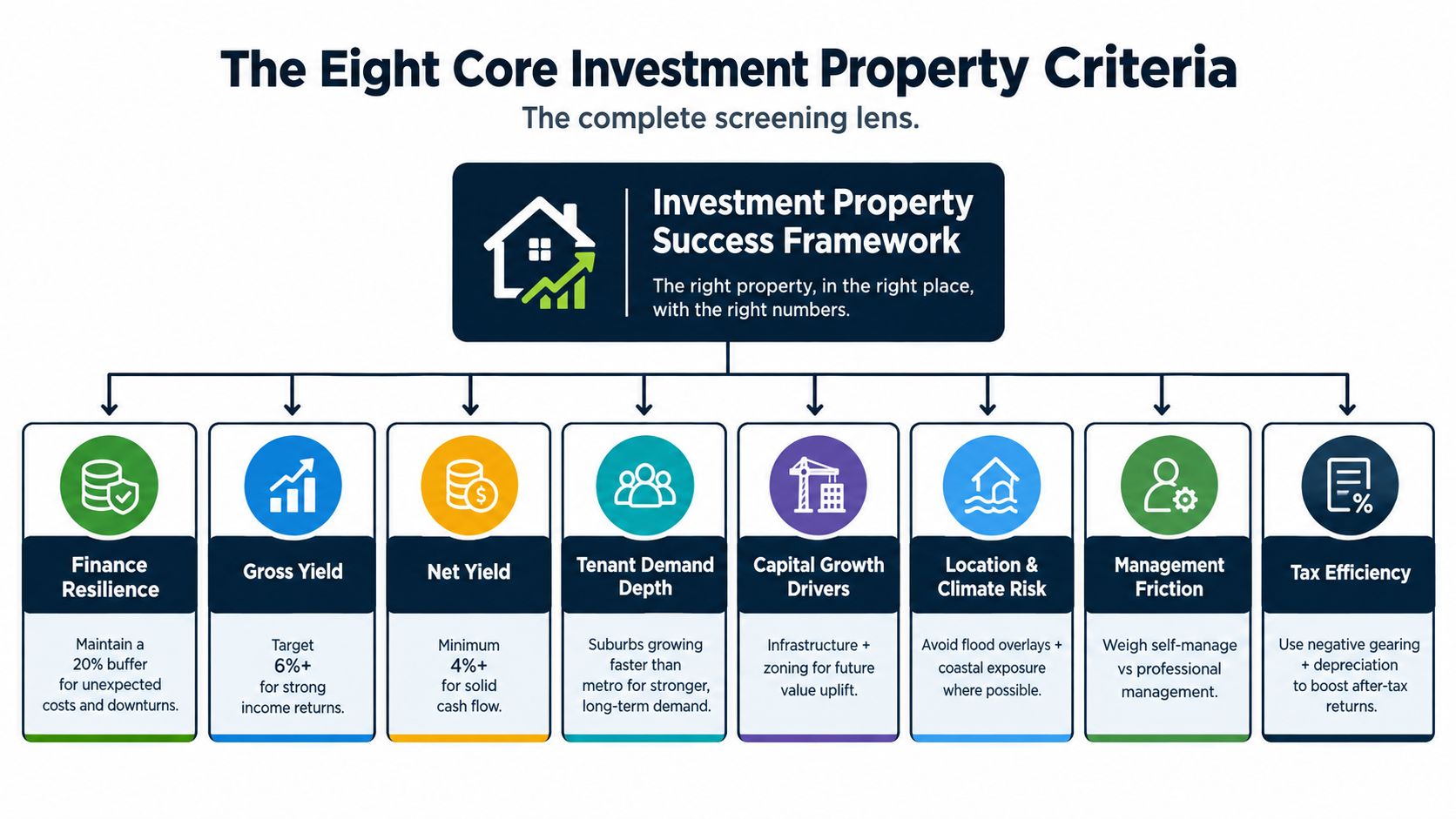
Use the eight criteria as a decision scorecard. Each one answers a different question, and none can replace the others.
Finance resilience: Can your income and cash reserves support the loan if rent softens, the property sits vacant or repayments change? The RBA's finding that around 80% of housing investors had at least one leveraged property makes debt assessment a normal part of investing, not an advanced strategy (RBA investor data).
Gross yield: What does annual rent represent as a proportion of the purchase price before ownership costs? Use it for comparison, never as the final answer.
Net yield: What remains after management, rates, insurance, maintenance, vacancy, strata and finance costs? This is the figure that belongs in your cash-flow model.
Tenant demand depth: Who will rent the property, and how many alternative homes can they choose? A family home in Lakelands or Meadow Springs needs a different demand test from a coastal villa in Madora Bay.
Capital growth drivers: What supports future value beyond a general hope that the suburb will rise? Consider employment links, transport, amenity, zoning and the quality of surrounding housing.
Location and climate risk: Could flooding, drainage, coastal exposure, corrosion or insurance limitations reduce the asset's resilience? Check the address, not just the suburb name.
Management friction: How much work will the property require? Older coastal homes, short-stay strategies and strata properties can consume more attention than their gross yield suggests.
Tax efficiency and exit liquidity: How will deductions and depreciation timing affect cash flow, and who is likely to buy the property when you sell? A property that appeals only to one narrow tenant or buyer segment carries a weaker exit position.
Write the answers beside the address before you compare offers. That simple discipline keeps the investment property criteria practical rather than theoretical.
Reading the Mandurah Rental Market Before You Run the Numbers
Rent must be tested against local household conditions before it enters a yield calculator. The 2021 Census recorded a median weekly rent of $300 across the Mandurah local government area, compared with $340 for Western Australia and $375 nationally (Australian Bureau of Statistics Mandurah QuickStats).
Those figures don't tell you what every property can command. They do provide a useful boundary for judgement. A premium home in Halls Head may attract a different tenant from an older unit in Falcon, while a newer family property in Lakelands or Meadow Springs may compete on comfort, parking and air-conditioning rather than location alone.
Affordability matters because rent increases have a limit. In the Mandurah South West statistical area, 40.4% of renting households were paying more than 30% of household income in rent, compared with 28.3% across Western Australia (ABS Mandurah South West QuickStats). That is a meaningful warning for investors who assume an advertised premium can be pushed indefinitely.
Demand needs a tenant, not just a postcode
Start with the tenant segment. Families may value a usable floor plan, storage, schools and access to employment. Downsizers may prefer a low-maintenance villa close to services. Lifestyle renters may prioritise coastal access, but that audience can be narrower and more sensitive to presentation, furnishing and seasonal alternatives.
Build your appraisal around a conservative achievable rent, not the highest figure mentioned during an inspection. Compare the property with competing homes of the same type, then ask whether the intended tenant could absorb that rent without compromising retention or increasing arrears risk.
Read vacancy evidence carefully
The broader Mandurah South West area recorded 14.0% unoccupied private dwellings, compared with 10.9% across WA and 10.1% nationally in ABS Census data (ABS Mandurah South West Census data). This is not a real-time rental vacancy rate. It includes holiday homes and other forms of non-standard vacancy.
That distinction matters in Madora Bay, Falcon, Halls Head and Wannanup, where lifestyle use can affect the local housing mix. Ask whether a comparable property is genuinely available for a standard long-term lease, used as a second home or competing through holiday letting. Your tenant pool should be based on year-round demand, not a simple reading of all vacant dwellings.
Use the Mandurah property market report as one local evidence source, then verify the specific address, dwelling type and recent comparable leases before making an offer.
From Headline Yield to Net Yield That Holds Under Pressure
A headline yield is useful only when you show what it leaves out. A recent Mandurah market listing reported a median weekly rent of $550 and a median annual sale price of $701,000, with annual rental growth of 4.4% (REIWA Mandurah listing data). The rent and sale price imply a gross yield of roughly 4.1%, before management fees, council rates, strata, insurance, maintenance, vacancy, land tax and finance costs.
That is a comparison point, not a promise. Your spreadsheet should begin with the achievable weekly rent and multiply it across the year, then subtract every recurring ownership cost. Don't bury repairs, insurance or vacancy in a general contingency line. Separate them so you can see which assumption is doing the work.
Build the calculation in layers
Use three views:
- Gross income: Annual rent divided by the purchase price. This shows the headline position only.
- Operating result: Rent less management, rates, insurance, maintenance, strata and vacancy allowance.
- Cash position: Operating result less loan interest and other finance costs, with principal repayments considered separately.
A property can look strong at the first layer and ordinary at the second. An older coastal home may need roof work, corrosion treatment, drainage attention or cooling upgrades. A unit may have strata costs that materially change the result. Those expenses don't disappear because the rental appraisal is optimistic.
The rental yield calculation guide can help structure the formula, but the assumptions still need to come from the property itself.
Stress-test the address, not just the market
Run the model with rent falling by 5%, one month vacant and a major maintenance event. Those are scenarios, not forecasts, and you don't need to pretend they will all happen together. Their purpose is to show whether your cash reserve and personal budget can handle a weaker year.
Financing structure deserves the same treatment. The RBA reported that investor housing-loan approvals represented almost 40% of the value of total housing-loan approvals in 2014, while property-investment lending represented about 20% of banks' total lending. It also found that approximately 64% of investor loan approvals were interest-only, compared with 31% for owner-occupiers, and that the typical interest-only period was about five years, with terms of up to 15 years available (RBA financial stability evidence).
Interest-only finance may improve early cash flow, but it doesn't remove the principal. Model the repayment path after the interest-only period and test refinancing risk. A property that survives only while the loan structure is at its most favourable isn't resilient enough.
Coastal Risk and Physical Due Diligence on the Mandurah Coast
Yield can't preserve capital if the building needs repeated coastal repairs or the insurer won't provide suitable cover. In Madora Bay, Wannanup, Halls Head and Falcon, inspect the physical condition with the same seriousness you apply to the rent.

Check the site before you admire the finishes
Start with the address and its exposure. Review flood overlays, drainage limitations, stormwater outfall capacity and possible backflow risk. Confirm soil classification, particularly where foundations, additions or retaining structures may create future costs.
Then inspect the building:
- Roof condition: Look for age, material deterioration and coastal corrosion.
- External metalwork: Check rust around fixings, balustrades, air-conditioning components and garage hardware.
- Termite evidence: Review accessible areas, stumps, garden edges and previous treatment records.
- Water management: Look for ponding, damp areas, blocked drainage and signs of inadequate falls.
- Cooling and ventilation: Confirm that air-conditioning is functional and suitable for long-term tenants.
Order a building and pest report before you become unconditional. For strata properties, read meeting minutes, maintenance plans, levies and records of special contributions. A lower purchase price doesn't compensate for an underfunded building or recurring repairs.
Confirm the legal and insurance position
Ask an insurer for a quote using the property's actual intended use. Confirm the premium, excesses, exclusions and whether the policy supports a standard long-term lease, furnished occupancy or short-stay use. Don't rely on the seller's current policy as proof that your proposed use will be covered.
The City of Mandurah's planning framework identifies Local Planning Scheme No. 12 as its primary statutory planning tool and includes Local Planning Policy LPP1 for residential development (City of Mandurah local planning framework). Check zoning, permitted use and development controls before assuming you can add a dwelling, renovate for a different tenant segment or operate short-stay accommodation.
A building report, insurer conversation, council enquiry and tenant-demand review should happen before the final offer terms are fixed. A small apparent yield advantage often proves less valuable than sound construction and reliable cover.
Use the coastal property due diligence guide to keep the enquiry organised.
Matching Property Type to Tenant Segment Across Mandurah Suburbs
The right property type depends on the renter you can retain, not the suburb name printed on the appraisal. Lakelands and Meadow Springs generally suit an investor seeking family demand, while Madora Bay and Wannanup may appeal to tenants prioritising coastal lifestyle. Halls Head and Falcon offer a mix of units, villas and established homes, and Dudley Park can attract investors considering redevelopment or alternative layouts.
Future supply makes this comparison more important. The Peel Region's 2026 construction and housing snapshot records 7,138 rented dwellings, representing 23.46% of households. The WA Government has also announced an approved central Mandurah build-to-rent project delivering 98 apartments, including 31 affordable rentals, with construction expected to commence shortly. The project forms part of a broader state fund that could support almost 850 additional homes (Peel Region construction and housing snapshot).
Professionally managed apartments may compete directly with older units and villas for price-sensitive renters. Test your property against that incoming stock now.
| Property Archetype | Typical Suburbs | Target Tenant Segment | Likely Supply Pressure | Key Watchpoint |
|---|---|---|---|---|
| Family homes | Lakelands, Meadow Springs | Families seeking space, parking and practical living | Moderate, depending on new family stock | Floor plan, storage, schools and maintenance |
| Coastal villas | Madora Bay, Wannanup | Lifestyle renters and downsizers | Moderate to high if apartments attract smaller households | Insurance, corrosion, furnishing and year-round demand |
| Units and duplexes | Halls Head, Falcon | Singles, couples and downsizers | High from professionally managed apartments | Strata costs, parking, air-conditioning and presentation |
| Redevelopment plays | Dudley Park | Flexible tenants or future owner-occupiers | Depends on approved local supply and end product | Zoning, permitted use, construction costs and exit appeal |
The key question is not whether new apartments are automatically harmful. It is whether your property offers something they don't, such as a yard, secure parking, storage, a second living area or a better fit for families. Conversely, an older unit with no lift, poor cooling or weak storage may struggle even if its current yield looks attractive.
Model rent resilience by tenant segment. If the property needs the highest possible rent from a narrow audience, treat that as a risk. A broader tenant pool often protects occupancy and exit flexibility better than a sharp but fragile yield.
WA Tax Rules That Change the Maths of a Mandurah Investment
Tax deductions improve the model only when you classify them correctly. The Australian Taxation Office explains that interest on investment borrowings, council rates, repairs and maintenance, and depreciating assets costing $300 or less may generally be claimed in the income year incurred, while capital works and depreciation of assets over $300 are generally claimed over multiple years (ATO rental expense guidance).
Put those costs into separate spreadsheet columns. Immediate deductions may affect the current income year, while capital works, borrowing expenses and larger depreciating assets must be spread across the relevant period. Don't treat every invoice as an immediate cash refund.
Residential capital-works deductions are generally spread at 2.5% over 40 years or 4% over 25 years, depending on the type and timing of construction expenditure. For residential rental properties, capital-works deductions are generally available only where the building was constructed after 17 July 1985 and is rented or available for rent (ATO capital works guidance).
That distinction can affect the comparison between newer construction in Lakelands or Meadow Springs and established stock in Halls Head or Wannanup. Newer doesn't automatically mean better, but construction dates and eligible expenditure may produce a different depreciation profile. Obtain a qualified tax assessment rather than estimating deductions from the listing photos.
Planning also belongs in the financial model. A short-stay strategy, ancillary dwelling or redevelopment concept may change insurance, management and tax assumptions, but it still has to comply with the City of Mandurah planning framework. Check the scheme and local policy before you price the strategy.
Stamp duty is another acquisition cost that shouldn't be hidden from the initial cash requirement. Review the Mandurah investment property stamp duty guide and confirm the final position with your conveyancer and accountant.
Your Pre-Offer Checklist and Final Investor FAQ
The night before you submit an offer, reduce the property to a single page. If you can't answer the questions below, you're not ready to price it.
- Finance resilience: Confirm the loan structure, repayment path and personal cash buffer under weaker rent conditions.
- Yield calculation: Verify gross rent, then subtract management, vacancy, rates, insurance, maintenance, strata and finance costs.
- Tenant demand: Identify the tenant segment and compare the property with competing homes in Lakelands, Madora Bay, Meadow Springs, Halls Head, Falcon, Wannanup or Dudley Park.
- Supply pressure: Check whether new apartments or other approved stock could compete for the same renter.
- Physical risk: Obtain building and pest reports, review drainage, roof condition, corrosion, termites and coastal exposure.
- Insurance: Get a quote with the intended lease type, excesses, exclusions and relevant hazards confirmed.
- Tax treatment: Separate immediate deductions from capital works, borrowing expenses and depreciation claimed over time.
- Exit liquidity: Ask who will buy the property later and whether the layout, location and condition appeal beyond one narrow investor audience.

Questions investors should settle before signing
How should I use an agent's rental appraisal? Treat it as a starting hypothesis. Ask for comparable leased properties, the proposed tenant profile, likely days on market and the features that justify the rent.
When does interest-only finance help? It may support early cash flow, but the unpaid principal still has to be addressed. Compare the full repayment path, not only the initial payment.
What should I ask about coastal insurance? Confirm the premium, excess, exclusions, storm and flood treatment, corrosion-related limitations and whether your intended lease use is covered.
How should I model a rent fall? Apply a 5% reduction to annual rental income, then test one month of vacancy and a major maintenance event separately. The result should inform your cash reserve and offer price.
What does local professional guidance add? A buyer's agent, property manager, building inspector, conveyancer, insurer and accountant each test a different part of the decision. David Beshay Real Estate provides local property guidance, appraisals and investment-focused assessment across Mandurah and surrounding suburbs, while specialist advisers should confirm finance, tax, insurance and legal matters.
The best investment property criteria don't identify the property with the loudest yield. They identify the property that still makes sense when rent, maintenance, finance and competition become less convenient.
David Beshay Real Estate can help you compare Mandurah investment properties through realistic rent, tenant demand, coastal risk and local appraisal evidence. Visit David Beshay Real Estate to discuss a property in Lakelands, Madora Bay, Meadow Springs, Halls Head, Falcon, Wannanup or Dudley Park before you make an offer.

