

Holding a signed power of attorney doesn't automatically give someone the right to sell and settle a Western Australian property. For a home in Halls Head, Lakelands, Madora Bay or Falcon, the more important question is whether the authority is drafted, witnessed, lodged and accepted in a form Landgate can use for the transfer.
That changes the usual advice. The hardest part of selling under power of attorney isn't always finding a buyer or choosing an asking price. The serious risk can appear after the contract is signed, when an attorney's authority is found to be too general, the required original cannot be produced, or the document was never noted with Landgate. A short legal and conveyancing review before marketing is often more valuable than rushing into an early campaign.
Table of Contents
- The Hidden Settlement Risks of Attorney Property Sales
- Navigating Landgate Lodgement and Documentation Rules
- General Versus Enduring Authority for Incapacitated Owners
- Your Pre-Listing Authority and Title Verification Checklist
- Preventing Conflicts of Interest and Valuation Disputes
- Aligning Legal Readiness with Premium Coastal Marketing
The Hidden Settlement Risks of Attorney Property Sales
Families commonly assume that a signed document gives a son, daughter, partner or trusted friend everything needed to sell a home. In Western Australia, that assumption can create a gap between authority to act and authority Landgate will accept. A general informal authorisation may help someone communicate with an agent, but it may not authorise the attorney to sign the transfer of land or complete settlement.
Landgate requirements apply under the Transfer of Land Act 1893. Before a transaction signed by an attorney can generally be lodged for registration, the power of attorney must be deposited and noted with Landgate. The attorney's authority must also expressly, or by necessary implication, relate to Western Australian real property and provide sufficiently clear powers, such as selling, mortgaging or leasing land and signing the relevant transfer. Landgate's guidance on power of attorney types identifies the practical risk clearly: the document may exist, yet still be technically unusable for the proposed transaction.
Why a signed document may not be enough
A property campaign can run smoothly from the first appraisal through to an accepted offer. The buyer may have finance organised, the contract may be signed and the seller may believe settlement is just an administrative step. If the attorney's authority hasn't been properly reviewed, that confidence can be misplaced.
The issue might involve:
- Insufficient wording: The instrument doesn't clearly authorise dealings with WA land or signing the transfer.
- Missing Landgate notation: The authority wasn't deposited before the transaction reached registration.
- Wrong original: The lodging party has a photocopy or an incomplete counterpart rather than the original signed instrument.
- Title complications: The registered owner, trust structure or signing requirements don't match the assumptions made at listing.
Practical rule: Treat authority verification as a pre-listing task, not a settlement-day formality.
For a Mandurah seller, the appropriate first conversation is usually with a solicitor or settlement agent who can review the document and title structure. A local agent can coordinate the campaign, but shouldn't be treated as a substitute for legal advice. It's also useful to understand what a settlement agent does before deciding who should manage the transaction.
The most reliable sequence is simple: confirm the legal authority, check the title and lodgement position, then set the marketing timeline. That approach may feel slower at the beginning, but it protects the seller from discovering after contract that the buyer cannot receive clear, registrable title.
Navigating Landgate Lodgement and Documentation Rules
The administrative detail matters because an attorney's signature has to connect properly to the registered land transaction. Before a home in Lakelands or Halls Head is marketed, the attorney, solicitor or conveyancer should establish whether the power of attorney has been lodged and noted in the way Landgate requires.
For a transaction signed by an attorney, Landgate generally requires the original signed instrument, not a photocopy. Landgate recommends preparing two originals, because one is retained in its permanent records and the second is returned to the lodging party. Legal Aid WA advises that a power of attorney intended for a land transaction should be lodged within three months of signing. These requirements are set out in Legal Aid WA's guidance on powers of attorney.
The original document and the registry record
The original isn't just a preferred piece of paperwork. It forms part of the evidence Landgate uses when assessing the attorney's authority. If a family has only a scanned copy, or the original is held interstate and cannot be located, the campaign timetable may need to change while the legal team resolves the documentation.
Identity verification and witnessing requirements also need attention. The attorney should expect the conveyancer or solicitor to check the identity of relevant parties, the execution of the instrument and the relationship between the authority and the land being sold. Those checks can expose problems that aren't visible from a quick reading of the first page.
The title should be checked at the same time. A certificate of title confirms the registered ownership details and can help identify whether the land is held by an individual, joint owners, a company or another structure. The power of attorney must then be considered against that ownership position.
A practical document sequence
A well-organised file should contain:
- The original power of attorney, together with any relevant counterparts or supporting documents.
- Evidence of Landgate lodgement or notation, confirmed by the legal representative managing the transaction.
- Identity documents and witnessing records, prepared in the form requested by the conveyancer.
- The current title details, including any trust or company information relevant to signing.
- The proposed transfer and contract documents, reviewed before an offer is accepted where possible.
- A clear settlement statement, showing how sale proceeds will be applied and paid.
Where money is received and distributed as part of a property transaction, disciplined handling matters too. A conveyancer or agency finance team may find a resource such as trust account management best practices useful when reviewing controls around receipts, records and payments.
The principal exception identified by Landgate concerns an attorney signing as transferee on behalf of a buyer. In that situation, the document may only need to be produced for inspection. That exception shouldn't be treated as a shortcut for an owner selling their property, where the authority generally needs to be deposited and noted before registration can proceed.
General Versus Enduring Authority for Incapacitated Owners
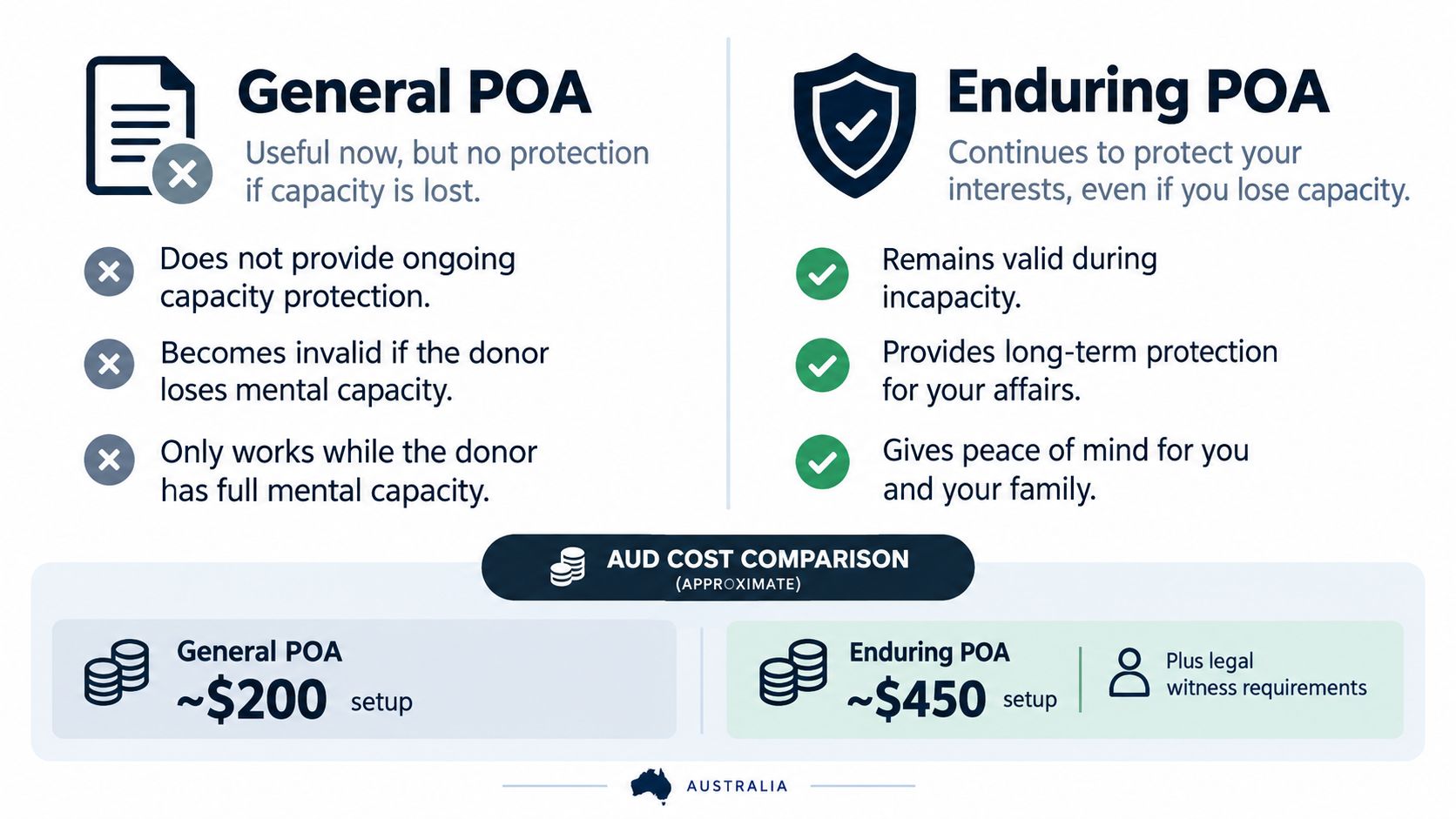
The distinction between a general and enduring power of attorney becomes critical when an owner in Meadow Springs, Falcon or Wannanup can no longer manage the sale personally. A general authority may allow an attorney to act while the donor retains legal capacity, depending on its terms. It doesn't provide the same protection where the donor later loses capacity.
An enduring power of attorney continues despite the donor later losing legal capacity. Landgate explains that, for purposes under the Transfer of Land Act 1893 and Property Law Act 1969, an enduring power operates as though it were made in the statutory form under section 143 of the Transfer of Land Act. That makes it an important mechanism for property decisions involving incapacity, aged-care transitions or a long-term inability to attend settlement. Landgate's enduring power of attorney guidance sets out this legal treatment.
Capacity changes the decision
If the owner still has capacity, they may be able to give clear instructions about the proposed sale, approve the appraisal approach and explain how the proceeds should be handled. Written instructions can help preserve the donor's wishes and give the attorney a stronger record of acting properly.
If capacity has been lost, the attorney must rely on the authority already granted and act within its scope. A temporary family arrangement or verbal agreement won't necessarily solve the problem. The legal team must establish that the enduring authority is valid, relevant to the land and available for the transaction being contemplated.
A conveyancing process for real estate becomes more than a routine exchange of forms in such cases. The conveyancer needs to coordinate the title, authority, contract and settlement documents as one connected file.
Fiduciary duties and related-party sales
An attorney's role is fiduciary. Landgate states that the attorney must act in the donor's best interests. A transfer to the attorney, the attorney's family or an associated party is generally prohibited because it may breach those duties.
A family member may sincerely believe a private sale is fair, especially if the property needs to be sold quickly for care costs. Good intentions don't remove the conflict. A related-party transaction can require detailed evidence, independent valuation material, proof of consideration and, in some circumstances, an order from the State Administrative Tribunal or a court.
The safest distinction is between authority to sell and permission to benefit personally. The first may be available under a properly drafted enduring power. The second attracts much closer scrutiny and shouldn't be assumed from broad wording.
Your Pre-Listing Authority and Title Verification Checklist
A pre-listing review should be treated like a property preparation task. Just as a seller fixes presentation issues before photography, the attorney should resolve authority issues before the home is exposed to buyers in Madora Bay, Halls Head or Dudley Park.
Start with the registered owner
Obtain the current title and confirm who owns the land. Check whether the registered proprietor is an individual, joint owners, a company, trustee or another entity. A power of attorney given by one person may not answer the signing requirements for a property held in a different capacity.
The review should also identify mortgages, caveats or other title matters that the settlement team will need to address. A title search is a practical starting point, and understanding a property title search helps sellers see why ownership and encumbrance checks should occur before marketing.
Read the authority against the proposed sale
Don't stop at the words “financial matters” or “real estate”. Ask the solicitor or conveyancer to confirm that the instrument:
- Relates to WA real property: The authority should expressly, or by necessary implication, cover Western Australian land.
- Allows a sale: It should provide the power to sell the property or land.
- Allows signing: It should authorise execution of the transfer and other instruments required for settlement.
- Matches the donor: The person who granted the authority must be the relevant owner or have the required legal capacity.
- Remains effective: The legal adviser should confirm whether it is general, enduring, revoked or otherwise limited.
The original signed instrument should be located before the campaign is scheduled. If the document can't be found, the family shouldn't assume a scan will be accepted just because everyone recognises the signature.
Confirm the Landgate position
Ask the conveyancer to establish whether the original has been deposited and noted, whether further evidence is required and whether the attorney's identity and witnessing records are satisfactory. Legal Aid WA's recommended timing for land-related lodgement makes early action particularly important.
Drafting quality also deserves specialist attention. Although overseas resources aren't a substitute for WA advice, a general discussion of POA drafting services illustrates why precise authority matters more than a document's title. For a Mandurah sale, the final review must be completed against Western Australian law and Landgate practice.
A useful file should also record the donor's instructions where capacity allows, the proposed method of sale, the appraisal evidence and the intended destination of net proceeds. Those details help the legal team assess the transaction and give the family a clear record if questions arise later.
Preventing Conflicts of Interest and Valuation Disputes
The most sensitive transaction is one where the proposed buyer is the attorney, a family member or an associated entity. The attorney may believe the price is generous, or the family may want a quick private arrangement. Landgate's concern is broader than intention. It is whether the attorney has acted loyally, obtained proper value and protected the donor.
A transfer to an attorney or family member is generally prohibited where it may breach fiduciary duties. Registration may require a court or State Administrative Tribunal order, or detailed supporting evidence including the donor's reasons or wishes, proof that the transaction benefits the donor, evidence that consideration was paid, evidence of full market value and an independent sworn valuation. Landgate's guidance on transfers by an attorney explains why an informal family deal can become a registration problem.
Why independent evidence matters
An independent appraisal doesn't guarantee that every dispute disappears. It does create a defensible starting point for the asking price, negotiation strategy and final result. The attorney should understand the difference between an agent's market appraisal and a lender's assessment, as explained in this guide to bank evaluations and real estate agent appraisals.
For an ordinary arm's-length sale, the file should include:
- Independent appraisal material: A written assessment of likely market value.
- Comparable-sales evidence: Relevant nearby sales used to support the pricing position.
- Marketing records: The listing, campaign activity and buyer enquiries.
- Negotiation notes: Offers received, counteroffers made and the reasons for accepting terms.
- Settlement evidence: A statement showing the sale proceeds and where the net funds were paid.
These records are particularly valuable where siblings disagree, an absent owner's affairs are being managed from interstate or the sale forms part of an aged-care transition.
Private deals create avoidable exposure
A private sale to a relative may appear efficient because it avoids a full campaign. It can also leave the attorney with little independent evidence that the price represented full market value. A discount may be challenged as an unauthorised gift, while a transfer without proper authority may not be registrable.
The cleanest related-party transaction is the one treated as though an independent seller and buyer were negotiating across the table.
That means separate legal advice for the donor's interests where appropriate, independent valuation evidence and careful documentation of the reason for the transaction. An attorney shouldn't negotiate with themselves, set an unsupported price or direct proceeds in a way that benefits them personally.
For a standard sale in Falcon, Wannanup or Madora Bay, an open and well-recorded campaign usually provides stronger evidence than a private arrangement. It also gives the conveyancer a clearer settlement trail and reduces the risk that the transaction will later be questioned.
Aligning Legal Readiness with Premium Coastal Marketing
Once the authority and title position are clear, the property can be prepared properly for the market. That preparation still needs to respect the legal timetable. A home in Wannanup, Madora Bay or Halls Head may need architectural photography, styling, copywriting and private inspections, but none of those steps should outrun the attorney's ability to complete the transfer.

Build the campaign around settlement readiness
The legal adviser should confirm what remains outstanding before the property is launched. If the power of attorney is unlodged, a statutory declaration or further supporting documentation may be required. If the donor has lost capacity, the team may need additional evidence that the enduring authority remains effective and that the attorney is acting within its scope.
This information should shape the campaign calendar. The agent can prepare the appraisal, presentation plan and buyer strategy while the legal team resolves the authority position. That is more disciplined than accepting an offer first and hoping the paperwork catches up.
A short delay for authority and valuation checks can reduce the risk of a failed settlement, family dispute or allegation that the donor's interests weren't protected, particularly during urgent sales and aged-care transitions in coastal suburbs. Western Australian public guidance on enduring powers of attorney supports the importance of confirming continuing authority when families are under pressure.
Premium marketing still needs a practical sequence
For a coastal property, the campaign may include:
- Presentation planning: Resolve maintenance, decluttering and styling decisions before photography.
- Accurate positioning: Use local comparable evidence rather than an emotional price expectation.
- Controlled access: Arrange inspections with the attorney's instructions and the owner's circumstances in mind.
- Clear offer handling: Record the terms, conditions and reasons for recommending a preferred buyer.
- Settlement coordination: Keep the solicitor, conveyancer, attorney and agent aligned as the contract progresses.
A premium campaign isn't defined only by polished imagery. It also depends on reliable information, measured negotiation and confidence that the seller can deliver what the contract promises.
The transaction should feel coordinated from the first open home to settlement. That requires the agent to understand the practical constraints without giving legal advice, and the attorney to keep legal and financial decisions with the appropriate professionals.
The following visual provides a useful way to think about the relationship between documentation, authority and completion:
For homeowners in Lakelands, Meadow Springs, Halls Head, Falcon and Dudley Park, the central lesson is straightforward. Selling property under power of attorney isn't just a matter of appointing someone to sign. It's a coordinated process involving the donor's interests, the exact wording of the instrument, Landgate requirements, title verification, valuation evidence and settlement controls.
David Beshay Real Estate offers locally informed appraisals, premium campaign planning and practical coordination for Mandurah property owners selling through complex family or attorney arrangements. Visit David Beshay Real Estate to discuss your property, review the right preparation sequence and plan a campaign that is ready for settlement as well as the market.

