


Ever wondered what officially proves you own your home? It's not just the keys or the sales contract. In Australia, the ultimate proof of property ownership is a document called the Certificate of Title.
Think of it as the official birth certificate for a piece of land. It’s a single, government-backed record that confirms exactly who owns the property and lays out any rights or restrictions tied to it. This document is the absolute cornerstone of property law and every single transaction that happens in WA.
Your Guide to Property Ownership Documents
When you buy a home, you're not just getting bricks and mortar. You're actually acquiring a bundle of legal rights to a specific piece of land. The Certificate of Title is the document that makes it all official, putting your ownership on the public record for everyone to see.
Here in Western Australia, the state's land information authority, Landgate, is responsible for managing this crucial register. It acts as the single source of truth, replacing the old, confusing systems of paper deeds. For any serious buyer or seller, getting your head around this document isn't just a good idea—it's essential.
What Key Information Does It Hold?
Every Certificate of Title is structured to paint a complete legal picture of the property. The information is standardised, which means you get clarity and consistency no matter which property you're looking at.
To help you get familiar with what you're looking at, here’s a quick rundown of the essential data points you'll find on every Certificate of Title.
Key Information on a Certificate of Title
| Information Type | What It Tells You |
|---|---|
| Unique Identifier | The Volume and Folio numbers. Think of these as a unique serial number for the property on the government's land register. |
| Registered Proprietor | This section officially names the legal owner or owners of the property. This is the proof of ownership. |
| Land Description | Provides a precise legal description of the property's boundaries, usually by referencing an official survey plan. |
| Encumbrances | Lists any claims or restrictions on the property. This includes things like mortgages, easements (like a right of way), or covenants. |
Understanding these components is the first step to confidently interpreting the legal status of any property you're interested in.
The Digital Shift
For a long time, Certificates of Title were physical, paper documents. You’d get a fancy-looking certificate to keep in a safe place. But times have changed.
Following legislation like the Real Property Amendment (Certificates of Titles) Act 2021, Australia has largely moved to an electronic system. This was a huge step forward. The move to a secure digital register has pretty much eliminated paper certificates, which massively speeds up property transactions and makes the whole process more secure. If you want to dive deeper, you can learn more about the transition to electronic records and how to read these digital documents.
How to Read a Certificate of Title
Opening up a Certificate of Title for the first time can feel a bit like trying to decipher a secret code. It's packed with legal jargon and official-looking text that can be pretty intimidating. But once you get the hang of its layout, the document starts to tell a clear and logical story about the property.
Think of this section as your personal translator. We’ll break down each part into simple, understandable pieces so you can read any title with confidence.
The Property's Unique Identifier
Every property in Western Australia has its own unique ID, much like a car has a VIN. On a WA Certificate of Title, this identifier is the Volume and Folio numbers. You'll find them right at the top. Think of them as the property's unique filing code in Landgate's massive digital library.
These numbers are absolutely essential for any official business related to the property. Whenever a lawyer, conveyancer, or bank needs to pull up your property’s legal record, they’ll use the Volume and Folio numbers to find the exact file.
First Schedule: The Official Owner
The first major section you'll come across is the First Schedule. This part is straightforward but incredibly important. It officially names the ‘Registered Proprietor’—the person, people, or company that legally owns the property.
This section is the definitive proof of who holds the keys, legally speaking. When you buy a property, the deal isn't truly done until your name is recorded here as the new Registered Proprietor. If there’s ever a dispute, this is the record that sets things straight.
A clean and accurate First Schedule is the bedrock of a smooth property transaction. It confirms the seller actually has the legal right to sell, which stops any potential issues with fraud or ownership arguments dead in their tracks.
Second Schedule: Uncovering the Burdens
Now for the interesting part. The real detective work starts when you get to the Second Schedule. This is where you’ll find any ‘encumbrances’ registered against the title. An encumbrance is just a formal term for any claim, right, or restriction that someone else has over the property.
Think of this section as the property’s financial and legal history report. It lays out any baggage or obligations that come with the land. Skipping over these details can lead to some major headaches after you’ve already bought the place, so it’s vital to understand what each entry means.
Here’s a breakdown of the most common encumbrances, explained with simple analogies:
- Mortgage: This is the one you’ll see most often. It’s like a secured loan notice on the title, showing that a bank or lender has a financial interest in the property until the loan is fully paid off.
- Easement: This is like a shared driveway agreement. It gives someone else the right to use a part of your property for a specific reason, like a utility company needing access to power lines or a neighbour having a right-of-way to get to their own block.
- Covenant: This acts like a set of neighbourhood rules that are legally attached to the land. It might restrict what you can build, the materials you can use, or even the colour you can paint your house, all to maintain a certain standard in the area.
The Title's Role in Property Transactions
A Certificate of Title is much more than just a piece of paper; it’s the active, central document in the entire process of buying or selling a home. Think of it as the property's passport. No one can legally transfer ownership without it, making it the engine of every real estate transaction in Western Australia.
This is why one of the very first steps your conveyancer takes is to perform a 'title search'. This isn't just a formality—it’s a crucial background check on the property you’re about to buy. The search confirms the seller has the legal right to sell and, more importantly, uncovers any hidden dramas tied to the land.
The Critical Title Search
A title search is your safety net, designed to uncover potential deal-breakers that could otherwise stay hidden until it's far too late. It’s a non-negotiable part of the due diligence process.
Your conveyancer will be looking for a few key things:
- Existing Mortgages: This ensures the seller's home loan will be fully paid off and wiped from the title at settlement. You don't want to inherit their debt!
- Caveats or Court Orders: These act like a 'freeze' on the title, flagging a dispute or claim by another party that absolutely must be resolved before the sale can proceed.
- Easements and Covenants: These are restrictions that could seriously impact your future plans for the property, like a neighbour having a right of way across your land or rules limiting what you can build.
By getting these issues out in the open early, you and your legal team can tackle them head-on before you’re legally locked into the purchase. This infographic breaks down the core elements a title search verifies.
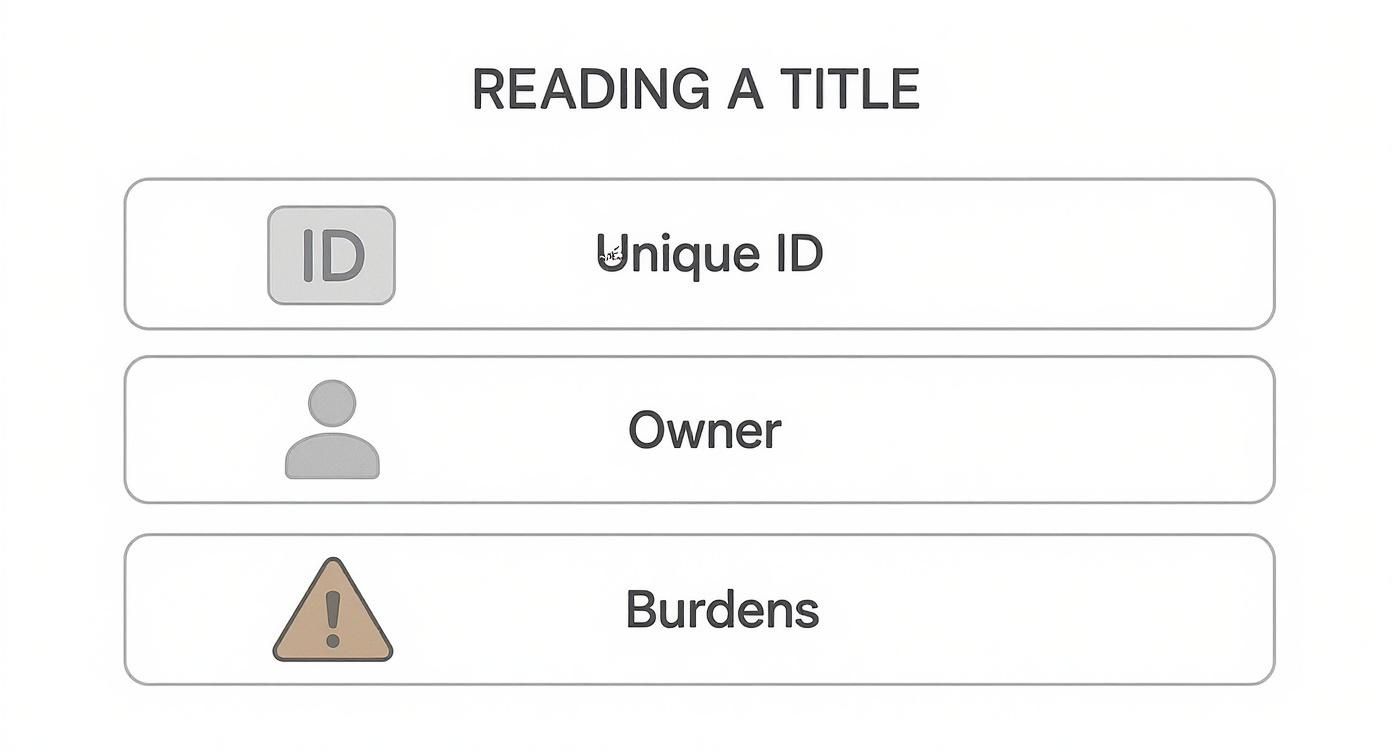
As the visual guide shows, it all comes down to confirming who the owner is (Registered Proprietor), the property's unique ID (Volume/Folio), and any burdens (Encumbrances) attached to it.
The Centrepiece of Settlement
The Certificate of Title truly takes centre stage on settlement day. This is the moment where ownership officially changes hands, and the title is the key that makes it all happen. In fact, the entire settlement process revolves around updating this single, vital document.
It's a carefully coordinated dance of legal and financial steps. Various parties work in sync to ensure a smooth transfer of ownership, all centred on that title record. If you'd like to dive deeper into this final step, our guide explains in detail what conveyancing in real estate involves.
During settlement, a few things happen in quick succession:
- The seller's bank lodges a 'Discharge of Mortgage' to officially remove their financial interest from the title.
- Your bank (if you're getting a mortgage) registers its own mortgage against the title, securing its loan against your new property.
- A 'Transfer of Land' document is lodged, which is the final move that removes the seller's name and adds yours as the new Registered Proprietor.
This meticulous process ensures that when you finally get the keys, you receive a 'clear title'—totally free from the previous owner's debts—and your ownership is securely and legally recorded for all to see.
The Shift From Paper Deeds to Digital Titles
Not so long ago, proving you owned a property meant digging out a dusty, fragile bundle of paper deeds. It’s hard to imagine now, but that system was how things were done for decades. The journey from those cumbersome documents to the instant, secure digital titles we use today is a massive leap forward, and it’s the reason modern property ownership is so reliable.
The old way of doing things, with its long chain of physical papers, was slow, prone to mistakes, and wide open to fraud or just plain losing the documents. The first big shake-up was the introduction of the Torrens Title system across Australia. This was a game-changer. It created a single, state-guaranteed register for all land, meaning each property got one definitive Certificate of Title instead of a messy collection of historical papers.
This "single source of truth" approach set the stage for the next logical step: taking it all online.
The Rise of the Electronic Register
Moving to an electronic register, which in WA is managed by Landgate, was the natural evolution. It took the core idea of the Torrens system—one reliable record—and supercharged it with modern technology to make it faster, safer, and easier to access. Today, your property ownership is recorded in a secure digital database, not a filing cabinet.
This shift has brought huge benefits for both homeowners and buyers:
- Tougher Security: Digital titles are far less vulnerable to being forged, faked, or physically lost. The system is built with multiple layers of security to keep your ownership information safe.
- Faster Transactions: Electronic conveyancing platforms mean property settlements can happen almost instantly. We’re talking minutes, not days.
- Pinpoint Accuracy: A central digital register cuts down on the risk of human error, making sure the information on your title is always correct and up-to-date.
The whole point of a Certificate of Title is to give you conclusive proof of ownership. The digital system makes sure that proof is not only accurate but also locked down with modern security, giving property owners peace of mind like never before.
This transition is still happening around the country. In states like Tasmania, for example, new laws are paving the way to stop issuing paper certificates entirely, cementing the move to a fully digital world. You can read more about this legal shift and the future of land title records to see where things are headed. This is the robust technology that stands behind the security of your property ownership today.
Finding and Searching a Certificate of Title
If you need to get your hands on a property's Certificate of Title, you don't need to be a detective. Thanks to centralised digital records, this vital information is surprisingly easy for anyone to access.
Whether you're a buyer doing your homework, a homeowner who needs a copy for your files, or just curious about a property's history, running a title search is your first move. This is the official way to ask for the current property record from the state’s land registry. In Western Australia, that’s all handled by Landgate. All you really need to kick things off is a street address or, if you happen to have them, the specific Volume and Folio numbers.
Your Search Options Explained
Not all title searches are created equal. Depending on what you’re trying to find out, you can dig for different levels of detail.
The most common request is for a Current Title Search. Think of this as a real-time snapshot of the property's legal status today. It tells you exactly who the current owner is, the land's specific details, and any registered claims against it, like mortgages or easements.
But if you need to go deeper, a Historical Title Search is the way to go. This search traces the property’s ownership all the way back through previous owners, revealing its complete transactional story. It's often used for legal research or to get to the bottom of long-standing rules or access rights that might still affect the land.
A title search is the single most effective way to verify a property's legal standing before making any decisions. It cuts through assumptions and provides you with the official, government-guaranteed facts recorded on the Certificate of Title.
How to Conduct a Title Search
The process for getting a title record is designed to be straightforward. You can usually order a search online directly through Landgate or an authorised information broker. The costs are pretty modest, making it an affordable and essential step in any property investigation.
To help you get a full picture of what this involves, our detailed guide covers all the ins and outs of what a property title search reveals and why it’s so critical.
To keep it simple, here’s a quick rundown of the main search types you can do in WA.
Title Search Options in WA
| Search Type | What It Provides | When to Use It |
|---|---|---|
| Current Title Search | An up-to-the-minute copy of the Certificate of Title, showing current ownership and encumbrances. | Essential for buyers during due diligence, or for homeowners needing a current record. |
| Historical Title Search | A timeline of all previous owners and registered dealings on the title since its creation. | Useful for legal disputes, genealogical research, or investigating the history of an encumbrance. |
By picking the right search, you’re arming yourself with accurate, official information straight from the source. It’s the best way to move forward with total confidence in your property dealings.
Common Issues Found on a Title Search
While everyone hopes for a perfectly ‘clean’ title, the reality is that many properties come with a bit of history. A title search is designed to bring these issues to light before they become your problem. Understanding these common findings will prepare you for discussions with your conveyancer and help you avoid nasty surprises down the track.
These issues are formally known as encumbrances—essentially, legal claims or restrictions that can limit how you use your property. They aren't necessarily deal-breakers, but you absolutely need to know about them.
Mortgages and Financial Interests
The most common encumbrance you'll see is a mortgage. This entry just shows that a lender has a registered financial interest in the property. It's completely standard and simply means the seller's home loan will be paid off and formally discharged from the title at settlement. Your conveyancer makes sure this happens so you receive the property free and clear of the seller’s debt.
Easements That Affect Your Land
An easement grants another party the right to use a portion of your land for a specific purpose, even though you own it. It’s a permanent arrangement that stays with the property when it's sold, so it becomes your responsibility.
Common examples include:
- Utility Easements: Allowing providers like Western Power or the Water Corporation to access pipes, cables, or powerlines running through your property.
- Right of Way Easements: Giving a neighbour the legal right to cross a part of your land to access their own property. You'll often see this with shared driveways or battle-axe blocks.
These can seriously impact your plans for landscaping, extensions, or installing a pool, so it's vital to know exactly where they are and what they permit.
Restrictive Covenants and Building Rules
A restrictive covenant is a private agreement or rule that limits what you can do with your property. These are often put in place by developers to maintain a certain look or standard within a neighbourhood.
Covenants can dictate anything from the type of fencing you can install and the colour you can paint your house, to prohibiting you from parking a boat or caravan in your driveway. Ignoring them can lead to legal action from neighbours or the local council.
Caveats: A Red Flag for Disputes
Finding a caveat on a title is a major red flag that requires immediate attention. A caveat acts as a legal ‘freeze’ on the title, preventing the owner from selling or dealing with the property. It signals that another party has a claim or interest they are trying to protect, often related to a financial dispute or a relationship breakdown.
This must be resolved and removed before any sale can proceed. Uncovering these issues early is critical, but some title complexities are so hidden they can evade even a thorough search. For this reason, many buyers and lenders explore what is title insurance for an extra layer of protection.
Got Questions? We’ve Got Answers
Stepping into the world of property documents can feel like learning a new language. Let's clear up some of the most common questions buyers and sellers in WA have about the Certificate of Title.
Do I Get a Physical Certificate of Title When I Buy Property?
Not anymore, in most cases. Australia has largely moved to a digital system for property dealings, so your ownership is now recorded in a secure electronic register. If you have a mortgage, your bank holds the electronic Certificate of Title (often called an eCT) as security for the loan.
So, while you won’t get a fancy piece of paper to lock away in a safe, you can always order an official title search from Landgate. This document is your definitive proof of ownership and contains all the critical details about your property.
Is a Certificate of Title the Same as a Property Title?
Good question. People often use these terms interchangeably, but there's a subtle yet important difference.
Think of it this way:
- A Property Title is the idea of ownership. It's your legal bundle of rights that says you can use, live on, sell, or lease the land.
- The Certificate of Title is the proof of that ownership. It's the official government record (these days, mostly digital) that confirms those rights belong to you.
Simply put, the title is your right, and the certificate is the evidence.
What Happens to the Title When I Pay Off My Mortgage?
This is a fantastic milestone for any homeowner! Once that final mortgage payment is made, your lender is legally required to lodge a ‘Discharge of Mortgage’ with Landgate here in WA.
This process officially removes the bank's claim (known as an encumbrance) from your Certificate of Title. The electronic title (eCT) is then released from their control, and you are left with a ‘clear’ title. It’s the moment you truly own your property outright, with no one else having a registered financial claim against it.
Ready to take the next step in your Mandurah property journey? Whether you're buying, selling, or just need an accurate appraisal, David Beshay Real Estate provides the expert guidance you need. Explore your options with us today.


Pingback: Selling Property Under Power of Attorney in WA - David Beshay Real Estate - Beshay Realty