


When you hear the term real estate commission, what comes to mind? For many, it's just a percentage of the sale price. But it's much more than that. Think of it less as a service charge and more as a success fee—you only pay your agent when they successfully sell your home.
Unpacking the Value Behind Your Commission Fee

Agreeing to a commission fee isn’t just about putting a ‘For Sale’ sign in your front yard. It’s an investment in a complete package of professional services, all geared towards one goal: getting you the best possible price for your property, as quickly as possible.
This fee is what aligns your agent’s interests directly with yours. Because their payment is tied to your home's final sale price, they're deeply motivated to negotiate every last dollar on your behalf. A higher sale price for you means a higher commission for them, creating a powerful partnership focused on getting you a fantastic result.
What Your Fee Actually Covers
The commission fee is essentially an all-inclusive cost that bundles together a huge range of essential services. It covers the agent’s time, their expertise, and the very real costs of marketing your property effectively—expenses the agency pays upfront with no guarantee of a sale.
Here’s a snapshot of what that fee typically funds:
- Expert Marketing and Advertising: This isn't just a simple online listing. It includes professional photography, virtual tours, detailed floor plans, prominent listings on major portals like realestate.com.au, targeted social media campaigns, and even print advertising to reach the widest possible net of qualified buyers.
- Buyer Management: A huge amount of an agent's time goes into fielding enquiries, vetting potential buyers to weed out the time-wasters, and conducting countless private inspections and open homes.
- Skilful Negotiation and Closing: This is where a great agent truly earns their keep. They manage offers, navigate complex counter-offers, and handle the intricate contract negotiations to protect your interests and secure the best terms.
A lot of sellers get stuck on the percentage, but it’s helpful to reframe it.
That commission fee is the fuel for the entire sales engine. It powers the marketing, pays for the expertise, and gives your agent the negotiation muscle needed to drive a premium result for your property.
Essentially, you’re hiring a dedicated project manager, a sharp marketing strategist, and an expert negotiator all in one. The fee ensures they have both the resources and the motivation to handle every detail, from the first open home to the final settlement. This leaves you free to focus on your next chapter while they manage the complexities of the sale.
Calculating Your Real Estate Commission Fee
Getting your head around how the commission is actually calculated is the first step to feeling confident about your sale budget. While there are a few different ways agents structure their fees, the most common model you'll see in Mandurah and across Australia is the good old percentage-based fee.
What this means is the agent's payment is directly tied to the final sale price of your home. It’s a straightforward formula that connects their success to your success.
The Standard Percentage-Based Model
Let's break down the basic maths. It's much simpler than most people think and is the foundation for understanding any agent's proposal.
The Formula: Final Sale Price × Commission Rate (%) = Total Commission Fee
Imagine you're selling your place in Mandurah and you've agreed to a 2.5% commission rate. If your home sells for $650,000, the calculation is pretty simple:
- $650,000 (Sale Price) × 0.025 (2.5%) = $16,250 (Total Commission)
That $16,250 is the gross commission figure, before GST is added. This is the amount that will be paid out from the sale proceeds at settlement.
It might not seem like a lot, but even tiny changes in the commission rate can make a big difference to your bottom line. Let's look at what half a percent can do on that same $650,000 Mandurah property.
| Commission Rate | Calculation | Total Fee | Your Savings |
|---|---|---|---|
| 2.5% | $650,000 x 0.025 | $16,250 | Baseline |
| 2.0% | $650,000 x 0.020 | $13,000 | You save $3,250 |
This little table really highlights why getting familiar with the numbers is so powerful. Having a conversation about the commission fee real estate agents charge is one of the most effective ways you can put more money back in your pocket from the sale.
Exploring Incentive-Based Structures
While a flat percentage is standard, some agents offer more dynamic, performance-based fee structures. These are designed to really align your goals by rewarding the agent for smashing your price expectations. A popular version of this is called a tiered or incentive-based commission.
It works by setting an agreed-upon target sale price. The agent gets a standard commission rate up to that price, but then earns a higher, "bonus" percentage on every dollar they secure above it.
Think of it this way: An incentive structure gives your agent a powerful reason to push past a good price and fight tooth and nail for a great one. It turns them from just a service provider into a highly motivated partner in your financial success.
Let's see it in action. Say you and your agent agree on an expected sale price of $700,000. The structure might look like this:
- Standard Commission: 2.0% on the sale price up to $700,000.
- Incentive Commission: 10% on any amount achieved above $700,000.
Now, if your agent works their magic and negotiates a final sale price of $730,000, the commission gets calculated in two parts:
- Base Commission: $700,000 × 2.0% = $14,000
- Incentive Bonus: $30,000 (the amount over $700k) × 10% = $3,000
The total commission would be $17,000. In this case, you walk away with an extra $27,000 in your pocket (after the agent's bonus), and your agent is rewarded for their fantastic negotiation skills. It’s a true win-win that ensures your agent is chasing every last dollar for you.
Typical Commission Rates Across Australia
Have you ever wondered why a real estate agent in Hobart might charge a different commission fee than one in Sydney? If so, you've hit on a key quirk of the Australian property market. There’s no single, nationwide commission fee real estate agents have to stick to. Instead, what we see is a patchwork of different averages, all shaped by local market forces.
Think of it like the price of your morning coffee. You’d expect to pay a different price for a flat white in a competitive Melbourne laneway than you would in a small, remote town with only one café. It's the same principle with real estate commissions—they shift based on things like property values, how many agents are competing for business, and the general health of the local market. Knowing your state’s typical rates is your first step in figuring out if a quote is fair.
A State-by-State Commission Snapshot
To get a clearer picture, it helps to look at the typical ranges across each state. Broadly speaking, real estate agent commissions in Australia fall somewhere between 1.6% and 3.5% of the final sale price. But the differences from one state—and even one city—to the next can be significant.
Densely populated cities with lots of agents, for example, tend to see lower rates because of the fierce competition. On the other hand, states with smaller populations or vast regional areas often have higher commissions to make up for fewer sales and longer travel times. This is why location is everything. If you'd like to dig deeper, you can find a lot of useful information in this in-depth analysis on Australian real estate commissions.
Here’s a rough breakdown of the average commissions you might see around the country as of 2025:
- New South Wales (NSW): The average is about 2.3%, though it usually falls between 1.8% and 2.8%. Sydney’s hot market often pushes rates toward the lower end of that scale.
- Victoria (VIC): With an average hovering around 2.2%, it’s one of the more competitive states, especially in the bustling Melbourne metro area.
- Queensland (QLD): Tends to be a little higher, averaging around 2.5%. You’ll see a fair bit of variation between Brisbane and the coastal or rural spots.
- Western Australia (WA): The average commission sits at approximately 2.45%. It's also worth noting that fees here are sometimes capped for lower-value properties.
This infographic really drives home how much negotiation power you have when you understand the going rates in your area.
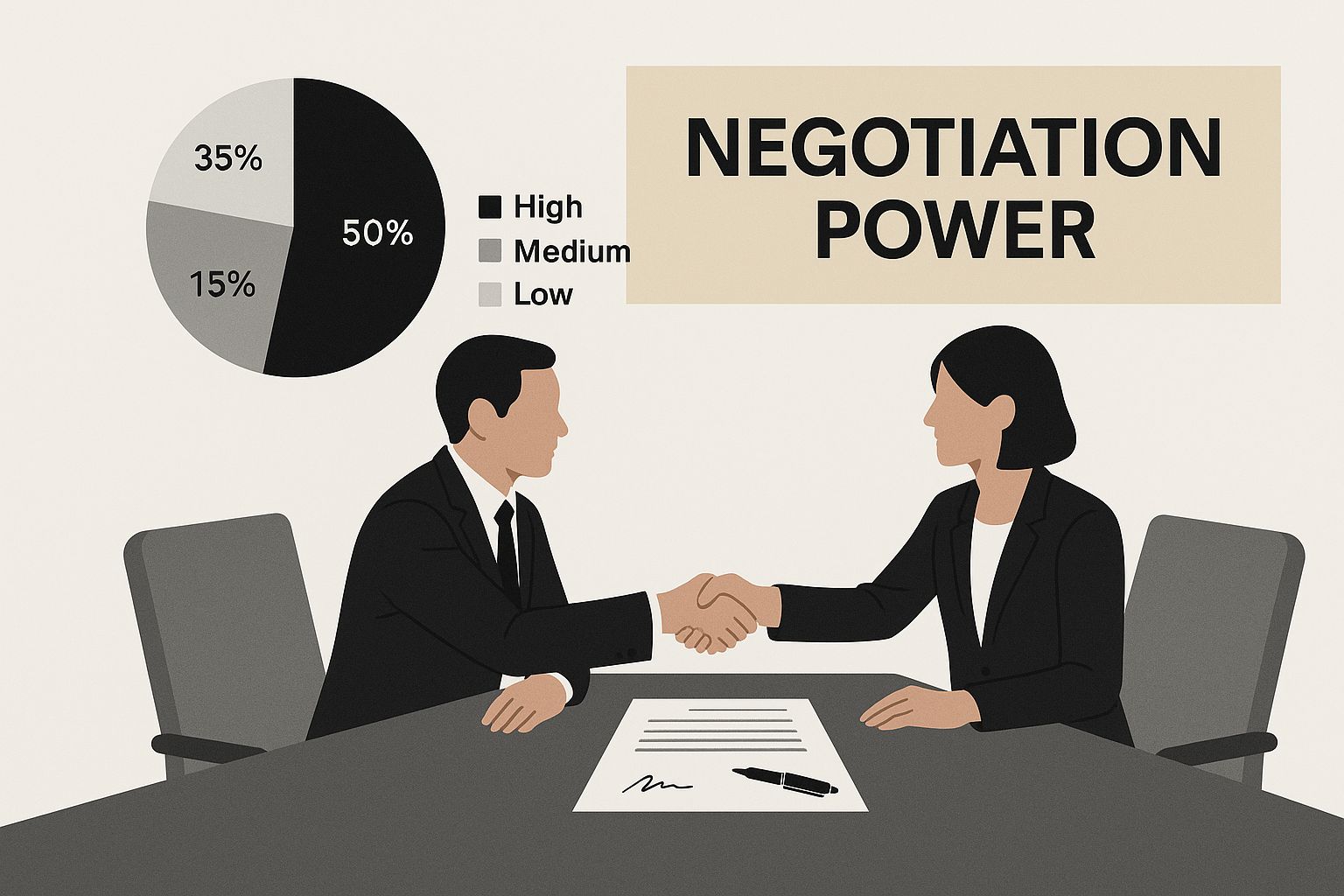
As the image shows, knowledge is your best asset. Being informed about local averages gives you a solid footing for any fee discussions with potential agents.
Understanding Higher Commission Regions
While the eastern states and WA cluster around similar averages, a couple of places in Australia have noticeably higher rates. This isn’t random; it’s a direct result of their unique market conditions.
The commission rate is often a story about supply and demand—not just for houses, but for real estate agents themselves. In areas with fewer agents and vast distances, the cost of doing business is naturally higher, and the fees reflect that reality.
Tasmania and the Northern Territory are perfect examples of this.
- Tasmania (TAS): This is one of the states with a higher average commission, sitting near 2.8%. Its smaller market and fewer competing agents give agencies more leverage on pricing.
- Northern Territory (NT): The NT commands the highest rates in the country, averaging close to 3.0% and often ranging between 2.5% and 3.5%. The massive geography and unique logistical hurdles all contribute to these higher fees.
At the end of the day, these regional differences aren't just numbers. They’re a direct outcome of the economic and competitive forces at play in each market. Knowing where your local area, like Mandurah, fits into this bigger picture is the first step toward having a confident and productive chat about commission with your agent.
Key Factors That Influence Your Commission Rate
The commission fee an agent puts forward isn’t a number pulled out of thin air. It’s a carefully calculated figure that balances market realities, your property’s unique features, and the agent’s own business model. Getting your head around what drives this rate is the key to shifting from a passive seller to an informed one who understands the logic behind the numbers.
Think of it like pricing any professional service. A top lawyer handling a complex corporate merger is going to charge more than a fresh graduate reviewing a simple contract. It’s the same in real estate. The amount of effort, expertise, and even risk involved in selling your specific home directly shapes the commission.
The Power of Location and Local Competition
Where your property is located is probably the single biggest factor. I’m not just talking about the suburb, but the intensity of agent competition in that specific pocket. A busy area like metro Perth, where dozens of agencies are fighting for listings on every street, is a totally different ball game to a quiet regional town with only a handful of agents.
It all comes down to simple supply and demand.
- High Competition Areas (e.g., Metro Perth): When loads of agents are competing for your business, they’re far more likely to sharpen their pencils and offer a competitive rate to win you over. The market is working in your favour.
- Low Competition Areas (e.g., Regional WA): In spots with fewer agents, there’s less pressure to drop fees. On top of that, the cost of doing business can be higher—think longer travel times and lower sales volumes—which gets factored into the commission.
Western Australia is a perfect real-world example. The average commission across WA hovers around 2.44%, but this can easily swing up to 3.25% or dip lower depending on the postcode. In densely populated Perth suburbs, rates often sit closer to 2.2% because the competition is fierce. Head out to regional areas, though, and you’ll often see commissions pushing 3% or more. You can dive deeper into the data on how WA real estate fees vary by region.
Your Property's Value and Desirability
Next up is your property itself—specifically, its market value and overall appeal. Agents are often more flexible on their commission for higher-priced homes. Why? Because a smaller percentage of a big sale can still be a bigger payday than a higher percentage on a cheaper property that took just as much work to sell.
A 2% commission on a $1.2 million property is $24,000. That’s a lot more attractive to an agent than a 3% commission on a $600,000 property, which comes to $18,000. This simple maths often gives sellers in the upper price brackets a bit more room to negotiate.
It’s not just about the price tag, either. The "saleability" of your home is huge. A beautifully presented, well-maintained home on a desirable Mandurah canal is a world away from a fixer-upper that needs a ton of work. Agents know that a turnkey property will likely fly off the market, attracting strong interest and cutting their marketing time and costs. That lower risk and effort can often translate into a better commission rate for you.
The Agent's Experience and Service Level
Finally, the agent you choose is bringing their own value to the table, and their fee reflects that. You’re not just paying someone to put a sign out the front; you’re investing in their expertise, their network, and their track record.
- Top-Tier, Experienced Agents: An agent with decades in the game, a powerful list of potential buyers, and a history of smashing suburb records will naturally command a higher commission. Their fee reflects the premium results they deliver through sharp negotiation skills and brilliant marketing.
- Newer or Discount Agents: Someone new to the industry or working for a budget brokerage might offer a lower rate to get a foothold in the market. While the savings look good on paper, you have to be sure they have the skills and resources to market your home properly and fight for the best possible price.
At the end of the day, the commission is an exchange of value. A cheap fee might save you a few thousand dollars upfront, but it could cost you tens of thousands if it leads to a lower final sale price. The trick is to weigh up all these factors—location, property value, and the agent’s calibre—to figure out what a fair commission fee real estate agents in your area are charging for the result you’re after.
Strategies for Negotiating Your Commission Fee
Here’s something many sellers don’t realise: the commission fee an agent puts forward isn’t set in stone. In almost every case, that fee is negotiable. A confident, well-informed conversation can lead to some serious savings.
Approaching this chat isn’t about being confrontational. It’s about understanding the value you’re bringing to the table and finding a fair rate that reflects the work involved. With the right approach, you can land on a fee that feels right for both you and your agent, paving the way for a motivated partnership focused on getting a top-notch result.
Create Healthy Competition
One of the sharpest moves you can make is to interview at least two or three different agents before you sign anything. This isn’t about playing them off against each other; it’s about getting a feel for the different service levels, marketing strategies, and fee structures out there in the Mandurah market.
When agents know they're competing for your business, they are naturally more inclined to put their best foot forward with a competitive offer. This process also gives you a golden opportunity to compare their track records, communication styles, and overall game plan. It’s much easier to make a solid choice when you have a clear picture of your options, which is a key part of learning how to choose a real estate agent who’s a genuine fit for you.
Leverage Your Property’s Strengths
Don't forget, your property itself is a powerful negotiation tool. Agents are running a business, and they’re acutely aware of which homes are likely to fly off the market versus those that will need a long, expensive campaign.
You've got more bargaining power if your home has desirable features like:
- A High Market Value: A smaller percentage of a high-value home often means a bigger payday for the agent than a higher percentage on a lower-priced one.
- Excellent Condition: A "move-in ready" home that’s well-kept and beautifully presented is far easier to market and tends to grab immediate buyer interest.
- A Sought-After Location: If your home is in a prime Mandurah spot with strong buyer demand, agents know it’ll be an easier sell.
By highlighting these strengths in your conversations, you show the agent that your listing is a lower risk and likely a faster, more straightforward sale. That alone can justify a more flexible commission rate.
Remember, negotiating your commission isn't just about chasing the absolute lowest fee. It’s about striking the perfect balance between a fair cost and the top-tier service that delivers a premium sale price.
Choosing an agent based only on the cheapest commission can be a very expensive mistake. An inexperienced or discount agent might save you $2,000 on the fee but cost you $20,000 on the final sale price because of weak negotiation skills or poor marketing. The real goal is to negotiate a fair commission fee real estate professionals will see as a strong incentive, making sure they are fully invested in getting the best possible outcome for you.
Understanding Costs Beyond the Commission
While your agent's commission is usually the biggest line item when you sell, it's definitely not the only cost you'll face. Getting a clear picture of all the potential expenses right from the start is crucial to avoid any nasty surprises at settlement. It’s the difference between guessing your profit and knowing it for sure.
Think of the commission fee real estate agents charge as the main course of your selling expenses. But there are a few side dishes you need to account for as well. These additional costs cover the essential legal work, marketing, and presentation needed to get your property sold smoothly and for the best possible price.
Common Additional Selling Expenses
Some of these costs are non-negotiable legal requirements, while others are smart investments designed to boost your final sale price. It's always a good idea to ask your agent exactly what's included in their service package and what will be billed separately.
Here’s a quick rundown of what else to budget for:
- Marketing and Advertising Fees: Most agents cover basic online listings, but if you want to make a real splash with professional photography, video tours, or a big print campaign, this might be an extra upfront cost.
- Conveyancing or Legal Fees: This one's a must. You'll need a solicitor or conveyancer to handle all the legal paperwork for transferring ownership. This fee is always separate from the agent's commission.
- Property Styling and Repairs: These are optional, but sprucing up your home with professional staging or fixing minor issues can often deliver a fantastic return on your investment by attracting higher offers.
Understanding the full spectrum of costs is the key to financial clarity. It transforms your estimated sale price into a realistic net figure, which is the number that truly matters for your future plans.
Finally, don't forget about tax. Depending on your circumstances, you might need to factor in Capital Gains Tax (CGT) on any profit you make from the sale. You can get a better handle on this by learning more about how Capital Gains Tax applies to property in Australia.
The level of agent competition in your area can also play a role in your total costs. In competitive metro suburbs, agents often bundle more marketing services into their fee to win your business. For instance, fierce competition in a Sydney suburb like Randwick can see commission rates drop as low as 1.92%. In contrast, a regional town like Bendigo, with fewer agents competing, might have average rates closer to 2.44% for a similar property, just because the market dynamics are different. You can dive deeper into how agent competition impacts fees on OpenAgent.com.au.
Common Commission Fee Questions Answered
When you get down to the nitty-gritty of selling, a few common questions about real estate commissions always seem to pop up. Even after you've got the basics down, it’s the finer details that can make all the difference.
Let's clear up some of the most frequent points of confusion we hear from sellers. Getting these answers straight is key to budgeting properly and feeling confident about the process.
Are Marketing Costs Included in the Commission?
This is a fantastic question, and one that trips up a lot of sellers. The short answer is: it depends entirely on the agent and the agreement you sign.
Years ago, the commission fee was often seen as an all-inclusive charge that covered an agent's basic marketing efforts. However, the game has changed. Today, it's far more common for marketing costs to be a separate, itemised expense that the seller pays for upfront. This is often called a Vendor Paid Advertising (VPA) budget.
- What it covers: Think professional photography, premium listings on major portals, social media campaigns, and quality print materials.
- Why it's separate: This approach guarantees your property gets a dedicated, high-impact marketing campaign. It means the agent isn't forced to cut corners on advertising to protect their own bottom line, especially if the property takes a little longer to sell.
Always, always ask for a clear breakdown of what’s included in the commission versus what you'll need to budget for separately.
What Happens if My Property Doesn’t Sell?
This is the big "what if" that keeps many sellers up at night. The good news is that if you sign a standard "no sale, no fee" agreement, you generally don’t have to pay the agent's commission if your property doesn’t sell by the end of your agreement term.
A "no sale, no fee" structure is the industry standard. It means the commission is a true success fee—the agent only gets paid for delivering a successful sale.
But here’s the crucial part to remember: you will almost certainly still be responsible for any separate, pre-paid costs you approved, like the marketing (VPA) budget. That money has already been spent promoting your home.
Is GST Included in the Quoted Commission Rate?
No, and this is a big one to remember when you're doing your sums. The commission percentage an agent quotes is almost always exclusive of GST. You’ll need to add 10% for the Goods and Services Tax on top of the final commission figure.
For example, if the commission works out to be $20,000, the final amount payable from your settlement proceeds will actually be $22,000. It's a critical detail that can impact your final net proceeds. It's understandable why some sellers explore options like selling a house without an agent to avoid these fees, though that path definitely comes with its own set of challenges.
At David Beshay Real Estate, we believe in complete transparency. If you have any more questions about selling your Mandurah property, we're here to provide clear, honest answers. Get in touch for a no-obligation chat about your real estate goals. https://realestate-david-beshay.com.au


Pingback: Real Estate Commission Comparison in Mandurah - David Beshay Real Estate - Beshay Realty