


Selling your Mandurah home privately can seem like an attractive path, promising significant savings by avoiding agent commissions. The idea of being in complete control and pocketing the full sale price is compelling. However, this path is fraught with potential challenges that can turn a seemingly straightforward transaction into a costly and stressful ordeal. Many sellers in the Peel region underestimate the complexity involved, from accurate pricing and legal obligations to marketing reach and negotiation skills.
This guide illuminates the seven most significant pitfalls of selling house privately in the Mandurah market, offering a clear-eyed view of the risks involved. We will move beyond generic advice to provide actionable, region-specific strategies to help you navigate these common challenges effectively. Understanding these potential hurdles is the first step toward a successful sale. By being thoroughly prepared, you can protect your investment, save time, and avoid the common costly mistakes that private sellers often make. Forewarned is forearmed, especially when your most valuable asset is on the line.
1. Pricing Your Home Incorrectly
Setting the wrong price is one of the most common and costly pitfalls of selling house privately. Without access to the real-time, hyper-local data used by professionals, homeowners in Mandurah often rely on a combination of online estimators and emotional attachment. This frequently leads to a price that is disconnected from the current market reality, causing significant financial and logistical problems.

Overpricing is a classic error. A Halls Head homeowner, for instance, might see a high valuation on a national property website and price their canal home 10% above its true market value. The result? The property languishes for months, accumulating 'listing staleness' and deterring serious buyers. Eventually, it sells for less than it would have if priced correctly from the start. Conversely, underpricing is just as damaging. In rapidly appreciating suburbs like Lakelands or Madora Bay, an owner without up-to-the-minute sales data might unknowingly list their home for $20,000 to $40,000 below what the market would happily pay, leaving a huge amount of equity on the table.
How to Price Your Property Accurately
To avoid this critical mistake, a strategic, data-driven approach is essential. Your goal is to find the sweet spot that attracts competitive offers without undervaluing your asset.
- Obtain a Sworn Valuation: For a truly unbiased and legally recognised assessment, hire a licensed valuer. While this comes at a cost, it provides a definitive benchmark based on objective criteria, removing all guesswork.
- Conduct Hyper-Local Research: Look at recently sold properties that are highly comparable to yours (similar age, size, condition, and land area) within a one-kilometre radius. Focus on sales from the last 90 days for the most relevant data.
- Be Objective About Condition: Honestly assess your home's condition. Factor in the cost of any necessary repairs or desirable upgrades that buyers in your area expect. If the kitchen is dated or the roof needs work, this must be reflected in your asking price.
- Seek an Expert Opinion: A key advantage agents have is their access to the Comparative Market Analysis (CMA). You can leverage this expertise by requesting a complimentary, no-obligation property appraisal from a local specialist like David Beshay Real Estate. This gives you an expert’s insight into your property's value, based on current Mandurah market dynamics, without any commitment.
2. Legal and Documentation Complications
Navigating the labyrinth of legal paperwork is one of the most intimidating pitfalls of selling house privately. A property transaction is governed by a strict set of laws and requires meticulous documentation. Without the guidance of a professional, sellers in Western Australia can easily overlook critical disclosure obligations, misunderstand contract clauses, or mishandle the settlement process, exposing themselves to significant legal and financial risk.
Imagine a seller in Falcon who, unaware of their full disclosure duties, fails to mention a known structural issue with the patio. The new owner discovers it months later, leading to a costly legal dispute and potential claims for damages. Similarly, a deal on a beautiful family home in Greenfields could be delayed or even collapse entirely because the private seller used a generic online contract template that didn't include specific clauses required under Western Australian property law, such as those relating to the RCD and smoke alarm compliance. These are not just theoretical problems; they are real-world consequences of bypassing expert oversight.
How to Ensure Legal Compliance
Protecting yourself legally is non-negotiable. A systematic approach to your contracts and disclosures will safeguard your sale and provide peace of mind.
- Engage a Settlement Agent or Conveyancer Early: Before you even list your property, engage a licensed settlement agent or conveyancer. They are specialists in the legal transfer of property in WA and will prepare the crucial Contract for Sale of Land or Strata Title by Offer and Acceptance.
- Understand Your Disclosure Obligations: In WA, sellers must disclose known material facts that could affect a buyer's decision. This includes things like unapproved building works, encroachments, or asbestos. Be transparent and document everything to avoid future claims.
- Use the Correct, Compliant Contracts: Never rely on generic templates. Your settlement agent will provide the correct, legally compliant documents. Ensure all conditions, timelines, and inclusions (like dishwashers or window treatments) are clearly and accurately stated in the contract.
- Comply with Statutory Requirements: Ensure your property meets all legal requirements before settlement, including having the correct number of compliant smoke alarms and at least two RCDs (residual current devices) installed. Failure to do so can delay or terminate the sale. Delving into the nuances of these requirements is crucial, and you can learn more about the legal complexities of a private sale in our detailed guide to selling a house without an agent.
3. Limited Marketing Reach and Exposure
Relying on a "For Sale" sign and a few online classifieds is a surefire way to encounter one of the most significant pitfalls of selling house privately: limited marketing reach. Professional agents cast a wide, strategic net to capture the maximum number of potential buyers. Without access to these networks and tools, your property remains invisible to a huge portion of the active buyer pool, severely restricting competition and ultimately impacting your final sale price.
A private seller in a desirable suburb like Falcon might invest in a professional sign and list their home on Gumtree. However, they miss out on the crucial Multiple Listing Service (MLS) or equivalent industry portals where the vast majority of buyer's agents are actively searching for their clients. This leads to a trickle of enquiries instead of a flood. Studies consistently show that this limited exposure results in fewer showings and a much longer time on the market, creating stress and uncertainty.
The following infographic highlights key statistics that illustrate the stark difference in marketing outcomes between FSBO and agent-listed properties.
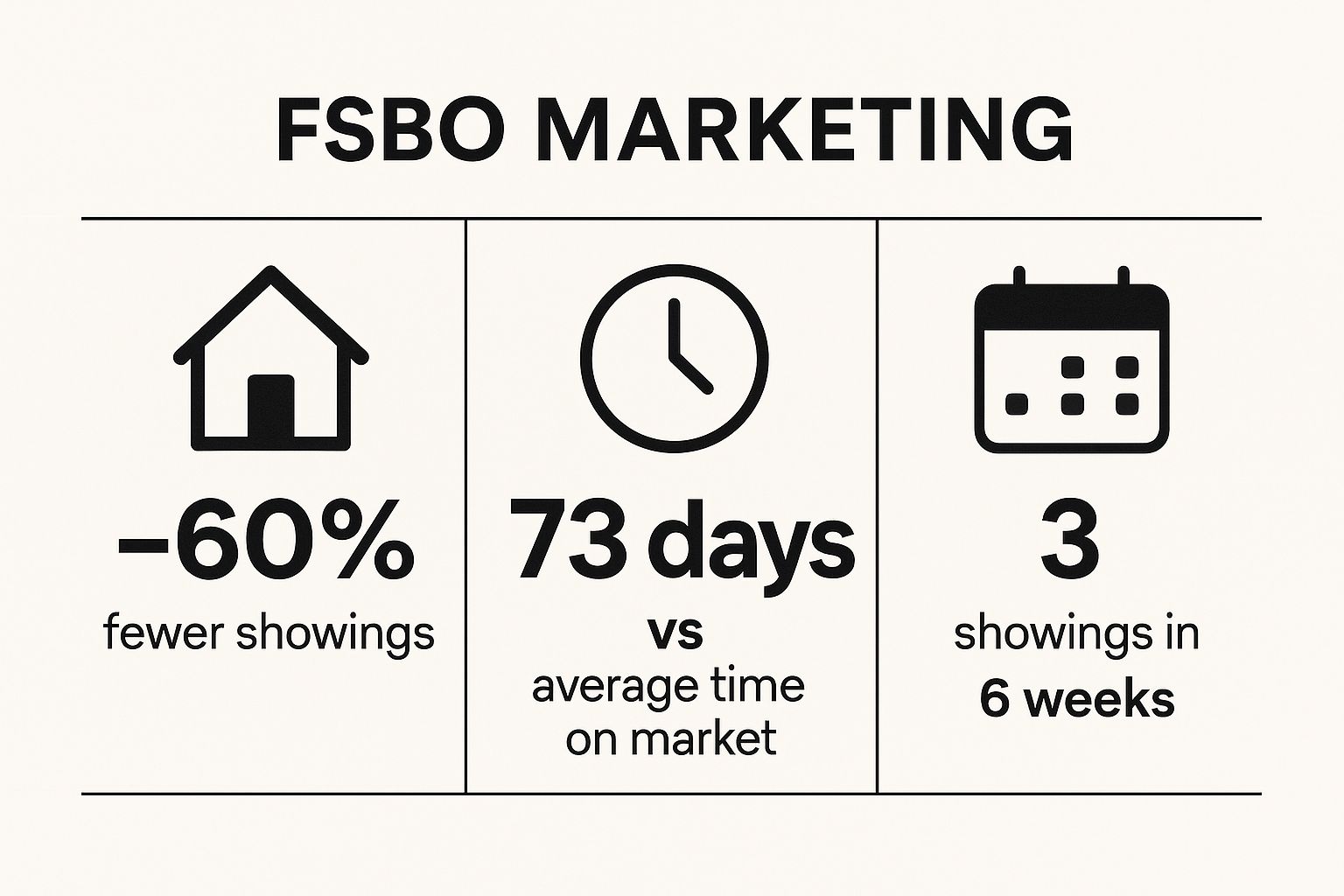
These numbers clearly show that professional marketing isn't just a luxury; it's a critical component for achieving a timely and profitable sale.
How to Maximise Your Property's Exposure
To overcome this hurdle, you must proactively replicate a multi-channel marketing strategy to ensure your Mandurah home is seen by the right people at the right time.
- Invest in Professional Photography: First impressions are everything. Low-quality phone pictures will deter buyers instantly. Hire a professional real estate photographer to capture high-resolution images, a floor plan, and ideally, a virtual tour.
- Utilise a Flat-Fee MLS Service: Several services allow private sellers to get their property onto the main real estate portals (like realestate.com.au and Domain) for a one-off fee. This is the single most effective step you can take to expand your reach.
- Leverage Social Media Strategically: Don't just post to your personal profile. Use targeted Facebook and Instagram ads aimed at people with interests in "property investing," "moving to Mandurah," or those within a specific age and location demographic.
- Create High-Quality Marketing Materials: Design a professional-looking brochure or flyer that highlights your home’s best features, includes key details, and features your stunning professional photos. To learn more about how to best present your home, you can review our ultimate home selling guide.
4. Negotiation Inexperience and Emotional Decision-Making
Navigating the high-stakes negotiation process is a significant challenge and one of the most underestimated pitfalls of selling house privately. Professional agents spend years honing their skills in market psychology and strategic negotiation. A private seller, on the other hand, is often dealing with a profound emotional attachment to their home, which can cloud judgement and lead to poor decisions when faced with a seasoned buyer's agent.
This inexperience can manifest in several costly ways. For example, a Meadow Springs seller, feeling flattered by the first offer, might accept it immediately without attempting a counteroffer. They could later discover the buyer was pre-approved for a much higher amount, leaving tens of thousands of dollars on the table. Conversely, a Wannanup owner might react emotionally to a lowball offer or a request for repairs on their beloved family home, causing the negotiation to break down and a willing buyer to walk away. Agreeing to excessive or non-standard conditions due to a lack of familiarity with common contract clauses in WA is another frequent and damaging error.
How to Negotiate Effectively and Remain Objective
To protect your financial interests, you must separate emotion from the business transaction of selling your property. A methodical and prepared approach is your best defence.
- Establish Your Walk-Away Point: Before you even receive an offer, decide on your non-negotiable terms. This includes your minimum acceptable price (your "net sheet" figure), settlement date, and any specific inclusions or exclusions. Write this down to use as your anchor.
- Implement a Cooling-Off Period: Never respond to an offer immediately. Institute a personal 24-hour rule to allow yourself time to review the terms objectively, consult with a partner or advisor, and let the initial emotional reaction subside.
- Focus on the Net Proceeds: The highest sale price isn't always the best offer. Analyse each proposal based on the net amount you will receive after factoring in any requested repair credits, seller concessions, or other costs.
- Research Local Negotiation Norms: Understand what is standard practice in the Mandurah market regarding building and pest inspections, finance clauses, and settlement periods. This knowledge prevents you from agreeing to unusual or unfavourable terms. You can gain this insight by speaking with a real estate professional who can provide clarity on what constitutes a strong, clean offer in the current climate.
5. Safety and Security Risks During Showings
Opening your home to strangers is an unavoidable part of selling, but managing the associated dangers is one of the most serious pitfalls of selling house privately. Real estate agents are trained in safety protocols and vet potential buyers, creating a professional buffer. When you sell on your own in Mandurah, you lose this critical layer of protection, potentially exposing yourself, your family, and your possessions to theft, intimidation, or worse.

The risks are not merely hypothetical. There are numerous reports of FSBO sellers experiencing break-ins shortly after showing their home to unverified individuals, or having personal items stolen during open houses. Imagine a scenario in your Falcon home where a prospective buyer becomes aggressive during a private negotiation, leaving you feeling threatened. Without the presence of a neutral third party, these situations can escalate quickly and dangerously. It’s the lack of screening and professional oversight that turns a simple showing into a significant security liability.
How to Protect Yourself During Showings
Prioritising your safety is non-negotiable. Implementing strict protocols can significantly mitigate the risks and allow you to show your property with greater peace of mind.
- Pre-Qualify Every Viewer: Before scheduling a showing, insist on seeing a pre-qualification or pre-approval letter from a reputable lender. This verifies that the person is a serious buyer, not someone with ulterior motives.
- Never Show the Property Alone: Always have a trusted friend, family member, or neighbour with you during any showing. Their presence acts as a powerful deterrent to anyone with ill intentions.
- Secure Your Valuables: Before the first viewer steps inside, remove or lock away all valuables. This includes jewellery, cash, prescription medications, personal documents, and small electronics. Treat every showing as a potential security risk.
- Trust Your Instincts: If a conversation feels off or a potential buyer’s behaviour makes you uncomfortable, do not hesitate to end the showing immediately and ask them to leave. Your safety is more important than a potential sale.
6. Time Investment and Opportunity Cost
Underestimating the sheer volume of time required is a fundamental pitfall of selling house privately. Many sellers focus solely on the potential commission savings, failing to calculate the significant personal time and effort the process demands. Managing marketing, fielding enquiries, coordinating viewings, and handling paperwork is not a passive task; it's a part-time job that can easily consume 40 to 80 hours over several months.
This immense time commitment comes with a steep opportunity cost. A busy professional in Falcon or a small business owner in Greenfields might find that the hours spent managing their sale could have been used for more profitable work or essential family time. One study revealed the average private seller dedicates 3 to 4 hours daily to sale-related tasks during the active marketing phase. For many, the stress, steep learning curve, and constant interruptions mean the money saved on commission is quickly offset by lost income, added anxiety, and the potential for mistakes that require even more time to fix.
How to Manage Your Time and Assess Opportunity Cost
To avoid being overwhelmed, you must realistically evaluate the time investment and whether the savings truly justify the commitment.
- Calculate Your Opportunity Cost: Before you begin, perform a simple calculation. Determine your effective hourly rate from your job or business. If you spend 60 hours selling your home to save a $15,000 commission, your effective "pay" for the work is $250 per hour. If your professional time is worth more, you may be losing money by going it alone.
- Set Firm Time Boundaries: Treat the sale like a project with a defined schedule. Allocate specific blocks of time each day or week for answering calls, responding to emails, and preparing for viewings. This prevents the sale from consuming your entire life.
- Automate Where Possible: Use modern tools to ease the burden. Online scheduling apps can help manage viewing appointments, and setting up an email template for frequently asked questions can save you from repetitive typing.
- Evaluate Hybrid Options: You don't have to choose between full-service and fully DIY. Consider a flat-fee or discount brokerage that handles some of the more time-consuming tasks like online listings or enquiry filtering, freeing you up to focus on the high-value activities.
7. Financing and Buyer Qualification Challenges
Navigating the complexities of buyer financing is a critical, and often underestimated, hurdle. This is one of the most significant pitfalls of selling house privately because sellers typically lack the tools and experience to properly vet a buyer's financial stability. Without this expertise, you risk accepting an offer from someone who cannot secure a loan, leading to a collapsed sale, wasted time, and the frustration of having to relist your property.
A common scenario involves a private seller in a suburb like Greenfields or Coodanup accepting an offer backed by a weak "pre-qualification" letter. After weeks of waiting for settlement, the deal falls through during the final underwriting stage because the buyer was never truly approved for the loan amount. This sets the seller back by months and attaches a stigma to the property. Conversely, a seller might reject a strong offer from a buyer using a less common but perfectly legitimate financing method, simply due to unfamiliarity, missing a great opportunity. Professional agents prevent this by leveraging relationships with lenders and understanding the crucial difference between a cursory pre-qualification and a robust pre-approval.
How to Properly Qualify Buyers
To safeguard your sale, you must act like a professional and rigorously assess every potential buyer's financial capacity. This ensures you only engage with those who have a high probability of securing finance and reaching settlement.
- Insist on a Full Pre-Approval Letter: A pre-qualification is often just a quick estimate. A pre-approval letter from a reputable lender or broker means the buyer’s credit, income, and assets have been verified. This is a much stronger indicator of their ability to purchase.
- Verify the Details with the Lender: Do not hesitate to contact the mortgage broker or loan officer listed on the pre-approval letter. Confirm the letter's authenticity, the loan amount, and ask if they foresee any potential issues with the buyer's application for your specific property.
- Understand Different Loan Types: Familiarise yourself with the basics of common loan types (e.g., standard variable, fixed rate) and their general timelines. This knowledge helps you evaluate the feasibility of a buyer's proposed settlement date. For deeper insight, you can explore the difference between a mortgage broker vs bank to better understand your buyer's financing journey.
- Request a Substantial Earnest Money Deposit: A larger deposit (or 'good faith deposit') indicates a higher level of seriousness and financial capability from the buyer. It provides you with greater security should they default on the contract for reasons not covered by finance clauses.
7 Key Pitfalls of Private Home Sales Compared
| Issue / Aspect | Implementation Complexity 🔄 | Resource Requirements ⚡ | Expected Outcomes 📊 | Ideal Use Cases 💡 | Key Advantages ⭐ |
|---|---|---|---|---|---|
| Pricing Your Home Incorrectly | Moderate: Requires market analysis and adjusting for factors | Access to recent comparable sales data and market tools | Accurate pricing leads to timely sale and maximized equity | Sellers wanting to avoid extended market time or financial loss | Professional pricing improves sale success and equity capture |
| Legal and Documentation Complications | High: Complex legal and regulatory compliance | Legal expertise, disclosure documents, contract templates | Reduced risk of lawsuits, smoother transaction | Sellers unfamiliar with legal requirements or complex contracts | Ensures compliance and avoids costly legal issues |
| Limited Marketing Reach and Exposure | Moderate: Marketing across multiple channels | Professional photography, MLS access, social media | Increased buyer visibility, faster sales | Sellers needing broad buyer exposure and competitive positioning | Professional marketing increases showings and sale price |
| Negotiation Inexperience and Emotional Decision-Making | High: Requires strategic negotiation skills and emotional control | Knowledge of negotiation practices, market psychology | Better deal terms, fewer deal failures | Sellers uncomfortable or inexperienced in negotiation | Objective negotiation improves sale outcomes and net proceeds |
| Safety and Security Risks During Showings | Low to Moderate: Implementing screening and safety protocols | Buyer pre-qualification, scheduling, companion presence | Reduced risk of theft, harm, or uncomfortable situations | Sellers concerned about personal and property safety | Enhances seller safety and security during showings |
| Time Investment and Opportunity Cost | High: Significant time required to manage sale process | Time for marketing, showings, communication, paperwork | Possible stress and lost productivity | Sellers with limited time or demanding careers | Saves commission but may cost considerable personal time |
| Financing and Buyer Qualification Challenges | High: Understanding financing complexities and evaluating buyers | Evaluating pre-approval, lender coordination | Avoids failed deals, faster closings | Sellers unfamiliar with financing nuances | Better buyer vetting reduces transaction risks |
Your Property, Your Choice: Weighing the Risks Against the Rewards
Embarking on the journey to sell your Mandurah property is a monumental step, and the decision to do so privately versus with an agent is one of the most critical you'll make. The allure of saving on commission is powerful, but as we've explored, the path of a private sale is lined with significant challenges. Understanding these potential pitfalls of selling house privately is not meant to discourage you, but to empower you with the knowledge to make an informed, strategic choice that protects your most valuable asset.
This article has detailed seven critical areas where a For Sale By Owner (FSBO) journey can go wrong. We began with the foundational error of incorrect pricing, a mistake that can either leave thousands of dollars on the table or leave your home languishing on the market. We then navigated the treacherous waters of legal and documentation complications, where a single misstep can lead to contractual disputes or settlement failures. The challenge of achieving limited marketing reach highlighted how a lack of exposure directly translates to fewer qualified buyers and a lower final sale price.
Beyond these technical aspects, we delved into the more personal, yet equally costly, pitfalls. The pressure of inexperienced negotiation and the high stakes of emotional decision-making can quickly erode your financial position. We also addressed the crucial safety and security risks involved in opening your home to strangers and the immense time investment and opportunity cost that a private sale demands from your already busy life. Finally, the difficulty of managing buyer qualification and financing can lead to deals collapsing at the last minute, forcing you to start the entire process over again.
The True Value of Professional Guidance
Ultimately, the decision rests with you. Successfully navigating a private sale requires a unique combination of market knowledge, legal savvy, marketing expertise, negotiation prowess, and an abundance of time and emotional resilience. For some, this challenge may be invigorating. For many others, however, the real value lies not in saving a commission, but in maximising the final sale price and minimising risk.
A seasoned real estate professional offers more than just a listing; they provide a comprehensive, strategic service designed to mitigate every one of these pitfalls. They leverage market data for precise pricing, manage all legal paperwork, execute sophisticated marketing campaigns, handle negotiations with professional detachment, and ensure every potential buyer is properly vetted. This expertise is what transforms a stressful, uncertain process into a streamlined and profitable transaction. Before you commit to the demanding path of a private sale, consider the alternative: a partnership that safeguards your investment and is dedicated to achieving the best possible outcome for your Mandurah home.
Are you considering selling your Mandurah property and want to understand its true market value before making a decision? Contact David Beshay Real Estate for a comprehensive, no-obligation property appraisal. We provide the data-driven insights and local expertise needed to help you confidently weigh the pros and cons, ensuring you choose the path that best aligns with your financial goals.


Pingback: A Guide to Selling a Home Privately - David Beshay Real Estate - The Agency