


For anyone looking to subdivide land in Western Australia, the first question is always about the cost. As a starting point, a simple two-lot subdivision typically falls somewhere between $60,000 and $120,000.
This initial figure covers the essentials like surveying, council applications, and hooking up basic services. But it's important to remember this is a ballpark range – the final number can swing quite a bit depending on your specific property and what the local council requires.
Your Quick Guide to Land Subdivision Costs
Before we get into the nitty-gritty, it helps to think of the subdivision process as a financial journey. It’s less like buying a single, fixed-price item and more like funding a multi-stage project. The final cost isn't one number but a sum of many smaller, interconnected parts, each with its own price tag.
Understanding this from the get-go is key to realistic budgeting. It helps avoid sticker shock down the track and lets you plan for where the major costs will pop up. Your total investment will be a mix of professional fees, government charges, and the physical work needed to get each new lot compliant and ready to go.
A Ballpark Estimate for Planning
To give you a clearer idea, let's look at what you might expect to pay for a standard two-lot split in a typical Mandurah or Perth suburb. Of course, these are just estimates and will change based on your project's unique details, which we’ll cover soon.
A common mistake I see is underestimating the cost of infrastructure and service connections. These "on-the-ground" works often end up being the biggest part of the budget, sometimes gobbling up more than 50% of the total price to subdivide land.
This first look gives you a basic understanding. The main takeaway is that subdivision costs are layered. Here’s a simple look at the main expense buckets:
- Professional and Consultant Fees: This is for your team of experts – the surveyors, town planners, and engineers who handle all the technical and legal prep work.
- Statutory and Council Fees: These are the non-negotiable charges for lodging applications and getting the green light from government bodies like the WAPC.
- Site Works and Servicing: This covers the physical labour of connecting water, sewer, and power, plus building any necessary driveways or access points.
- Titling and Legal Costs: The final step involves the legal fees for creating and officially registering the new land titles.
To make this even clearer, here is a table that breaks down the typical costs for a straightforward two-lot subdivision. It's a handy guide to see where your money is likely going.
Estimated Cost Breakdown for a Standard 2-Lot Subdivision
| Expense Category | Typical Cost Range (AUD) |
|---|---|
| Surveying & Planning | $8,000 – $15,000 |
| WAPC & Council Application Fees | $5,000 – $10,000 |
| Service Connections (Water, Sewer, Power) | $20,000 – $50,000 |
| Civil Works (Driveways, Earthworks) | $15,000 – $30,000 |
| New Titles & Legal Fees | $4,000 – $8,000 |
| Contingency (10-15%) | $6,000 – $15,000 |
Keep in mind these are estimates. A complex site with steep slopes or difficult access will push these numbers higher, while a perfectly flat, well-serviced block might come in at the lower end. The key is to get tailored quotes for your specific project.
Unpacking the Core Costs of Subdividing Land
Thinking about the price of subdividing land is a bit like planning a major home renovation. It’s never just one single expense. Instead, it's a collection of different costs, from professional fees to the actual physical work, that all add up to the final number.
To put together a realistic budget, you have to understand each piece of the puzzle. Let’s peel back the layers and look at the key financial commitments you’ll come across on your subdivision journey, so you can see exactly where your money is going and avoid any nasty surprises.
This flowchart gives you a clear visual breakdown of the main cost categories you'll be looking at.
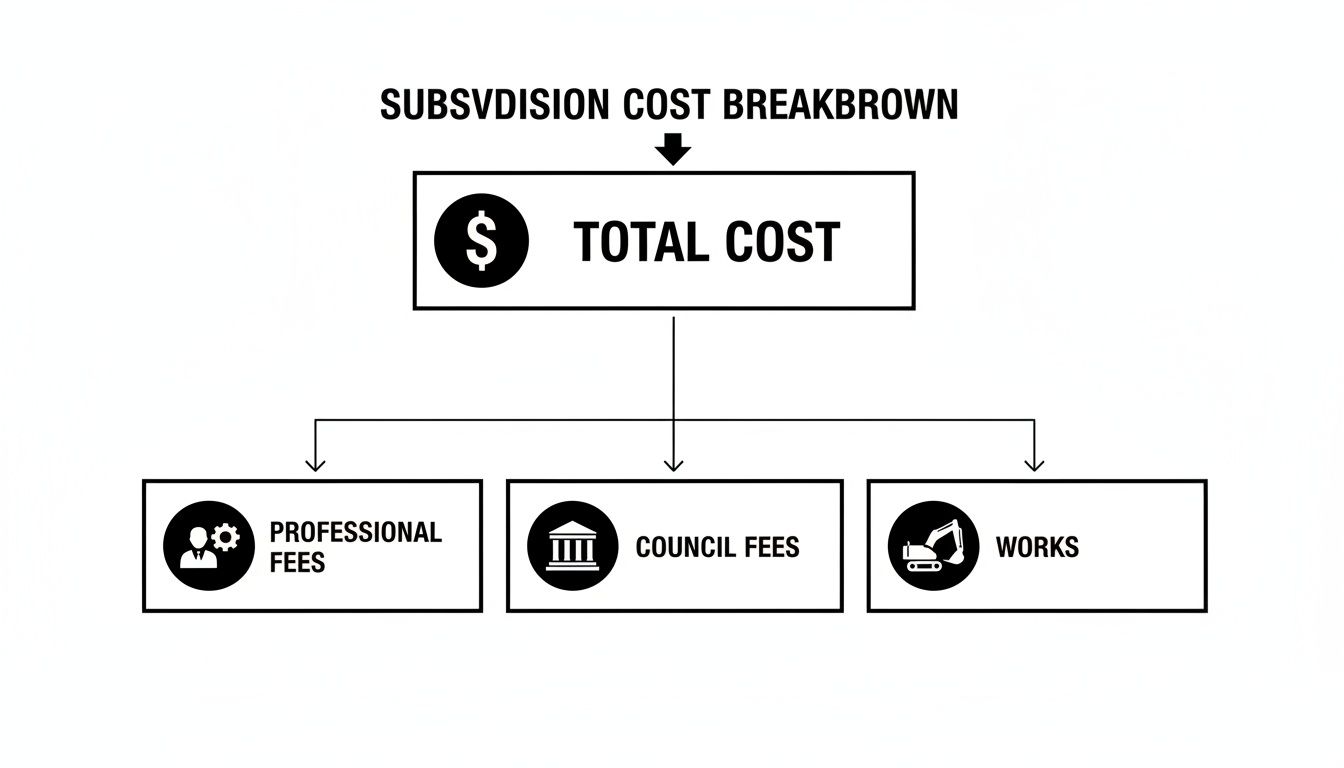
As you can see, the total cost is a combination of what you pay the experts, what you pay the council, and what you pay for the physical work to get the new lots ready.
Professional and Consultant Fees
Long before any dirt gets moved, you’ll need to assemble a team of experts. These professionals are the ones who handle the crucial planning, design, and approvals that get your project off the ground.
Your most important hire is the licensed land surveyor. They’re the ones responsible for preparing the official survey plan that legally defines the new property boundaries. This is an absolute non-negotiable for creating new land titles.
But the surveyor is just the start. You'll likely need a few other specialists on your team:
- Town Planner: A good town planner is worth their weight in gold. They help prepare and manage your development application, and their deep knowledge of local council rules and the state’s R-Codes can be the difference between a smooth approval and a frustrating delay.
- Engineer: If your project involves putting in new driveways, drainage, or requires major earthworks, you'll need a civil engineer to design everything to meet strict council standards.
- Geotechnical Engineer: Got a block with tricky soil or a steep slope? You'll probably need a 'geo-tech' report. This is to make sure the land is stable and safe to build on.
Council and Statutory Application Fees
Subdividing land is a formal process that’s overseen by government bodies, and yes, each step comes with a fee. These charges cover the administrative time and effort for the authorities who have to review and sign off on your plans.
Your main fee will be for the application to the Western Australian Planning Commission (WAPC), which is the state authority that ultimately grants subdivision approval. On top of that, your local council will have its own set of fees for checking your proposal against their local planning scheme. This can include anything from vehicle crossover permits to verge bonds.
One of the bigger, and often overlooked, expenses is the developer contribution. Depending on your council, you might have to pay a levy to help them fund new community infrastructure like parks, roads, and public facilities that the new lots will benefit from.
Infrastructure and Site Works
This is where the big money is often spent. These are the real-world, on-the-ground costs to get each new lot fully serviced, compliant, and ready for a new building. It’s the cost of turning one big block into several smaller, functional ones.
Major site works typically include:
- Service Connections: Every new lot needs its own connection to the essentials. This means paying providers like Water Corporation for water and sewer, and Western Power for electricity.
- Civil Works: This covers all the physical construction needed. Common jobs include building new driveways (crossovers), installing stormwater drainage, or levelling the site with earthworks.
- Demolition: If there's an old shed, a swimming pool, or even part of the existing house in the way of the new boundary, you'll need to budget for it to be safely knocked down and removed.
For a standard two-lot subdivision in a suburban area, the total cost can really add up. Projects in Australia often fall somewhere in the $50,000 to $90,000 range, sometimes more. Out of that, you can expect professional fees to be around $12,000 to $18,000, with the infrastructure and site works costing anywhere from $18,000 to $30,000.
Legal Fees and New Title Registration
The final hurdle is making it all official. This involves engaging a settlement agent or conveyancer to handle the legal paperwork and register the new titles with Landgate, WA's official land registry. While these costs are smaller than the site works, they are absolutely crucial. To learn more about this part of the process, you can read our guide on how much conveyancing costs. This final step is what brings your new lots into existence, making them ready to sell or build on.
Key Factors That Drive Your Final Subdivision Price
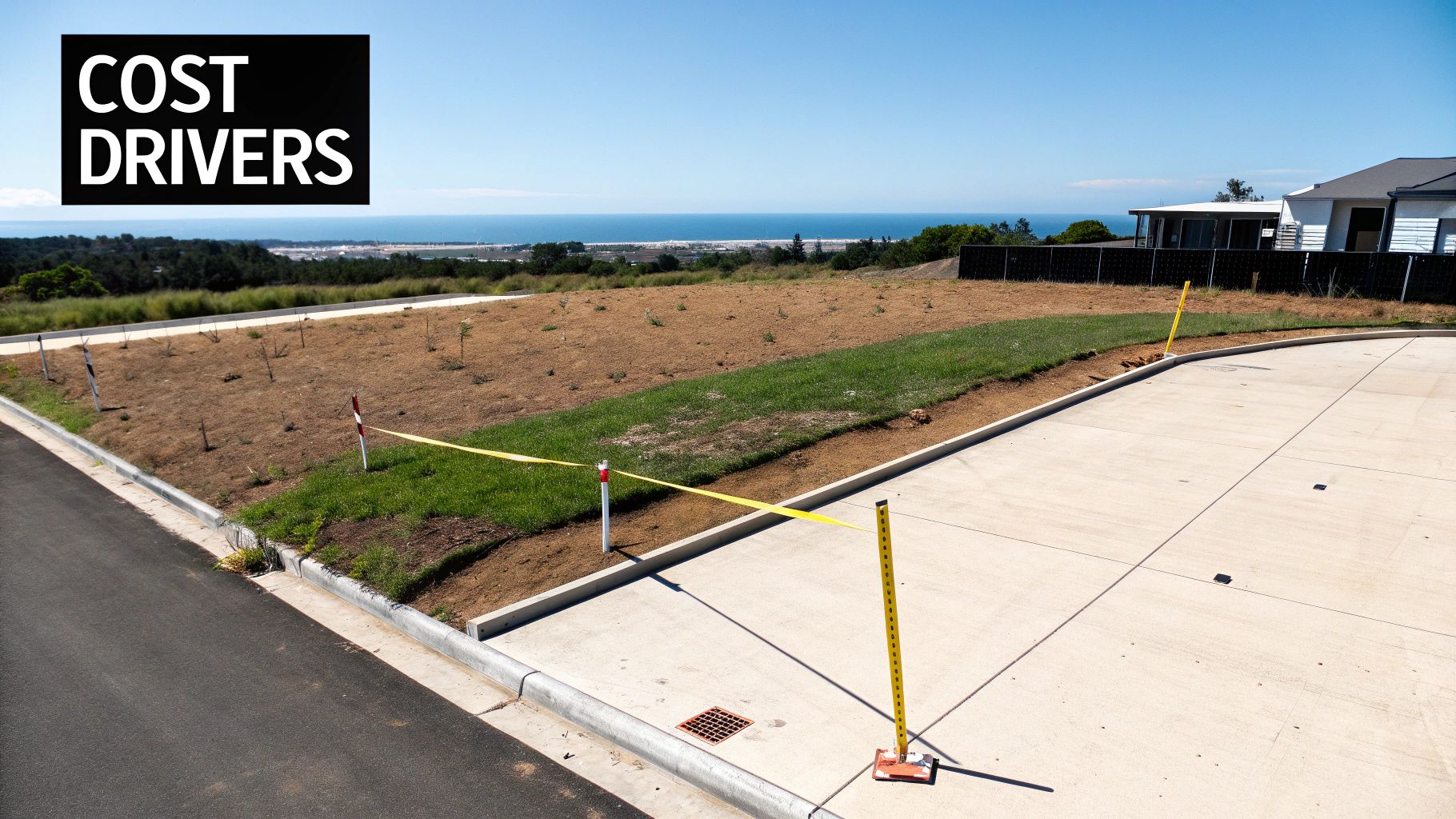
Thinking about subdividing? The first thing to get your head around is that there's no fixed price tag. The final cost is a moving target, shaped entirely by your property’s unique DNA. You could have two blocks that look identical from the street, but one ends up costing tens of thousands more to split because of what's hiding just under the surface.
Getting a grip on these variables is the key to setting a realistic budget and sidestepping those nasty, expensive surprises down the track. Let’s break down the big-ticket items that will ultimately shape your final invoice.
Location and Council Requirements
Where your block is located is hands down the biggest factor in your subdivision price. Every single local council in Western Australia operates under its own set of rules, with unique planning schemes, fee structures, and development standards. A project that’s a walk in the park in one suburb could be tangled in red tape in another.
Councils in built-up urban areas, for instance, tend to have much stricter regulations to manage density, which naturally leads to higher compliance costs. Over in New South Wales, it’s not uncommon to see subdivision costs swing anywhere from $20,000 to $100,000, with location being the primary driver. Urban councils charge more than their rural counterparts, and if you’re in a premium spot like a waterfront or heritage zone, expect another layer of complexity and cost.
The specific zoning of your land dictates everything—minimum lot sizes, setbacks, and what you can even build. Getting this wrong from the start is one of the costliest mistakes a developer can make.
On top of that, some areas demand higher developer contributions to help fund local infrastructure. Having your block close to great amenities is fantastic for the final sale price, but it might also put you in a precinct with higher council levies. A good way to get a feel for the local landscape is to see what’s out there; check out our current listings for land for sale in Mandurah WA to get started.
The characteristics of the land itself can either make your project a dream run or a costly headache. Here's a look at how different factors can swing your budget from one extreme to the other.
How Different Factors Impact Subdivision Costs
| Influential Factor | Low-Cost Scenario | High-Cost Scenario |
|---|---|---|
| Location | Rural or outer-suburban council with lower fees and straightforward planning rules. | Inner-city or premium coastal area with high developer contributions and complex heritage overlays. |
| Topography | A perfectly flat, level block that requires minimal earthworks. | A steeply sloping site needing major cut-and-fill, plus expensive retaining walls to create building pads. |
| Soil Type | Easy-to-excavate sandy soil, allowing for simple trenching and standard foundations. | Hitting solid rock or dealing with reactive clay, requiring heavy machinery and specialised engineering. |
| Lot Shape | A simple, rectangular block that's easy to divide into compliant new lots. | An odd-shaped "battle-axe" or triangular lot that complicates access and meeting frontage requirements. |
| Services | Water, sewer, and power mains are located right on your street frontage for easy connection. | Services are on the opposite side of the road, far away, or require a new main extension to be built. |
As you can see, the physical and administrative landscape of your property plays a massive role in the final numbers. A "good" block for subdivision is one that ticks as many boxes in the "Low-Cost" column as possible.
Site Topography and Soil Conditions
The physical nature of your land has a huge say in your site work costs. The dream scenario? A perfectly flat, rectangular block. But the moment you add challenges like slopes, rocks, or tricky soil, you can watch the budget climb.
- Slope and Gradient: A sloping block almost always means more extensive (and expensive) earthworks to create level building pads. This usually involves "cut and fill" work and building retaining walls, which can easily add tens of thousands of dollars to the project.
- Soil Type: Sandy soil is generally cheap and easy to work with. But if you've got clay, rock, or reactive soil, you're in for a challenge. Clay might demand special foundations, while hitting rock when digging trenches for services can stop work in its tracks and bring in the heavy-duty machinery.
- Vegetation: Clearing a heavily treed lot costs money. Plus, removing significant trees often requires a separate arborist report and another layer of council approval, adding both time and expense to your project.
Lot Size, Shape, and Layout
The dimensions and shape of your original block directly affect how complex and costly the subdivision will be. A large, regularly shaped lot gives you flexibility and makes it much easier to design a layout for the new lots that is both compliant and cost-effective.
On the flip side, an awkwardly shaped block—think a triangle or a long, narrow "battle-axe" lot—can be a real design headache. You might struggle to provide legal road access or meet minimum frontage requirements, forcing you into clever (and more expensive) survey and engineering solutions. The total area matters, too; a bigger site might allow for more lots, but it also means more infrastructure, like longer driveways and service trenches.
Availability of Essential Services
This is a big one, and it's often underestimated. How easily you can connect each new lot to essential services like water, sewer, power, and communications can literally make or break your budget.
In the best-case scenario, all the main service lines run right along your street frontage, making connections a relatively simple affair. The nightmare scenario is when services are far away, on the wrong side of the road, or don't have enough capacity. For instance, if the closest sewer main is at the back of your property or in the next street over, you might have to pay to install a whole new extension—a shockingly expensive job that involves complex approvals from providers like Water Corporation. The depth and location of these connection points are one of the very first things a savvy developer checks.
Right, so you've got a handle on the costs, but what about the actual journey? Knowing the price to subdivide land is one thing, but understanding the path ahead is what keeps your project on schedule and, more importantly, on budget.
Let's be clear: the subdivision journey is a marathon, not a sprint. You wouldn't expect a new home to be built in a month, and the same logic applies here. For a typical two-lot subdivision here in Western Australia, you're usually looking at anywhere from 9 to 18 months from the moment you lodge your application to finally holding those shiny new titles in your hand.
The Key Milestones in Your Subdivision Journey
The whole process is essentially a series of approvals and clearances from different authorities, mainly the Western Australian Planning Commission (WAPC) and your local council. Think of it as a roadmap where you must complete each stage before you can even think about moving on to the next.
Here’s a rough breakdown of what that looks like:
- Initial Feasibility and Planning: This is your homework phase. You’ll work with a surveyor or town planner to make absolutely sure your block can be legally subdivided under the local R-Codes and planning schemes. This step is absolutely vital – it stops you from throwing good money after a project that's doomed from the start.
- Lodging the Subdivision Application: Once your plans are locked in, your surveyor will formally submit the application to the WAPC. This is what kicks off the official review process, where various government agencies get to have their say.
- Receiving Conditional Approval: After a few months of assessment, the WAPC will issue what’s called a conditional approval or a "Decision Letter." This is a huge milestone, but it’s not the final green light. It’s more like a project to-do list, packed with conditions you must meet before anything is finalised.
This list of conditions is your bible for the project. It will spell out exactly what site works are needed, from connecting new services and building driveways to potentially clearing land or paying developer contributions.
From Conditions to Final Titles
Once you've got that conditional approval, the real work begins. This is where most of the heavy lifting and serious costs come in, as you start ticking off every single box on the WAPC’s list. It's also where unexpected delays love to pop up.
The final steps in the process look something like this:
- Completing Site Works: You'll bring in contractors to handle all the required works, like installing new sewer lines, water connections, and power infrastructure.
- Obtaining Final Clearances: As you complete each condition, you need to get an official sign-off from the relevant authority (like Water Corporation, Western Power, or the council). This is your documented proof that the work is done to their standard.
- Lodging for New Titles: With all the clearances in your pocket, your surveyor submits the final package to Landgate. After one last review, the new land titles are officially created and issued, and just like that, the subdivision is complete.
Navigating this bureaucratic maze takes a good dose of patience and organisation. A classic pitfall is underestimating how long it takes to get clearances from service providers or running into delays with contractors. Planning for these little hiccups is absolutely essential for keeping your subdivision timeline and budget from spiralling out of control.
Is Subdividing Your Land a Smart Financial Move?

So, you've got a handle on the costs and the steps involved. Now for the million-dollar question: is this whole subdivision thing actually going to make you money?
Figuring that out boils down to one simple, yet absolutely critical, calculation. You need to weigh every single dollar you pour into the project against the potential profit waiting at the other end.
The goal is pretty straightforward: the combined market value of your new lots needs to be significantly more than what you spent to create them. This isn't a time for gut feelings. It's about a cold, hard analysis of the local property market to see what your return on investment could realistically look like.
Calculating Your Potential Return on Investment
To get started, you need two key numbers: your total estimated subdivision cost (all of it!) and the current market value for similar vacant lots in your area. This means diving deep into recent sales data for blocks of a similar size in your specific Mandurah suburb.
Here’s the basic formula you’ll be working with:
(Combined Sale Price of New Lots) – (Total Subdivision Costs) – (Selling Costs) = Net Profit
Don't forget to bake in selling costs like agent commissions and marketing, which usually hover around 2% to 3% of the sale price. It’s also wise to remember that the tax office will want its share, so factor in potential capital gains tax on your profit.
It's vital to be realistic. Sure, turning one block into two $300,000 lots sounds fantastic. But if your all-in cost is $120,000, your gross profit is $180,000 before you've paid taxes and other selling fees. A healthy buffer is non-negotiable.
Broader Market and Economic Influences
Your project doesn't happen in a bubble. The wider economic climate has a massive say in how successful you'll be. The Australian land development industry has been navigating some serious headwinds lately, with fluctuating interest rates and building costs directly impacting buyer demand and what people are willing to pay for land.
On top of that, developers are dealing with zoning delays and tighter regulations, all of which can push up the per-lot cost of a subdivision. If you want to get a better handle on land-related charges, check out our helpful guide on what land tax is in Australia.
This economic reality paints a clear picture: timing the market is crucial. Launching your new lots in the middle of a property boom can deliver amazing returns, but a downturn calls for serious caution.
Current industry forecasts point towards a slow recovery, making a conservative financial approach more important than ever. You can learn more about these market trends and their impact on developers by exploring the latest industry analysis on ibisworld.com. A thorough evaluation, backed by real-time local data, will give you the confidence to decide if this venture truly aligns with your financial goals.
Of course. Here is the rewritten section, crafted to sound like an experienced human expert and match the provided examples.
Your Land Subdivision Questions Answered
When you start digging into the idea of subdividing your land, a whole host of questions naturally pops up. It's not just about the cost; it's about the timeline, the logistics, and how it all fits together. To give you a bit more clarity, here are some straight-up answers to the common queries we get from property owners right here in Western Australia.
How Long Does the Entire Land Subdivision Process Take in WA?
This is the big one, and the honest answer is: it's not a quick flip. For a standard two-lot subdivision in WA, you should realistically budget for 9 to 18 months from start to finish. That's from lodging your initial application to getting those shiny new titles in your hand.
Why so long? Well, the process is broken into distinct stages. You've got the WAPC assessment, which can take 3-4 months. Then comes the real work of fulfilling all the conditions of your approval, like site works and service connections, which easily eats up another 3-6 months. Finally, you're looking at 2-4 months for final clearances and Landgate to issue the new titles.
Could it take longer? Absolutely. If you run into complex site issues, hit a backlog with utility providers, or need to appeal a decision, the timeline can stretch out. A bit of patience is definitely a virtue in this game.
Can I Live on the Property While It Is Being Subdivided?
Yes, you almost certainly can. For most subdivisions where you're keeping the original house, you can continue living there throughout the process. The most disruptive part is when the machinery rolls in for the physical site works—think trenching for new pipes and building a driveway for the new lot.
This work is generally contained to one part of your property and can be managed to keep the disruption to a minimum. Good, clear communication with your project manager and contractors is the key to making sure everything runs as smoothly as possible while you're still on-site.
Here's a key takeaway for homeowners: your day-to-day life doesn't have to be turned upside down. The heavy machinery and digging are temporary. A good project manager will work hard to contain the construction footprint, ensuring you can still get in and out and live comfortably while the project unfolds.
What Is a Developer Contribution and Will I Have to Pay It?
Developer contributions are basically fees that local councils charge to help fund the public infrastructure needed to support the new homes being created. Think of it as a contribution towards things like local parks, road upgrades, and community facilities that a growing population will use. In WA, these are usually handled through a formal Development Contribution Plan.
So, will you have to pay it? It all comes down to your local council's specific policies. For a simple two-lot infill subdivision, you might find you're not required to pay anything. But for larger projects or in specific development areas, these contributions can be a significant and non-negotiable cost you need to factor in.
Do I Need a Town Planner for a Simple Subdivision?
While it’s not always a legal requirement to hire a town planner, I can tell you from experience it's highly recommended. These professionals live and breathe the Residential Design Codes (R-Codes) and local planning schemes, which are incredibly complex and full of little nuances that can trip you up.
A good planner can spot potential roadblocks before you even start, put together a professional application that ticks all the boxes (making it far more likely to get a smooth approval), and handle the back-and-forth with the WAPC and other agencies. In the end, the fee you pay a planner is often a fantastic investment that saves you a massive amount of time, money, and stress down the track.
Ready to uncover the true potential of your property? For a clear, no-obligation appraisal and expert guidance on the subdivision process in Mandurah, get in touch with David Beshay Real Estate. Let's explore your options together. Find out more at https://realestate-david-beshay.com.au.

